The short answer: Red Sea diving in Egypt falls into four areas, and each does something different. Sharm el Sheikh gives you the coral walls of Ras Mohammed National Park and the Straits of Tiran from a five-star resort. The northern wreck route has the SS Thistlegorm, the most famous wreck in the Red Sea, and the ships’ graveyard of Abu Nuhas. The offshore marine parks (the Brothers, Daedalus and Elphinstone) are where you go by liveaboard for hammerheads and oceanic whitetips sharks. The Deep South below Marsa Alam is warmer and quieter, with dolphins at Fury Shoal and the caverns of Shaab Claudia and St John’s. Pick March to May or September to November for warm water and calmer seas.
I have been diving for more than 25 years, with more than 1,500 logged dives and more than 40 liveaboard trips behind me. This Red Sea diving guide describes each area and its main dive sites first. I have beeen to Egypt seven times, from the northern wrecks and the Brothers to Daedalus and the Deep South. My own notes are marked From my logbook, and my most recent trip, three weeks and 35 dives from north to south, is summarised further down.
Red Sea Diving at a Glance
| Region | Best for | How to dive it | Level | Gateway |
|---|---|---|---|---|
| Sharm el Sheikh, Ras Mohammed & Tiran | Coral walls, schooling fish, a national park, luxury resorts | Resort and day boats, or a northern liveaboard | All levels | Sharm el Sheikh (SSH) |
| Hurghada & the northern wrecks | Wrecks: the SS Thistlegorm and the four wrecks of Abu Nuhas | Liveaboard, or day boats from Hurghada and Sharm | Beginner+ at Abu Nuhas, Advanced for the Thistlegorm (penetration needs training) | Hurghada (HRG) or Sharm el Sheikh (SSH) |
| Offshore marine parks: the Brothers, Daedalus & Elphinstone | Hammerheads, oceanic whitetips, silky sharks, big pelagics | Liveaboard (Elphinstone also by day boat from Marsa Alam) | Advanced | Hurghada or Marsa Alam (RMF) |
| Marsa Alam & the Deep South | Dolphins, caverns, healthy coral, fewer boats | Liveaboard from Port Ghalib | Beginner+ | Marsa Alam or Hurghada |
The Four Regions of Egyptian Red Sea Diving, North to South
Egypt’s Red Sea coast runs for well over 1,000 kilometres, and the diving changes as you go south: wrecks and busy coral walls in the north, open-ocean reefs in the middle, and quieter, warmer, wilder reefs in the Deep South. Here is what each area offers and which dive sites matter most.
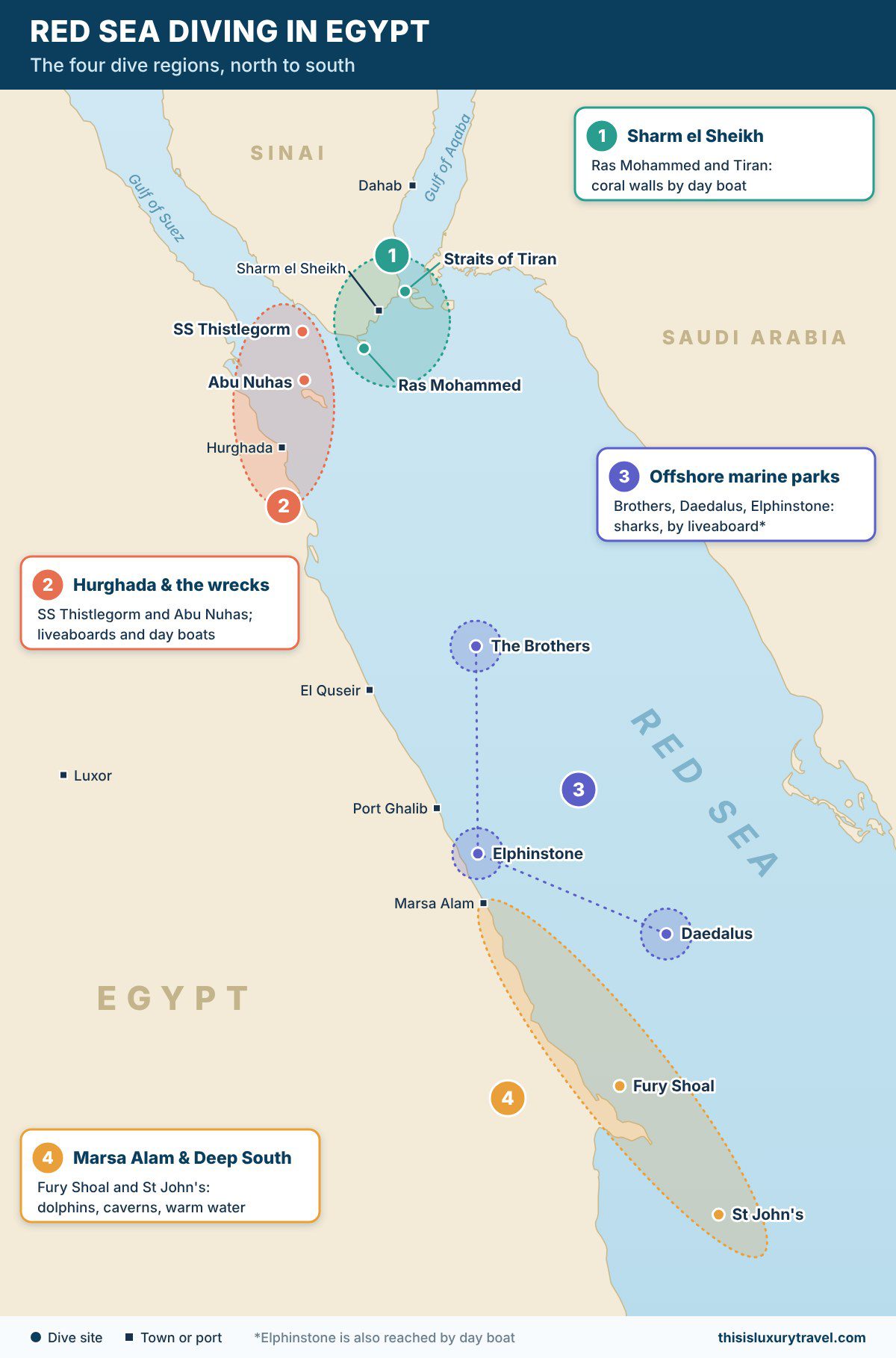
Red Sea diving, north to south: what each area is known for
1. Sharm el Sheikh, Ras Mohammed & Tiran
Shark & Yolanda Reef · Jackson Reef · resort house reefs · day boats from Sharm
2. Hurghada & the northern wrecks
SS Thistlegorm · Abu Nuhas (Giannis D, Carnatic) · liveaboards and day boats
3. Offshore marine parks
The Brothers · Daedalus · Elphinstone · hammerheads and oceanic whitetips
4. Marsa Alam & the Deep South
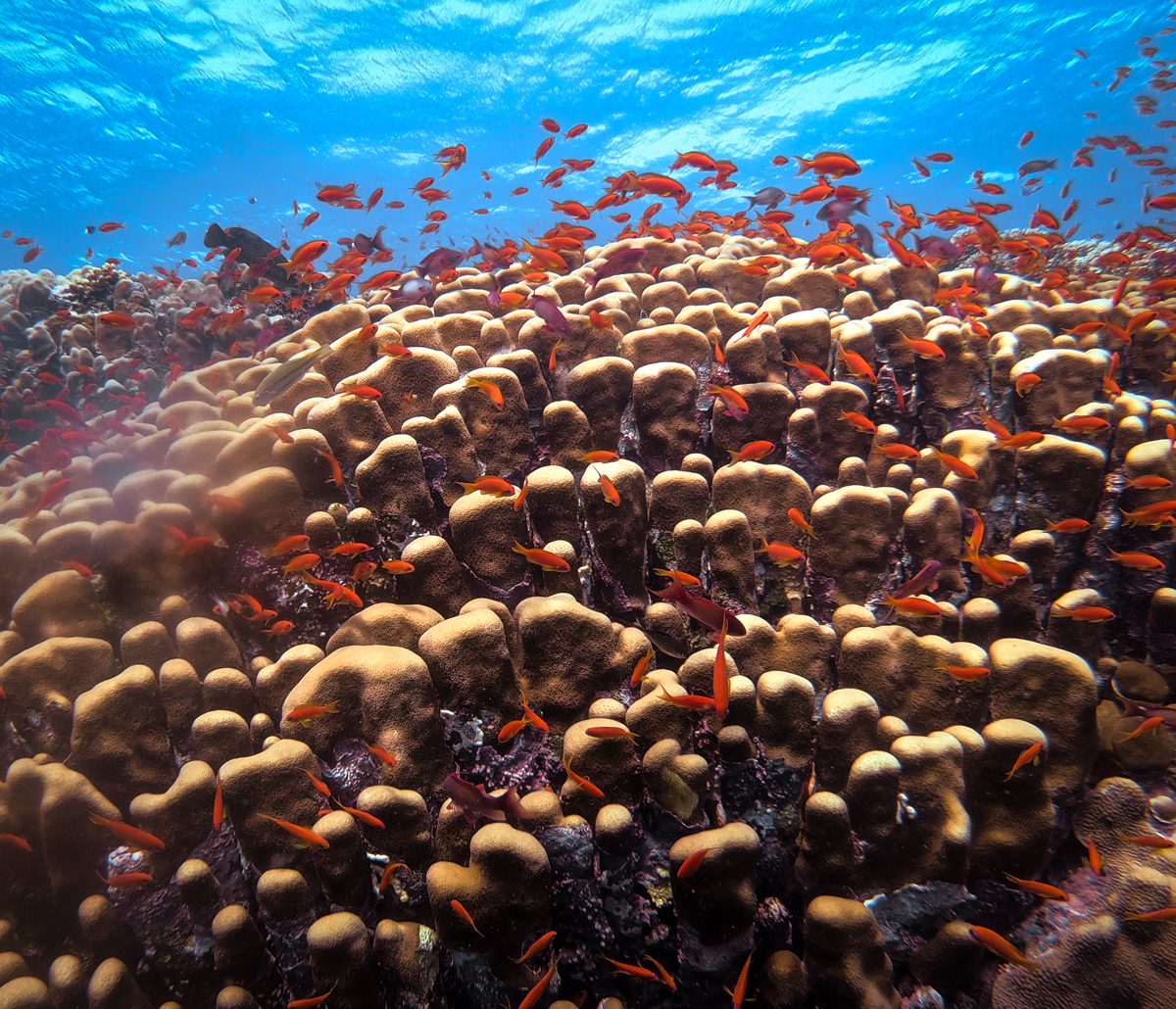
Fury Shoal dolphins · Shaab Claudia caverns · St John’s swim-throughs · the warmest water
1. Sharm el Sheikh, Ras Mohammed and the Straits of Tiran
Sharm el Sheikh sits at the southern tip of the Sinai, where the Gulf of Aqaba and the Gulf of Suez meet the main Red Sea. The currents that run where they meet feed the reefs, which is why this short stretch of coast holds two of Egypt’s best-known dive areas: Ras Mohammed National Park to the south and the Straits of Tiran to the north-east. Both are classic Red Sea diving by day boat from Sharm’s resorts, with no liveaboard needed.
Ras Mohammed National Park
Ras Mohammed is the headland at the very tip of the Sinai, roughly an hour by boat south of Sharm. It was declared Egypt’s first national park in 1983, and more than 220 species of coral and more than 1,000 species of fish have been recorded here. Its signature dive, Shark and Yolanda Reef, is regularly named among the best dives in Egypt.
- Shark and Yolanda Reef: submerged pinnacles rising beside a deep wall at the corner of the headland, usually dived as a single drift. You start on Shark Reef, a sheer wall that drops hundreds of metres into the blue, cross a saddle of coral garden and finish on Yolanda Reef. The freighter Yolanda ran aground here in 1980, and although the ship itself later slid off into deep water, her cargo still lies scattered at 15 to 20 metres: toilets, bathtubs and pipes, now part of the reef. In summer, June to August especially, huge schools of snapper, batfish and barracuda gather on Shark Reef. Currents can be strong and can change mid-dive, so it suits divers who are comfortable drifting.
- Anemone City: a shallow reef shoulder just north of Shark Reef, carpeted in anemones and their anemonefish.
- Jackfish Alley and Ras Za’atar: caves and swim-throughs in the shallows at Jackfish Alley, and a wall of gorgonian fans and soft coral at Ras Za’atar.
- Shark Observatory: a vertical wall with caves full of glassfish.
The park charges a small entry fee per diver, which your dive centre normally collects with the day’s diving.
From my logbook: I dived Shark and Yolanda Reef from Blue Force 3 on the Top Red Sea route, starting on the Anemone City side. Looking into the blue as we crossed between the pinnacles, we saw huge tuna and schools of jacks; a big school of snapper was waiting near Shark Reef, and a school of unicornfish swam so close they seemed not to notice us. The Yolanda’s toilets lie at about 17 metres, a surreal sight, and the shallow coral garden above was full of red anthias. It was so good that we asked to dive it a second time.
The Straits of Tiran
Four reefs sit in a line in the middle of the strait at the mouth of the Gulf of Aqaba: Jackson, Woodhouse, Thomas and Gordon. Shipping lanes pass on either side, the current can run hard, and the deep water around them brings in bigger animals than Sharm’s coastal reefs.
- Jackson Reef: the northernmost reef and the one with the best coral: a wall, in places easing into a slope, covered in hard and soft coral, with dense reef fish, turtles and passing pelagics. The remains of the freighter Lara sit on top of the reef. In summer, experienced divers swim out into the blue off the north side to look for scalloped hammerheads. The sheltered south side is an easy dive; the drifts are for advanced divers.
- Woodhouse Reef: a long, narrow reef with no moorings, dived as a drift past black coral and schooling fish.
- Thomas Reef: the smallest of the four and one of the most colourful, with a deep canyon for technical divers that starts at about 35 metres.
- Gordon Reef: the closest to Sharm and the easiest, with a shallow plateau, garden eels and the wreck of the Loullia stranded on top.
Sharm also has local reefs along its own shoreline, used for check dives, training and afternoon dives, and several resorts have a house reef you can dive straight from the jetty.
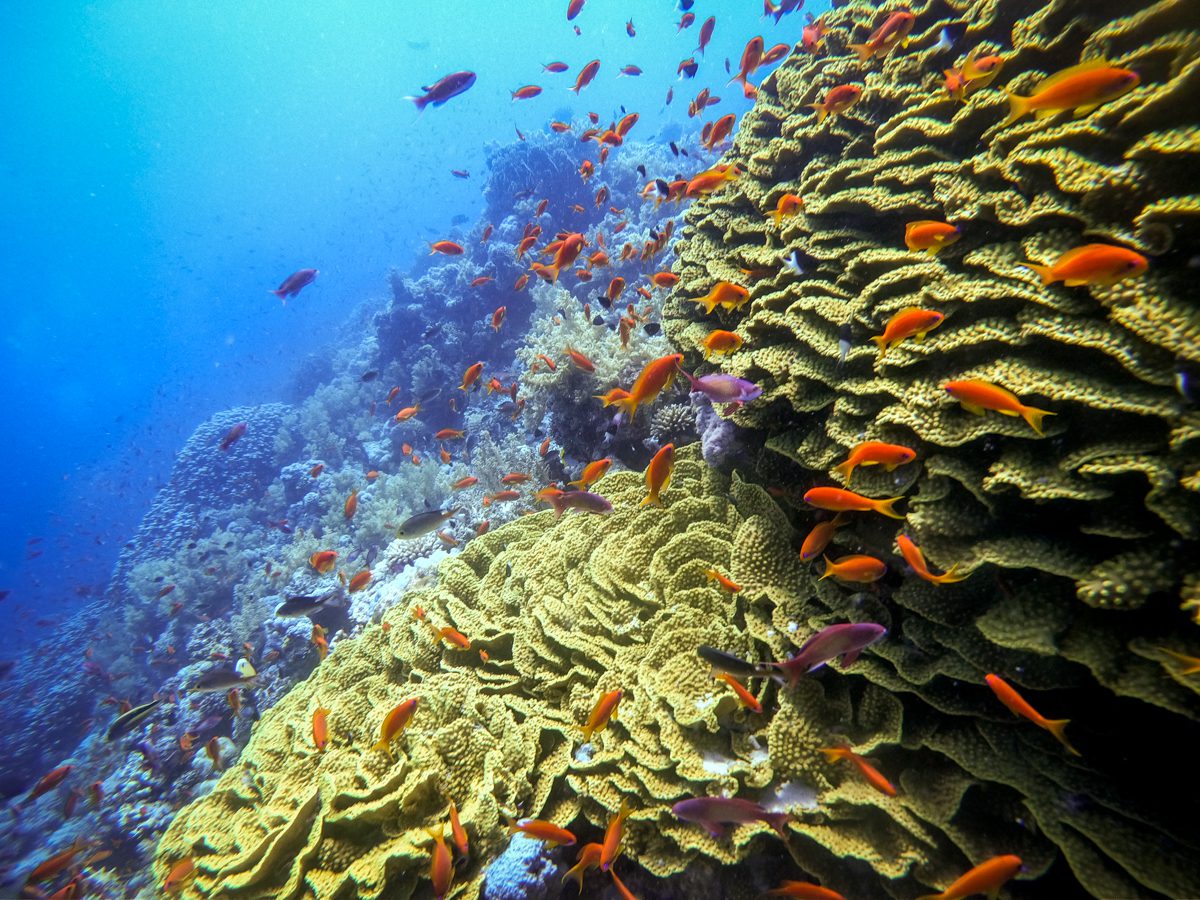
From my logbook: I dived Sharm from the Four Seasons Sharm el Sheikh, whose 500 HP speedboat covers the 10 kilometres to Jackson Reef in about ten minutes at up to 70 km/h. It is James Bond diving: hydraulic seats, flying over the swell, and back at your sun lounger by late morning. We dived the sheltered side of Jackson: more small fish than I could take in, no sharks that day, but three unbothered turtles. The resort’s own house reef is coral bommies on sand with almost no current, anemonefish everywhere (one bit me, a first in 1,500 dives) and a scorpionfish at less than a metre. It is an ideal place to learn or to fit in a sunset dive.
Dahab: further up the Sinai coast on the Gulf of Aqaba, Dahab is Egypt’s shore-diving town, known for the Blue Hole and the Canyon. I haven’t dived it yet and will add it when I have.
2. Hurghada and the Northern Wrecks
Hurghada is the departure port for most northern Red Sea liveaboards, and the “north and wrecks” route is the classic first Red Sea diving liveaboard. It works the Strait of Gubal, the busy shipping channel at the mouth of the Gulf of Suez, where a century and a half of groundings and one wartime air raid have left the best concentration of diveable wrecks in the Red Sea.
SS Thistlegorm
The Thistlegorm is the most famous wreck in the Red Sea and one of the best-known wreck dives in the world. She was a British merchant ship, 126 metres long and launched in Sunderland in 1940, carrying supplies for the Allied forces in North Africa. On 6 October 1941, while she lay at anchor at Sha’ab Ali in the Strait of Gubal, two German Heinkel bombers hit her near the stern. The ammunition in the aft hold exploded, nine men died and she sank upright with most of her cargo still in place.
That cargo is why divers come. The forward holds are a wartime time capsule: Bedford trucks, BSA and Norton motorcycles stacked in rows, Lee-Enfield rifles, aircraft parts, Wellington boots and Bren gun carriers. Two steam locomotives that were carried on deck were blown clear by the explosion and now lie on the sand either side of the hull. Jacques Cousteau found the wreck in the early 1950s; it then dropped out of sight until the early 1990s, and more than a million people are estimated to have dived it since.
- Depth: the main deck is at about 17 metres and the seabed at about 30, so the whole wreck sits within recreational limits.
- Level: most operators ask for Advanced Open Water. The current is often strong, visibility is typically 15 to 25 metres, and going inside the holds calls for wreck training and good buoyancy.
- How to dive it: a northern liveaboard is the comfortable way, because the boat moors on the wreck and you dive it more than once, often with an early-morning or night dive when the day boats are not there. From Sharm el Sheikh it is a long day trip: a pre-dawn start, about three hours each way by boat and two dives on the wreck. From Hurghada it is usually dived on a liveaboard or a two to three day safari, often paired with Abu Nuhas.
- Look, don’t touch: nine men died here and the wreck is slowly deteriorating, so take nothing and watch your fins inside the holds.
From my logbook: we gave the Thistlegorm four dives from Blue Force 3, including a night dive inside the holds: fantastic, and a little spooky, so bring a good torch. Trucks, motorbikes, rifles and the two locomotives make it feel like an underwater museum, and the wreck is full of scorpionfish, crocodilefish and batfish. I have dived a lot of wrecks, and this is one of the most impressive I have ever seen. If you dive Egypt once, don’t miss it.
Abu Nuhas
Abu Nuhas is a triangular reef beside the shipping lane just north of Shadwan Island, about 40 kilometres north of Hurghada, and it has caught enough ships to be known as the ships’ graveyard. Four wrecks lie along its north side, all at recreational depths:
- Giannis D: the Greek freighter that struck the reef in 1983 with a cargo of timber. She broke apart as she sank, and the stern section, with its engine room and tilted corridors, is the part most divers explore, in 13 to 24 metres.
- Carnatic: a British steamship lost in 1869, now a skeleton of iron ribs covered in soft coral and filled with glassfish.
- Chrisoula K: a freighter that ran aground in 1981 carrying floor tiles, which is why divers call her the tile wreck.
- Kimon M: a cargo ship that went down in 1978 carrying lentils, and the deepest of the four at up to 32 metres.
Abu Nuhas is reached by day boat from Hurghada in calm weather and is a fixture on northern liveaboard routes. The outside of the wrecks suits most certified divers; going inside needs training. Other wrecks on the same route include the Rosalie Moller, sunk two days after the Thistlegorm and much deeper, and the Dunraven near Ras Mohammed. Hurghada itself is day-boat country, with easy, sheltered reef diving around the Giftun Islands that suits new divers.
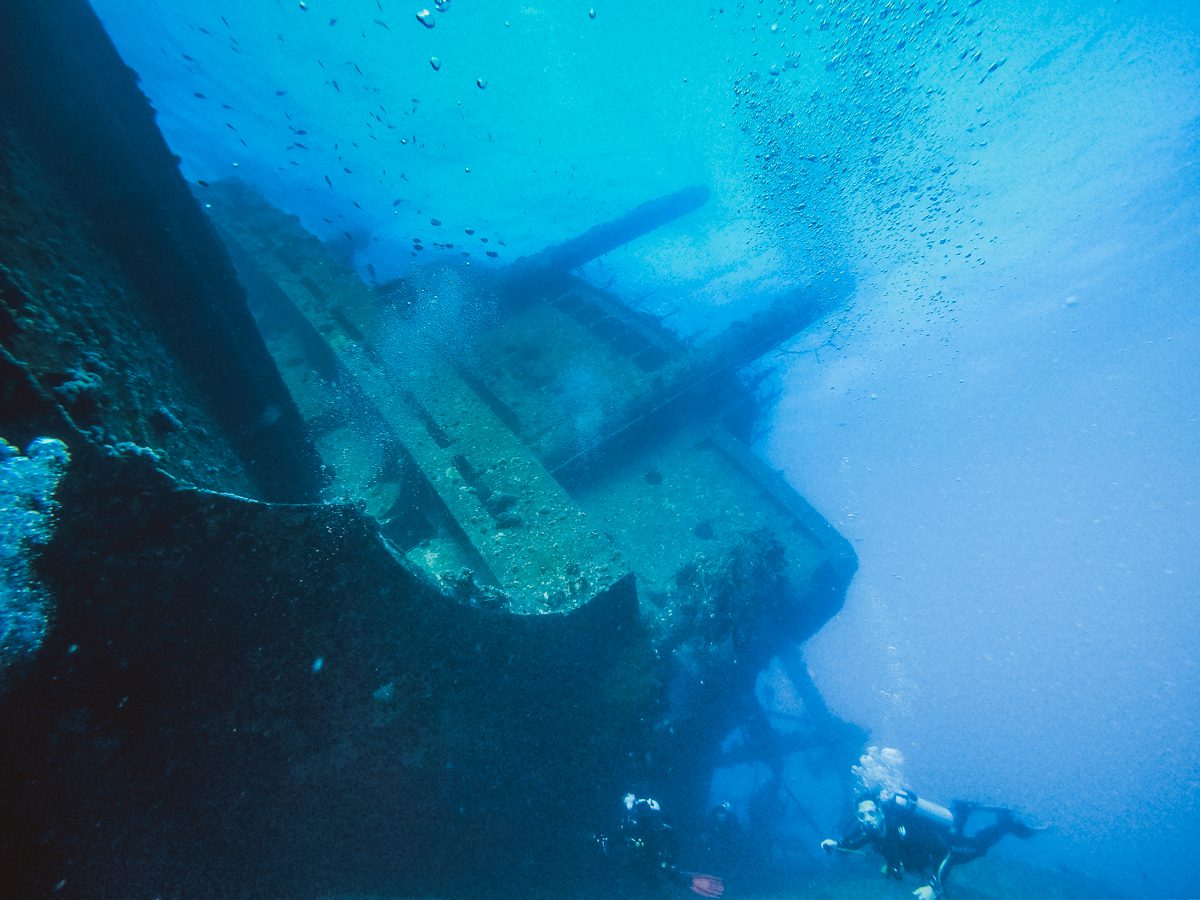
From my logbook: my week on Blue Force 3 out of Hurghada followed the Top Red Sea route: Poseidon Reef for the check dive, a night dive at Abu Nuhas, the Thistlegorm, the Dunraven, Ras Mohammed, Small Giftun, the Brothers and Panorama Reef off Safaga. On the Giannis D we went inside, through hidden passages and rooms full of glassfish, and found a pink pipefish, with a turtle posing on the coral slope afterwards. In June the northern water was 25 to 26°C, two degrees cooler than the Deep South the following week. Blue Force 3 has since moved to the Maldives; the fleet’s boat in Egypt is now Blue Force 2, which I cover in the liveaboard section below.
3. The Offshore Marine Parks: the Brothers, Daedalus and Elphinstone
This is the Red Sea diving that sends divers home with shark stories. Three isolated reefs rise from deep water off the coast south of Hurghada, and liveaboards often combine them in one itinerary known as BDE (Brothers, Daedalus, Elphinstone). All three are for experienced divers: deep walls, open blue water and current.
The Brothers
Big Brother and Little Brother are two small islands about 67 kilometres off El Quseir, a kilometre apart and reachable only by liveaboard. Big Brother carries a lighthouse built by the British in 1883 and two wrecks, the Numidia and the Aida, on its walls. The islands are known for oceanic whitetips, hammerheads and thresher sharks, and for strong currents.
From my logbook: I dived Big Brother twice and Little Brother once on Blue Force 3, after a 12-hour overnight crossing. The briefing focused on oceanic whitetips: don’t stay at the surface, and if one comes close, stay calm and vertical. None came. Nature makes no promises, and the biggest shark we saw was a grey reef shark, with a blacktip, a whitetip, big barracuda and tuna. The walls made up for it: Little Brother has some of the most stunning soft-coral walls I have ever seen. Watch your depth there, as we met a spiralling, upward current.
Daedalus Reef
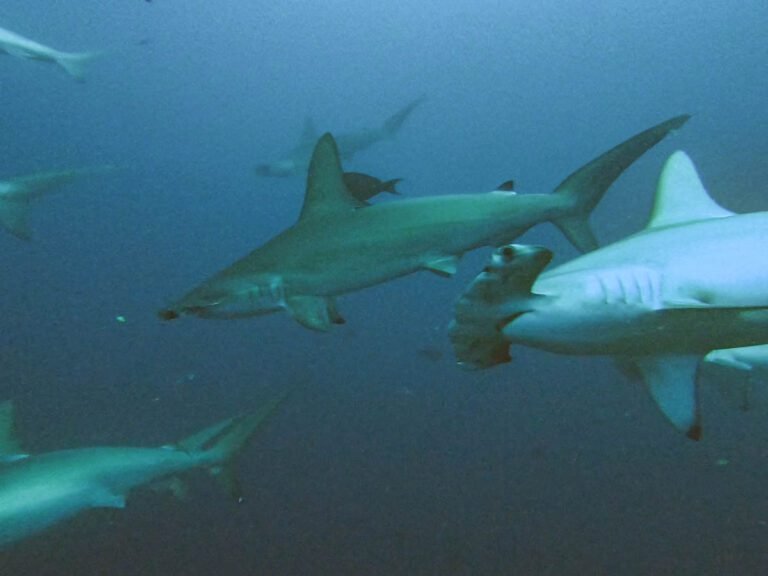
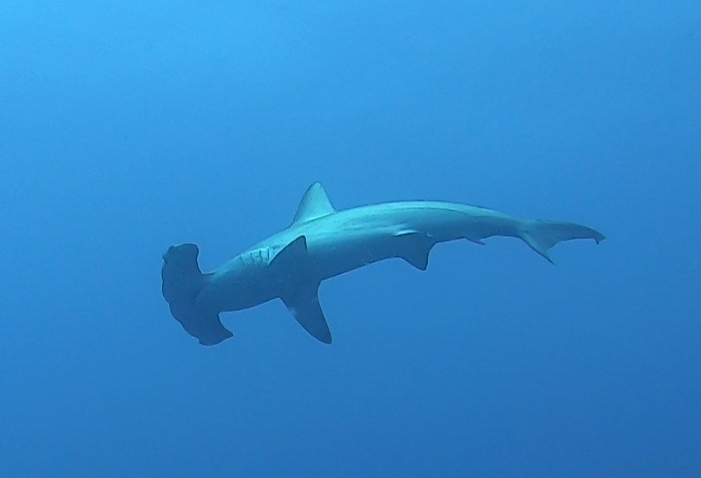
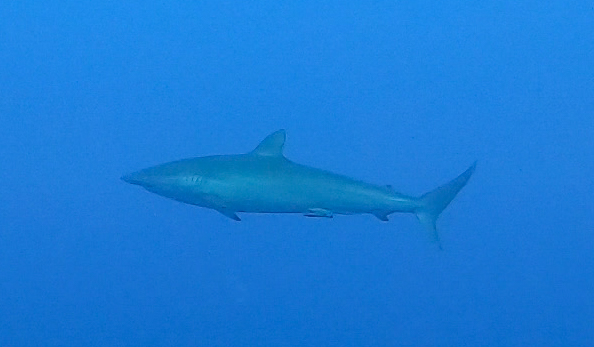
Daedalus is an isolated reef about a kilometre long, with a lighthouse at its centre, roughly 90 kilometres off Marsa Alam and reachable only by liveaboard. It rises from several hundred metres of open water, so the whole reef works as a meeting point and cleaning station for whatever comes in from the blue: scalloped hammerheads in summer, silky sharks, oceanic whitetips in autumn, and tuna, barracuda and trevally all year. The classic dive is along the wall early in the morning, a few metres out from the reef, watching the blue.
Elphinstone
Elphinstone is a narrow reef more than 400 metres long, about 25 kilometres north of Marsa Alam and close enough to shore to be dived by day boat as well as by liveaboard. Sheer walls on its east and west sides drop beyond 100 metres, and plateaus step down at the northern and southern ends, which is where the sharks are: oceanic whitetips from October to December, and hammerheads if you are lucky. The current can be strong and the walls are deep, so treat it as an advanced dive.
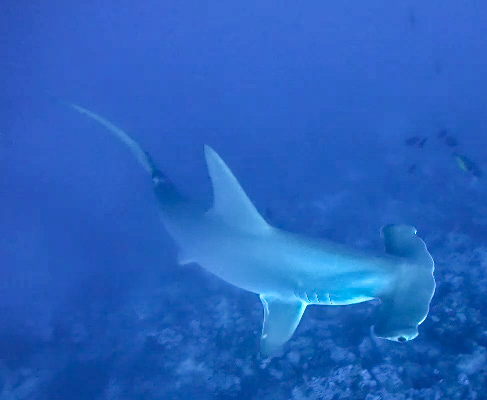
How to see hammerheads in the Red Sea: they hang off the wall in the blue, so swim parallel to the reef a few metres out rather than hugging it. Don’t bang your tank, turn off video lights and strobes, and dive on nitrox: Daedalus and Elphinstone reward depth, and nitrox buys you bottom time at 30 metres.
From my logbook: I dived Daedalus and Elphinstone in June on the Red Sea Aggressor III. These were the dives:
- Daedalus, dive one: no hammerheads, but a family of four dolphins, including a calf, slipped up behind us. Tuna and a school of barracuda in the blue.
- Daedalus, dive three: three hammerheads, one of which circled us for more than five minutes, with giant trevally, tuna and great barracuda passing.
- Daedalus, last dive: three silky sharks, one swimming straight at us, and a bite-marked Napoleon wrasse that stuck to our group for ten minutes as if we were its bodyguards.
- Elphinstone, off Marsa Alam, on the last morning: a huge Napoleon and giant trevally hunting, then two hammerheads joined in, frantic, and one came straight at me. Gently sloping plateaus sit at about 20 metres on both sides of the reef, and the steep drop-off makes it easy to sink deeper than you meant to.
Nine boats were moored at Daedalus when we arrived, and in normal times there can be up to 20. We still had the reef largely to ourselves underwater because the Aggressor runs a different dive schedule from most boats. Climb to the lighthouse at sunset if your boat allows it.
4. Marsa Alam and the Deep South
South of Marsa Alam the coast empties out, and Red Sea diving gets quieter. The reefs here are warmer (27 to 28°C in June), see fewer boats than the north and have the most interesting topography in Egypt: caverns, swim-throughs and shallow coral gardens. Most of it is dived by liveaboard from Port Ghalib, about 200 kilometres south of Hurghada, and with little current on most sites it is also the gentlest liveaboard route in Egypt.
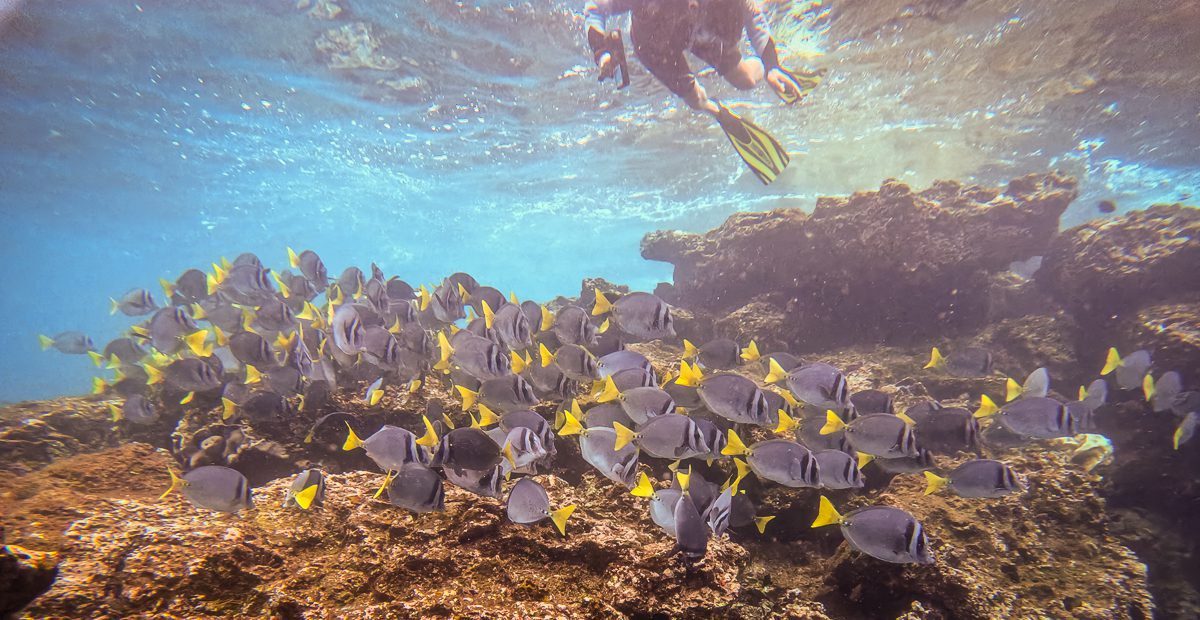
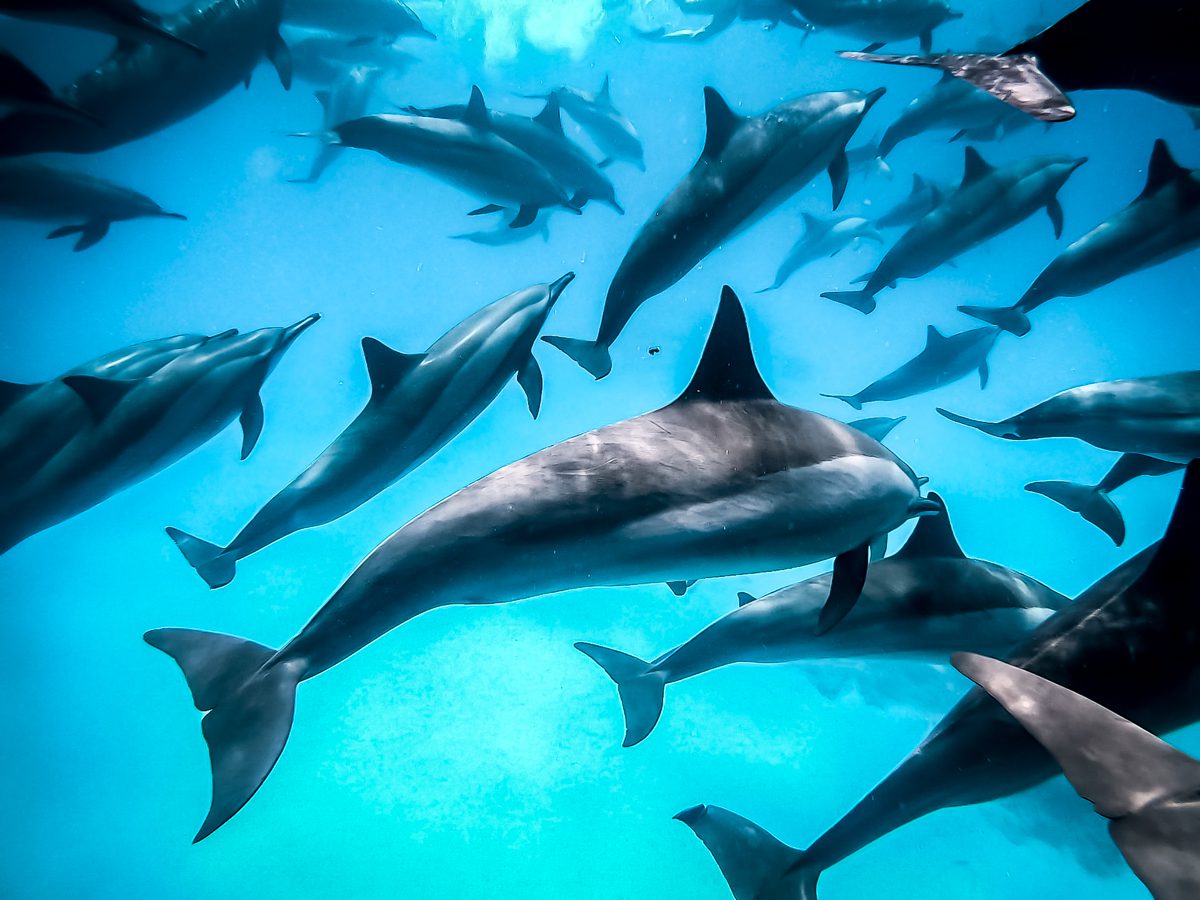
- Fury Shoal: a chain of reefs south of Marsa Alam. Sataya, also called Dolphin Reef, is a horseshoe-shaped reef whose lagoon has a resident pod of spinner dolphins, and the outer walls are gentle drifts. From my logbook: we snorkelled with more than 50 dolphins, and several came within touching distance when we stayed still. The dive itself was a drift along a 100-metre wall, with healthier coral round the corner where the current picked up.
- Shaab Claudia: also part of Fury Shoal: caves and corridors through enormous coral heads, shallow and lit from above, like diving inside Gaudí’s cathedral. From my logbook: we found a whitetip reef shark in one cave, and many guests rated it the dive of the week.
- St John’s: a large reef system close to the Sudanese border and the southernmost diving in Egypt. Pinnacles stand close together, forming swim-throughs and canyons where light streams in. St John’s Cave is shallow and easy but needs good buoyancy.
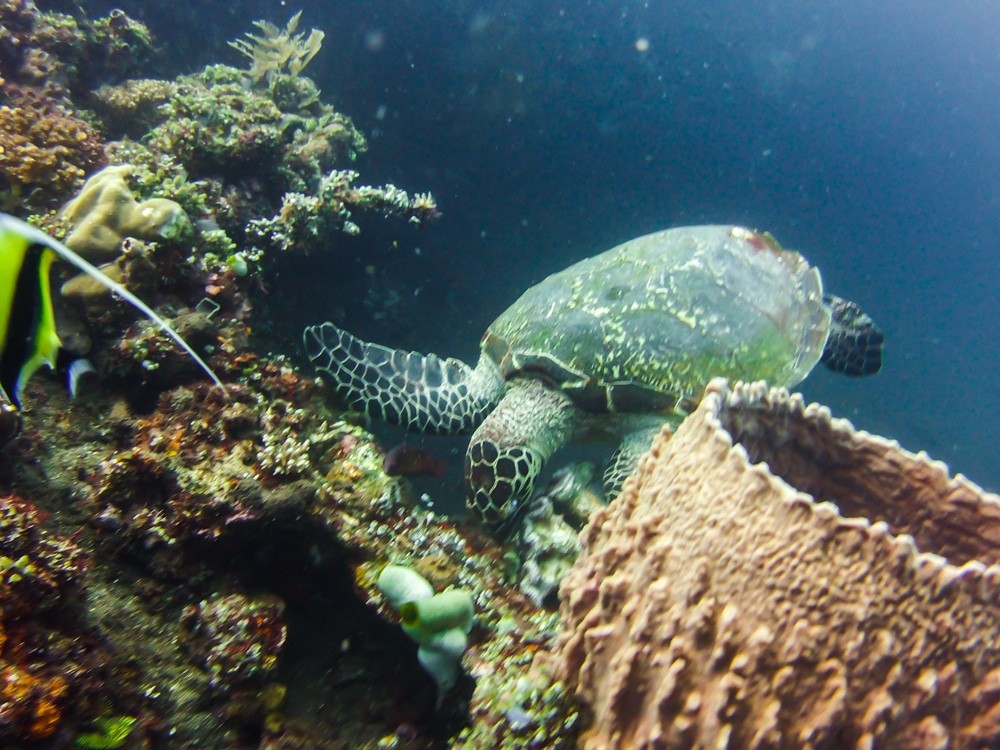
- Marsa Alam’s coast: shore and day-boat diving in sheltered bays with seagrass, where dugongs and turtles feed. From my logbook: Marsa Shouna, our check dive, is a coral slope to 30 metres with seagrass. No dugong for us, but a turtle being cleaned by two large remoras.
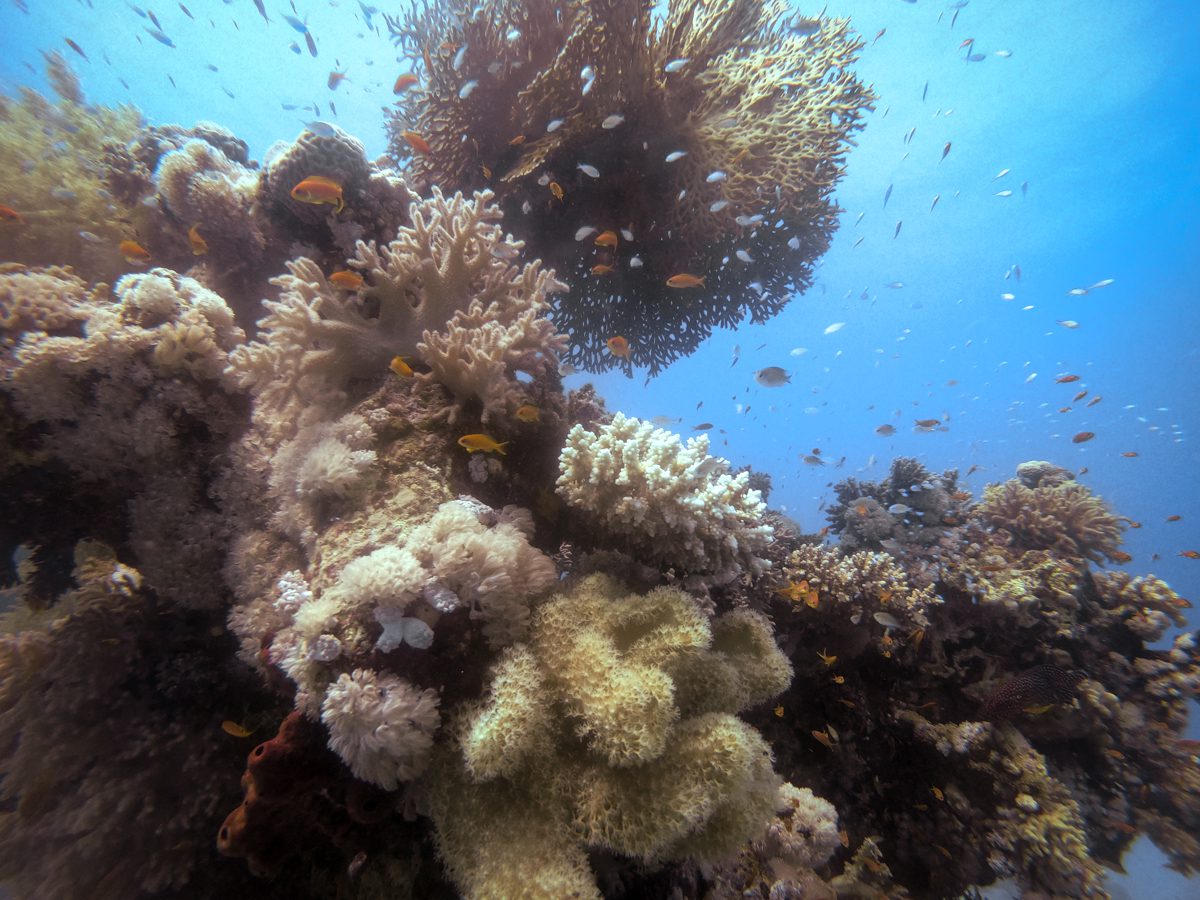
The 9 Best Red Sea Diving Sites
Ranked from my own logbook. The first two are also the classics that top almost every list of Red Sea diving.
- SS Thistlegorm: the most famous wreck in the Red Sea, with trucks, motorcycles and rifles still in her holds. I gave it four dives, including one at night. Advanced; by liveaboard or a long day boat from Sharm.
- Shark and Yolanda Reef, Ras Mohammed: a sheer wall, schools of snapper and unicornfish, and a cargo of toilets on the reef, inside Egypt’s first national park. So good we dived it twice. Intermediate; expect current.
- Daedalus Reef: hammerheads, silky sharks and dolphins in a single day. Advanced, liveaboard only.
- Elphinstone: two hammerheads and a hunting Napoleon before breakfast. Advanced; watch your depth.
- Fury Shoal (Sataya): more than 50 dolphins on a snorkel. Easy.
- Shaab Claudia: the most dramatic cavern landscape of my trip. Easy, good buoyancy needed.
- Jackson Reef: astonishing fish numbers on a coral-covered wall, ten minutes from a five-star bed. Easy to intermediate.
- St John’s Cave: swim-throughs and light beams. Easy, shallow.
- Giannis D: the classic northern wreck at Abu Nuhas. Easy outside, training needed to go in.
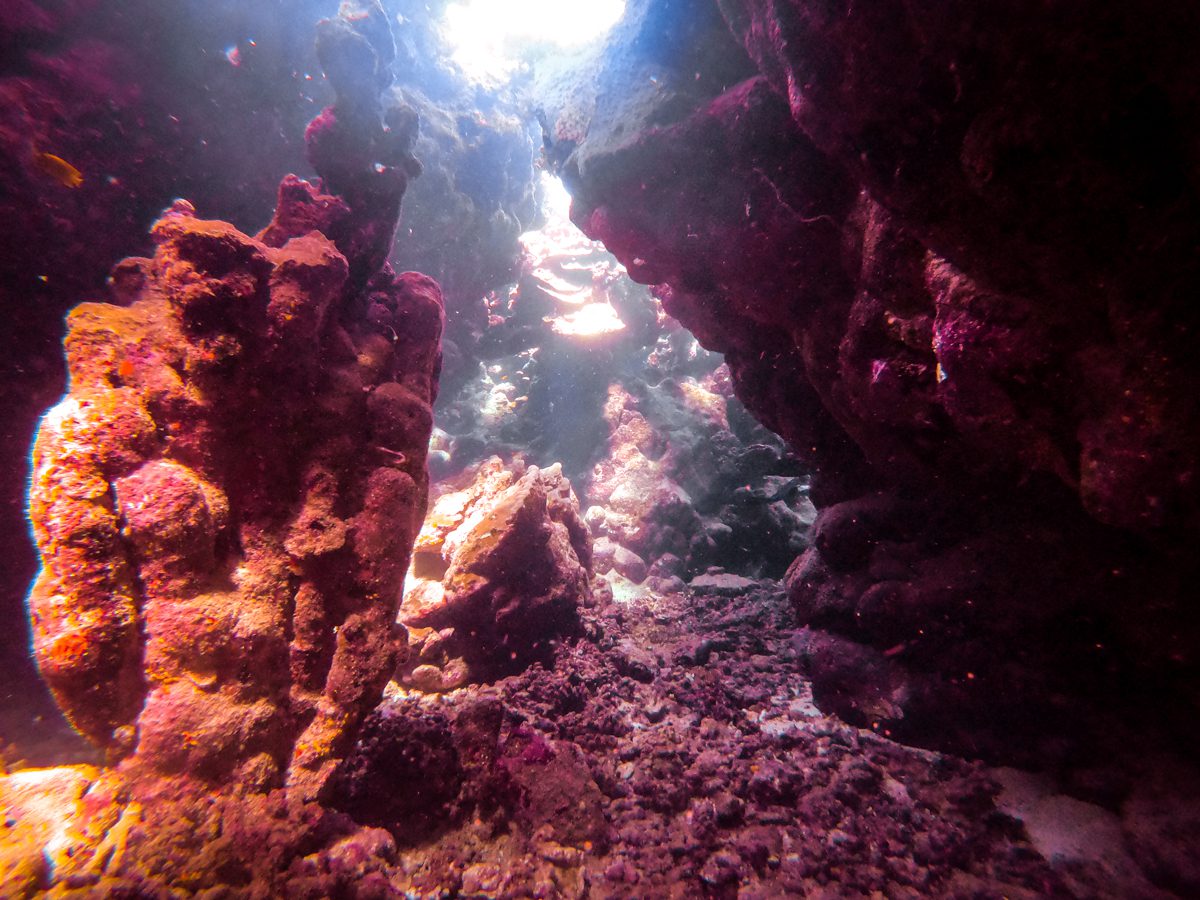
Best Time to Dive the Red Sea
You can dive the Egyptian Red Sea all year, but the right month depends on what you want to see and how much cold water you will tolerate.
- March to May and September to November: my pick for most divers. Warm water, long days, and calmer seas than midwinter.
- June to August: the warmest water and the hottest air; land temperatures reached 40°C when I was there in June, though the wind at sea made the boat comfortable. I saw hammerheads at Daedalus and Elphinstone in June. It is also when the big fish schools gather at Shark Reef in Ras Mohammed.
- October to December: the season divers chase oceanic whitetip sharks at the offshore reefs.
- December to February: the coolest water and the windiest seas, especially in the north. Cheap, uncrowded, and fine from a Sharm resort if you bring a thicker wetsuit.
Red Sea diving calendar (Egypt)
| J | F | M | A | M | J | J | A | S | O | N | D | |
|---|---|---|---|---|---|---|---|---|---|---|---|---|
| North sea temp (°C) | 23 | 22 | 22 | 23 | 25 | 26 | 27 | 28 | 28 | 27 | 25 | 24 |
| Deep South sea temp (°C) | 24 | 23 | 23 | 24 | 26 | 27 | 28 | 29 | 29 | 28 | 26 | 25 |
| Hammerheads (Daedalus) | · | · | · | ○ | ○ | ● | ● | ● | ○ | ○ | · | · |
| Oceanic whitetips | ○ | · | · | · | · | · | · | · | ○ | ● | ● | ● |
| My pick for comfort | ★ | ★ | ★ | ★ | ★ | ★ |
● peak season · ○ possible · · unlikely. Sea temperatures are typical monthly averages; my own June readings were 25–26°C in the north and 27–28°C in the Deep South.
What Wetsuit Do You Need for the Red Sea?
At 27 to 28°C, as I had in June, a 3 mm full suit is usually plenty, even at five dives a day. In winter, when the north drops to around 22°C, most divers wear 5 mm, and a hood helps on the fourth dive of the day. My scuba gear list covers what I travel with.
Liveaboard or Resort? How to Dive the Red Sea
I did both on the same trip, and the answer comes down to sharks versus comfort.
- Choose a liveaboard if you want Daedalus, the Brothers or Elphinstone at dawn, or simply the maximum number of dives. On the Red Sea Aggressor III we did four or five dives a day, sometimes before breakfast.
- Choose a resort if you are travelling with a non-diver, want two dives and an afternoon by the pool, or have only a few days. From the Four Seasons Sharm el Sheikh, Jackson Reef was a ten-minute ride and the dive centre carried, rinsed and dried my gear.
- Do both if you have two or three weeks. Hurghada to Sharm el Sheikh is a 30-minute flight.
| If you want… | Do this |
|---|---|
| Hammerheads and silky sharks | Deep South or BDE liveaboard from Port Ghalib, June to August |
| Oceanic whitetips | Offshore reefs by liveaboard, October to December |
| Dolphins | Deep South liveaboard with Fury Shoal (Sataya) on the route |
| Wrecks, including the Thistlegorm | Northern wrecks liveaboard, or a long day boat from Sharm el Sheikh |
| Five-star comfort and a non-diving partner | Sharm el Sheikh resort with day boats to Tiran and Ras Mohammed |
| Your first liveaboard | Deep South (St John’s, Fury Shoal): easy, mostly current-free reefs |
| Learning to dive | A Sharm resort with a house reef |
My Red Sea Diving: Seven Trips to Egypt
My Red Sea trip in numbers
I have dived Egypt on seven trips, covering the northern wrecks, the BDE route and the Deep South. The most recent, in June 2021, was three weeks built as a north-to-south traverse so I could compare the three ways most people dive the Red Sea:
- The north by liveaboard: a week on Blue Force 3 out of Hurghada, including the Thistlegorm, Abu Nuhas, Ras Mohammed and the Brothers.
- Sharm el Sheikh from land: three days at the Four Seasons Sharm el Sheikh, diving its house reef and Jackson Reef in the Straits of Tiran.
- The Deep South by liveaboard: a week on the Red Sea Aggressor III from Port Ghalib to Daedalus, St John’s, Fury Shoal, Shaab Claudia and Elphinstone.
Everything marked From my logbook is first-hand. The rest of the guide describes each area from its established facts, and where I haven’t dived a place yet (Dahab’s Blue Hole, Sudan, Saudi Arabia) I say so plainly. You can read more about how I review.
The Best Red Sea Liveaboards I Have Sailed
Red Sea Aggressor III (Deep South, from Port Ghalib)
The best service I have had on any dive boat in Egypt. The 40-metre yacht, built in 2017, takes 22 divers in 11 cabins; within ten minutes of boarding the whole crew knew my name. Expect four or five dives a day, four meals, complimentary beer and wine, and a hot towel after every dive. The trade-off: two guides for 22 divers, so most diving is in buddy pairs. On the gentle Deep South reefs that felt liberating; newer divers can stay close to a guide or take a course on board. Wi-Fi is only available in port, so buy a local SIM.
Aggressor III currently shows no online availability, so the easiest way to sail the same routes is its sister ship, Red Sea Aggressor IV: a 43.5-metre yacht for 26 guests that runs the Brothers, Daedalus and Elphinstone and St John’s routes from Port Ghalib, from about $124 a day.
Check dates and prices for its sister ship, Red Sea Aggressor IV, on Liveaboard.com · Read my full Red Sea Aggressor III review.
Blue Force 2 (north, from Sharm el Sheikh)
I dived the north on Blue Force 3, a 42-metre steel yacht built in 2018, with the best water pressure I have had on any liveaboard and food better than some five-star hotels. I rated it 4.5/5. That boat has since moved to the Maldives. The fleet’s boat in Egypt today is Blue Force 2, a 28-metre yacht for 18 divers in nine cabins that sails the northern routes from Sharm el Sheikh. I haven’t sailed it myself, but it comes from the same operator and is supposed to be equally good.
Check Blue Force 2 dates and prices on Liveaboard.com · Read my Blue Force 3 review to see what the fleet is like.
For other boats on the Egyptian Red Sea, compare Red Sea liveaboards on Liveaboard.com.
Where to Stay for Red Sea Diving
Four Seasons Resort Sharm el Sheikh
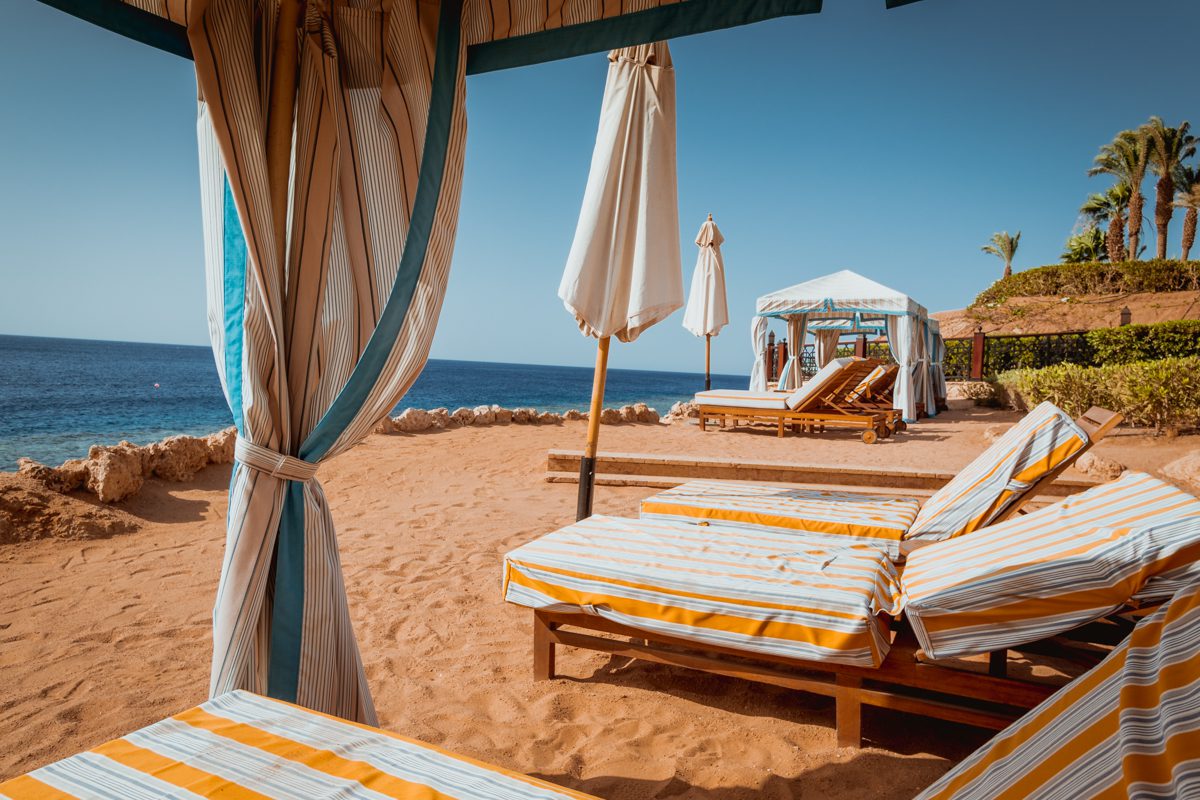
The most luxurious way to dive the northern Red Sea, and my rating is 4.5/5. The resort sits on a cliff under ten minutes from Sharm el Sheikh airport, with a funicular between the lobby level and the beach, a genuine house reef, and the fastest dive boat I have been on. My one-bedroom suite (number 154) was so well soundproofed that it gave me the best night’s sleep of three weeks in Egypt. Downsides: a small, busy beach, no adults-only pool, and no eating on the sun loungers. The resort roughly doubled in size with its 2023 expansion, adding private-pool categories.
Rates move often, so compare before you book: check rates on Booking.com, compare on Trip.com or see it on Expedia. Full detail in my Four Seasons Sharm el Sheikh review.
How Hard Is Red Sea Diving?
Easier than most of the world’s big-animal destinations, with two exceptions.
Red Sea dive sites by difficulty (from my dives)
Four Seasons house reef · beginner
St John’s, Fury Shoal, Shaab Claudia · easy, almost no current on my trip
Jackson Reef, Giannis D, Shark & Yolanda Reef · easy to intermediate
Elphinstone, SS Thistlegorm · advanced: deep, with current; easy to overshoot your depth
Daedalus, the Brothers · advanced: open blue, 30–40 m, offshore
- Certification: for Daedalus and Elphinstone, be Advanced Open Water so you can work at 30 to 40 metres, and dive on nitrox. Most operators also ask for a minimum number of logged dives on offshore routes; check when booking.
- Rules on my boat: maximum 30 metres, 60 minutes or 50 bar, no decompression dives and no solo blue-water dives, with a spare tank hung at five metres for safety stops. Boats carry divers’ GPS locators for current dives.
- Buddy diving: Egyptian liveaboards often let buddy pairs dive without a guide. Confident divers love it; if you have under 50 dives, ask for a guided group.
- The Thistlegorm and Ras Mohammed: the Thistlegorm lies between about 17 and 30 metres in current that is often strong, so most operators ask for Advanced Open Water. Shark and Yolanda Reef is a drift along a deep wall and suits divers who are comfortable in current.
Red Sea Marine Life: What You Can See
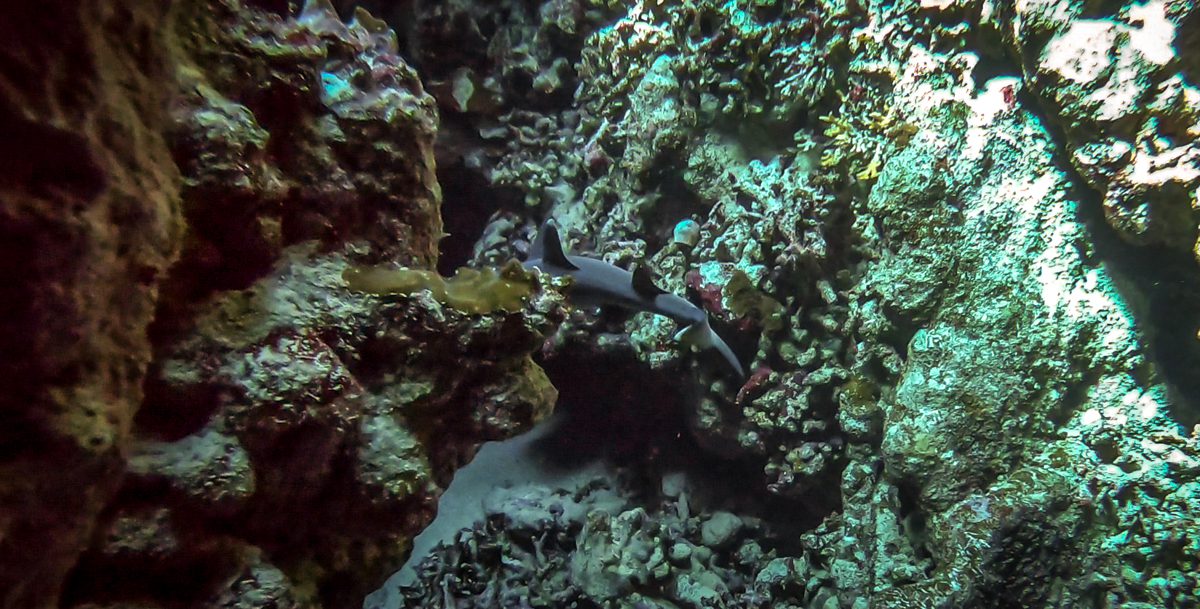
- Sharks I saw: scalloped hammerheads at Daedalus and Elphinstone, silky sharks at Daedalus, a grey shark at Elphinstone and whitetip reef sharks in the Shaab Claudia caves.
- Marine mammals: spinner dolphins at Fury Shoal and a family of four dolphins at Daedalus. Dugongs graze the seagrass near Marsa Alam.
- Big fish: Napoleon wrasse, giant trevally, tuna, great barracuda and schools of yellow snapper and goatfish.
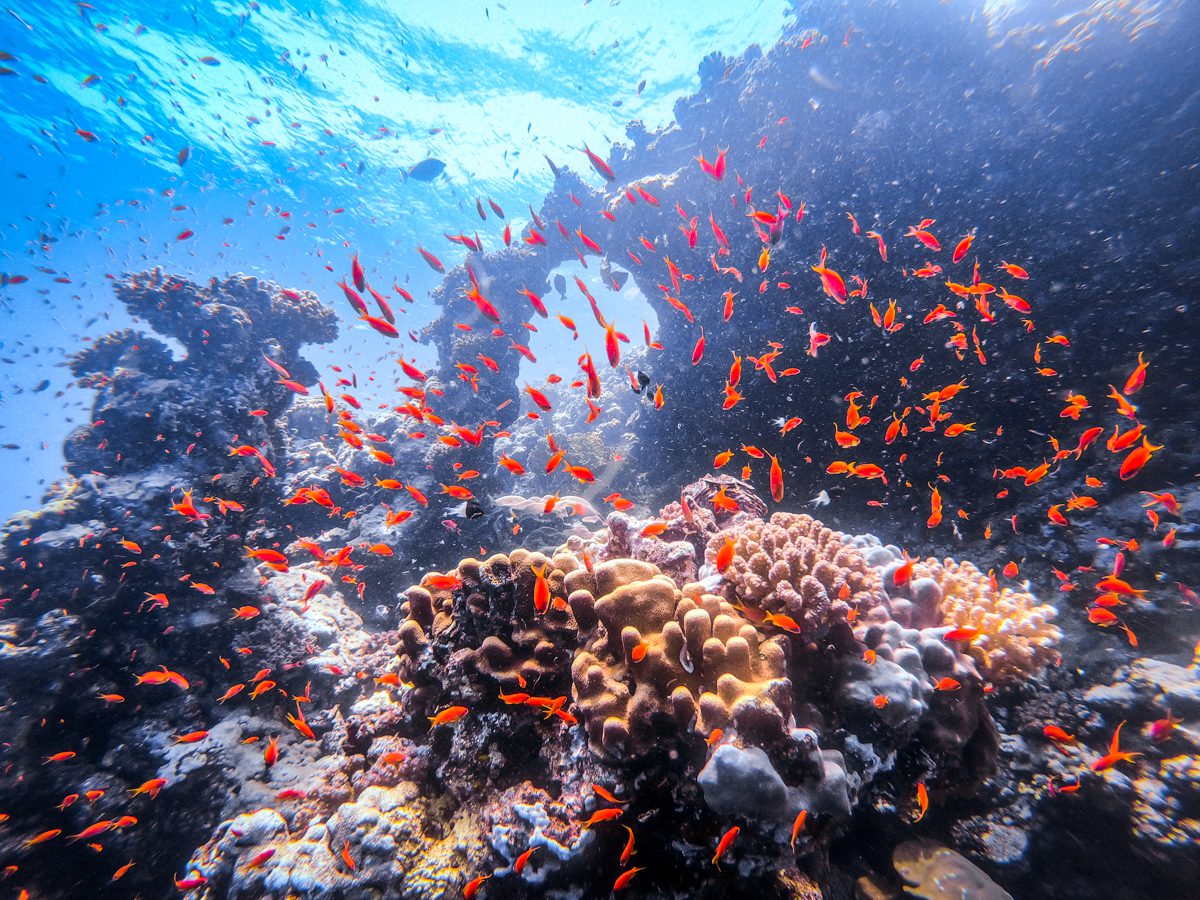
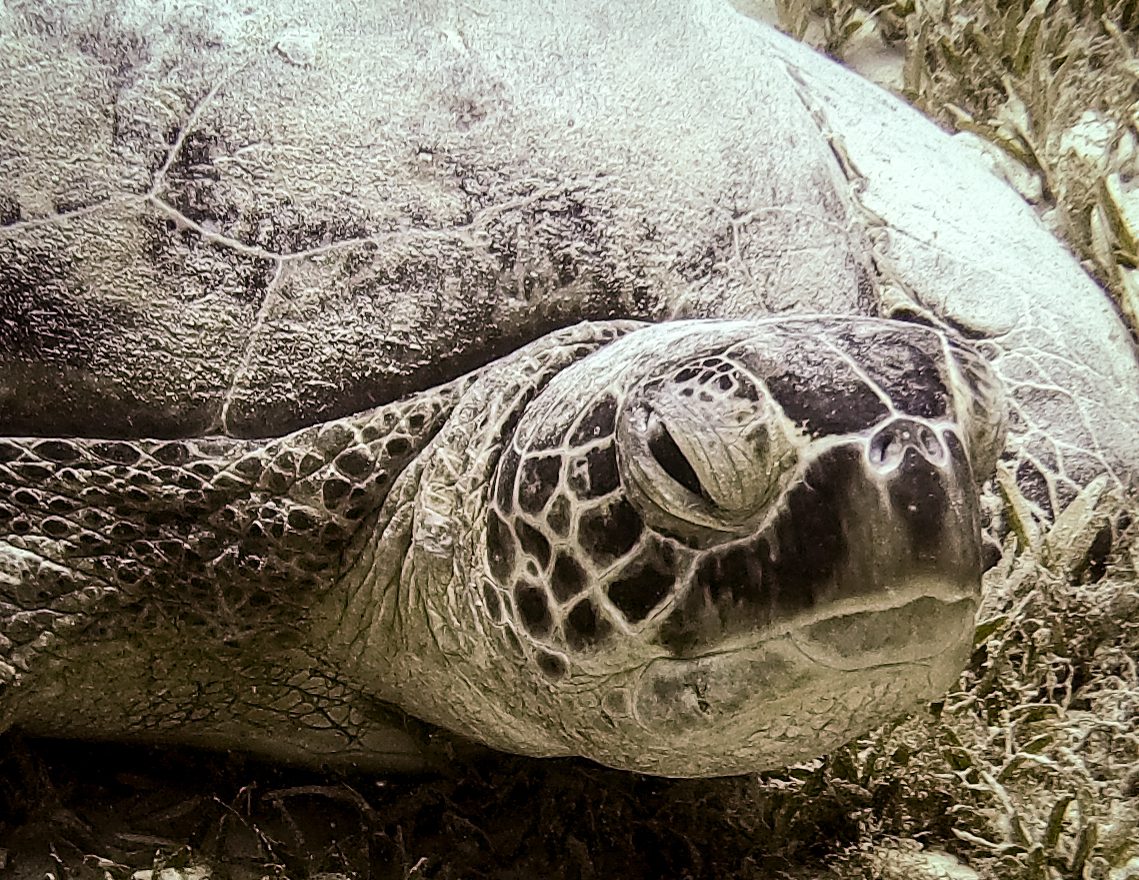
- Reef life: clouds of orange anthias, Red Sea anemonefish, moray eels, scorpionfish, blue-spotted stingrays and turtles on almost every southern dive.
- Possible, not seen by me: oceanic whitetips (autumn), whale sharks and mantas at Tiran, thresher sharks at the Brothers.
For underwater photography the Deep South is a wide-angle trip: sharks, dolphins and cavern light. I saw few new nudibranchs or critters; for macro, look to Indonesia.
Getting to the Red Sea
- From Europe: Sharm el Sheikh and Hurghada have direct flights, many of them charters, from across Europe, which makes the Red Sea one of the closest serious dive destinations to Europe. From the US or Asia, Turkish Airlines via Istanbul connects well.
- Hurghada (HRG): the hub for northern liveaboards, and the realistic gateway for the Deep South. Port Ghalib is about 200 km south, roughly three hours by car; book a driver or let your boat arrange it.
- Marsa Alam (RMF): the closest airport to Port Ghalib, but it had very few flights when I went.
- Sharm el Sheikh (SSH): under ten minutes from the Four Seasons. Agree a taxi fare before you get in.
- Between the two coasts: Hurghada to Sharm el Sheikh is a 30-minute EgyptAir flight. Save your money and fly economy; business class bought me nothing on this route.
I start every flight search on Aviasales. It shows the lowest fares from reliable agencies with no added fees or markups, and when your dates are flexible it tells you which nearby dates come out cheaper. You can also set a price alert on your route to Sharm el Sheikh, Hurghada or Marsa Alam and let it message you when the fare drops. For routings the airlines don’t sell, Kiwi.com stitches together carriers that have no agreement with each other, which is often how a route becomes much cheaper; the legs are separate tickets, so leave yourself a generous layover. Search flights on Aviasales · Compare on Kiwi.com
Check Egypt’s current entry and visa rules before you travel, as they change.
Phone and Internet
Treat your phone, not the boat, as your internet. The Red Sea Aggressor fleet offers Wi-Fi only in port, and there was no coverage at Daedalus or St John’s. I bought a Vodafone Egypt SIM at Hurghada airport, just after customs, and had the best coverage of the trip; bring your passport, and allow an hour for the data to activate.
Add Luxor
Port Ghalib is about five hours by road from Luxor, and the temple of Dendera makes a good stop on the way. It is also a sensible way to leave a day between your last dive and your flight home. In Luxor, my pick is the Sofitel Winter Palace, the city’s best hotel.
How Much Does Red Sea Diving Cost?
Red Sea diving costs less than any other big-animal destination I have dived. When I checked Liveaboard.com in October 2026, Egyptian liveaboards started from about $104 per person per day, well-reviewed boats sat between about $110 and $140 a day, and the top end was around $200 a day. Blue Force 2 started from $136 a day, or roughly $1,220 to $1,560 for a week. Those rates typically cover your cabin, meals and diving. Check current Red Sea liveaboard prices here.
On land, a week of five-star sleep at the Four Seasons Sharm with daily boat dives costs less than a comparable week in the Maldives. Budget separately for nitrox (strongly recommended offshore), marine park and port fees (about $150 a trip on the Red Sea Aggressor III), crew tips, transfers to the port, and drinks if your boat doesn’t include them. The Red Sea Aggressor III included beer and wine; Blue Force 3 sold them at the bar.
Is Red Sea Diving Safe?
Red Sea diving is safe with the right operator, but choose your boat carefully, because the Egyptian liveaboard fleet has had a run of serious accidents. The Carlton Queen capsized near Hurghada in April 2023. The Hurricane caught fire near Elphinstone in June 2023, killing three British divers. The Sea Story capsized south of Port Ghalib in November 2024, leaving eleven people dead or missing. In 2025 the UK’s Marine Accident Investigation Branch said it knew of 16 incidents involving Red Sea dive boats in five years, with numerous deaths, and warned divers to be extremely cautious when choosing a boat. It found unstable and heavily modified vessels, defective or missing life-saving equipment, poor fire protection and weak or absent safety briefings.
My recommendation: the Red Sea is cheap enough that you don’t need the cheapest boat. Dive with the most premium and experienced operators, on boats from established fleets, and book through a reputable agent. On board, expect a full safety briefing before the boat leaves port, and find your life jacket and the emergency exit from your cabin on the first evening.
The diving I did was well run and conservative: thorough emergency briefings, depth and time limits, GPS locators on current dives, and a spare tank at five metres. The sharks most divers worry about, oceanic whitetips, are curious around boats in autumn, so follow your guide’s rules: stay together, avoid snorkelling when they are about, and don’t linger at the surface. On the reef, look where you put your hands: I found a scorpionfish in less than a metre of water on the Four Seasons house reef. For travel safety, check your government’s advice for Egypt before you book.
Red Sea Diving Beyond Egypt
Red Sea diving does not stop at Egypt’s borders, and three other coasts are on most divers’ lists.
- Aqaba, Jordan: easy shore diving and wrecks at the top of the Gulf of Aqaba. I have dived it: it is OK diving, but not as good as the best sites in Egypt.
- Sudan: remote liveaboards to Sanganeb and Sha’ab Rumi, with Cousteau’s Precontinent II site. I haven’t dived it yet.
- Saudi Arabia: a newly opened Red Sea coast with very few divers so far. I haven’t dived it yet.
How the Red Sea Compares
For hammerheads in big numbers, the Galapagos, Cocos Island and the Banda Sea beat Egypt: I counted more than 70 on one Cocos dive and more than 200 in a week in the Banda Sea. What the Red Sea has instead is accessibility, warm water, easy reefs between the big-animal dives, and a five-star resort scene the remote destinations can’t match. For a week away from Europe, nothing else I have dived comes close. If you are weighing it against Asia, start with my comparison of the Maldives and Komodo.
Then there is the price of Red Sea diving. Egypt is the cheapest liveaboard destination in the world: when I checked Liveaboard.com in October 2026, the lowest rates started from about $104 a day in Egypt, against about $245 in the Maldives, $312 in Indonesia and $568 in the Galapagos.
Planning Checklist
- Get Advanced Open Water and nitrox before you go if the offshore reefs are on your list.
- Pack a surface marker buoy for the offshore reefs. My liveaboard packing list covers the rest.
- Ask for a cabin towards the back of the boat if you get seasick; it is the most stable spot.
- Choose reef-safe sun protection; the Egyptian sun burned several guests on the Aggressor’s sun deck. See reef-safe sunscreen for divers.
- Bring cash for tips and extras, including the T-shirts sold on Daedalus island.
Frequently Asked Questions About Red Sea Diving
Is the Red Sea good for diving?
Yes. On one 35-dive trip I saw hammerheads, silky sharks, more than 50 dolphins, wrecks and some of the densest reef fish life I have dived, all within a six-hour flight of most of Europe.
What is the best month to dive the Red Sea?
March to May and September to November for warm water and calmer seas. Go June to August for hammerheads at Daedalus, and October to December for oceanic whitetips.
Where is the best diving in the Red Sea?
In Egypt, the two classics are the SS Thistlegorm wreck and Shark and Yolanda Reef in Ras Mohammed National Park. For sharks, go to the offshore marine parks: Daedalus for hammerheads and Elphinstone for sharks hunting on the plateau. For easier diving, choose the Deep South reefs of St John’s, Fury Shoal and Shaab Claudia, or Jackson Reef off Sharm el Sheikh.
What is the most famous wreck in the Red Sea?
The SS Thistlegorm, a British supply ship bombed in 1941 and now lying at about 30 metres in the Strait of Gubal with trucks, motorcycles and rifles still in her holds. Dive it from a northern liveaboard, or on a long day trip from Sharm el Sheikh.
Can you dive Ras Mohammed from Sharm el Sheikh?
Yes. Ras Mohammed National Park is roughly an hour by day boat from Sharm el Sheikh, and Shark and Yolanda Reef is its best-known dive. Go from June to August for the big fish schools.
Can beginners dive the Red Sea?
Yes. The Four Seasons Sharm el Sheikh house reef is ideal for learning, and the Deep South reefs had almost no current on my trip. Daedalus and Elphinstone are for Advanced divers.
What is the water temperature in the Red Sea?
In June I measured 25 to 26°C in the north and 27 to 28°C in the Deep South. Winter water in the north drops to around 22°C.
Do you need a liveaboard to dive the Red Sea?
Only for the offshore reefs such as Daedalus and the Brothers. Sharm el Sheikh, Hurghada and Marsa Alam all have excellent day-boat diving from resorts.
Where can you see hammerhead sharks in the Red Sea?
At Daedalus Reef and Elphinstone, where I saw three and two respectively. Swim a few metres off the wall, stay quiet and switch off your lights.
Is it safe to dive in the Red Sea?
With a good operator, yes, but choose carefully: Egyptian liveaboards have had several serious accidents since 2023, including fires and capsizes. Book a premium, experienced boat and expect a proper safety briefing. The operators I dived with were safety-focused, with strict depth and time limits and GPS locators on current dives. Follow your guide’s shark rules, especially around oceanic whitetips in autumn, and check current travel advice for Egypt.
Do you need nitrox for the Red Sea?
It isn’t required, but I recommend it. The best action at Daedalus and Elphinstone is deep, and with four or five dives a day nitrox gives you more bottom time and an easier week on your body.
Disclosure: this article contains affiliate links. If you book through them, I earn a small commission at no extra cost to you. Read my full disclosure policy.
Every note marked From my logbook in this guide is first-hand. Read more about how I review, or visit my Work With Me page.