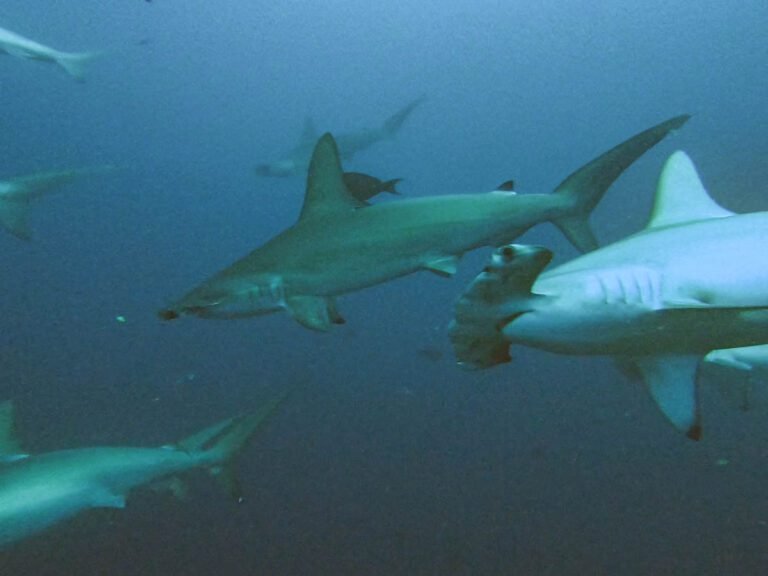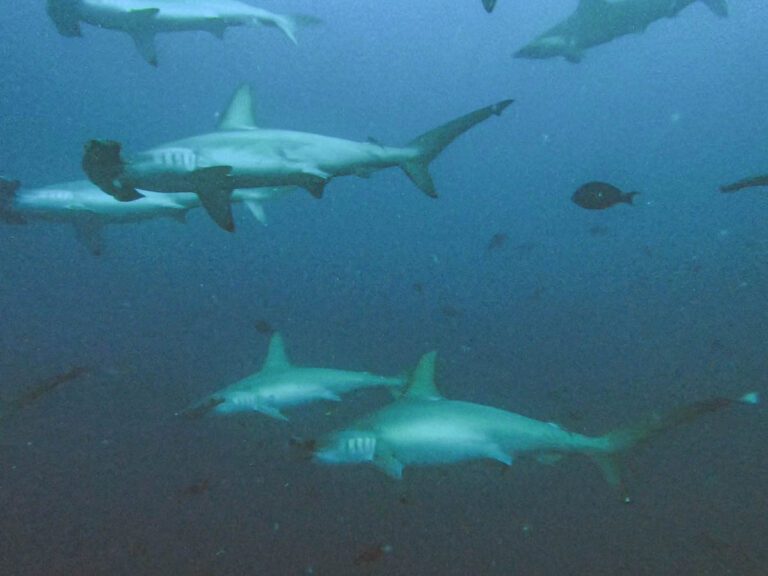
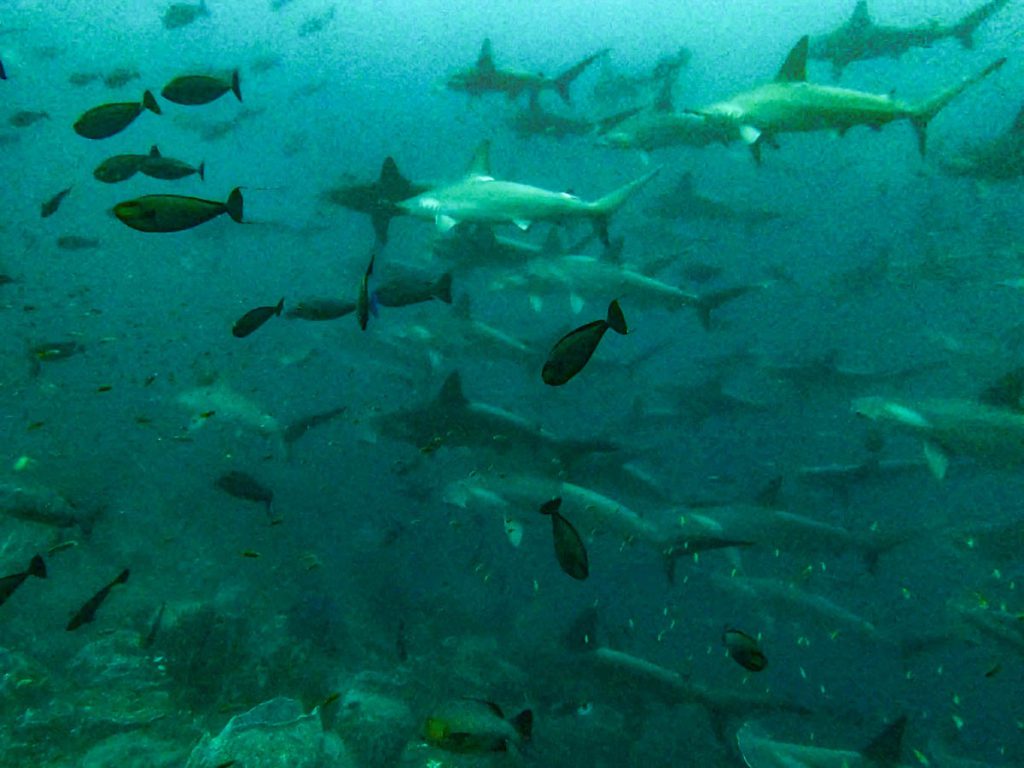
Few moments in a diving life beat coming across your first school of a hundred hammerheads cruising by. Mine came at Suanggi, a speck of rock in the middle of the Banda Sea: a shape at the edge of visibility, then another behind it, and then the whole blue filled with them. Up close they are huge, three to four meters long and all muscle, and the energy of a school sweeping past is contagious. It is still one of the most exciting things I have experienced underwater, and one I keep going back to repeat.
Hammerheads are also elusive. The first time I went to the Banda Sea in hammerhead season, I dived for ten days and did not see a single one. There is no guarantee with wild animals, but there are places and months that tip the odds firmly in your favor. This guide covers 19 places for hammerhead shark diving, from the five where I have dived with them, the Banda Sea, Cocos Island, the Galápagos, the Red Sea and the Maldives, to the ones still on my list, from Japan and South Africa to Hawaii and Papua New Guinea. For each, I tell you what the encounter is like, when to go, how experienced you need to be, whether I have dived it myself, and how to maximize your chances of meeting these giants.
Where can you see hammerhead sharks? For the biggest schools of scalloped hammerheads: the Banda Sea in Indonesia (September to November, peak October and November), Malpelo in Colombia (January to May), Cocos Island in Costa Rica (year-round, biggest schools June to November) and Darwin and Wolf in the Galápagos (all year).
Closer to Europe, Egypt’s Red Sea has small groups at Daedalus and Elphinstone from May to July. For great hammerheads, one big shark at a time, go to Bimini in the Bahamas or Rangiroa in French Polynesia from December to March. Japan (Mikomoto in summer, Yonaguni in winter), Protea Banks in South Africa, Molokai in Hawaii, Malapascua in the Philippines and the Maldives all have their own seasons, covered below.
Quick facts: hammerhead shark diving
- Species you will see: the scalloped hammerhead, in schools, at most sites; the great hammerhead, alone, at Bimini, Rangiroa, Jupiter and Protea Banks; the smooth hammerhead by snorkel in the Azores
- Biggest school I have seen: about 100 at Suanggi, Banda Sea
- Most hammerheads in a week: the Banda Sea, more than 200 in five schools
- Most consistent: Cocos Island, with hammerheads on all but one dive of a ten-night trip
- Latest count: 11 hammerheads on one dive at Jackpot, Suanggi, in October 2026
- Easiest to reach from Europe: the Red Sea, by liveaboard from Port Ghalib
- Level: Advanced Open Water at least; current, depth to 30 meters and blue-water dives
- Based on: six Banda Sea trips, including the Sea Safari 6 (late October), the Neomi (October), the Ilike’s Ambon to Sorong crossing (end of October 2019) and the Scubaspa Zen (November 2022 and October 2026); Red Sea Aggressor III in the Deep South (June 2021); Okeanos Aggressor II to Cocos Island (April); Galapagos Sky to Darwin and Wolf (March 2024); and the EcoPro Seascape in the Maldives (December 2025)
Where to Dive With Hammerhead Sharks: 19 Places on the Map
Hammerheads gather at a small number of seamounts, pinnacles and ocean passes around the tropics and subtropics. The map shows every destination in this guide; the orange pins are the places where I have dived with them, the blue pins are the places still on my list.
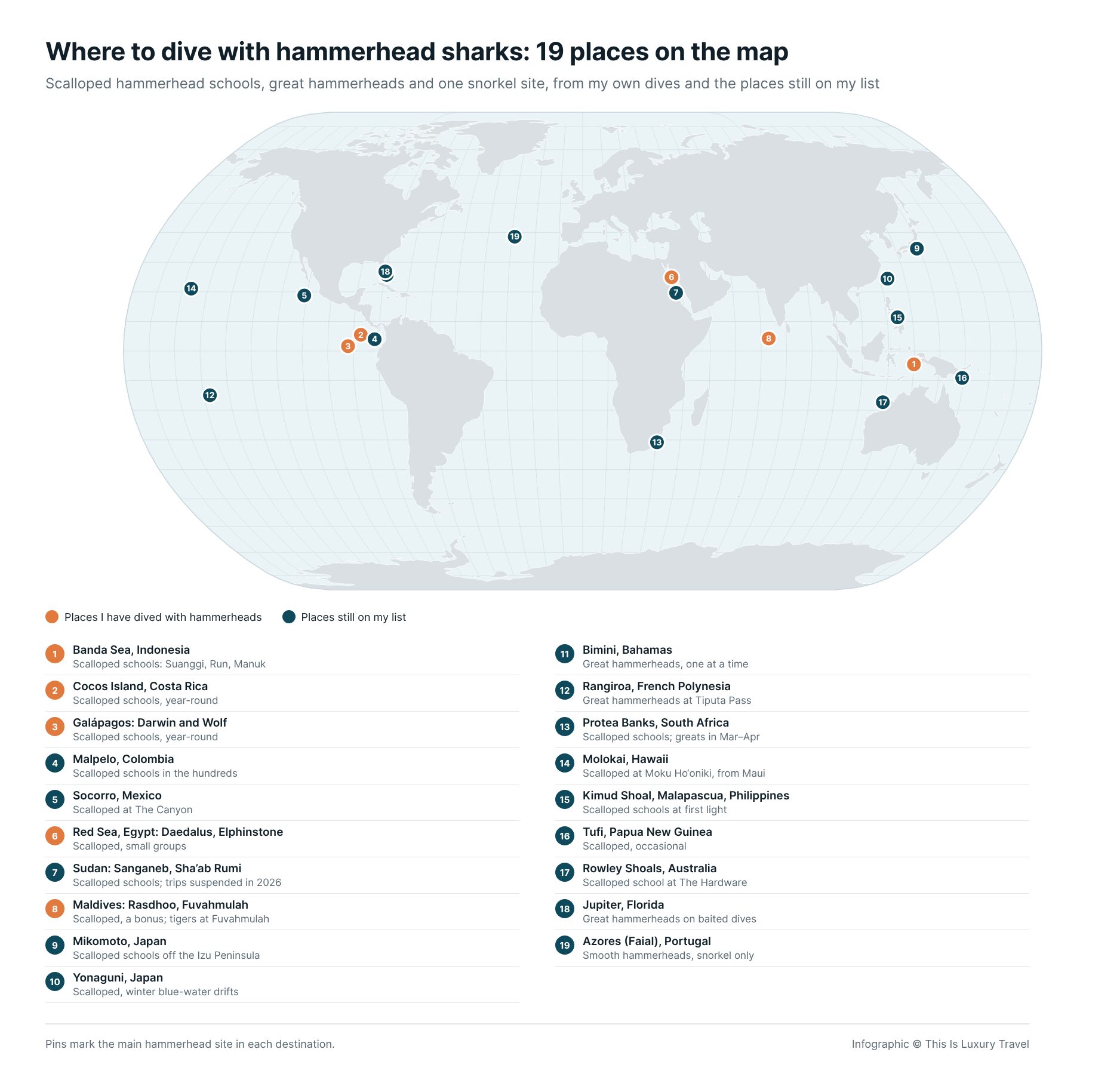
The 19 Hammerhead Destinations at a Glance
| Destination | Species | Best months | Access | Have I dived it? |
|---|---|---|---|---|
| 1. Banda Sea, Indonesia | Scalloped schools | Sep–Nov, peak Oct–Nov; also Mar–May | Liveaboard from Ambon | Yes, six trips: a school of about 100 and 200+ in a week |
| 2. Cocos Island, Costa Rica | Scalloped schools | Year-round; biggest schools Jun–Nov | Liveaboard from Puntarenas, 36 h | Yes: 70+ on day one, hammerheads on all but one dive |
| 3. Galápagos, Ecuador | Scalloped schools | Year-round | Liveaboard to Darwin and Wolf | Yes: schools of 25 and 30 |
| 4. Malpelo, Colombia | Scalloped schools in the hundreds | Jan–May | Liveaboard from Buenaventura, 30–40 h | Not yet |
| 5. Socorro, Mexico | Scalloped | Nov–Jun season | Liveaboard from Cabo San Lucas, 24–30 h | Not yet |
| 6. Red Sea, Egypt | Scalloped, small groups | May–Jul; season to Nov | Liveaboard from Port Ghalib; Elphinstone by day boat | Yes, seven Egypt trips: three at Daedalus, two at Elphinstone |
| 7. Sudan | Scalloped schools | Jan–Apr | Liveaboard from Port Sudan; trips suspended in 2026 | Not yet |
| 8. Maldives | Scalloped, a bonus | Dec–Apr at Rasdhoo; Oct–Apr at Fuvahmulah | Liveaboard, resort or local dive center | Yes, six cruises: one hammerhead |
| 9. Mikomoto, Japan | Scalloped schools | Jun–Oct, peak Jul–Sep | Day boat from Shimoda, 2.5 h from Tokyo | Not yet |
| 10. Yonaguni, Japan | Scalloped schools | Nov–May, best Dec–Mar | Day boat; flights from Ishigaki or Naha | Not yet |
| 11. Bimini, Bahamas | Great hammerheads | Dec–Apr, peak Jan–Mar | Day boat; 50 miles from Miami | Not yet |
| 12. Rangiroa, French Polynesia | Great hammerheads | Nov–Apr, peak Dec–Feb | Day boat from Rangiroa; liveaboard | Not yet |
| 13. Protea Banks, South Africa | Scalloped schools; greats | Late Oct–early May; greats Mar–Apr | Surf launch from Shelly Beach | Not yet |
| 14. Molokai, Hawaii | Scalloped schools | May–Oct | Day boat from Lahaina, Maui | Not yet |
| 15. Kimud Shoal, Philippines | Scalloped schools | Jan–Apr, peak Mar–Apr | Day boat from Malapascua | Not yet |
| 16. Tufi, Papua New Guinea | Scalloped, occasional | Apr–Nov | Resort; flight from Port Moresby | Not yet |
| 17. Rowley Shoals, Australia | Scalloped, occasional | Sep–Nov | Liveaboard from Broome | Not yet |
| 18. Jupiter, Florida | Great hammerheads | Mar–May, peak Apr | Day boat | Not yet |
| 19. Azores, Portugal | Smooth hammerheads, snorkel | Jul–Sep | RIB from Pico or Faial | Not yet |
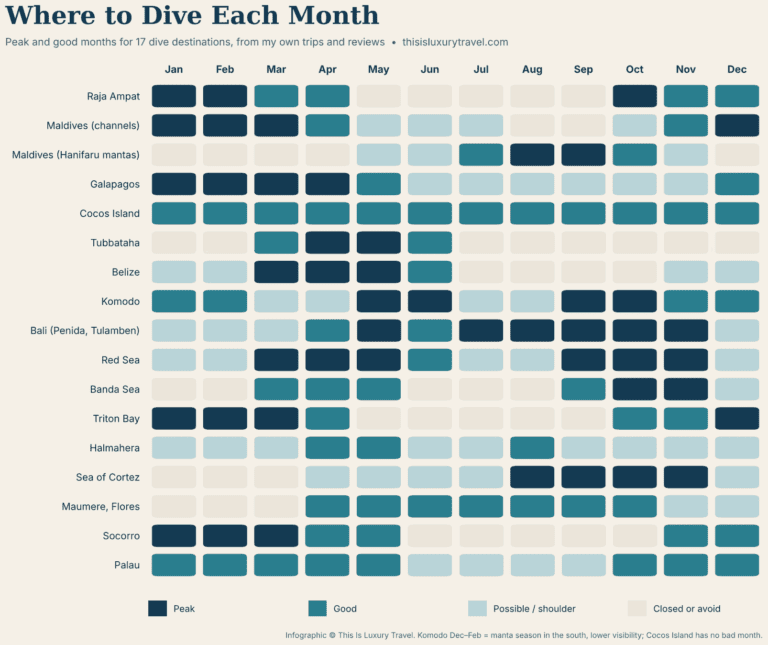
The infographic below shows the same seasons month by month, with the months I was there marked in orange.
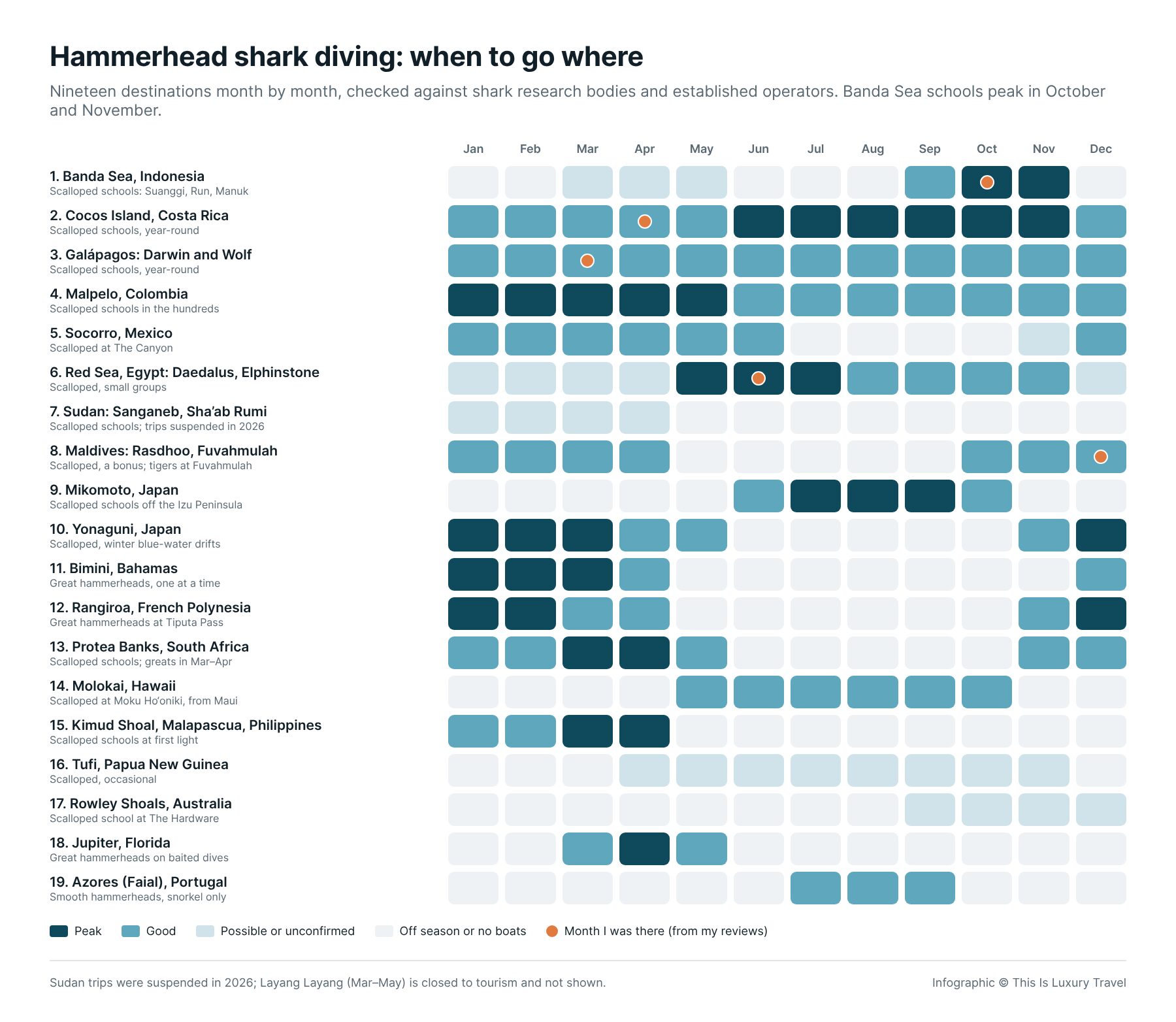
Where to See Hammerhead Sharks Month by Month
Each month lists the destinations in this guide that are in season, best first.
| Month | Where I would go for hammerheads |
|---|---|
| January | Malpelo, Galápagos, Cocos, Bimini and Rangiroa for great hammerheads, Yonaguni, Socorro, Kimud Shoal, the Maldives (dawn dives at Rasdhoo), Protea Banks |
| February | Malpelo, Galápagos, Cocos, Bimini, Rangiroa, Yonaguni, Socorro, Kimud Shoal, the Maldives, Protea Banks |
| March | Malpelo, Galápagos (where I saw schools of 25 and 30), Kimud Shoal at its peak, the Banda Sea’s shorter spring season, Cocos, Bimini, Yonaguni, Protea Banks (greats), Jupiter, the Maldives |
| April | Cocos Island (my trip), Malpelo, Kimud Shoal, Protea Banks, Jupiter at its peak, the Banda Sea, Galápagos, Socorro, the Maldives |
| May | The Red Sea at Daedalus (schools most reliable), Malpelo, the Banda Sea, Cocos, Socorro, Molokai, Jupiter, Galápagos |
| June | The Red Sea (my trip), Cocos as its bigger-school season begins, Galápagos, Mikomoto, Molokai |
| July | Cocos Island, Mikomoto at its peak, the Red Sea, Galápagos, Molokai, the Azores by snorkel |
| August | Cocos Island, Mikomoto, Galápagos, the Red Sea, Molokai, the Azores |
| September | The Banda Sea season opens, Cocos Island, Mikomoto, Galápagos, Molokai, the Azores, Rowley Shoals |
| October | The Banda Sea (peak: I counted more than 200 in one week, and 11 on a single dive in 2026), Cocos, Mikomoto, Galápagos, Molokai, the Maldives at Fuvahmulah, Rowley Shoals |
| November | The Banda Sea (still peak season), Cocos Island, Protea Banks, Galápagos, Rangiroa, Yonaguni, Socorro, the Maldives, Rowley Shoals |
| December | Galápagos, Cocos Island, Bimini and Rangiroa for great hammerheads, Yonaguni, Protea Banks, Socorro, the Maldives (my sighting at Fotteyo Kandu) |
Why Trust This Guide
I have been diving for more than 25 years, with more than 1,500 logged dives and over 40 liveaboard trips, and I review each boat in depth here on This is Luxury Travel. Every hammerhead encounter below comes from one of those first-hand reviews, linked in the section where it happened. I have made seven trips to Egypt’s Red Sea, I have dived Suanggi in the Banda Sea on six trips, most recently in October 2026, and the Galápagos is where I have seen more fish than anywhere else I have dived. I also tell you when the hammerheads did not show, because that happens too.
For the destinations I have not dived yet, I say so at the top of the section, and the seasons, depths and school sizes come from shark research bodies, national park rules and the operators who dive those sites every week. Where operators disagree about the best months, I tell you that as well.
Hammerheads are only one reason to plan a trip around the seasons. My ranking of the best dive destinations in the world puts these places in context, and my guides to the best places to dive with whale sharks and the best places to dive with manta rays cover the other big animals most divers chase. To line them all up by date, my diver’s calendar of where to dive each month puts the seasons side by side.
1. Banda Sea, Indonesia: the Biggest Schools
Have I dived it? Yes, six trips, most recently in October 2026. This is where I saw my first school of 100.
The Banda Sea is the hammerhead destination that taught me patience, and then rewarded it like nowhere else. It only works for a few weeks a year: liveaboards cross the sea from Ambon on their way between Komodo and Raja Ampat, and the hammerhead trips run in that window. When it works, nothing I have dived beats it.
Ten Days, Not a Single Hammerhead
My first Banda Sea trip was in hammerhead season, and I dived for ten days without seeing one. That is the honest starting point for anyone planning this trip: the sharks are wild, they follow the water temperature rather than the brochures, and some weeks they simply stay deep.
So I went back. At the end of October 2019, on the Ilike’s Ambon to Sorong crossing, my group saw two hammerheads at Run while I was looking the other way, and I finally met my first school, about ten of them, at Suanggi. On another October crossing, on the Neomi, we saw hammerheads every single day, in ones and twos and one school of ten, mostly between 25 and 33 meters. The strangest moment of that trip came at Run, where I watched a hammerhead being chased through the blue by a blue marlin.
Suanggi: the Week I Counted More Than 200
Then came the week every hammerhead diver dreams of. I sailed from Ambon to Suanggi, Banda Neira, Manuk and Nusa Laut on the Sea Safari 6 in late October. Suanggi is a tiny, uninhabited island in the middle of nowhere, ringed by five or six underwater ridges that start at about 15 meters and drop into walls.
Within five minutes of the first dive, a school of 30 hammerheads came past. On the second dive, about 100 surrounded us and started to circle, close enough to see the muscles working along their flanks. We dived Suanggi eight times that week and saw hammerheads on seven of them. On the very last dive, after the other boats had left, the visibility suddenly dropped, the water turned cold, and a school of 30 swam straight at us, some within touching distance. On the safety stop we spotted another 10 to 15 below and went back down. Five schools, more than 200 hammerheads, in one week.
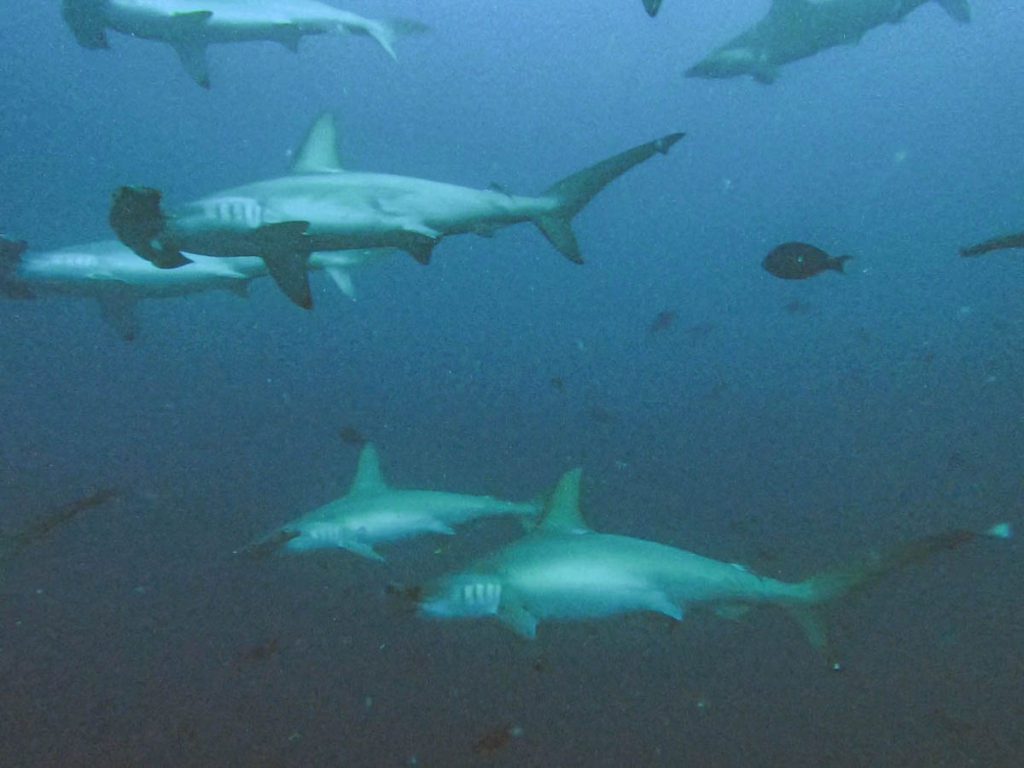
Suanggi in 2022 and 2026: Same Boat, Same Season, a Different Sea
I have crossed the Banda Sea twice on the Scubaspa Zen, four years apart, and the two visits to Suanggi could not have been more different. In November 2022, a poor year for hammerheads in the Banda Sea, the team scheduled a dawn dive so we were first in the water at 6 am, and we saw two hammerheads, far off at about 40 meters.
In October 2026 we did three dives there in one day. The first, on Suanggi Ridge, was empty of sharks. The second, on the wall, produced one. The third, on the Jackpot pinnacle, lived up to its name: eleven hammerheads in five separate encounters, in poor visibility, with the certainty that many more were out in the blue. Lunch was interrupted by dolphins, a bait ball and diving birds beside the boat.
Here is the video I filmed at Suanggi in October 2026:
The rest of the crossing shows how local the sharks are. At Nusa Laut, where hammerheads sometimes hang around the corner, I saw one at about 40 meters in 2022; in 2026 the divers went deep there and found none. Tanjung Buton on Hatta, where hammerheads pass at sunrise in season, gave us none on either trip, and a 6 am dive at Tanjung Rhun on Run in 2026 found none either. Suanggi is the best hammerhead site I know in Indonesia, and it is never guaranteed. The infographic below shows what each of my Banda Sea trips gave me.
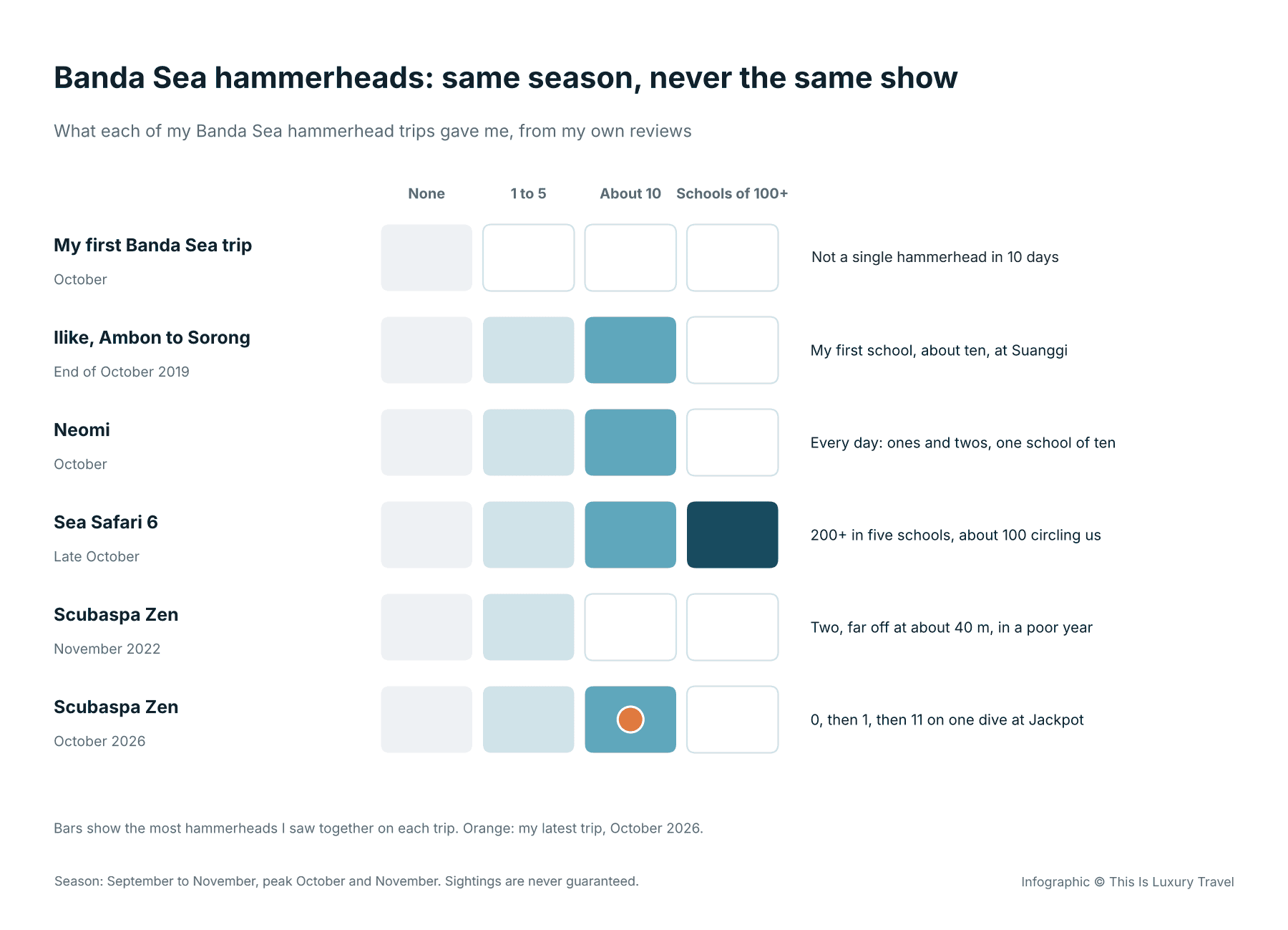
Further south, on the Ilike’s Forgotten Islands expedition from Saumlaki to Maumere, some of our group saw a group of hammerheads cruising past the deep wall at Terbang Selatan, and two more at Lembata.
When Is Hammerhead Season in the Banda Sea?
The main season runs from September to November, with October and November the peak months. Since 2015, annual aggregations of 10 to 200 scalloped hammerheads have been recorded around the southern Banda Sea islands in October and November. Some boats also see hammerheads on the reverse crossing, roughly March to May. Outside these windows, few or no boats make the trip. October and November trips sell out early, often a year ahead, so book the boat first and plan the flights after.
How to Maximize Your Chances in the Banda Sea
Pick an itinerary with several dives at Suanggi rather than one: on my best week we dived it eight times. Ask for dawn dives too: on both my Scubaspa Zen crossings the team scheduled 6 am dives at the hammerhead sites, and at the popular Banda sites we were regularly the first group in the water. Choose a boat with guides who are good at spotting sharks in the blue; on the Sea Safari 6 and the Neomi, that made the difference. And be ready to go deep: I have consistently seen the hammerheads at 20 to 35 meters (see nitrox or air below).
Getting there means a domestic flight to Ambon; Indonesian airline websites often reject foreign cards, so I book through Trip.com, which sells all the domestic carriers. You can also check dates for the boats I have sailed: the Sea Safari 6, the Neomi, the Ilike and the Scubaspa Zen. The Neomi, the Ilike and the Scubaspa Zen are also on Divebooker.
👉 Check Banda Sea liveaboard prices and availability (October 2027 departures): on Liveaboard.com | on Divebooker
Prices for the same liveaboard trip can vary significantly between websites, so it pays to compare both Liveaboard.com and Divebooker before you book: their promotions sometimes differ, and the better deal for your dates can be on either site. Divebooker adds free DAN dive insurance on request and a loyalty credit worth up to 10% on your next trip. I have written a guide on how to find the best price for your liveaboard cruise: read it here.
2. Cocos Island, Costa Rica: Hammerheads on Almost Every Dive
Have I dived it? Yes, ten nights on the Okeanos Aggressor II in April.
If the Banda Sea is a gamble with a jackpot, Cocos is the safe bet. It sits more than 500 kilometers off the Pacific coast of Costa Rica, and the only way there is a liveaboard from Puntarenas; the crossing home alone took us 36 hours. I went in April on the Okeanos Aggressor II, a ten-night trip I rated 5 out of 5, and the hammerheads were there from the very first minutes.
On the check dive in Chatham Bay, six appeared within five minutes and stayed for about ten. By the end of that first day, around Manuelita, I think we had seen more than 70. And it never really stopped. At Alcyone, a school of thousands of jacks closed in around us while 20 or 30 hammerheads cruised past behind them. At Dirty Rock we finished in the blue surrounded by more than 30. At Manuelita Deep they came in small groups and in groups of 20, and two came close enough for me to see their teeth.
Only one dive of the whole trip produced no hammerhead at all.
The water was 28 to 29°C, with thermoclines down to 21°C: you do not need cold water and 40 meters to see them here.
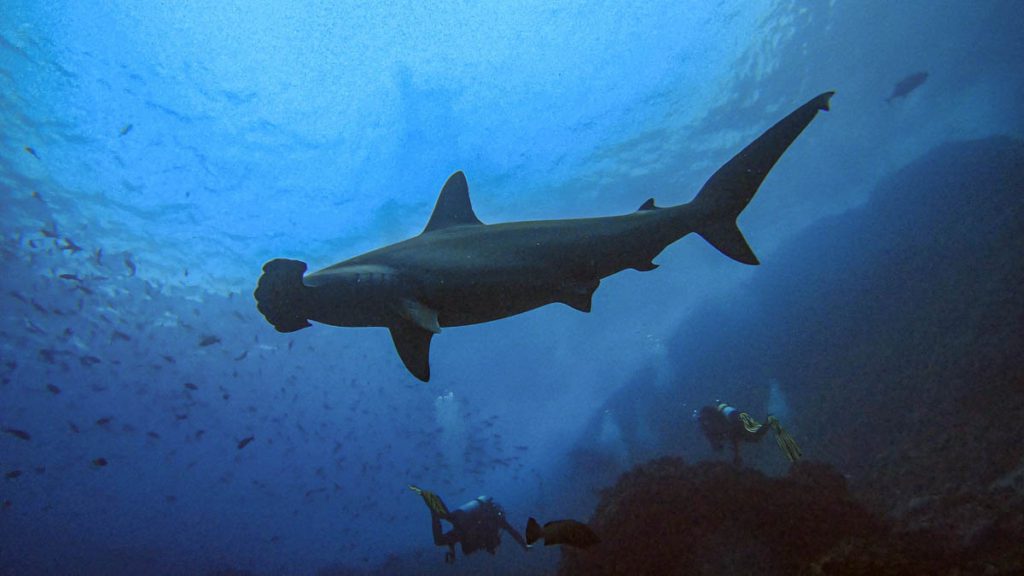
When to go: hammerheads are at Cocos all year. The wet season, from June to November, brings cooler, nutrient-rich water and the largest schools (one operator logged more than 300 at Bajo Alcyone in August 2024), along with rougher crossings and lower visibility. The dry season, from December to May, means calmer seas and clearer water. My April trip, at the turn into the rains, brought plenty of rain and plenty of hammerheads. You can also check dates for the Okeanos Aggressor II on Liveaboard.com or Divebooker.
👉 Check Cocos Island liveaboard prices and availability: on Liveaboard.com | on Divebooker
3. Galápagos, Ecuador: Darwin and Wolf
Have I dived it? Yes, on the Galapagos Sky in March 2024, after a week on Ecoventura’s yachts.
The Galápagos made me wait, and then gave me hammerheads with everything else thrown in. Darwin and Wolf, two small uninhabited islands at the northern edge of the archipelago, sit on the route scalloped hammerheads travel between the Galápagos and Cocos. I dived them in March 2024 on the Galapagos Sky, after a week above water on Ecoventura’s Origin, Theory and Evolve yachts, where the hammerheads stayed out of sight on our snorkel at North Seymour.
The first proper dive, at Bartolomé in the central islands, brought four hammerheads that kept coming back for the schooling fish. Then we sailed north overnight. Because of the park’s permit system, our boat was the only one at every site we dived. At Darwin Arch, on the rocky platforms beneath what remains of the arch, the first hammerhead swam past within one minute of the first dive. They stayed with us over all four dives, including a school of about 25, alongside Galápagos sharks, an eagle ray and the biggest tuna I have ever seen.
Wolf tested our patience. We did four dives in Shark Bay, and the hammerheads kept appearing in the distance, never quite committing. It took until the end of the third dive for the moment we had been waiting for: a school of about 30 swimming straight towards us.

When to go: the hammerheads school at Darwin and Wolf all year. Operators disagree on which season brings the biggest schools: some point to the cool, nutrient-rich months from June to November, others to the warmer season from December to May, and tagging research found the sharks stayed longer at the northern islands between December and February.
I saw schools of 25 and 30 in March, so I would not plan around it; choose by water temperature and whale sharks instead, which my Galápagos diving guide sets out month by month. If you are not on a liveaboard, Gordon Rocks off Santa Cruz is the best-known day dive for hammerheads. You can also check dates for the Galapagos Sky on Liveaboard.com or Divebooker.
👉 Check Galápagos liveaboard prices and availability: on Liveaboard.com | on Divebooker
4. Malpelo, Colombia: Schools in the Hundreds
Have I dived it? Not yet. It is at the top of my list, for the same reason it tops most divers’ lists.
Malpelo is a bare rock 500 kilometers off Colombia’s Pacific coast, a UNESCO World Heritage site since 2006, and the third point of the hammerhead triangle with Cocos and the Galápagos. The sharks move between all three, and Malpelo is where divers report the biggest schools, in the hundreds, at sites such as La Nevera, La Gringa, El Sahara and El Bajón, mostly between 18 and 40 meters. Expect the same recipe as Cocos: deep, blue, current-swept pinnacles, with silky sharks and Galápagos sharks for company.
Access is what keeps the number of divers down. Only Colombian liveaboards may visit, only one boat is allowed in the park at a time, with a maximum of 25 guests in groups of no more than six, and the trip starts in Buenaventura, about three hours by road from Cali, with a crossing of 30 to 40 hours each way. Trips run about nine nights. Boats ask for Advanced Open Water and nitrox, and a 7 mm suit is standard: the water can be surprisingly cold.
When to go: most operators and guides put the biggest schools in the dry season, from January to May, when cooler water brings the sharks up, though visibility can drop to about 10 meters. One operator argues for July to December, with the largest schools in December. Hammerheads are present all year; I would go between January and May.
5. Socorro and the Revillagigedo Islands, Mexico
Have I dived it? Not yet. Socorro is on my list for the giant mantas as much as the hammerheads.
The Revillagigedo Islands, usually called Socorro, lie 400 kilometers south-west of the tip of Baja California, and are best known for giant oceanic mantas that come to play with divers. Scalloped hammerheads are part of the package: The Canyon, off San Benedicto, is the hammerhead site, where schools pass the cleaning station at the edge of the deep, often beyond 30 meters, with silky and Galápagos sharks closer in. Roca Partida, the other famous site, is more about whitetips stacked in the ledges and whatever swims past in the blue.
Liveaboards leave from Cabo San Lucas and take 24 to 30 hours to reach the islands; most ask for Advanced Open Water and around 50 dives, and the national park charges a fee. Trips run eight to ten nights.
When to go: the season runs from November to June, when the boats sail. For hammerheads, operators disagree: some say January to March, when the water is coolest; others April to June, when the water warms and the hammerheads school more reliably at The Canyon. Humpback whales sing through the dives from January to March.
👉 Check Socorro liveaboard prices and availability: on Liveaboard.com | on Divebooker
6. The Red Sea, Egypt: Daedalus and Elphinstone
Have I dived it? Yes, seven Egypt trips; the hammerheads came on the Red Sea Aggressor III in June 2021.
The Red Sea will not give you hundreds of hammerheads, but it is the closest of these destinations to Europe and the cheapest, and the schools come within diving depth for a short window each year. I dived Daedalus and Elphinstone in June 2021 on the Red Sea Aggressor III, on a Deep South itinerary from Port Ghalib.
Daedalus is an isolated reef about 90 kilometers offshore with a lighthouse at its center, reachable only by liveaboard. Our first dive there brought a family of four dolphins rather than sharks, and the second nothing at all. The third was the lucky one: three hammerheads, one of which swam around us for more than five minutes.
The best moment came on the last morning, at Elphinstone off Marsa Alam. Two hammerheads joined a Napoleon wrasse and giant trevally that were hunting on the plateau. They were frantic, nothing like the slow, cruising schools of the Banda Sea, and one came straight at me before turning away.
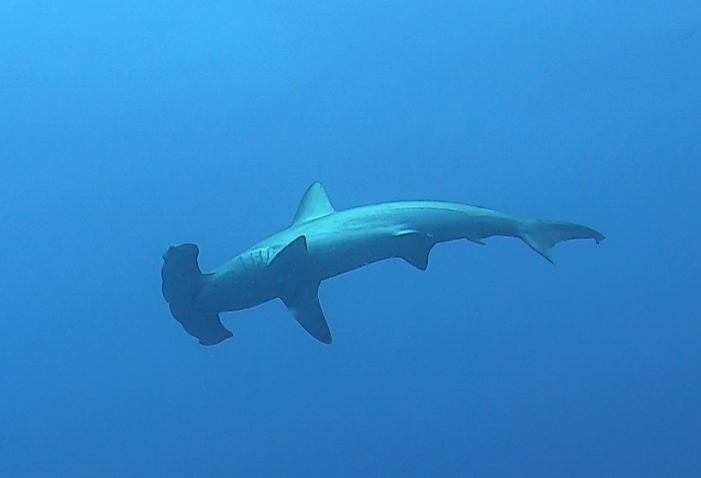
When to go: scalloped hammerheads gather at Daedalus in the northern summer, usually in groups of up to about ten. Operators point to May and early June as the most reliable months for schools, when the thermocline brings them up into recreational depths, with sightings continuing through the summer and into autumn. The Brothers add great hammerheads in the deep from about September to November, and hammerheads can turn up at Elphinstone through the summer too.
Egyptian law requires at least 50 logged dives and an SMB for the offshore marine parks. My Red Sea diving guide covers all seven of my Egypt trips, and the oceanic whitetip season that follows in autumn. You can also check dates for the Red Sea Aggressor III.
👉 Check Red Sea liveaboard prices and availability: on Liveaboard.com | on Divebooker
7. Sudan: Sanganeb and Sha’ab Rumi
Have I dived it? Not yet, and not possible for now: liveaboard trips have been suspended because of the conflict.
Sudan’s Red Sea is the wilder, emptier sister of Egypt’s, with the same offshore reefs and far fewer boats. Sanganeb, with its lighthouse, and Sha’ab Rumi, where Jacques Cousteau built his Precontinent II underwater village in 1963, both have south plateaus where scalloped hammerheads school in the cooler months, usually between 20 and 40 meters, and the remote southern reef of Dahrat Abid has produced schools of more than 100. Trips sailed from Port Sudan and asked for about 50 logged dives.
When to go: the hammerhead season runs from about November to April, with January to April the most reliable months. In 2026, operators were not running Sudan trips and government travel advice warned against travel, so treat this as a destination to watch rather than book.
8. The Maldives: a Bonus, Not a Banker
Have I dived it? Yes, six liveaboard cruises: one hammerhead, at Fotteyo Kandu in December 2025.
I have dived the Maldives on six liveaboard cruises, and the first five gave me mantas and reef sharks, but never a hammerhead. The sixth changed that. On my ten-day EcoPro Seascape cruise in December 2025, we hung in the blue at Fotteyo Kandu in Vaavu Atoll for twenty minutes, staring into nothing, until a single hammerhead glided past.
That is the honest picture: the Maldives is not a hammerhead destination in the way the Banda Sea or Cocos are, but two places tip the odds.
- Rasdhoo Atoll, Hammerhead Point (Madivaru). The classic Maldives hammerhead dive, done at dawn in the blue at about 25 to 40 meters, in strong current. The best months are roughly December to April, especially January to March.
- Fuvahmulah, in the deep south. A single-island atoll with local dive centers, best known for tiger sharks, which are seen there all year. Scalloped hammerheads turn up seasonally, roughly October to April, on deep dives with strong current, and great hammerheads are occasionally seen at the deeper sites. Some deep-south liveaboards also call there.
I have not dived either site yet. On the question I am asked most, whether Fuvahmulah has more hammerheads than the central atolls, I found no reliable count either way: it is famous for its tiger sharks, and its hammerheads are a seasonal bonus there too. My Maldives diving guide covers the channels and seasons. You can also check dates for the EcoPro Seascape on Liveaboard.com or Divebooker.
👉 Check Maldives liveaboard prices and availability: on Liveaboard.com | on Divebooker
9. Mikomoto Island, Japan: the Hammerhead River
Have I dived it? Not yet. It is the hammerhead site I most want to add, because it is a day trip from Tokyo.
Japan is the hammerhead destination most guides forget, and Mikomoto is its star. The island sits off the southern tip of the Izu Peninsula, about two and a half hours from Tokyo by express train to Shimoda and then a short boat ride. From early summer to autumn, scalloped hammerheads school over the current-swept ridges, and the local operators call the procession the “hammerhead river”: dozens on a normal day, hundreds on a good one. Kame-ne, at about 25 meters, is the main hammerhead site, with Enokuchi and the deeper Zabu-ne and Mitsu-ne ridges as alternatives.
These are open-ocean drift dives with no lines and sometimes strong current, and the operators are strict: at least 30 logged dives and a dive in the last year, your own SMB and computer, a 35-minute limit and a turn at 70 bar.
When to go: June to October, with July to September the peak. For a second Japanese hammerhead dive close to Tokyo, Izu Ōshima, a short ferry ride from the capital, has an early-morning shore dive at Keikai where groups of hammerheads, sometimes up to 100, pass in the shallows from about July to October.
10. Yonaguni, Japan: Winter Hammerheads at the Edge of the Map
Have I dived it? Not yet.
Yonaguni is the westernmost island of Japan, closer to Taiwan than to Okinawa, and famous for its mysterious underwater “monument”. For divers it has a second claim: in winter, scalloped hammerheads gather off Irizaki, the island’s western point, ten minutes by boat from Kubura port. The dives are blue-water drifts at 15 to 20 meters, occasionally deeper, watching the schools form below; on good days photographers have counted more than 100. Flights come from Ishigaki (35 minutes, several a day) or Naha (an hour and a half, one a day).
When to go: November to May, with December to March the best months, when the schools are most reliable. Visibility is often excellent, but the winter weather can cancel boats, so give yourself several days. Further north in the Okinawa chain, Kume Island’s Tombara site also sees hammerheads in winter.
11. Bimini, Bahamas: Great Hammerheads, One at a Time
Have I dived it? Not yet. It is a different kind of dive, and the one I would do to meet a great hammerhead.
Everything so far has been about scalloped hammerheads in schools. Bimini is the opposite: great hammerheads, the giants of the family at four to six meters, met one or two at a time on the sand off South Bimini, in about six meters of water, 50 miles east of Miami. The dives are baited and run by local operators, so the sharks come close and stay, sweeping the sand with that enormous head while divers kneel in a line. Nurse sharks and bull sharks often join in, and the water is clear and shallow enough for long bottom times. Tiger Beach, off Grand Bahama, is the sister dive for tiger sharks, with the occasional great hammerhead.
When to go: December to mid-April, with January to March the peak, when the great hammerheads gather in Bimini’s cooler winter water. It is a land-based trip by day boat, open to any certified diver who is comfortable kneeling still on the sand while a five-meter shark passes within arm’s reach.
To compare Bahamas liveaboards and prices, check here.
12. Rangiroa, French Polynesia: Great Hammerheads in Tiputa Pass
Have I dived it? Not yet.
Rangiroa’s Tiputa Pass is best known for its dolphins and for the wall of gray reef sharks on the incoming tide, but in the southern summer it is also one of the most reliable places on earth to see a great hammerhead in open water. Researchers who photo-identified more than 100 individuals here, and had the pass declared an Important Shark and Ray Area, found them on about two thirds of research dives, usually one to a handful at a time, patrolling the outside of the pass between about 15 and 45 meters. Unlike Bimini, there is no bait: you drift the pass and watch the blue. Fakarava’s Garuae Pass, a short hop away, sees them too.
When to go: November to April, with December to February the peak and more sightings around the full moon. Rangiroa is dived from land, with several dive centers on the atoll, and a few liveaboards cruise the Tuamotus.
To compare French Polynesia liveaboards and prices, check here.
13. Protea Banks, South Africa: Scalloped Schools and Great Hammerheads
Have I dived it? Not yet.
Protea Banks is a reef on the edge of the continental shelf off Shelly Beach, on KwaZulu-Natal’s south coast, and one of the few places where scalloped hammerhead schools and great hammerheads share the same water. The Southern Pinnacles, at around 30 meters, is where the scalloped schools gather, sometimes in the hundreds; great hammerheads pass through in the austral autumn, and bull sharks, tiger sharks and, in winter, ragged-tooth sharks make it one of the best all-round shark dives anywhere. It is serious diving: a surf launch through the breakers, the Agulhas Current running at up to eight kilometers an hour, and deep, fast drifts for advanced divers. Across the border, Mozambique’s Ponta do Ouro and Zavora see scalloped hammerheads in the same season.
When to go: operators give different windows, but the scalloped schools are reported from about late October to early May, with great hammerheads most likely in March and April. The sardine run, from about June to July, is a different spectacle, with sharks of many species following the bait.
14. Molokai, Hawaii: Hammerheads Off Maui
Have I dived it? Not yet.
Hawaii is not on most hammerhead lists, but Moku Ho’oniki Rock, off the eastern tip of Molokai, has a well-kept secret: scalloped hammerheads school over its “Fish Rain” and “Fish Bowl” reef sections at 12 to 30 meters in summer, with divers counting anything from a handful to more than 100 on a good day. The dive is reached by boat from Maui, with operators sailing from Mala Ramp in Lahaina across the Pailolo Channel, a crossing of about 45 minutes that can be rough. Operators ask for Advanced Open Water and around 25 dives, and the site is also a regular for gray reef sharks and eagle rays. Check that the trip is running before you book flights: at the time of writing, at least one Maui operator listed it as unavailable.
When to go: May to October, when the channel is calmest; local divers say the hammerheads are either there in numbers or not at all.
15. Kimud Shoal, Malapascua, Philippines
Have I dived it? Not yet. Malapascua is on my list for the threshers as much as the hammerheads.
Malapascua is famous for thresher sharks at Monad Shoal, but 45 minutes further out, Kimud Shoal is a hammerhead site. Scalloped hammerheads school over the seamount at first light, with divers dropping from the shoal’s top at about 10 meters down to 30 and watching the blue beyond, where the wall falls away to more than 200 meters. Numbers build through the season, with schools reported to reach 200 by late March and April. It is an early start, an open-water descent and a deep wait, so advanced certification is sensible even if operators do not insist on it.
When to go: January to April, with March and April the peak.
👉 Check Malapascua liveaboard prices and availability: on Liveaboard.com | on Divebooker
16. Tufi, Papua New Guinea
Have I dived it? Not yet.
Papua New Guinea’s fjords at Tufi, on the north coast, reach the open ocean on plankton-rich currents, and the offshore reefs, Veale’s Reef and Cyclone Reef among them, are where hammerheads turn up: a resident albino hammerhead has been reported on Veale’s, and groups of two or three on Cyclone Reef, about 30 minutes by boat from the resort. Milne Bay, further south-east, has the deep walls and currents hammerheads like, and liveaboards cruise it in the southern summer. In honesty, PNG is a hammerheads-possible destination rather than a hammerheads-likely one, and you go for the reefs, the muck diving and the wrecks first. Access is by Twin Otter from Port Moresby.
When to go: Tufi dives from about April to November; Milne Bay liveaboards run from about October to March.
To compare Papua New Guinea liveaboards and prices, check here.
17. Rowley Shoals, Australia
Have I dived it? Not yet.
Rowley Shoals are three coral atolls, Mermaid, Clerke and Imperieuse reefs, about 260 kilometers off Broome in Western Australia, a day’s sail away and dived by only a handful of liveaboards in a short season. At a site called The Hardware, the crew of the True North reported a school of more than 100 scalloped hammerheads on their first dive there in 2002, and hammerheads on every visit in the seasons that followed. That report is now more than 20 years old, and recent liveaboard reviews describe hammerheads at the Shoals as occasional, so ask the boat about recent sightings before booking for the sharks alone. The atolls also offer some of the clearest water and healthiest coral in Australia, drift dives through the lagoon channels on the tide, and almost no other boats.
When to go: the liveaboard season runs from about September to November, with a few departures into early December, when the weather window opens before the cyclone season. There are only a few boats and few departures, so book about a year ahead. Fly to Broome via Perth (Qantas or Virgin) or Darwin (Airnorth).
To compare Rowley Shoals liveaboards and prices, check here.
18. Jupiter, Florida: Great Hammerheads in Spring
Have I dived it? Not yet.
Jupiter, an hour north of Miami, runs baited shark dives in the Gulf Stream all year, with lemon, bull, silky and tiger sharks, and in spring the great hammerheads join them, drawn by the migrating blacktips along the beaches. The dives drift in about 20 to 30 meters of water over sites such as Hammer Beach, and unlike Bimini the sharks are in open water rather than on the sand. Scalloped hammerheads pass the deeper ledges in summer.
When to go: March to May, with April the peak month for great hammerheads.
19. The Azores, Portugal: Smooth Hammerheads by Snorkel
Have I dived it? Not yet.
The one place on this list where you leave the tanks behind. In summer, juvenile smooth hammerheads gather in the shallows below the northern cliffs of Faial, and operators run RIB trips from Pico and Faial to snorkel with them at the surface, where 20 or more fins can break the water at once. It is cool-water Atlantic snorkelling in a thick suit, and the sharks are small, but it is the easiest hammerhead encounter in Europe. The Azores are better known to divers for the mobula rays at Princess Alice Bank and the blue sharks offshore.
When to go: July to September.
To compare Azores liveaboards and prices, check here.
A note on two names you will see elsewhere. Layang Layang, a Malaysian atoll in the South China Sea whose scalloped hammerheads gather from March to May, was closed to tourism at the time of writing with no reopening date. And El Bajo, the seamount off La Paz in Mexico’s Sea of Cortez that was once the world’s most famous hammerhead dive, has lost its schools: divers’ records show numbers falling from around 150 per dive in the 1970s to about five in the 2010s. Both are reminders that hammerhead sites are fragile.
Which Hammerheads Do Divers See? Scalloped, Great and Smooth
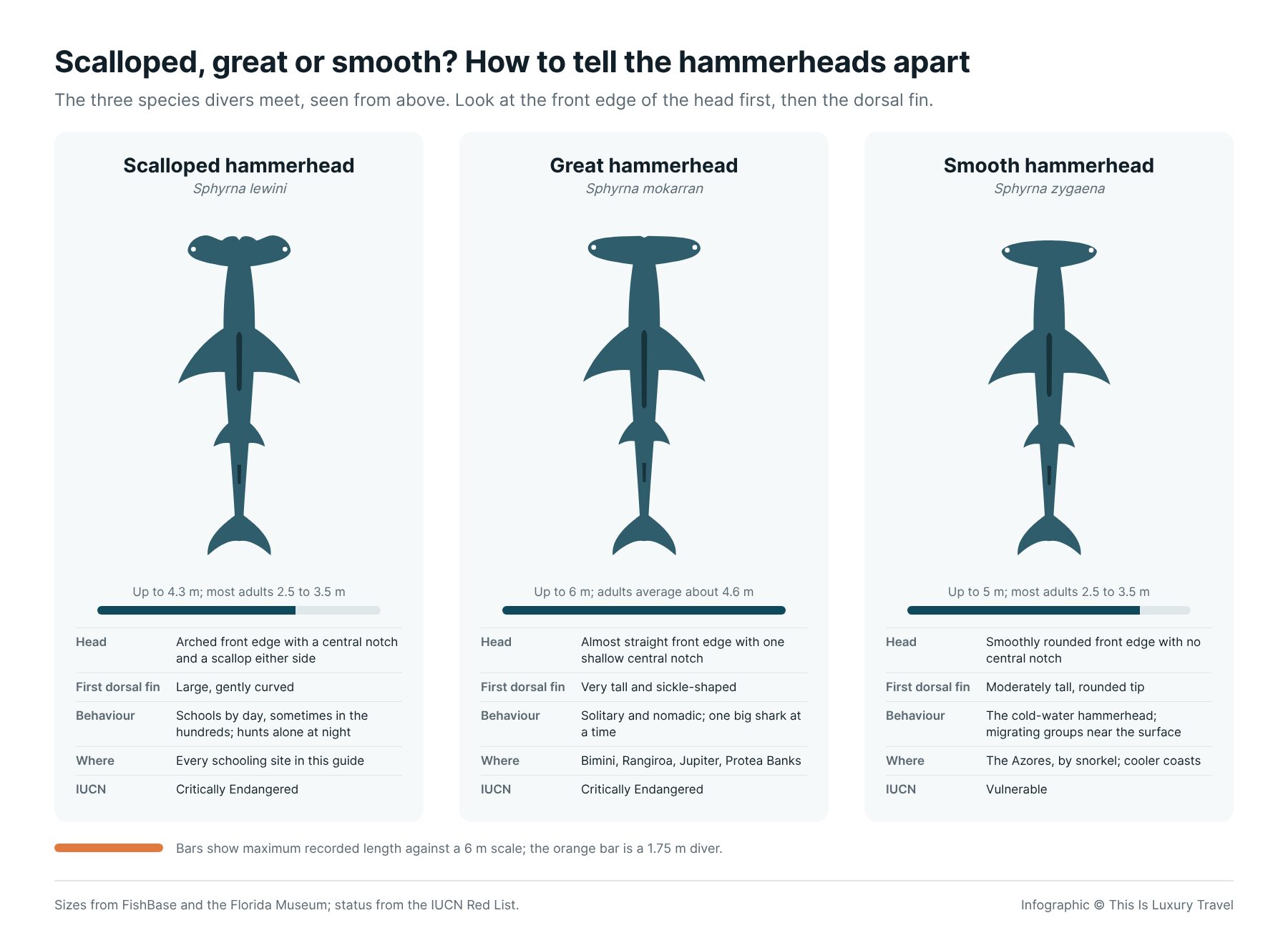
There are nine hammerhead species, but three matter to divers, and the front edge of the head tells them apart.
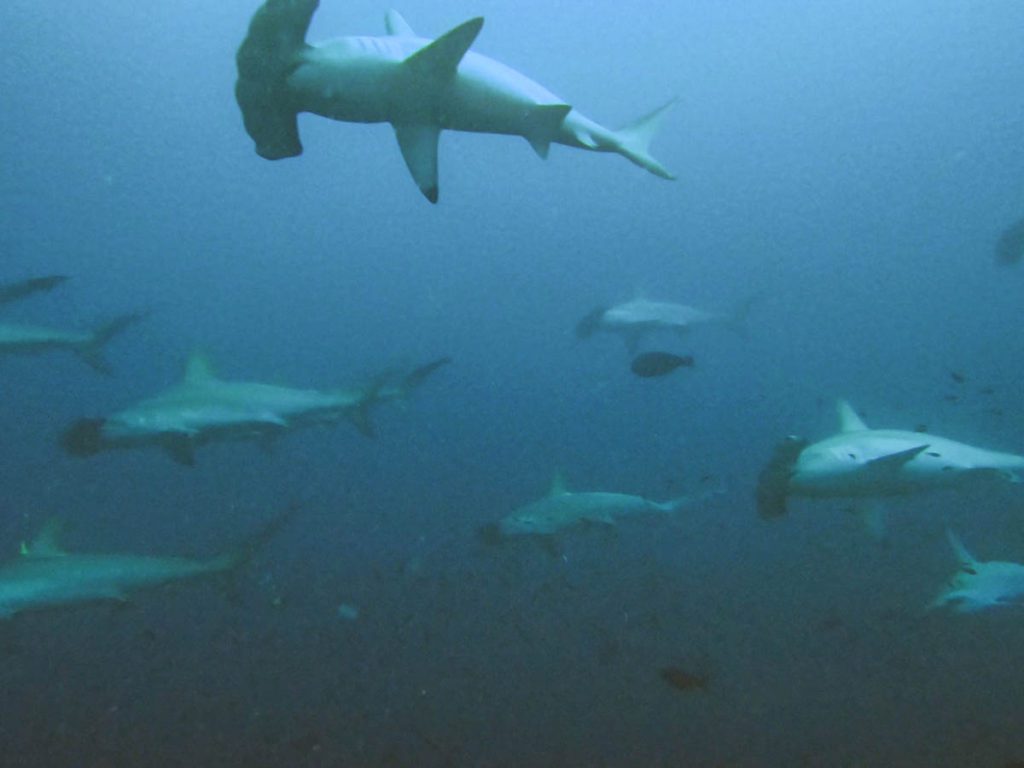
- Scalloped hammerhead (Sphyrna lewini). The schooling species, and the one at most sites in this guide. The front edge of the head is arched, with a notch in the center and a scallop either side. It gathers in the daytime around seamounts, pinnacles and offshore islands, sometimes in groups of hundreds. Females mature at about 2.5 meters, and the largest recorded reach 4.3 meters, according to the Florida Museum species profile. It is assessed as Critically Endangered.
- Great hammerhead (Sphyrna mokarran). The largest of the family, usually seen alone rather than in schools. Adults average about 4.6 meters and can reach 6 meters, and you can tell them by the almost straight front edge of the head, with a single shallow notch, and a very tall, sickle-shaped first dorsal fin. Bimini, Rangiroa, Jupiter and Protea Banks are the places to meet one. Also Critically Endangered.
- Smooth hammerhead (Sphyrna zygaena). The cold-water hammerhead, with a smoothly rounded head and no central notch, more often seen near the surface on cooler coasts, from the Azores to South Africa. Up to 5 meters, and assessed as Vulnerable.
What Is the Hammer For?
The flattened head, called a cephalofoil, is packed with sensors. Shark researchers rank its likely jobs in this order: spreading out the electro-sensitive pores that detect the weak electrical fields of prey hidden in the sand, spacing the nostrils wide apart so the shark can smell in stereo, helping it steer, and adding lift. It also explains the head-swinging you see in a passing school: the sharks are sweeping the water with their senses.
Why Are Scalloped Hammerheads Endangered?
Their fins are among the most valuable in the trade. A study cited in the 2013 CITES listing proposal estimated that 1.3 to 2.7 million scalloped and smooth hammerheads were killed for their fins each year. Declines of more than 80 per cent have been documented in several regions, including 98 per cent in one north-west Atlantic data set between 1972 and 2003, and the collapse at El Bajo in Mexico happened within a diver’s lifetime. A female has a litter of about 12 to 41 pups, but in some populations she does not mature until 15 years old. Scalloped, great and smooth hammerheads have been on CITES Appendix II since September 2014, which means their fins can only be traded legally with export permits, and the IUCN now lists both the scalloped and the great hammerhead as Critically Endangered.
Alive, they are worth far more than their fins. A study by National Geographic’s Pristine Seas project and the University of California, Santa Barbara calculated that each shark in the Galápagos is worth about US$5.4 million to tourism over its lifetime, against about US$200 for a dead one sold by fishermen. Every diver who pays to see a school is part of that argument, and so is choosing operators that do not touch, feed or crowd the sharks at schooling sites.
Why Do Hammerhead Sharks School?
Scalloped hammerheads school by day and hunt by night. Research led by Peter Klimley found that the daytime schools over seamounts are busy social groups, with sharks using a range of body movements to compete for position, and that at dusk they break up and head out to feed in deeper, open water, navigating back to the same seamount by following patterns in the Earth’s magnetic field. Tagging in the Galápagos found the same daily rhythm: schools at fixed sites during the day, dispersal at night. For divers, that means two things. Hammerhead dives are daytime dives, and they happen at the same few pinnacles and seamounts, which is why the sites in this guide are so famous.
Temperature matters too. In the Banda Sea, the moment the water turned noticeably colder at Suanggi on my last dive of the Sea Safari 6 trip, a school of 30 appeared. Cooler upwelling water seems to bring the hammerheads up into diving depths, which is why so many of the seasons above follow the cool season.
Do You Need to Be an Advanced Diver to See Hammerheads?
In practice, yes. Hammerhead shark diving at the schooling sites is not for beginners, and most liveaboards ask for Advanced Open Water and a good number of logged dives; the Galapagos Sky recommended 50 to 100, Egypt requires at least 50 for the offshore marine parks, and Mikomoto in Japan asks for 30. The exceptions are the shallow great hammerhead dives at Bimini and the snorkel in the Azores. What you need to be comfortable with:
- Depth. I have seen most hammerheads between 20 and 35 meters, so you will be watching your no-decompression limit closely, especially in the Banda Sea.
- Current and surge. At Cocos we aborted one dive because of the current; at Darwin and Wolf you spend much of the dive tucked behind boulders; Protea Banks and Mikomoto are fast drifts.
- Negative entries and blue water. At Suanggi you need to drop straight down to find the ridge where the big animals gather, and many safety stops are done hanging in open water.
Nitrox or Air for Hammerhead Shark Diving?
For most divers, nitrox. Hammerhead dives are deep, repetitive dives: on a liveaboard you might do three or four a day at 20 to 35 meters, several days in a row. Nitrox, air with extra oxygen, means less nitrogen in your body on each of those dives, so you get noticeably longer no-decompression time at 25 to 30 meters and shorter surface intervals. When a school appears ten minutes before your computer wants you to go up, those extra minutes are what you are paying for.
The trade-off is depth. The more oxygen in the mix, the shallower your maximum operating depth, and hammerheads do not always stay inside it.
| Gas | Maximum depth (at a ppO2 of 1.4) | Best for |
|---|---|---|
| Nitrox 32 | About 34 meters | Most hammerhead dives: Cocos, Darwin and Wolf, Daedalus, and the Banda ridges at 20 to 30 meters |
| Nitrox 28 | 40 meters | Deeper sites where schools sit at 30 to 40 meters, such as Malpelo, Socorro’s Canyon and Protea Banks; ask the crew to blend it |
| Air | No oxygen limit within recreational depths | Divers who want the option to drop to 40 meters, at the cost of much shorter no-decompression time |
In the Banda Sea, some divers on the crossings prefer air so they can follow a school down to 40 meters or more if it appears below them; on my 2022 crossing, the only hammerheads we saw were at about 40 meters. I stay on nitrox, and it was enough for every dive on my 2026 crossing. Whatever you breathe, a school is never worth breaking your limits for: they will come up again, and you will be diving tomorrow.
Get certified before the trip if you can. Nitrox costs extra on most boats (US$200 a week on the Galapagos Sky), and many liveaboards, including the Scubaspa Zen, run the course on board.
How to Behave Around Hammerhead Sharks
Hammerheads keep their distance from noisy, busy divers, so the less you do, the more you see.
- Hang still, near the reef edge. In the Red Sea, swim parallel to the wall a few meters out rather than hugging it; at Cocos and in the Galápagos, settle at the cleaning station or behind a boulder and let them come in.
- Do not make noise. Hammerheads dislike it. Never bang your tank with your pointer stick, or with a tank banger, to show your buddy a shark: use hand signals, and keep your breathing slow and quiet, since a burst of bubbles can turn a school away.
- Turn off lights and strobes. They do not like them, which makes hammerhead photography a natural-light job.
- Never chase. Let the sharks set the distance; on my best dives they came to us.
Tips for Photographing Hammerheads
Hammerhead photography is a game of patience and natural light. I currently shoot with a smartphone in a DiveVolk SeaTouch housing. With no lights allowed and the sharks often at the edge of visibility, go wide and get as close as the shark lets you. My Xiaomi 17 Ultra underwater review, shot in Raja Ampat in that housing, shows what a phone can do.
Shoot slightly upwards, so the school stands out against the bright surface instead of the dark blue below. Keep shooting through the safety stop, because schools often pass beneath you as you hang there, as one did at Suanggi. And set your camera before you descend: at Suanggi and Darwin the first hammerheads appeared within minutes of the drop.
One warning for deep hammerhead dives: the housing’s external shutter button stopped working for me at about 30 meters, where the pressure stops it releasing, and it cost me hammerhead shots. Check how your own set-up behaves at depth before the trip.
How Much Does a Hammerhead Shark Diving Trip Cost?
Hammerhead shark diving usually means a liveaboard, so the boat is most of the budget. These are the prices I found in October 2026, with links to the current listings; the land-based destinations (Japan, Bimini, Protea Banks, Molokai, Jupiter) are day-boat trips priced per dive.
| Trip | Price guide | Extras to budget | Source |
|---|---|---|---|
| Banda Sea liveaboard | Popular Banda Sea boats from about US$286 to US$488 per day; trips from about US$1,200 to US$17,490. The Sea Safari 6 from about US$2,700 per person for 6 to 7 nights | Nitrox, park and port fees (on the Scubaspa Zen in 2026, a flat US$70 per person per day), tips of about US$10 to US$15 a day, a night in Ambon | Indonesia liveaboards, October 2027; my Sea Safari 6 and Scubaspa Zen reviews |
| Cocos Island liveaboard | From about US$459 per day on the Okeanos Aggressor II, US$477 on the Cocos Island Aggressor and US$553 on the Sea Hunter; trips of ten nights or more from about US$6,399 to US$8,999 | Marine park fees, nitrox and tips (check what each boat includes), a night in San José before you sail | Costa Rica liveaboards |
| Galápagos liveaboard | About US$567 to US$908 per day; trips from about US$4,790 to US$9,994 | US$200 park fee, US$20 Transit Control Card, nitrox (US$200 a week on the Galapagos Sky) | Galápagos liveaboards |
| Malpelo liveaboard | Trips from about US$3,636 to US$4,132 | Park fee, nitrox, transfers from Cali to Buenaventura | Colombia liveaboards |
| Socorro liveaboard | From about US$202 to US$429 per day; trips from about US$1,895 to US$6,681 | Park fee, nitrox, a night in Cabo San Lucas | Socorro liveaboards |
| Red Sea liveaboard | About US$72 to US$195 per day across the fleet; popular boats about US$112 to US$202 a day | Nitrox, marine park fees, a US$25 visa on arrival; check what each boat includes | Egypt liveaboards |
| Maldives liveaboard | Popular boats from about US$229 to US$374 per day; trips from about US$1,806 to US$6,305 | Nitrox, tips and the Maldives green tax; check what each boat includes | Maldives liveaboards |
| French Polynesia liveaboard | From about US$558 to US$648 per day; trips from about US$5,113 to US$11,302 | Long-haul flights to Tahiti and the domestic hop to the Tuamotus | Polynesia liveaboards |
| Bahamas liveaboard | From about US$263 to US$327 per day | Bimini’s great hammerhead dives are day trips from the island, priced per dive | Bahamas liveaboards |
| Malapascua liveaboard | From about US$267 to US$389 per day | Kimud Shoal is also a day trip from Malapascua’s dive centers | Malapascua liveaboards |
| Papua New Guinea liveaboard | From about US$332 to US$388 per day | Domestic flights in PNG, which are the expensive part | Papua New Guinea liveaboards |
| Rowley Shoals liveaboard | From about US$435 per day; trips from about US$3,473 to US$3,892 | Flights to Broome | Rowley Shoals liveaboards |
Cocos, Malpelo and October Banda Sea departures are often fully booked a year ahead, so check dates early.
What to Pack for Hammerhead Shark Diving
| Destination | Water I had | Wetsuit | Don’t forget |
|---|---|---|---|
| Banda Sea | 24°C at the Banda sites in October 2026; up to 30°C on earlier trips | 3 mm on earlier trips; a 5 mm or two layers in a cold year like 2026 | Nitrox certification, because the dives are deep |
| Cocos Island | 28 to 29°C, thermoclines to 21°C | 3 mm or 5 mm | Motion sickness tablets: the open-ocean crossing takes about 36 hours each way. And patience, because rain cuts the visibility |
| Galápagos | Down to 14°C in a thermocline | 3 mm for most dives; I rented a 7 mm on board for the four coldest | A hood or beanie in case you need it, thin gloves for the barnacle-covered rocks, and seasickness tablets for the crossing to Darwin and Wolf |
| Red Sea | 27 to 28°C in the Deep South in June; 25 to 26°C in the north | 3 mm in summer; thicker in winter, when the water drops to about 22°C | An SMB and at least 50 logged dives: Egyptian law requires both for the offshore marine parks, Daedalus included. Prone to seasickness? Ask for a cabin towards the back of the boat |
| Malpelo, Socorro, Protea Banks | Cool upwellings; operators recommend a 7 mm at Malpelo | 5 mm to 7 mm, with a hood | Your own SMB and reef hook; Malpelo and Socorro are blue-water drifts a long way from help |
| Japan, Jupiter, the Azores | Temperate: 18 to 26°C in Japan’s seasons, cooler in the Azores | 5 mm to 7 mm; a drysuit for the Azores if you feel the cold | Mikomoto requires your own SMB and computer |
Everywhere: a dive computer you trust for repeat deep dives, an SMB for blue-water safety stops, and the patience to switch your video light off. My full kit, from the dive computer to the reef hook and the Nautilus LifeLine GPS I carry on remote trips, is in what is in my dive bag, and everything else I take on a two-week boat trip is in my liveaboard packing list.
Liveaboard or Day Boat?
The biggest schools live at seamounts too far offshore for a day boat. Suanggi is about 18 hours from Ambon by boat. Daedalus is about 90 kilometers off the Egyptian coast. Cocos and Malpelo are crossings of well over a day each way, Socorro is a full day, and Darwin and Wolf are a night’s sail north of the central islands. For all of those, a liveaboard is the only way, and choosing the boat matters as much as the destination: on the Sea Safari 6 and the Neomi, guides who were good at spotting sharks in the blue made the difference.
The land-based hammerhead dives are the second tier, and they are not to be dismissed: Mikomoto and Yonaguni in Japan, Bimini and Jupiter for great hammerheads, Protea Banks, Molokai, Kimud Shoal, Rangiroa, Elphinstone and Gordon Rocks are all day trips, and Rasdhoo and Fuvahmulah in the Maldives can be dived from land too. They suit a week’s holiday with a hammerhead day in it, where the liveaboard destinations are the whole trip.
So Where Should You Go? My Pick
For the biggest schools, the Banda Sea in October or November, if you can book far enough ahead and accept that nature makes no promises, or Malpelo between January and May if you want the odds stacked higher still. For the most consistent hammerhead diving in any month, Cocos Island. For hammerheads with oceanic mantas, sea lions and more fish than anywhere I have dived, the Galápagos. For a shorter, cheaper trip from Europe, the Red Sea’s Deep South between May and July. For a great hammerhead at arm’s length, Bimini in winter. For a hammerhead day from a city, Mikomoto, two and a half hours from Tokyo, in summer. And if you are in the Maldives anyway, book the dawn dives and treat any hammerhead as a gift.
Hammerhead Shark Diving: Frequently Asked Questions
Where is the best place to dive with hammerhead sharks?
It depends on what you want from the trip. For the biggest schools of scalloped hammerheads, the Banda Sea in Indonesia, where I have seen a school of about 100 at Suanggi and counted more than 200 in a week in late October, and Malpelo in Colombia, where schools in the hundreds are reported from January to May. For the most reliable sightings in any month, Cocos Island in Costa Rica, where I saw more than 70 on the first day and hammerheads on all but one dive. For hammerheads with everything else, Darwin and Wolf in the Galápagos. For the shortest, cheapest trip from Europe, Daedalus and Elphinstone in Egypt’s Red Sea between May and July. And for a great hammerhead at close range, Bimini in the Bahamas from December to April.
What is the best month to see hammerhead sharks?
There is a hammerhead destination in season every month of the year. October and November are the peak in the Banda Sea; January to May at Malpelo, Kimud Shoal in the Philippines and the great hammerhead sites of Bimini and Rangiroa; May to July for the schools at Daedalus in the Red Sea; June to November for the biggest schools at Cocos Island; July to September at Mikomoto in Japan; December to March at Yonaguni; and any month at Darwin and Wolf in the Galápagos. The month-by-month table earlier in this guide gives the best option for every month.
Is it safe to dive with hammerhead sharks?
Yes. Divers dive with schooling hammerheads every week at the destinations in this guide. Scalloped hammerheads are shy and usually keep their distance, and the International Shark Attack File records fewer than two dozen unprovoked hammerhead bites in its entire history. The real risks on a hammerhead dive come from the conditions rather than the sharks: depth, current, negative entries and safety stops in open water. The closest I have come to a tense moment was at Elphinstone, when a hunting hammerhead came straight at me before turning away.
Are scalloped hammerheads aggressive?
No. They are wary of divers, they dislike bubbles, noise and lights, and the best encounters come when you stay still and let them approach. When divers do that, they come close: at Suanggi a school swam within touching distance, and at Cocos two came near enough for me to see their teeth.
How big are hammerhead sharks?
Scalloped hammerheads, the schooling species, mature at about 2.5 meters for females, and the largest recorded reach 4.3 meters; in a school at Suanggi, the biggest looked three to four meters long to me. Great hammerheads average about 4.6 meters and can reach 6 meters. Smooth hammerheads reach about 5 meters.
What is the difference between a scalloped, a great and a smooth hammerhead?
Look at the front edge of the head. The scalloped hammerhead (Sphyrna lewini) has an arched front edge with a central notch and a scallop either side; it is the schooling species at most sites in this guide and is Critically Endangered. The great hammerhead (Sphyrna mokarran) has an almost straight front edge with a single shallow notch, a very tall sickle-shaped dorsal fin, and is usually alone; it is the largest, at up to 6 meters, and also Critically Endangered. The smooth hammerhead (Sphyrna zygaena) has a rounded front edge with no central notch and prefers cooler water; it is assessed as Vulnerable.
Do hammerhead sharks travel in schools?
Scalloped hammerheads do, by day, around seamounts, pinnacles and offshore islands, sometimes in groups of hundreds. The biggest school I have seen was about 100 at Suanggi in the Banda Sea, and I have counted schools of about 25 and 30 in the Galápagos and more than 30 at Dirty Rock at Cocos. Great hammerheads are usually seen alone or in small groups.
Why do hammerheads school?
Scalloped hammerheads gather in social schools around seamounts and islands during the day, with sharks competing for position in the group, then disperse at night to hunt in deeper water. Research suggests they navigate back to the same seamount by following patterns in the Earth’s magnetic field, which is why the same few sites see them year after year, and why hammerhead dives are daytime dives.
When is hammerhead season in the Banda Sea?
September to November, with October and November the peak, and a shorter season on the reverse crossing from about March to May. Since 2015, annual aggregations of 10 to 200 scalloped hammerheads have been recorded around the southern Banda Sea islands in October and November. Even in peak season nothing is guaranteed: I counted more than 200 in a week on the Sea Safari 6, two in November 2022, eleven on a single dive at Jackpot in October 2026, and none at all in ten days on my first Banda Sea trip.
Where can you see hammerhead sharks in Indonesia?
In the Banda Sea, between Ambon and the Banda Islands, on liveaboards that cross in the hammerhead season. Suanggi is the best site I know, and I have dived it on six trips; Run, Hatta, Manuk and Nusa Laut are the other places boats look for them, and I have seen hammerheads at Run and Nusa Laut too. Further south, in the Forgotten Islands, some of my group saw hammerheads at Terbang Selatan and Lembata on the Ilike’s expedition to Maumere.
When is hammerhead season in the Galápagos?
All year at Darwin and Wolf, where scalloped hammerheads school in every month. Operators disagree on the best season, and tagging research found the sharks stayed longer at the northern islands between December and February, but I saw schools of about 25 and 30 there in March 2024, so I would not plan around it. Whale sharks add to the trip from about June to November. If you cannot do a liveaboard, Gordon Rocks off Santa Cruz is the best-known day dive for hammerheads.
When is hammerhead season at Cocos Island?
All year. The wet season, from June to November, brings cooler, nutrient-rich water and the largest schools, along with rougher crossings and lower visibility. The dry season, from December to May, means calmer seas and clearer water. I went in April, at the turn into the rains, and saw more than 70 hammerheads on the first day; only one dive of the whole ten-night trip produced none.
When is the best time to dive Malpelo for hammerheads?
Most operators put the biggest schools between January and May, the dry season, when cooler water brings scalloped hammerheads up in the hundreds, though one argues for July to December. Only Colombian liveaboards may visit, one boat at a time, sailing from Buenaventura with a crossing of 30 to 40 hours. I have not dived it yet.
When is hammerhead season in the Red Sea?
Schools are most reliable at Daedalus from May to July, with May and early June the best months, when the thermocline brings them up into recreational depths; sightings continue through summer and into autumn, and the Brothers see great hammerheads from about September to November. I saw three at Daedalus and two at Elphinstone in June 2021. Egyptian law requires at least 50 logged dives and an SMB for the offshore marine parks.
Can you see hammerhead sharks in the Maldives?
Yes, but treat one as a bonus. My first there came after five earlier Maldives cruises without a sighting: in December 2025, on the EcoPro Seascape, we hung in the blue at Fotteyo Kandu in Vaavu Atoll for twenty minutes before a hammerhead glided past. The best odds are on dawn dives at Hammerhead Point in Rasdhoo Atoll, roughly December to April, and at Fuvahmulah in the deep south, roughly October to April, where tiger sharks are the main draw all year.
Where can you see hammerhead sharks in Japan?
Mikomoto Island, off the Izu Peninsula about two and a half hours from Tokyo, is the most famous site, with schools of dozens and sometimes hundreds from June to October, peaking from July to September. Yonaguni, near Taiwan, has hammerheads in winter, from November to May and best from December to March, and Izu Ōshima has an early-morning shore dive with hammerheads from about July to October. I have not dived Japan yet.
Where can you dive with great hammerheads?
Bimini in the Bahamas, on baited dives in about six meters of water from December to April, is the classic. Tiputa Pass in Rangiroa, French Polynesia, sees them on unbaited drift dives from November to April, peaking from December to February. Jupiter in Florida has them on baited drifts from March to May, and Protea Banks in South Africa in March and April. The Brothers in the Red Sea see them in the deep from about September to November.
Can you see hammerhead sharks in Hawaii?
Yes, at Moku Ho’oniki Rock off the eastern tip of Molokai, where scalloped hammerheads school at 12 to 30 meters from about May to October. The dive is reached by boat from Lahaina on Maui, across the Pailolo Channel, and operators ask for Advanced Open Water and around 25 dives. Check that the trip is running before you book.
Can you see hammerheads in Papua New Guinea?
Occasionally. Tufi, on the north coast, sees hammerheads on its offshore reefs, including a resident albino hammerhead on Veale’s Reef and small groups on Cyclone Reef, and Milne Bay has the deep walls and currents they like. Go to Papua New Guinea for the reefs, muck diving and wrecks first, and count a hammerhead as a bonus.
Can you still dive Layang Layang for hammerheads?
Not at the time of writing. Layang Layang, the Malaysian atoll in the South China Sea whose scalloped hammerheads gather from March to May, was closed to tourism with no reopening date announced.
Can you snorkel with hammerhead sharks?
Only in a few places. The schools at the sites in this guide gather at 20 to 35 meters, well below snorkelling depth. The exception is the Azores, where juvenile smooth hammerheads gather at the surface below the cliffs of Faial from July to September and operators run snorkel trips to see them. On my Galápagos yacht week, we snorkelled North Seymour and the hammerheads stayed out of sight.
Do you need to be an advanced diver to see hammerheads?
Yes, in practice, at the schooling sites. Expect depths of 20 to 35 meters, strong current, negative entries and blue-water safety stops. Most liveaboards ask for Advanced Open Water and a minimum number of logged dives: the Galapagos Sky recommended 50 to 100, Egypt requires at least 50 for the offshore marine parks, and Mikomoto asks for 30. The shallow great hammerhead dives at Bimini are open to any certified diver.
Should you dive on nitrox or air for hammerheads?
Nitrox, for most divers. The hammerheads I have seen were mostly between 20 and 35 meters, and on three or four dives a day nitrox gives you longer no-decompression time and shorter surface intervals. The catch is depth: nitrox 32 limits you to about 34 meters and nitrox 28 to 40 meters. Some divers on the Banda crossings prefer air so they can follow a school down to 40 meters. I stay on nitrox, and it was enough for every dive on my 2026 crossing. If you are not certified, many liveaboards, including the Scubaspa Zen, run the course on board.
How deep can a hammerhead shark dive?
Much deeper than divers. One tagging study recorded a young scalloped hammerhead diving to between 120 and 250 meters at night to hunt, then staying above 50 meters by day. That daily rhythm is why the schools come up to the pinnacles in daylight, where I have seen most of mine, between 20 and 35 meters.
How many hammerheads will I see?
Nobody can promise a number. On my own trips the range runs from none at all in ten days, on my first Banda Sea trip, to more than 200 in a week on the Sea Safari 6. At Cocos I saw more than 70 on the first day, in the Galápagos schools of about 25 and 30, in the Red Sea three at Daedalus and two at Elphinstone, and in the Maldives one. Suanggi in October 2026 sums it up: no sharks on the first dive, one on the second and eleven on the third.
Are hammerhead sharks endangered?
Yes. The IUCN lists both the scalloped and the great hammerhead as Critically Endangered, mainly because of the fin trade: a study cited in the 2013 CITES listing proposal estimated that 1.3 to 2.7 million scalloped and smooth hammerheads were killed for their fins each year. Scalloped, great and smooth hammerheads have been on CITES Appendix II since September 2014. Alive, they are worth far more: a National Geographic Pristine Seas and University of California, Santa Barbara study calculated that each shark in the Galápagos is worth about US$5.4 million to tourism over its lifetime, against about US$200 for a dead one.
How much does a hammerhead dive trip cost?
Most hammerhead diving means a liveaboard, so the boat is most of the budget. When I checked in October 2026, the Red Sea started from about US$72 a day, Socorro from about US$202 a day, popular Banda Sea boats from about US$286 a day, Cocos Island from about US$459 a day, and the Galápagos from about US$567 a day plus a US$200 park fee and a US$20 Transit Control Card; Malpelo trips ran about US$3,636 to US$4,132. Budget for the extras too: on the Scubaspa Zen in 2026, port, park and visit fees were a flat US$70 per person per day, plus nitrox and tips.
What should I pack for a hammerhead trip?
Water temperature decides the suit. I had 27 to 29°C at Cocos and in the Red Sea’s Deep South in June, but 24°C at the Banda sites in October 2026, and a Galápagos thermocline took the water down to 14°C, when I was glad of the 7 mm I rented on board; Malpelo operators recommend a 7 mm. Bring an SMB for blue-water safety stops (Egypt requires one for the offshore parks, and Mikomoto in Japan requires your own), a dive computer you trust for repeat deep dives, motion sickness tablets for the long crossings to Cocos, Malpelo and Darwin and Wolf, and thin gloves and a hood or beanie for the Galápagos. My full kit is in my scuba diving gear list.
Is it possible to dive with hammerhead sharks in Bimini?
Yes, Bimini in the Bahamas is the best-known place for great hammerheads, which come into the shallows off South Bimini from December to mid-April, with January to March the peak. It is a very different dive from the scalloped schools in this guide: one big shark at a time, close to the sand, on baited dives in about six meters of water. I have not dived it yet.
Every hammerhead encounter in this guide that I describe first-hand comes from my own reviews; for the places I have not dived yet, I say so. Read more about how I review or visit my Work With Me page.
Disclosure: this article contains affiliate links. If you book through them, I earn a small commission at no extra cost to you. Read my full disclosure policy.