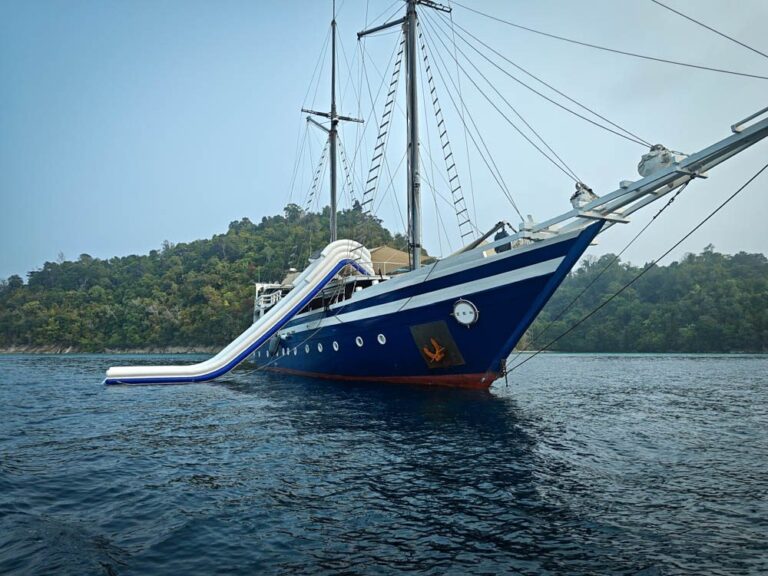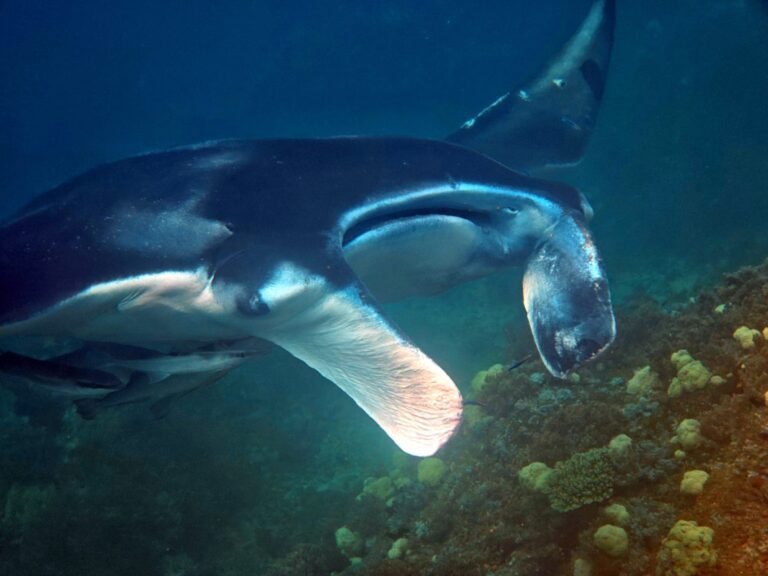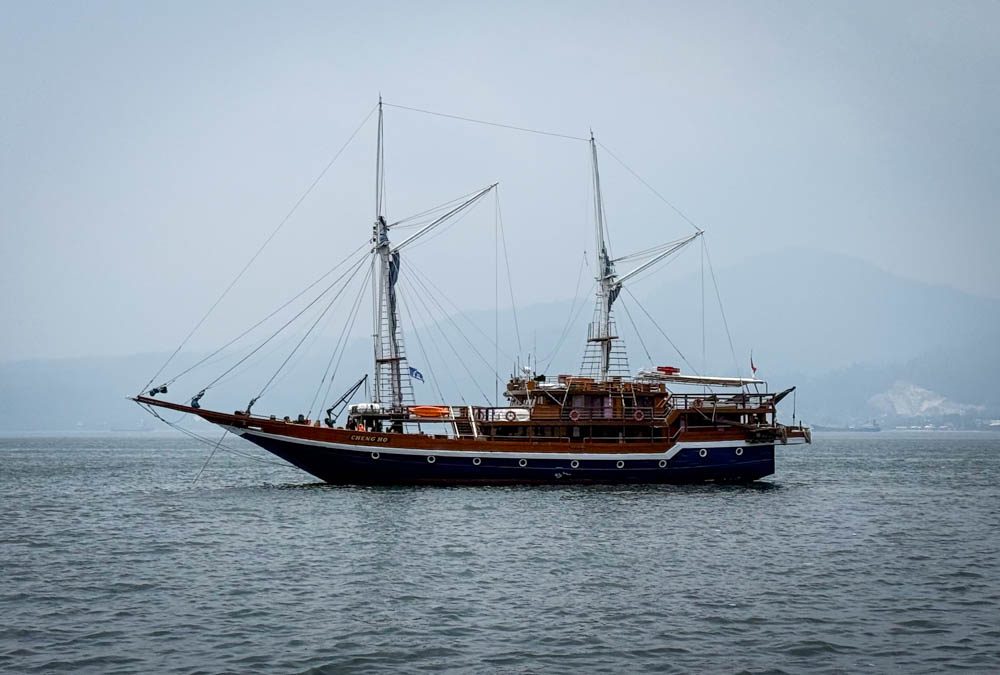
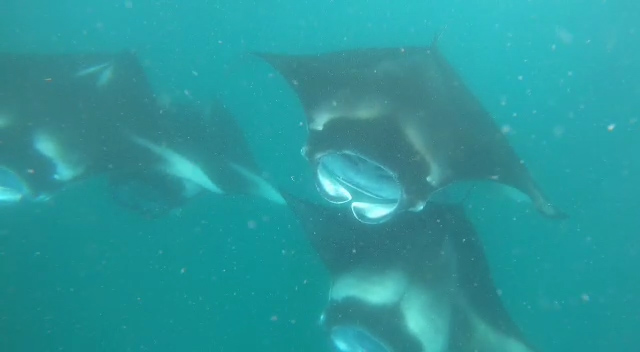
What makes a manta encounter special is not only the size of the animal. It is the feeling that the manta is as curious about you as you are about it. Mantas turn back for another pass, hover above you and look you in the eye, and you can sense that something is going on behind those eyes. This guide covers the best places in the world for manta ray diving and snorkelling: where the mantas are, which species you will meet, the best months for each site and how to get there, with notes from my own dives along the way.
Where are the best places to swim with manta rays? The top spots are Komodo in Indonesia (reef mantas year-round, peak December to March, with Manta Alley the standout site), the Maldives (Hanifaru Bay’s feeding trains from May to November, biggest July to October, snorkel only because diving is not allowed in the bay, plus cleaning stations and night dives in the central atolls), Raja Ampat and Misool (reef and oceanic mantas at many sites, October to April, with October the best month at Misool), Nusa Penida off Bali (reef mantas all year, best in May, but crowded), the Galápagos (oceanic mantas at Cape Marshall and other sites in the north of the archipelago, December to May, liveaboard only), Palau (German Channel), Mexico (giant oceanic mantas at Socorro, reached by liveaboard from Cabo San Lucas, November to May) and, for a night dive, Kona in Hawaii. Encounters are never guaranteed, but at the right site in the right month the odds are good.
Quick facts: manta ray diving
- Best for divers: Komodo’s Manta Alley, on a boat that sails to the south of the park
- Best for snorkellers: Hanifaru Bay, Maldives, August and September (snorkel only: diving is not allowed in the bay), and Mawan in Komodo
- Best night dive: Kona, Hawaii, where lights draw the mantas in to feed
- Best for oceanic (giant) mantas: Misool in Raja Ampat (Magic Mountain and Four Kings, best in October), the Galápagos (December to May) and Socorro off Mexico (November to May)
- Easiest to reach: Manta Point, Nusa Penida, as a day trip from Bali
- Level: snorkel to intermediate; Komodo and Galápagos sites need current experience
Mantas are only one reason to plan a dive trip around the seasons. For the wider picture, see my ranking of the best dive destinations in the world, and its companion guide to the best places to dive with whale sharks.
Why Trust This Guide
I have been diving for more than 25 years, with more than 1,500 logged dives and over 40 liveaboard trips, and I review each boat in depth here on This is Luxury Travel. Every review is first-hand, and most of the manta encounters mentioned in this guide come from those reviews, linked in the section where they happened. I have been to Komodo more than 20 times and have dived there in every month of the year, and the same goes for Bali, so I have seen both in every season. I have also dived Misool in six different months and Kona, Hawaii, in July. Raja Ampat is my number one dive destination for its corals, big fish and macro, and Misool is where I watched oceanic mantas around 5 meters across come in to be cleaned.
Where I have not been, I say so.
Reef Mantas vs Oceanic Mantas: What Is the Difference?
Until 2009 scientists thought there was a single manta species. There are two, and the one you meet depends on where you dive.
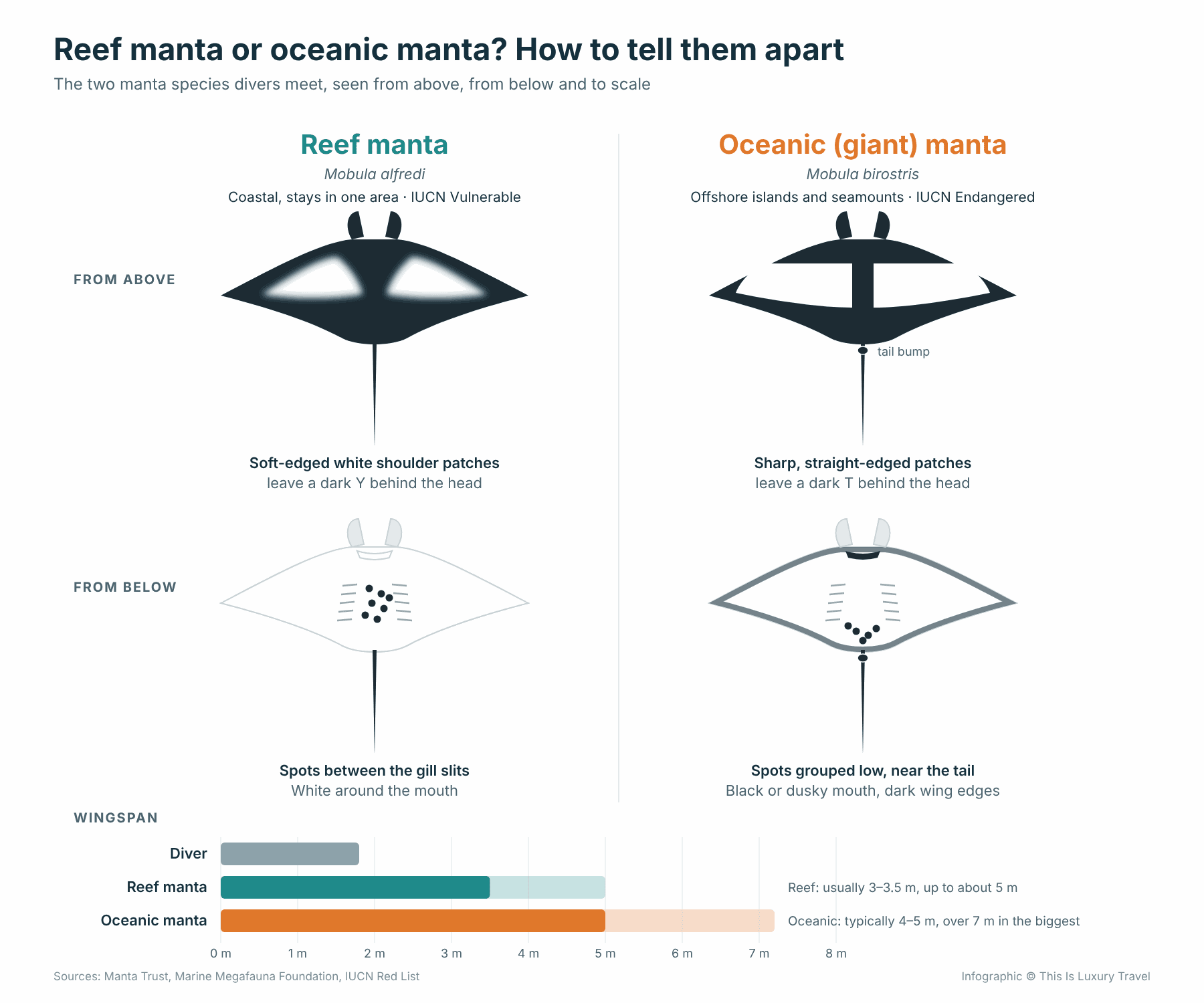
- Reef manta (Mobula alfredi). The coastal species, and the one you meet at Hanifaru, Komodo, Nusa Penida, Kona and most of the Maldives. Reef mantas usually measure 3 to 3.5 meters across, occasionally up to about 5 meters. The IUCN lists them as Vulnerable.
- Oceanic or giant manta (Mobula birostris). The largest ray in the world, typically 4 to 5 meters across and in the biggest individuals over 7 meters. It is more pelagic and turns up near offshore islands and seamounts. The IUCN lists it as Endangered.
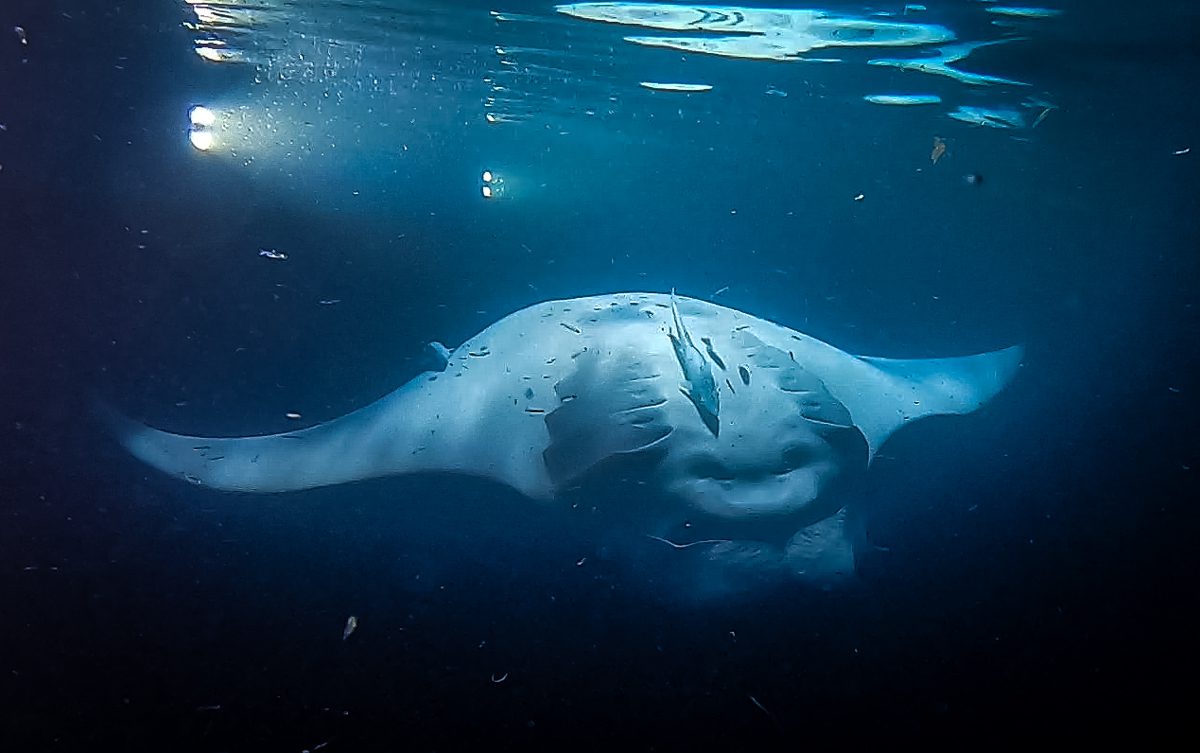
Underwater, the quickest tell is the belly. A reef manta’s white underside often has dark spots scattered between the gill slits; an oceanic manta has a clear dark border around the underside and its spots sit low, near the rear. Oceanic mantas also have a small bump at the base of the tail, behind the dorsal fin. I have seen oceanic mantas at Magic Mountain in Misool and at Cape Marshall in the Galápagos, and giant mantas in Palau, where I have no review yet. Raja Ampat is the place to see both species at the same cleaning stations.
From above, look at the white shoulder patches. On a reef manta they are soft-edged and leave a dark Y shape behind the head; on an oceanic manta they are sharp-edged and leave a dark T. The mouth helps too: it is white around a reef manta’s mouth, and black or dusky on an oceanic manta.

Manta Ray Diving: The Seven Best Places at a Glance
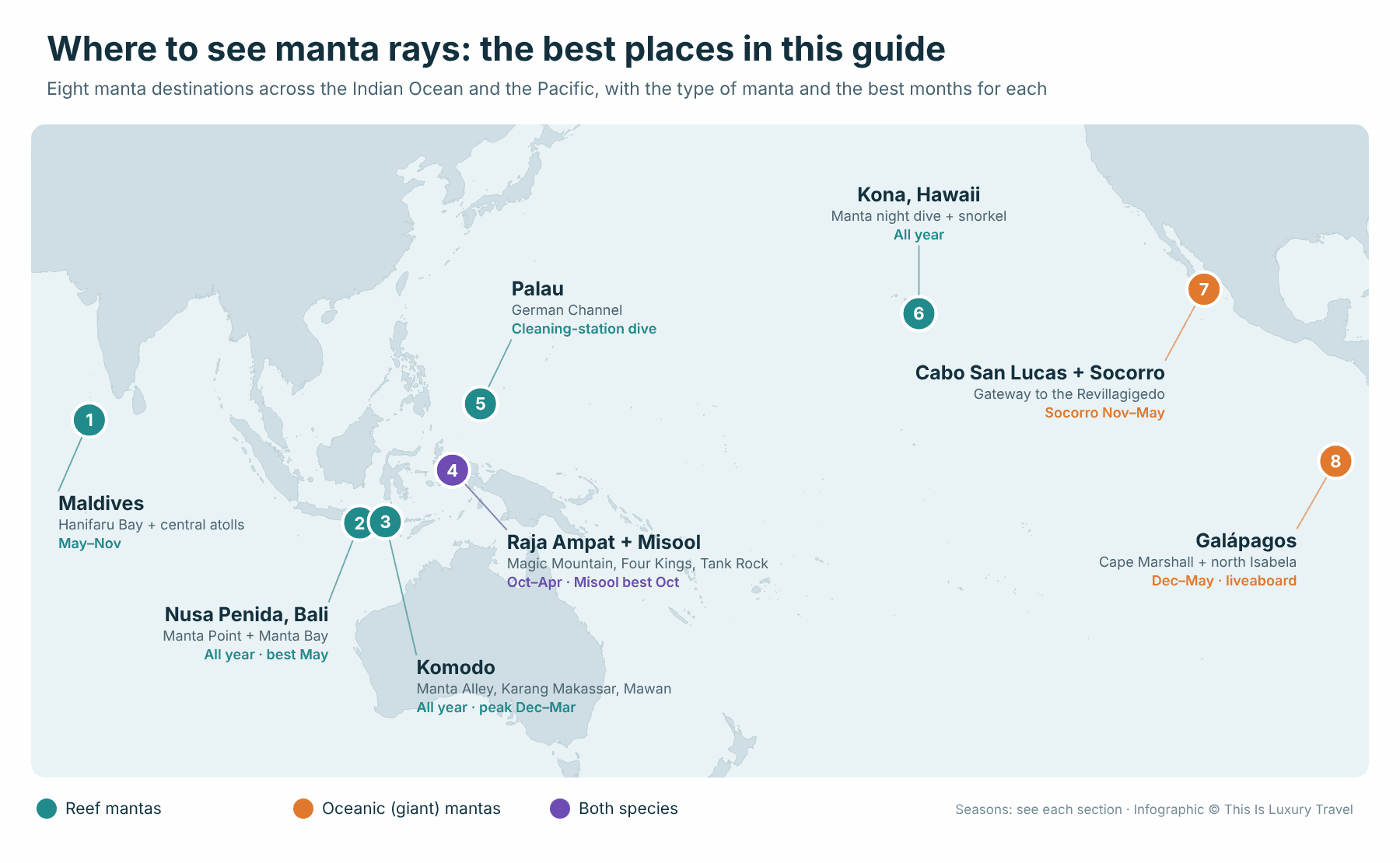
| Destination | Manta type | Best months | Dive or snorkel | Liveaboard or resort | My encounter |
|---|---|---|---|---|---|
| Hanifaru Bay, Maldives | Reef | May–Nov; biggest Jul–Oct | Snorkel only | Far North liveaboard, or a Baa Atoll stay | Trains of 20-plus mantas, September 2022 (Scubaspa Yin) |
| Central atolls, Maldives | Reef | May–Nov (south-west monsoon) | Both, plus night dives | Liveaboard | Mantas for a whole dive at Lankan Manta Point, August 2024 (White Pearl) |
| Komodo, Indonesia | Reef | Year-round; peak Dec–Mar | Both | Liveaboard | About 30 at Manta Alley, July 2024 (Tiare) |
| Raja Ampat & Misool, Indonesia | Reef and oceanic | Oct–Apr; best at Misool in Oct | Dive | Liveaboard, or Misool Resort | Mantas on more than half my dives, January 2021 (Misool Resort); five reef mantas from the surface at Tank Rock and two oceanic mantas for a whole dive at Magic Mountain, October 2026 (Scubaspa Zen) |
| Nusa Penida, Bali | Reef | Year-round; best in May | Both (Manta Bay for snorkellers) | Day boat from Bali | More than six at once on my best May dive (Diving in Bali) |
| Kona, Hawaii | Reef | Year-round | Night dive or night snorkel | Day boat | The manta night dive: spectacular |
| Cape Marshall, Galápagos | Oceanic | Dec–May | Dive | Liveaboard only | Four oceanic mantas, March 2024 (Galápagos guide) |
The infographic below shows the same seasons month by month, with the months I was there marked in orange.
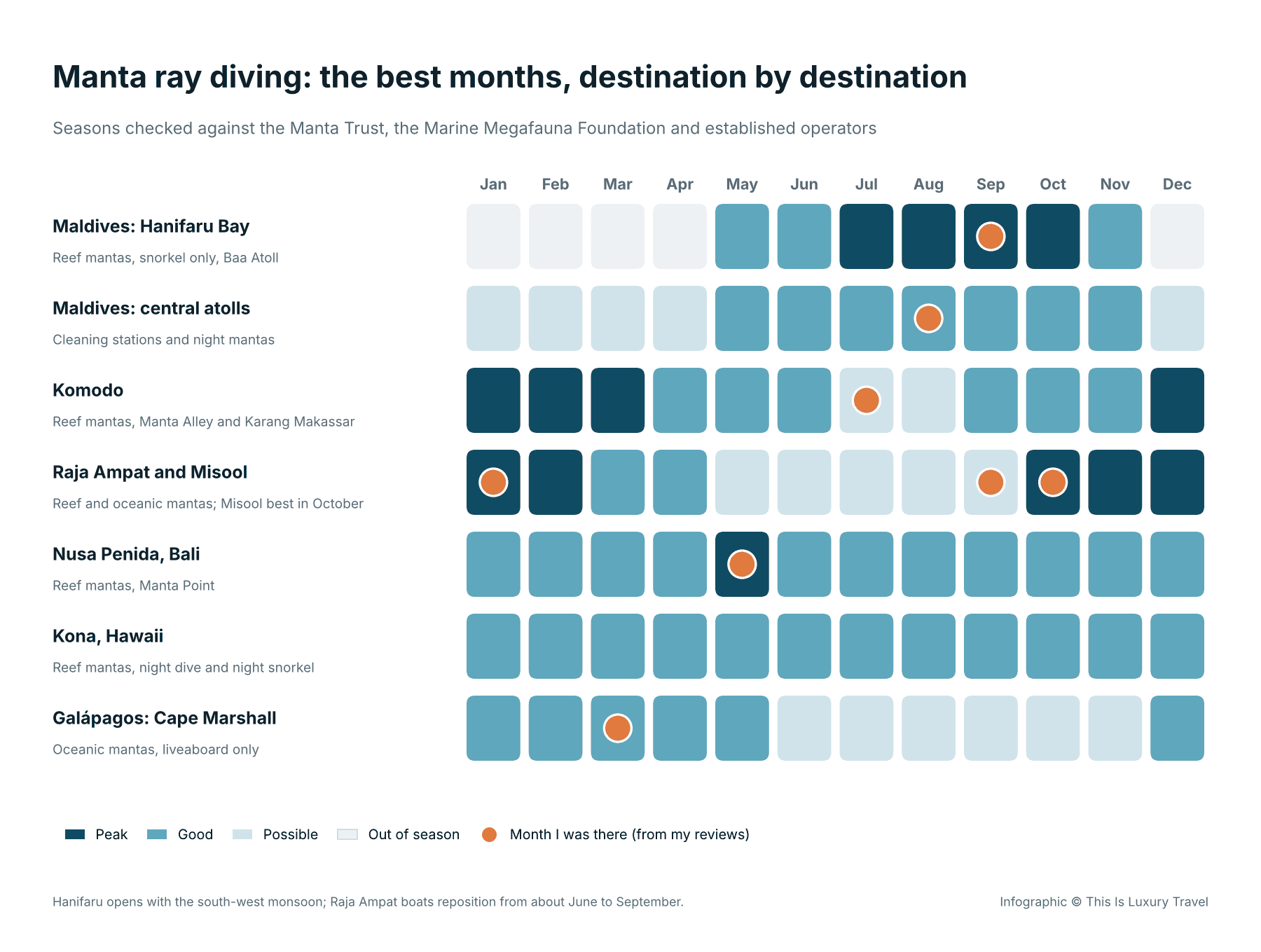
Where to See Manta Rays Month by Month
Use this as a quick planner. Each month lists the sites in this guide that are in season, best first. Kona works in every month, so it is not repeated.
| Month | Where I would go for mantas |
|---|---|
| January | Komodo (peak), Raja Ampat and Misool, Cape Marshall in the Galápagos |
| February | Komodo (peak), Raja Ampat, Cape Marshall |
| March | Komodo (last month of the peak), Cape Marshall, Raja Ampat |
| April | Cape Marshall, Raja Ampat, Nusa Penida |
| May | Nusa Penida (the best month), Cape Marshall, the start of the Hanifaru season |
| June | Maldives cleaning stations and Hanifaru Bay, Nusa Penida |
| July | Hanifaru Bay (the big gatherings begin), Maldives central atolls |
| August | Hanifaru Bay, Maldives central atolls |
| September | Hanifaru Bay (where I saw trains of 20-plus), Komodo before the rains |
| October | Misool (the best month: five mantas at Tank Rock and two oceanic mantas at Magic Mountain in October 2026), Hanifaru Bay, Komodo |
| November | Raja Ampat (peak begins), the last weeks of Hanifaru, Komodo |
| December | Komodo (peak begins), Raja Ampat, Cape Marshall |
For every other big animal by month, see my whale shark guide, my hammerhead shark diving guide and the best dive destinations ranking. To see every destination side by side, month by month, use my diver’s calendar of where to dive each month.
1. The Maldives — Hanifaru Bay, Cleaning Stations and Night Mantas
Manta ray diving in the Maldives comes in three completely different forms, and the season decides which one you get. My full atoll-by-atoll guide to diving in the Maldives covers all of them; this is the manta-only version.
Hanifaru Bay: Is It Worth It?
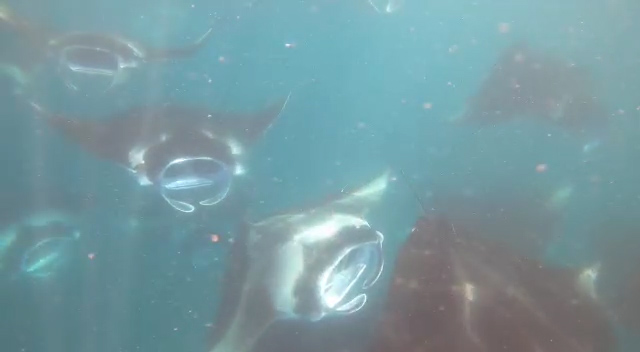
Hanifaru Bay in Baa Atoll is a narrow, dead-end bay that traps plankton pushed in by the south-west monsoon current, and in season it hosts some of the largest manta feeding gatherings in the world. I went in September on the Scubaspa Yin’s Far North cruise, my second trip on that boat. Rangers watch the bay and call the boats when the mantas arrive, so you wait. Our first full day there, the call never came. On day six it did, and the bay was already busy with ten boats. Once in, there were trains of more than 20 mantas feeding with their mouths open, so close that I lost count. It was also chaotic: inexperienced snorkellers kicking and shouting, and I took a few fins to the face.

- Season: the official season runs from May to November, with the largest gatherings usually between July and October. Mantas come in greatest numbers around the new and full moon.
- Rules: snorkel only. Diving is not allowed in the bay. Visits are capped at 45 minutes, a limited number of boats may enter at a time, and every group needs a certified Hanifaru guide. No strobes or video lights. The permit fee was included in my cruise.
- My tips: move a little away from the crowd and stay still, and the mantas come to you. The bay is large, so if you are not a strong snorkeller, wear a life jacket.
Is Hanifaru Bay worth it? Yes, for the sheer number of animals, but go with your eyes open about the crowds and the waiting. Because there is no guarantee the mantas will be in the bay during your week, I suggested in my review adding a few nights in Baa Atoll after a cruise. Dharavandhoo Divers on Dharavandhoo island run day trips and will call you when the mantas arrive. The check dive on that cruise, Dhonfaanu house reef, gave us ten mantas and ten mobulas on a gentle slope. The mantas at Kotterafu Manta Point, by contrast, stayed away because the current was running the wrong way.

Manta Cleaning Stations in the Central Atolls
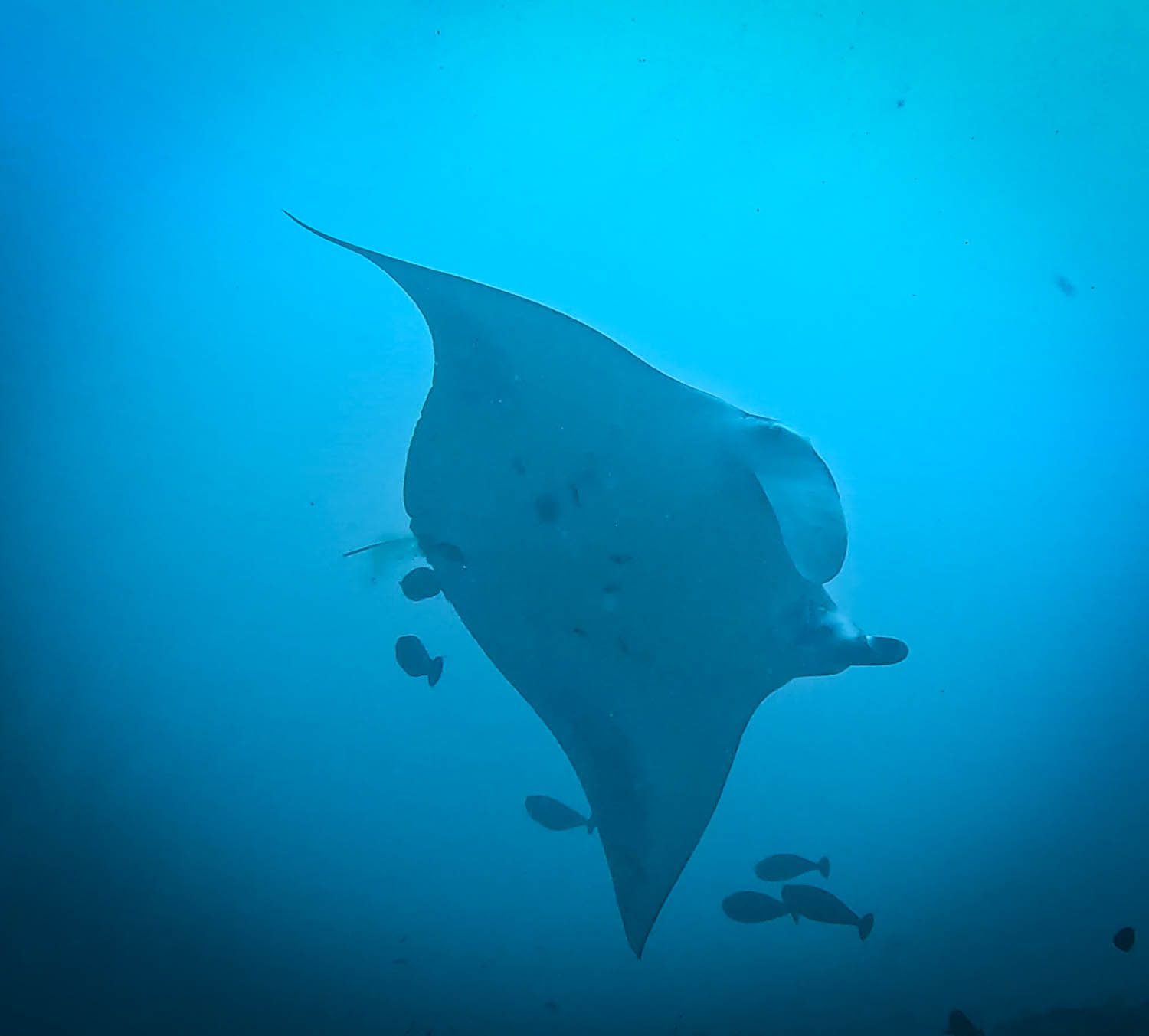
Away from Baa, Maldives manta diving means cleaning stations: you settle on the sand at 12 to 20 meters beside a coral head and wait for the mantas to circle in. My best was Lankan Manta Point near Malé, on the last diving day of my White Pearl cruise in August 2024. The mantas appeared almost immediately at the bommies at about 20 meters and circled overhead for the whole dive. The same week, Guraidhoo Manta Point and Digurah Arch produced none. On Blue Force One, Mahivadu Camel Rock took 20 minutes to give us one manta, and it shared the cleaning station with at least 60 divers. On my first Scubaspa Yin cruise through the central atolls, a single manta joined the snapper schools on one dive, and the group that chose the manta dive on the last day saw four.
For timing, the Maldives’ south-west monsoon, from about May to November, brings the plankton and with it the most mantas, at the cost of lower visibility and rougher crossings. That is the trade-off I explain in my guide to the best Maldives liveaboards.
Check prices and dates for White Pearl, Scubaspa Yin and Blue Force One. White Pearl and Scubaspa Yin are also on Divebooker.
👉 Check Maldives liveaboard prices and availability: on Liveaboard.com | on Divebooker
Prices for the same liveaboard trip can vary significantly between websites, so it pays to compare both Liveaboard.com and Divebooker before you book: their promotions sometimes differ, and the better deal for your dates can be on either site. Divebooker adds free DAN dive insurance on request and a loyalty credit worth up to 10% on your next trip. I have written a guide on how to find the best price for your liveaboard cruise: read it here.
2. Komodo, Indonesia — Manta Alley, Manta Point and Mawan
Komodo is the manta destination I would send a diver to first. The park’s resident population is put at more than 1,000 reef mantas, so you can see them in every month, and I have met black mantas there as well as the usual black-and-white ones. My full luxury guide to diving Komodo and my older piece on why Komodo diving is simply the best cover the park beyond the mantas.
Manta Alley, South Komodo
Manta Alley sits around a rocky islet off the south coast of Komodo, in colder, greener water than the north. I dived it in July 2024 on the Tiare, sailing from Bali to Komodo, and the Tiare was the only boat there; the sea was rough enough to keep the others away. Two black mantas met us at a cleaning station at just 5 meters. Deeper in the channel, at 15 to 20 meters, twenty mantas were feeding together, and on the second dive, at a cleaning station of about 20 meters, they kept coming for almost 40 minutes. I counted about 30 that day. We kept our distance and let them approach, and at times they came within touching distance and looked us in the eye.

Manta Point Komodo (Karang Makassar)
Manta Point, also called Karang Makassar, is a long reef of coral rubble in central Komodo, a shallow drift dive that suits both snorkellers and divers. It is also the busiest manta site in the park. On the Tiare, six or seven boats were diving it at once and we saw no mantas at all, only an eagle ray feeding. On the Komodo Sea Dragon, a manta glided past us at Makassar Reef within minutes, then left, and we counted at least ten sharks on the same dive. Operators report the largest aggregations here in January and February.
Mawan: a Shallow Cleaning Station
Mawan is a small island with a manta cleaning station at about 9 meters and a lovely hard-coral garden in the shallows. On my early dives there I saw mantas every time. In early July 2026, on the Moana, I snorkelled it instead because of my ears. About 30 boats were anchored nearby and perhaps 100 snorkellers were in the water. Our cruise director timed our entry around the other boats, and as they left one by one I ended up alone at the cleaning station. A manta circled me for about ten minutes, close enough to touch, and when it left another came by.

When Is Manta Season in Komodo?
I have dived Komodo in every month of the year, and mantas are there all year, but the plankton-rich rainy months from December to March bring the biggest aggregations, with lower visibility and fewer boats. July and August are the low point for manta numbers and the high point for crowds. My July Manta Alley day shows that a boat able to reach the south can still beat the calendar. The south is the area most boats reach in the rainy season, which is why choosing the right boat matters as much as the month, as I explain in my guide to the best Komodo liveaboards.
Check prices and dates for the Tiare, the Moana and the Komodo Sea Dragon. All three are also on Divebooker: Tiare, Moana, Komodo Sea Dragon.
👉 Check Indonesia liveaboard prices and availability: on Liveaboard.com | on Divebooker
3. Raja Ampat and Misool — Reef and Oceanic Mantas Together
Raja Ampat is the only place on this list where I have seen both manta species on the same cleaning stations, and a large share of its mantas are almost entirely black. ZuBlu puts it at around 40 per cent.
In Misool, mantas are not limited to one famous site. They turn up at Magic Mountain, Tank Rock, Nudi Rock, Boo, Yillet, Eagle Nest and Four Kings, and Four Kings also gets oceanic mantas.
Magic Mountain, Misool
I have dived Misool in January, February, May, October, November and December. I stayed at Misool Resort in January 2021 and saw mantas on more than half of my dives. The highlight was Magic Mountain, also called Shadow Reef, a pinnacle where oceanic mantas around 5 meters across come in to be cleaned. Because our group kept its distance, the mantas often stayed with us for the whole dive. The resort also uses manta cleaning stations that not every liveaboard knows. My one frustration was that we dived Magic Mountain only twice in a week. My comparison of Misool Resort and Papua Explorers explains what that protected reserve adds underwater.
I have since dived Magic Mountain twice from the Scubaspa Zen, which crosses the Banda Sea from Ambon to Misool, and the two dives could not have been more different. In November 2022 it gave us no mantas at all, only a huge school of batfish, giant trevallies, napoleons and barracuda on the current-exposed side. In October 2026 it was the last dive of the trip and the best of my year. As we came down onto the top pinnacle, the first thing we saw was a wobbegong shark. Within a minute, two oceanic mantas appeared and stayed with us for the entire dive, moving from diver to diver and checking each of us out, close enough to see their eyes move. On the deeper pinnacle there were about ten reef sharks, schools of jacks hunting, giant barracuda and oceanic triggerfish. Same site, same season, four years apart: that is manta diving. Liveaboards may dive Magic Mountain only once per trip, so it pays to be on a boat whose cruise director knows when to time it.
Here is the video I filmed on that dive at Magic Mountain:
Tank Rock and Misool’s Other Manta Sites
On the same 2026 trip I snorkelled more than I dived, and one of my best manta encounters of any kind was from the surface. At Tank Rock, near Boo in Misool, five reef mantas fed and cleaned at three to seven meters for over an hour, and I had them to myself; I would put it against most manta dives I have done. At Pulau Pisang, a site few boats visit, the divers on our boat logged two reef mantas and mobula rays, and at Puri Pinnacle a school of fifteen mobulas swept through the silversides on my dive. On the 2022 trip, at Eagle Nest, the dhoni crew called out an oceanic manta nearby, and we got back in for a glimpse before it dived.
This is my video from that snorkel at Tank Rock:
Black Mantas in Northern Raja Ampat
In September 2023 I spent 12 days in northern Raja Ampat on the Dewi Nusantara, outside the main manta season, and still found them. A manta came to check us out at Eagle Rock. At Black Rock we saw three, and a fully black one came back to us again and again throughout the dive. On the last day, the Dayang cleaning station, which has three stations at 5, 10 and 15 meters, gave us three more over two dives, the first a black manta that stayed with us for almost ten minutes. The falling tide is usually best there.

When to go: Raja Ampat’s manta season runs with the north-west monsoon, from October to April. At Misool, October is the best month for mantas. The area has been mostly off limits during the monsoon, so the sites have not yet seen many divers and the mantas still feel at home, and most of the liveaboard fleet is still in the Banda Sea chasing hammerheads, so the sites are close to empty. The risk is the sea: October is the end of the south-east monsoon, the crossing can be rough, and if Misool is not accessible in your week the boat relocates to central and north Raja Ampat. Since September 2026 the park has also run a booking system that allows only five boats in any one area on a given day, so ask your operator how it handles Magic Mountain before you book. From about June to September the south-east monsoon makes the south rough and most liveaboards leave; Misool Resort itself closes from mid-June to early September. The full month-by-month picture is in my guide to the best Raja Ampat liveaboards. Check prices and dates for the Dewi Nusantara and the Scubaspa Zen. The Scubaspa Zen is also on Divebooker.
👉 Check Indonesia liveaboard prices and availability: on Liveaboard.com | on Divebooker
4. Nusa Penida, Bali — the Easiest Manta Dive in Indonesia
Manta Point sits below the limestone cliffs of Nusa Penida’s exposed south-west coast: a series of cleaning stations on a rocky reef at 10 to 20 meters, with swell rolling in from the Indian Ocean. Reef mantas are there all year, and I have dived Bali in every month of the year. A Marine Megafauna Foundation and Murdoch University study identified 624 individuals in the area, using Manta Bay mainly to feed and Manta Point for cleaning and courtship. May is the best season: the seas have settled after the wet season and the cleaning stations are busy. On my best May dive I had more than six mantas over the cleaning station at once, some of them about 4 meters across.
Expect it to be very crowded. Nusa Penida is one of the most popular day trips from Bali, and many tourists come out to the manta sites for the day. When I snorkel there, I usually swim away from the groups: many beginner snorkellers are kicking in every direction, and you have just as good a chance of spotting the mantas snorkelling on your own as with 30 other people around you.
I dive Penida as a day trip from Candidasa on Bali’s east coast, about an hour by boat to Manta Point, and sleep in a proper hotel. If you are diving, insist on Manta Point; the shallower Manta Bay is mainly used by snorkel boats. Everything else, from the sunfish season to where to stay, is in my guide to diving in Bali.
5. The Galápagos — Oceanic Mantas in the Warm Season
The Galápagos is one of the few places where oceanic mantas are a realistic target, and they are not tied to a single site. Liveaboards meet them at Cape Marshall, beneath Wolf Volcano on Isabela’s north-east coast, along the wall at Punta Albemarle on the northern tip of Isabela, at Cousin’s Rock, and occasionally at Darwin and Wolf, where most divers are looking for hammerheads. The warm season, from about December to May, is the most reliable time for mantas. My own best manta day was at Cape Marshall on the Galapagos Sky in March 2024: four oceanic mantas appeared, and two came close and circled us while mobulas, eagle rays and a school of more than 1,000 barracuda passed. Cape Marshall and the northern islands are liveaboard only. My Galápagos diving guide and my Galapagos Sky review cover the rest of the trip. Check prices and dates for the Galapagos Sky on Liveaboard.com or Divebooker.
👉 Check Galápagos liveaboard prices and availability: on Liveaboard.com | on Divebooker


6. Palau — Mantas at German Channel
Palau, in Micronesia, is best known for its walls and sharks, but it is also a classic manta destination. Its best-known manta site is German Channel, a channel cut through the reef with manta cleaning stations along it. I have seen giant mantas in Palau, alongside a tiger shark and many reef sharks, but I have not written that trip up yet.
7. Cabo San Lucas and Socorro, Mexico
Mantas also turn up where you least expect them. On an offshore shark trip from Cabo San Lucas, the sharks disappeared as soon as we jumped in, and two manta rays came over to check us out instead; I tell that story in my Cabo San Lucas sharks and mantas review.
Cabo is also the departure port for the Revillagigedo Islands, better known as Socorro, about 24 hours offshore and one of the world’s great destinations for giant oceanic mantas. The season runs from about November to May. It is liveaboard only, and with open-ocean conditions it suits experienced divers: PADI recommends Advanced Open Water and 50 or more logged dives.
Can You Snorkel With Manta Rays? Where Manta Ray Snorkeling Works
Yes. Mantas feed and clean close to the surface, and some of my best encounters were with a mask and snorkel only. Hanifaru Bay is snorkel only by law. At Mawan in Komodo I had a manta to myself from the surface. Karang Makassar in central Komodo is shallow enough for snorkellers, and Manta Bay on Nusa Penida is mainly a snorkel site. In Misool, Tank Rock gave me five feeding mantas at three to seven meters, for over an hour, from the surface in October 2026. Where it does not work: Magic Mountain, Manta Alley’s deeper stations and Cape Marshall, which are dives. If you are travelling with a non-diver, both the Moana and the Suba spa take snorkellers, and the Scubaspa Zen runs its own snorkelling group. Snorkellers spend long stretches face down at the surface, so wear a rash guard and a hat instead of sunscreen. If you do use sunscreen, use reef-safe sunscreen.
Night Swimming With Manta Rays
The night manta is a different animal: lights draw plankton, and the plankton draws the mantas. On Blue Force One in Ari Atoll, a manta circled under the lights off the back platform, feeding on the plankton, while some guests snorkelled and others drank tea and watched. Later in the trip the crew set up the lights at Fesdu and we dived it, sitting in a circle on the sand while a manta looped through the beams close enough to touch. Visibility suffered on the silty bottom, so add a kilo or two of weight to settle quickly, and do not move. Or wait until the divers are out and snorkel: the manta usually stays, and you may have it to yourself.
Kona, Hawaii: the Manta Night Dive
The most famous night manta encounter in the world is on Hawaii’s Big Island, off the Kona coast, and I have done the night dive there, in July. It is spectacular. The boats go out around sunset to known feeding sites such as Manta Village off Keauhou Bay and Manta Heaven near the airport. Divers settle on the bottom around a cluster of lights and point their torches upwards, while snorkellers float above holding a board fitted with lights shining down. The lights pull in the plankton, and the resident reef mantas come in to feed through the beams, looping and somersaulting with their mouths wide open. The local mantas do not migrate, so the dive runs all year. Divers sit on the sand at around 10 meters (30 feet), so an Open Water certification is enough, and it is the easiest answer to where in the United States you can swim with manta rays. In 2026, Kona operators list shared night snorkel boats at around US$99 to US$169 per person.
Why Mantas Need Protecting
Mantas breed slowly: a female usually has a single pup every two to three years. That is why fishing hits them so hard. In 2013, an estimated 21,000 kg of dried manta gill plates were traded each year, about 4,652 rays, with about 99 per cent of the market in Guangzhou, and regional declines of more than 85 per cent had been recorded. The oceanic manta is now listed as Endangered by the IUCN and the reef manta as Vulnerable.
Tourism is the strongest argument for keeping them alive. A 2013 global estimate put direct revenue from manta dives and snorkels at more than US$73 million a year, and about US$140 million including travel spending. In Yap, the lifetime tourism value of a single reef manta was calculated at about US$1.9 million, against around US$41 for a dead manta at a Sri Lankan fish market. Komodo National Park banned manta fishing in 2013, Indonesia protected both species nationwide in 2014, and the Maldives protected all rays the same year.
I have seen what happens where mantas are not left in peace. Off Sangalaki Island, in the Derawan archipelago of East Kalimantan, I once dived with hundreds of mantas, but the constant dynamite fishing in the area seems to have driven them away. In Halmahera, the mantas I met were far shyer than anywhere else and would not hang out with divers; I suspect it is because they are still being hunted there too.
How to Choose a Responsible Manta Operator
The Marine Megafauna Foundation’s checklist is the one I use. A good operator briefs you and has a guide in the water, keeps groups small, slows its boats near mantas and waits its turn, keeps divers low and back from the cleaning station, pays the park fees and follows local rules, and shares its photos with researchers. In practice, the difference is easy to see. On the Moana, three divemasters guided seven divers, and the cruise director timed our entry at Mawan around the other boats. At Hanifaru Bay, rangers call the boats in when the mantas arrive.
Your Manta Photos Can Help Research
Every manta has a unique pattern of spots on its belly, so a clear photo of the underside identifies it for life. Upload your shots, with the date and the site, to MantaMatcher, the global identification database used by manta researchers. The Nusa Penida study cited above was built on exactly those photos, logged by citizen scientists and trained observers.
What Level Do You Need for Manta Ray Diving? Sites by Difficulty
This matters as much as the month. These are the conditions I found at each site.
| Site | Snorkellers? | Level for divers | What to expect |
|---|---|---|---|
| Hanifaru Bay, Maldives | Snorkel only | Diving is not allowed | A big bay and a lot of swimming; wear a life jacket if you are not a strong snorkeller |
| Central Maldives cleaning stations | Some sites | Intermediate: about 50 logged dives, reef hook and SMB | Kneel or hover at 12 to 20 meters in channel current |
| Mawan, Komodo | Yes | All levels, but the current can be medium strong | Cleaning station at about 9 meters, coral garden in the shallows |
| Karang Makassar, Komodo | Yes | Easy to intermediate drift | Shallow rubble drift, and the busiest manta site in the park |
| Manta Alley, Komodo | Maybe? (visibility is often bad) | Experienced: swell, colder green water | Cleaning stations from 5 to 20 meters in the south of the park |
| Manta Point, Nusa Penida | Manta Bay instead | Intermediate to advanced: swell and surge | Cleaning stations at 10 to 20 meters under the cliffs |
| Magic Mountain, Misool | Maybe ( current can be strong) | Intermediate: current on the exposed side, bring a reef hook | A seamount with a shallow top pinnacle and a deeper one, at about 20 meters; one dive per liveaboard trip |
| Tank Rock, Misool | Yes | I snorkelled it; divers dive the same site | Mantas feeding and cleaning at 3 to 7 meters |
| Cape Marshall, Galápagos | No | Advanced: current, cold thermoclines | Boulders and sand at 15 to 20 meters, oceanic mantas in the blue |
| Kona, Hawaii | Yes, at night | Open Water | A night dive on sand at about 10 meters around the lights |
How to Behave Around Manta Rays
A study of feeding mantas in the Maldives, published with the Manta Trust in 2019, found that only 44 per cent of human interactions followed the existing guidelines, and that chasing, obstructing and approaching from the front disturbed the animals’ feeding. The Manta Trust’s code of conduct comes down to a few rules:
- Keep at least 3 meters away, and stay passive: no splashing, touching or chasing.
- Approach from the side, within the manta’s field of view, and never block its path or dive down in front of it.
- At a cleaning station, stay on the edge and do not swim onto the cleaning area itself.
- Only experienced snorkellers should free-dive near mantas.
My own experience goes a step further. My closest encounters have happened when I pretended I was not interested: instead of looking straight at the manta, I look at other fish or critters on the reef, and that is when the mantas come to me, because they do not feel threatened. Mantas, and oceanic mantas in particular, are very curious animals. Swim towards them, though, and they read it as aggression and leave the site.
Then there are your bubbles. The general guideline is to avoid exhaling directly under a manta, as the bubbles might scare it away. Some mantas, however, seem to love them and will follow your bubbles.
How Much Does a Manta Trip Cost?
These are the prices I found when I checked, with the date. They move with the season and the cabin, so check the boat links in each section before you book.
| Trip | Price guide | Extras to budget | Source |
|---|---|---|---|
| Kona night snorkel | About US$99 to US$169 per person on a shared boat | The night dive costs more | 2026, Kona operators |
| Komodo liveaboard | From about US$362 per day (Ilike) to US$628 per day (Scubaspa Zen) | Park fee and nitrox on some boats; on my Komodo Sea Dragon trip they were about US$200 and US$100 | Indonesia liveaboards, September 2026 |
| Maldives liveaboard | From about US$245 per day | The Hanifaru permit was US$30, included on my Scubaspa Yin cruise | Maldives liveaboards, October 2026 |
| Misool Resort | 7-night package from US$4,940 per person sharing (South Beach Villa) | Diving is not included | September 2026, the resort |
| Galápagos liveaboard | About US$568 to US$909 per day; the Galapagos Sky from US$808 | US$200 national park fee and US$20 Transit Control Card | Galápagos liveaboards, October 2026 |
Budget for fees too. On my October 2026 Scubaspa Zen trip, port, park and visit fees were a flat US$70 per person per day, about US$700 on a ten-night cruise, and that included the Raja Ampat marine park fee of 1,000,000 rupiah, which is valid for a year.
Liveaboard or Resort for Mantas?
For most of the sites in this guide, a liveaboard is the better choice. It reaches Manta Alley and the other southern Komodo sites, the Far North of the Maldives and Cape Marshall, none of which you can do comfortably from a hotel. The exceptions are Misool Resort, which has its own manta sites inside its marine reserve, a Baa Atoll stay if Hanifaru is your only goal, and Nusa Penida, which is an easy day trip from Bali. My comparison of liveaboard versus resort diving in the Maldives sets out the trade-offs in more detail. If you are going by boat, my liveaboard packing list covers everything I take for two weeks at sea.
For Indonesia, all of these trips start with a domestic flight to Labuan Bajo, Sorong or Bali. Indonesian airline websites often reject foreign cards, so I book through Trip.com, which sells all the domestic carriers.
Photographing Mantas
Mantas are a wide-angle subject. At Hanifaru Bay strobes and lights are not allowed, so natural light and a wide or fisheye lens work best, and video captures the feeding trains better than stills. I currently shoot with a smartphone in a DiveVolk SeaTouch housing; my Xiaomi 17 Ultra underwater review shows what that set-up can do in Raja Ampat, and the rest of my kit is in what is in my dive bag. If you shoot a mirrorless camera instead, read my Seafrog housing review before you buy a budget housing.
- Get under them. The belly shot is the one researchers can use, and it is often the most striking picture too, with the manta framed against the surface.
- Stay still and let them come. At cleaning stations, the mantas loop back to the same coral head. Find your spot on the edge and wait for the pass rather than swimming after it.
- Use the light you are given. At night, the boat’s or the dive center’s lights do the work. Keep your own torch off the manta’s eyes.
- Shoot video. Feeding trains, somersaults and two mantas circling together read better in motion than in stills.
So Where Should You Go? My Pick
For divers, I would choose Komodo, on a boat that sails south to Manta Alley, between December and March, or in the shoulder months if you prefer calmer seas. For snorkellers, Hanifaru Bay in August or September, with a few spare days in Baa Atoll. If you want oceanic mantas and the best reefs in the world in the same trip, go to Misool in October. If you only have a long weekend in Bali, go to Manta Point in May. And for the most theatrical manta dive of all, do the night dive in Kona.
Manta Ray Diving: Frequently Asked Questions
Where is the best place in the world to dive with manta rays?
From my own dives, Komodo’s Manta Alley, where I had about 30 mantas and no other boats on the site in July 2024. Komodo’s resident population of more than 1,000 reef mantas means you can see them year-round, with December to March the peak. For snorkelling, Hanifaru Bay in the Maldives is unmatched in season; for oceanic mantas and the best reefs on the same trip, Misool in Raja Ampat in October; and for a night dive, Kona in Hawaii.
What is the best month to see manta rays?
There is no single month, because each site has its own season. December to March is Komodo’s peak, May is the best month at Nusa Penida, July to October brings Hanifaru Bay’s biggest gatherings, October is the best month at Misool, December to May is the most reliable time for oceanic mantas at Cape Marshall, and Kona works in any month. The month-by-month table earlier in this guide gives the best choice for every month.
Where can you see manta rays?
In the Maldives (Hanifaru Bay and the central atolls), Indonesia (Komodo, Raja Ampat, Misool and Nusa Penida), the Galápagos (Cape Marshall and the northern islands), Mexico (Socorro and Cabo San Lucas), Palau and Hawaii, among others. Reef mantas live along tropical Indo-Pacific coasts and return to the same cleaning stations; oceanic mantas favor offshore islands and seamounts, which is why you meet them at places like Magic Mountain and Cape Marshall.
Can you snorkel with manta rays?
Yes, and some of my best manta encounters were with a mask and snorkel only. Hanifaru Bay in the Maldives is snorkel only (diving is not allowed in the bay), Mawan and Karang Makassar in Komodo and Manta Bay on Nusa Penida are shallow enough for snorkellers, and at Tank Rock in Misool I had five mantas feeding at three to seven meters for over an hour from the surface. Stay passive, keep 3 meters away and let the mantas come to you.
Do you need to be a certified diver to swim with manta rays?
No. Hanifaru Bay is snorkel only, Mawan, Karang Makassar, Manta Bay and Tank Rock all work from the surface, and in Kona you can join the night snorkel instead of the dive. If you do want to dive, Open Water is enough for the Kona night dive, where you sit on the sand at about 10 meters; Manta Alley, Manta Point on Nusa Penida and Cape Marshall need experience in current and swell.
When is manta season in the Maldives?
During the south-west monsoon, roughly May to November, when the current brings in the plankton. Hanifaru Bay’s official season runs from May to November, with the biggest gatherings usually from July to October, especially around the new and full moon. I saw trains of more than 20 mantas there in September. The trade-off is lower visibility and rougher crossings.
When is manta season in Komodo?
All year, because the park has a resident population of more than 1,000 reef mantas. The rainy months from December to March bring the biggest aggregations, with lower visibility and fewer boats; July and August are the low point for manta numbers and the busiest months for crowds. A boat that reaches the south of the park can still beat the calendar: I had about 30 at Manta Alley in July 2024.
When is manta season in Raja Ampat?
October to April, with the north-west monsoon. At Misool, October is the best month in my experience: the area has been mostly off limits during the monsoon, so the sites have not seen many divers and the mantas still feel at home, and most of the liveaboard fleet is still in the Banda Sea. In October 2026 I had five reef mantas at Tank Rock and two oceanic mantas for a whole dive at Magic Mountain. From about June to September the south-east monsoon makes the south rough and most boats leave.
When is the best time to see manta rays at Nusa Penida?
Reef mantas are at Manta Point all year, but May is the best month: the seas have settled after the wet season and the cleaning stations are busy. On my best May dive I had more than six mantas over the cleaning station at once, some of them about 4 meters across. Divers should insist on Manta Point; the shallower Manta Bay is mainly used by snorkel boats.
What is the difference between a reef manta and an oceanic manta?
The reef manta (Mobula alfredi) is coastal, usually 3 to 3.5 meters across and stays in one area. The oceanic manta (Mobula birostris) is the world’s largest ray, typically 4 to 5 meters and occasionally over 7 meters, and wanders the open ocean between offshore islands and seamounts. From above, a reef manta’s soft-edged shoulder patches leave a dark Y behind the head and an oceanic manta’s sharp-edged patches leave a dark T; underneath, the oceanic has a black or dusky mouth, spots grouped low on the belly and a bump at the base of the tail.
Are oceanic manta rays rare?
They are less often seen than reef mantas because they live further offshore and travel long distances, and the IUCN lists them as Endangered. I have seen them at Magic Mountain in Misool, including two that stayed for a whole dive in October 2026, at Cape Marshall in the Galápagos, where four appeared on one dive, and in Palau.
How big do manta rays get?
Reef mantas usually measure 3 to 3.5 meters across and occasionally reach about 5 meters. Oceanic mantas are typically 4 to 5 meters, and the biggest exceed 7 meters, which makes them the largest rays in the world. The oceanic mantas I watched being cleaned at Magic Mountain were around 5 meters across, and some of the reef mantas at Nusa Penida were about 4 meters.
Is it safe to swim with manta rays?
Yes. Mantas have no stinging barb, they feed on plankton, and they swim away if they feel crowded. The risks at manta sites come from the sea itself: current at Komodo and Nusa Penida, swell, and other people’s fins at Hanifaru, where I took a few to the face. Choose an operator that briefs you and keeps a guide in the water, and if you are not a strong snorkeller, wear a life jacket.
Can you touch manta rays?
No. The Manta Trust’s code of conduct asks you to keep at least 3 meters away and stay passive: no touching, chasing or splashing, and never block a manta’s path or swim onto the cleaning station. Touching can damage the protective mucus coating on their skin. Mantas often come within touching distance on their own, as they did at Manta Alley and Mawan; let them, and keep your hands still.
What is a manta cleaning station?
A coral head or rocky outcrop where small cleaner fish pick parasites and dead skin off the mantas. The mantas return to the same stations again and again and circle slowly above them, which is why most manta dives are cleaning-station dives: you settle on the edge, at between about 5 and 20 meters at the sites in this guide, and wait for them to loop back. Stay off the station itself, or the mantas leave.
Why are some manta rays black?
Some reef mantas are almost entirely black on both sides instead of the usual black-and-white pattern. Raja Ampat has an unusually high share, around 40 per cent according to ZuBlu. I have met black mantas at Black Rock and the Dayang cleaning station in northern Raja Ampat, where one stayed with us for almost ten minutes, and at Manta Alley in Komodo, where two met us at a cleaning station at 5 meters.
Is Magic Mountain worth it?
Yes, it is one of the best manta dives in Indonesia, but plan for one shot. Liveaboards may dive it only once per trip, and since September 2026 Raja Ampat’s booking system allows only five boats in any one area on a given day. I have dived it with no mantas at all in November 2022 and with two oceanic mantas for the whole dive in October 2026. From Misool Resort you get more chances: I dived it twice in a week there.
Where in the US can you swim with manta rays?
Kona, on Hawaii’s Big Island, where the night snorkel and night dive run all year at Manta Village off Keauhou Bay and Manta Heaven near the airport. The resident reef mantas do not migrate, so any month works. I have done the night dive there and it is spectacular.
How deep is the manta ray dive?
In Kona, divers sit on the sand at around 10 meters (30 feet). Elsewhere, the cleaning stations in this guide sit between about 5 meters (Manta Alley’s shallowest station) and 20 meters (Lankan Manta Point, Magic Mountain and Manta Alley’s deeper stations), and at Tank Rock in Misool the mantas fed at three to seven meters, within reach of snorkellers.
How much does swimming with manta rays cost?
From about US$99 to US$169 per person for a shared Kona night snorkel in 2026, and US$30 for a Hanifaru Bay permit when I went. A liveaboard week costs far more: from about US$245 a day in the Maldives and US$362 a day in Komodo when I checked in 2026. Budget for fees on top: on the Scubaspa Zen in 2026, port, park and visit fees were a flat US$70 per person per day.
Is Hanifaru Bay worth it?
Yes, if you go in season and accept the crowds. When the rangers called the mantas in on my cruise, ten boats were already in the bay and the snorkelling was chaotic, but the trains of more than 20 feeding mantas were a once-in-a-lifetime sight. Build in spare days, because the mantas do not come every day: on our first full day there, the call never came.
The trips behind this guide: Scubaspa Yin’s Far North cruise (September 2022), Blue Force One and White Pearl in the central Maldives (White Pearl in August 2024), Tiare from Bali to Komodo (July 2024), Komodo Sea Dragon (2024), Moana in Komodo (July 2026), Misool Resort (January 2021), Dewi Nusantara in northern Raja Ampat (September 2023), Scubaspa Zen from Ambon to Misool (November 2022 and October 2026), Galapagos Sky (March 2024), my May dives at Nusa Penida and the Kona manta night dive.
The manta encounters in this guide are my own, and most are covered in full in my first-hand reviews. Read more about how I review or visit my Work With Me page.
Disclosure: this article contains affiliate links. If you book through them, I earn a small commission at no extra cost to you. Read my full disclosure policy.