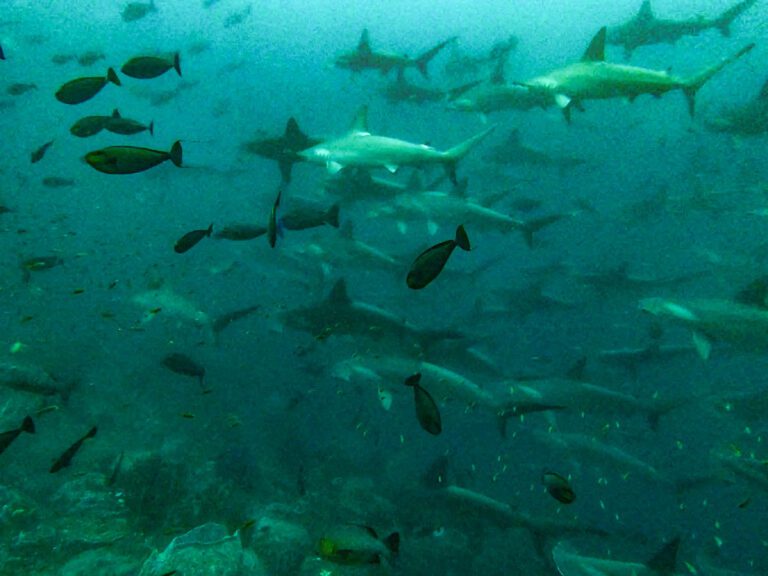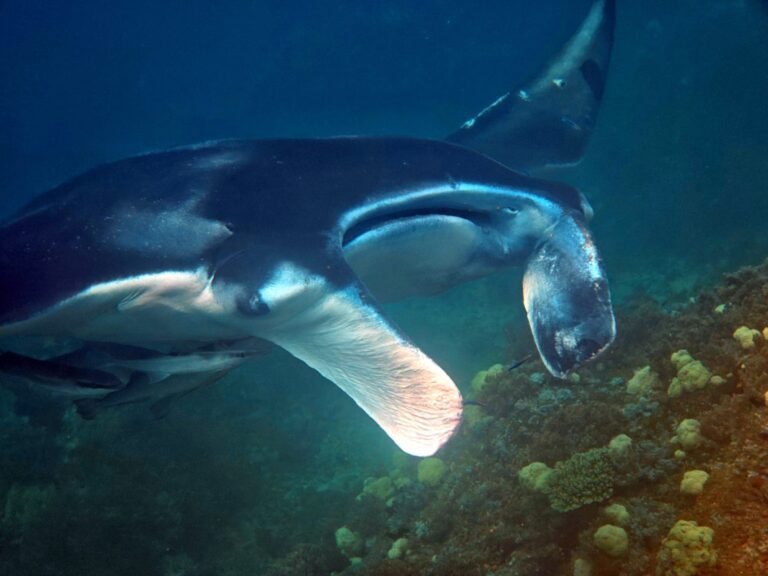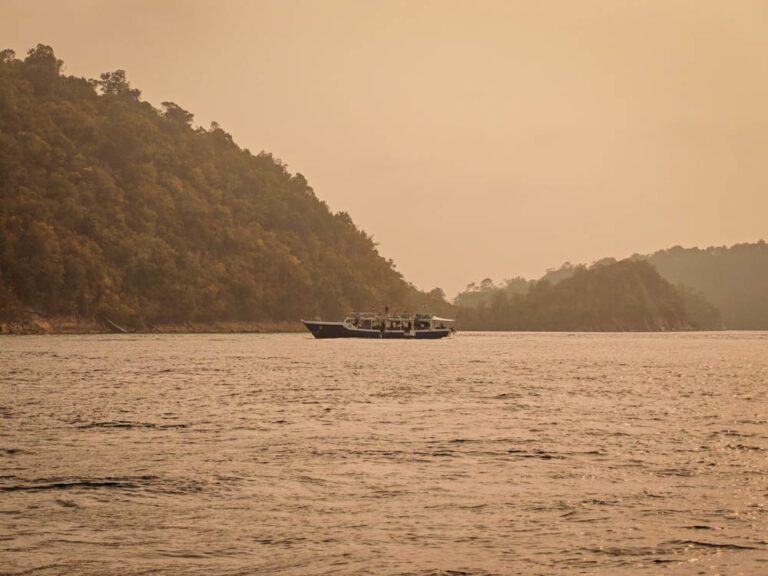
Six days into my second trip on Scubaspa Zen, with eleven hammerheads already in my logbook, the plan changed. Forest-fire smoke had closed Kaimana airport, our port of disembarkation, so the crew turned the boat north and rewrote the second half of the trip: Raja Ampat instead of Triton Bay. It turned out to be some of the best diving I have had in Raja Ampat in years, and the clearest test I have seen of how a liveaboard copes when things do not go to plan.
I have now sailed on Scubaspa Zen twice, four years apart, and it earns a 5/5 from me. Read on for everything I wanted to know before booking: which cabin to ask for, what the food is really like, how the separate dive boat changes your day, what the spa adds for divers and non-divers, and who should look elsewhere.
I first sailed on Scubaspa Zen in November 2022, on a 10-night diving trip from Ambon to Sorong across the Banda Sea. I came back in October 2026 for a second 10-night trip on the Scuba & Spa package. It was sold as Ambon to Kaimana via Triton Bay, and it became Ambon to Sorong via Raja Ampat halfway through, for a reason I explain below. This Scubaspa Zen review is based on those two trips. It covers the boat in detail first, then both trips day by day. If you are travelling with a non-diver, or you are curious about the snorkelling, spa and yoga side of the Zen, I wrote a separate guide to Scubaspa Zen for non-divers.
Scubaspa Zen is also one of the ten boats in my guide to the best luxury liveaboards in Indonesia, which ranks every one of them on price, cabins and the kind of diver each suits.
The underwater photos in this review were taken on my phone inside a DIVEVOLK housing. If you are choosing a housing for your own phone, my DIVEVOLK vs SeaLife SportDiver comparison explains which one to buy.
Scubaspa Zen at a Glance
| My rating | 5 / 5 after two trips (2022 and 2026) |
| The concept | A 53-meter phinisi with a full spa on board and a separate 21-meter dive boat. Dive, snorkel, spa, or mix all three. |
| Best for | Divers who want comfort between dives; couples where one person doesn’t dive; anyone who hates gearing up on a tender |
| Not for | Divers who want to dive four times a day and skip everything else; anyone who needs air-conditioned lounges |
| Where it sails | Raja Ampat, Banda Sea and the Maluku Islands, Triton Bay, Cenderawasih Bay, Komodo, Halmahera, the Forgotten Islands, depending on the season |
| My trips | Nov 2022: Ambon to Sorong via Banda and Misool (Scuba package). Oct 2026: Ambon to Sorong via Banda and Raja Ampat (Scuba & Spa package; planned for Kaimana and Triton Bay, rerouted because of the Papua forest fires) |
Why Trust This Scubaspa Zen Review?
I have logged more than 1,500 dives and sailed on more than 40 liveaboard trips across Indonesia, the Maldives, the Red Sea, Mexico and the Galapagos. I have been to Raja Ampat and Komodo more than 20 times. This Is Luxury Travel has reviewed more dive liveaboards than any other luxury travel publication, so when I write about a boat, I am comparing it with the boats it actually competes against.
I have now sailed on Scubaspa Zen twice, four years apart. That matters for a review: a boat that is excellent in its second season can be tired by its sixth. The Zen was better in 2026 than in 2022. I have also done two trips on its Maldivian sister ships, so I know how the Scubaspa formula works and where the Indonesian boat differs.
When I review a liveaboard I look at the diving, of course, but also at the things that make or break a trip: cabin comfort, food, dive organization, guide quality, safety, camera facilities, internet, value for money, and how it compares with competing boats in the same destination. My aim is not to tell you a boat is “good” or “bad”, but to help you work out whether it is the right boat for you.

The Boat: Facts and Figures
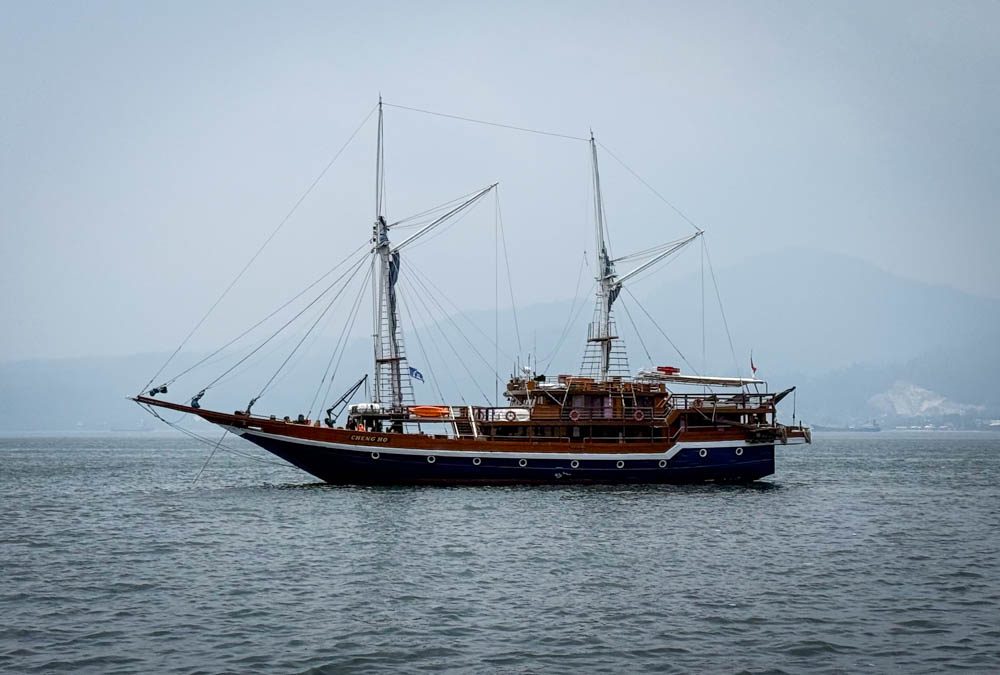
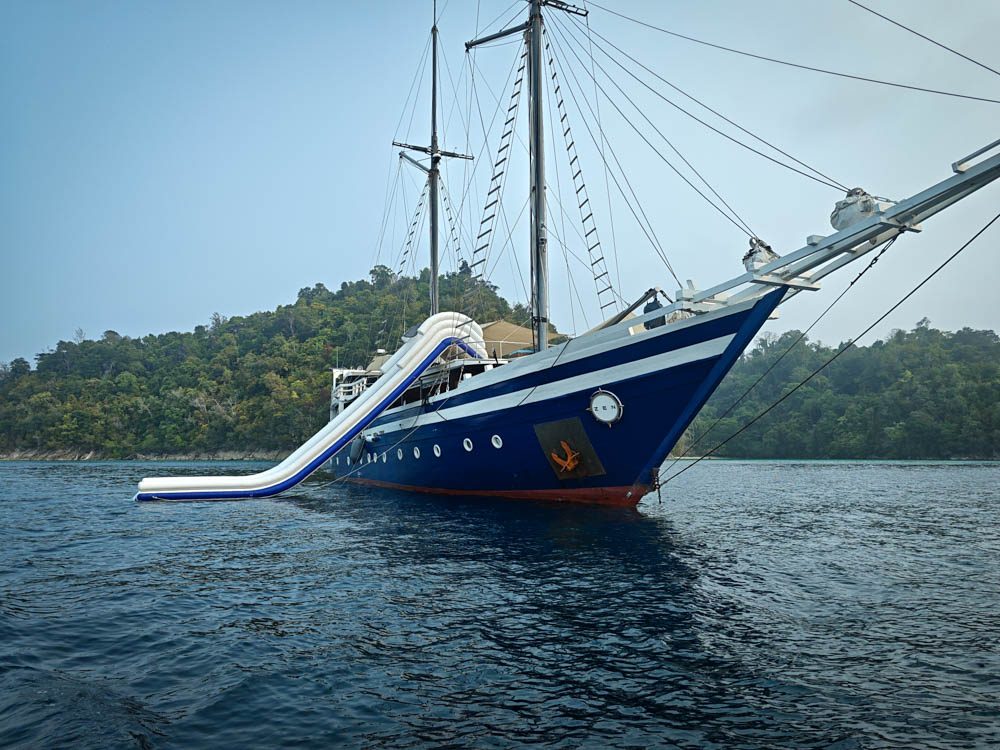
Scubaspa Zen is a two-masted wooden phinisi built in 2012 by the Konjo boat builders of South Sulawesi, the same community that has built Indonesia’s traditional sailing ships for centuries. Scubaspa, the company behind the Yin and Yang in the Maldives, took the boat over and relaunched her as the Zen in June 2022. She is 53 meters long with three decks, nine cabins for a maximum of 20 guests, and a crew of 27 that includes five dive masters, two spa therapists, three in the kitchen, two bartenders, and eleven sailors and mechanics for the ship and the dhoni.
| Type | Two-masted wooden phinisi, three decks |
| Built | 2012, Konjo boat builders, South Sulawesi; relaunched as Scubaspa Zen in June 2022 |
| Length | 53 m (beam about 9.5 m) |
| Guests | 20 in 9 cabins |
| Crew | 27 on my 2026 trip: cruise director, 5 dive masters, spa therapists, 3 in the kitchen, 2 bartenders (one also runs the snorkelling), 11 crew for the ship and dhoni, housekeeping |
| Dive boat | Separate 21 m dhoni with its own compressors, air and Nitrox membrane |
| Compressors | 2 Bauer high-pressure compressors plus a low-pressure Atlas Copco unit for the Nitrox membrane |
| Power | 220–240 V, multi-plug sockets in cabins and at the camera station |
| Internet | Starlink satellite Wi-Fi with two dishes; 1 GB free per guest, then 50 USD per 10 GB |
| Safety | Three life rafts, oxygen, a defibrillator (AED), EPIRB and satellite phone, fire extinguishers in every cabin, Nautilus GPS locator and SMB for every diver; the dhoni doubles as the evacuation vessel |
What sets the Zen apart from every other boat I have dived in Indonesia is the two-boat system. The main ship stays dry, quiet, and clean; all the diving happens from the dhoni. I explain what that means in practice in the diving section below.
One thing to know before you book: all the common areas on the Zen are open-air. Only the cabins are air-conditioned. The dining room, the bar and the sundeck are all open to the breeze. The spa is air-conditioned; I never found this a problem. There is almost always a good breeze at sea, you get used to the climate within a day or two, and it is actually better for diving: going from a cold, air-conditioned lounge straight into warm water and back again is thought to increase the risk of decompression sickness. If you are the kind of traveller who needs an icy lounge to retreat to, this is not your boat. If you like living outdoors, it is perfect.

The main deck
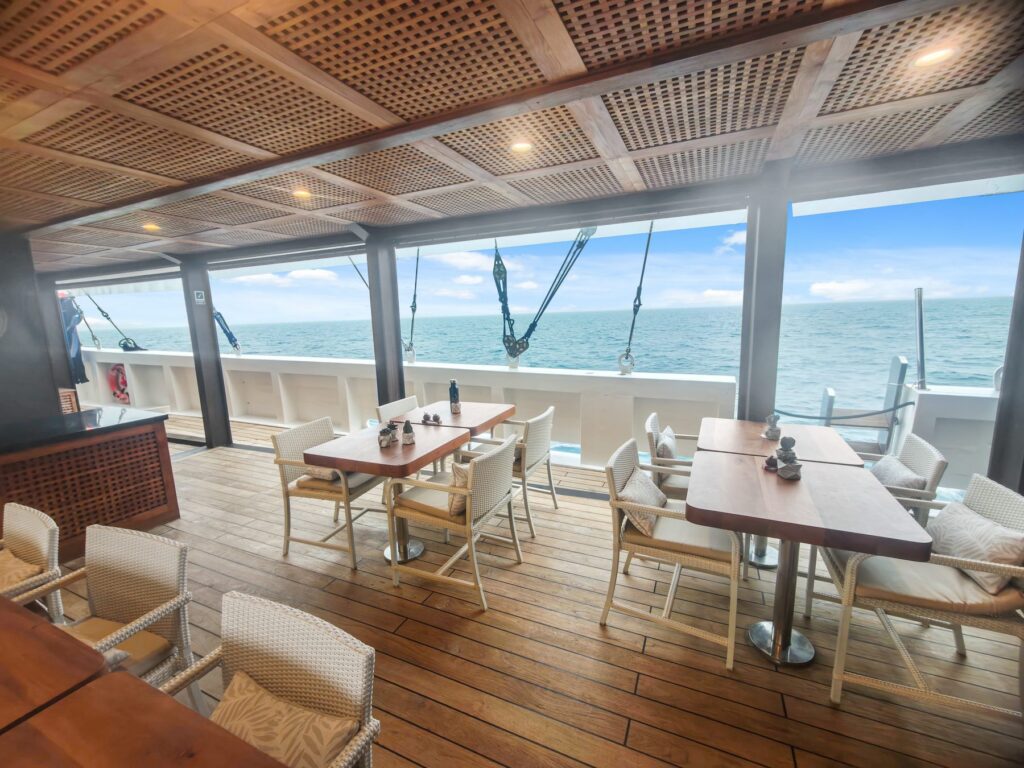
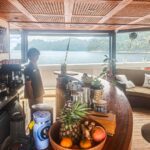
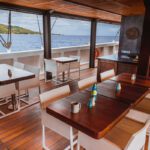
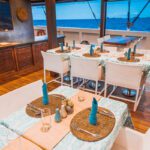
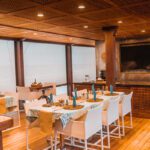
The main deck is the social heart of the boat: the restaurant, the bar and the camera station are all here. The bar has a pretty rounded shape and is well stocked, with craft beers, wine and proper cocktails.

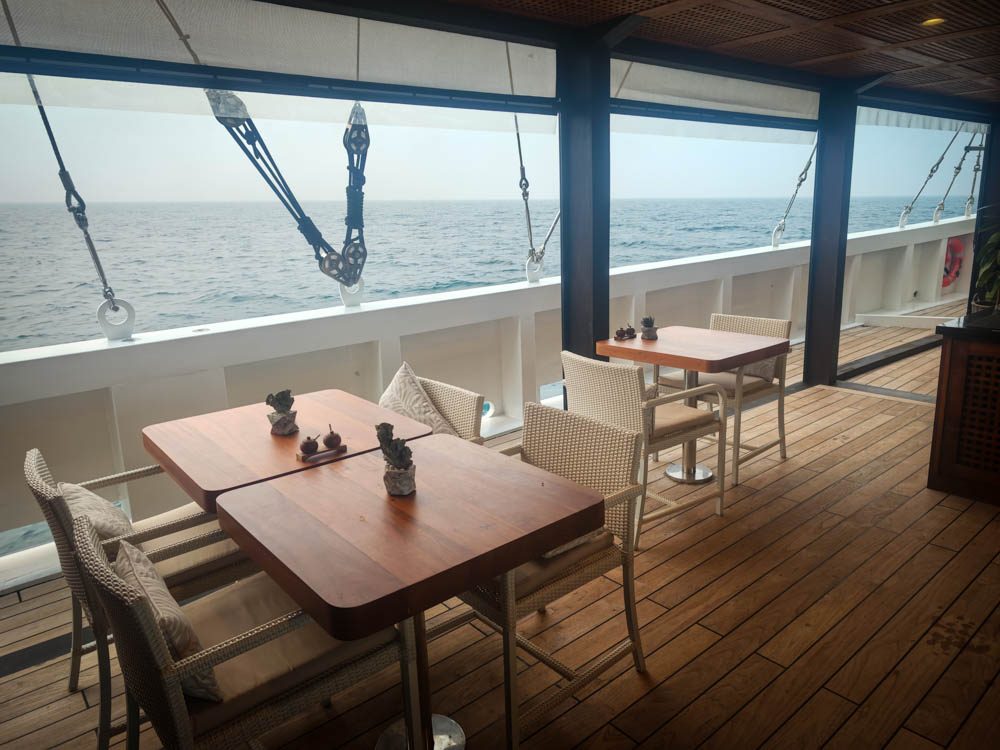
The dining room is open on both sides so the breeze flows through, and it is a lovely place to sit while the boat is underway. There is a buffet counter for lunch. The dining tables can be set for two, four or six, so you can eat with your partner or join a bigger table and meet the other guests.
The smoking area is on the main deck, just in front of the bar, so smokers do not have to hide at the stern.
The camera station has anti-slip mats and plenty of mains and USB sockets, and because it is semi-outdoors and not air-conditioned, your camera will not fog up with condensation when you take it into the water. One house rule for photographers: external batteries, for strobes, torches and cameras, must be charged at the camera station and not in the cabins. It is the standard fire precaution on a wooden boat, and it means planning your charging around the dives rather than overnight by the bed.


The sundeck
The sundeck on the Zen is huge for a boat of this size: Scubaspa quotes 168 square meters. Since my first trip they have enlarged the shaded area and added several comfortable sofas, so there is now a proper outdoor lounge up there as well as the rows of loungers. If you want sun, the deck is so large that you will always find a spot in it. Indonesia sits on the equator and the sun is fierce, so bring real sunscreen.
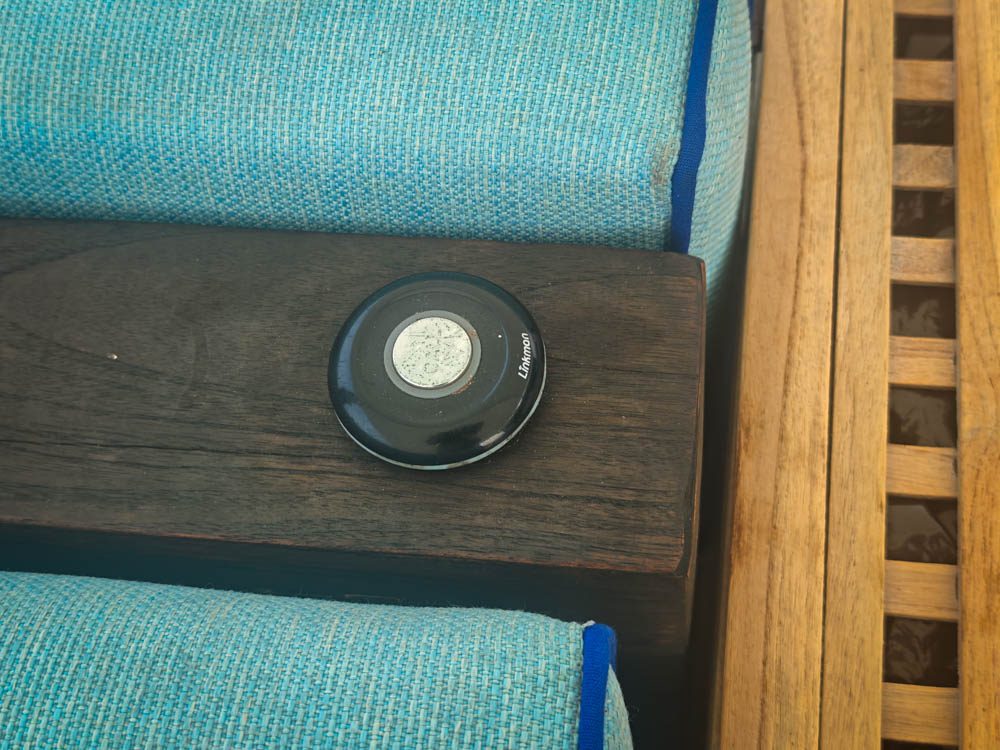
My favorite detail is small: there are wireless call buttons mounted between the loungers. Press one, and someone comes up from the bar to take your drink order. You never have to leave your spot.

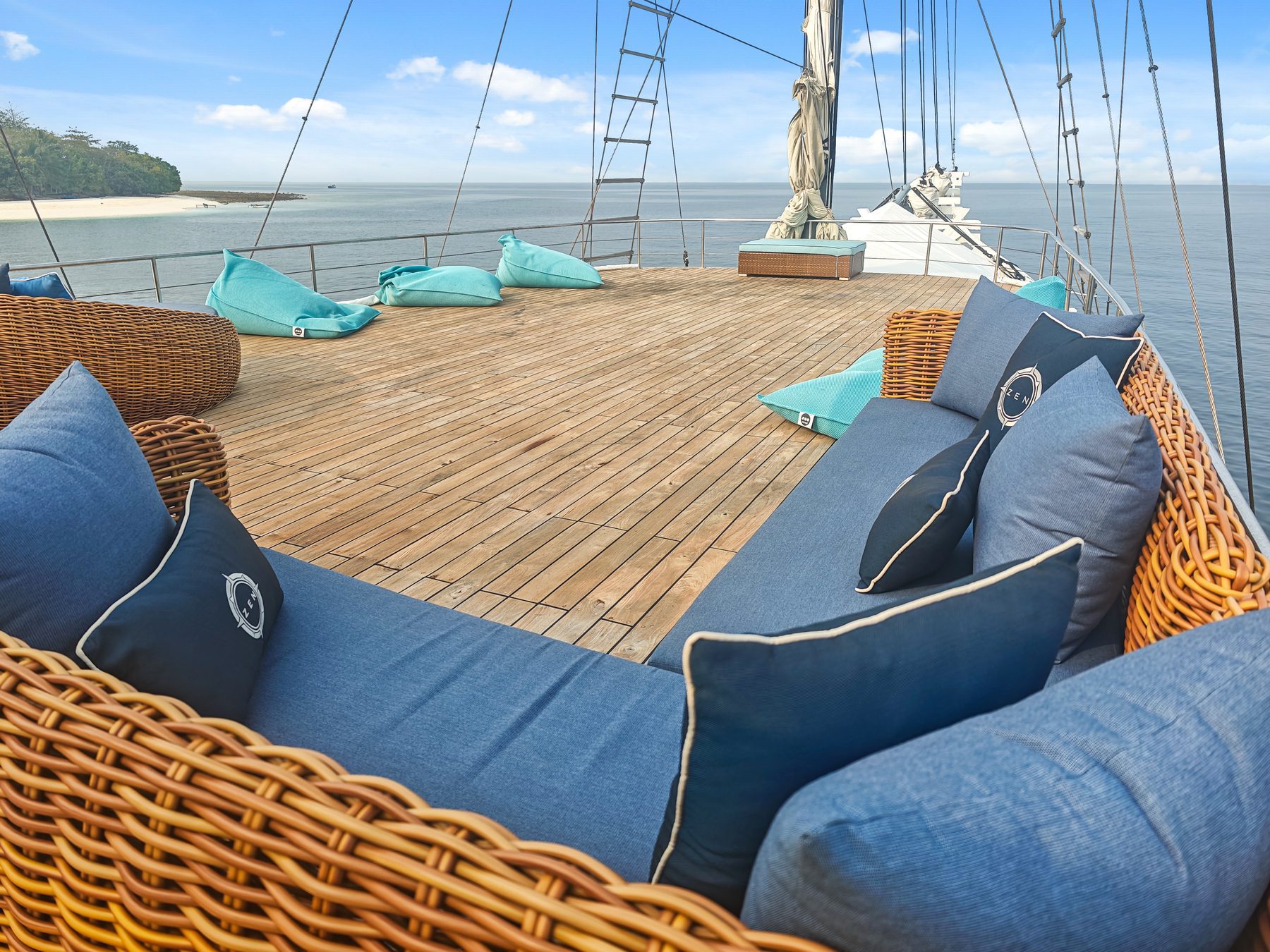
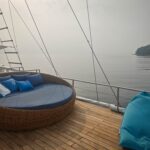
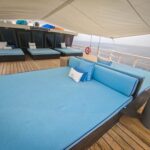

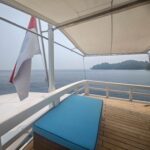
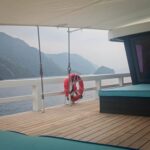
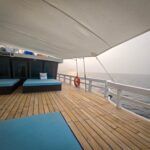
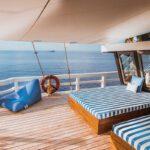
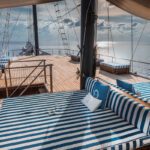
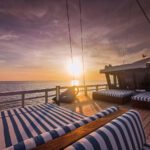
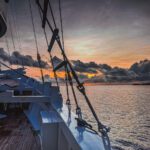
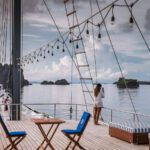

The sundeck is where you want to be during the long crossings. On both my trips we saw dolphins from up here while crossing the Banda Sea, and in 2022 a family of blue whales off Koon. It is also where sunset cocktails and the occasional dinner under the stars happen. At night, when the boat is far from any town, the crew turn the top-deck lights off while navigating.
INSIDER TIP
If the sky is clear, check out the top deck at night while the boat navigates away from civilization. The stars will appear much bigger and be enthralling.
The spa cabin is also up here; more on that in the spa section below.
The sundeck is also where the 6 am yoga sessions happen, and it is big enough for group activities or simply for lying down and watching the bow cut through the water on a crossing.
Scubaspa Zen Cabins: Which One to Book
Scubaspa Zen has nine cabins in four categories. All have individually controlled air-conditioning, an en-suite bathroom and a safe.
| Cabin | Deck | Size | Number |
|---|---|---|---|
| Owner’s Manta Suite | Main deck, stern, with private terrace | about 60 m² | 1 |
| Cowrie Suite | Main deck | about 18–20 m², sofa for a third person | 1 |
| Dolphin Suite | Main deck | about 17–18 m² | 1 |
| Sea Star Suites | Lower deck | about 16 m² | 6 |
Sizes are from Scubaspa’s listings and vary slightly between booking sites.
The Owner’s Manta Suite
The Manta Suite is the one to book if you can. It is about 60 square meters, sits at the stern of the main deck, and opens onto its own private overwater terrace with a lounge and a panoramic view of the sea. I have been on a lot of Indonesian liveaboards and I think this is probably the nicest private terrace on any dive boat in the country. It is a truly special room, but you need to book it early: it is often the first cabin to go.

The Sea Star Suites
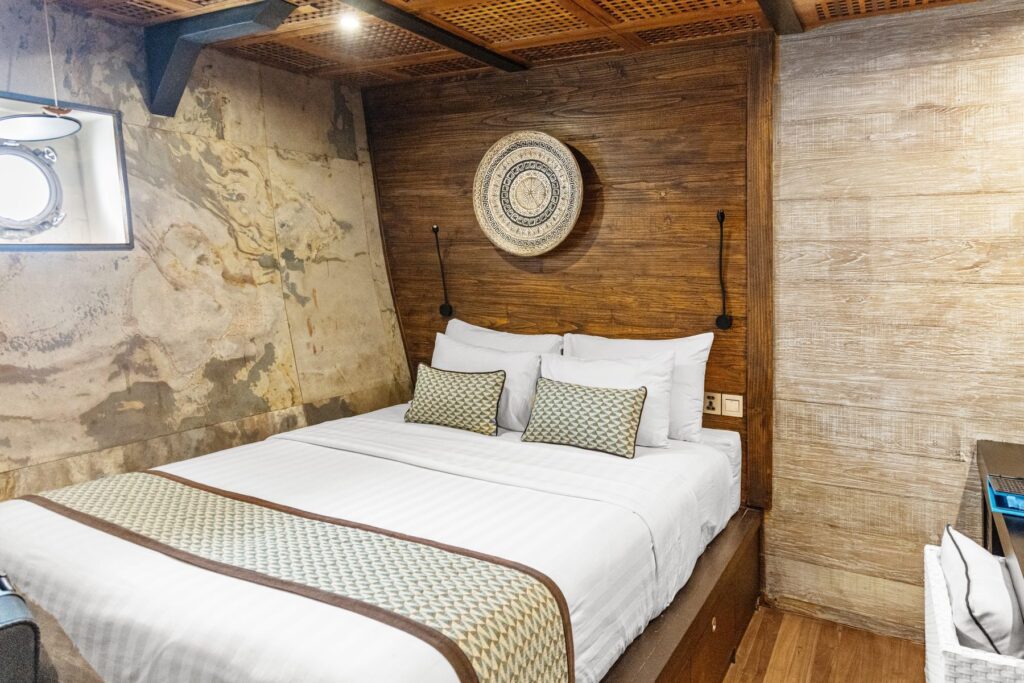
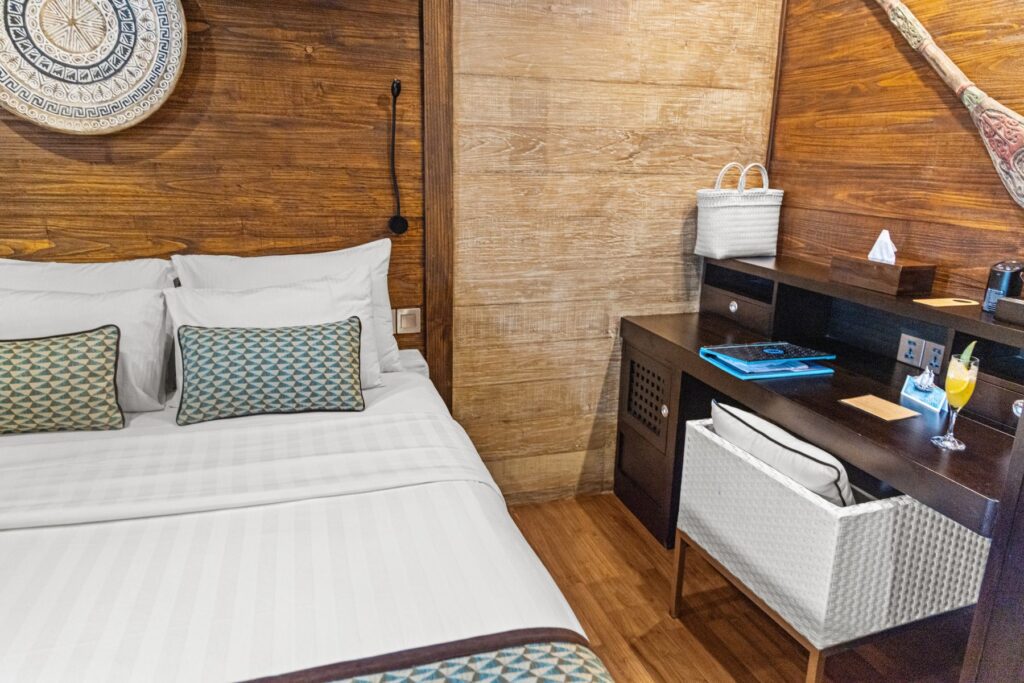
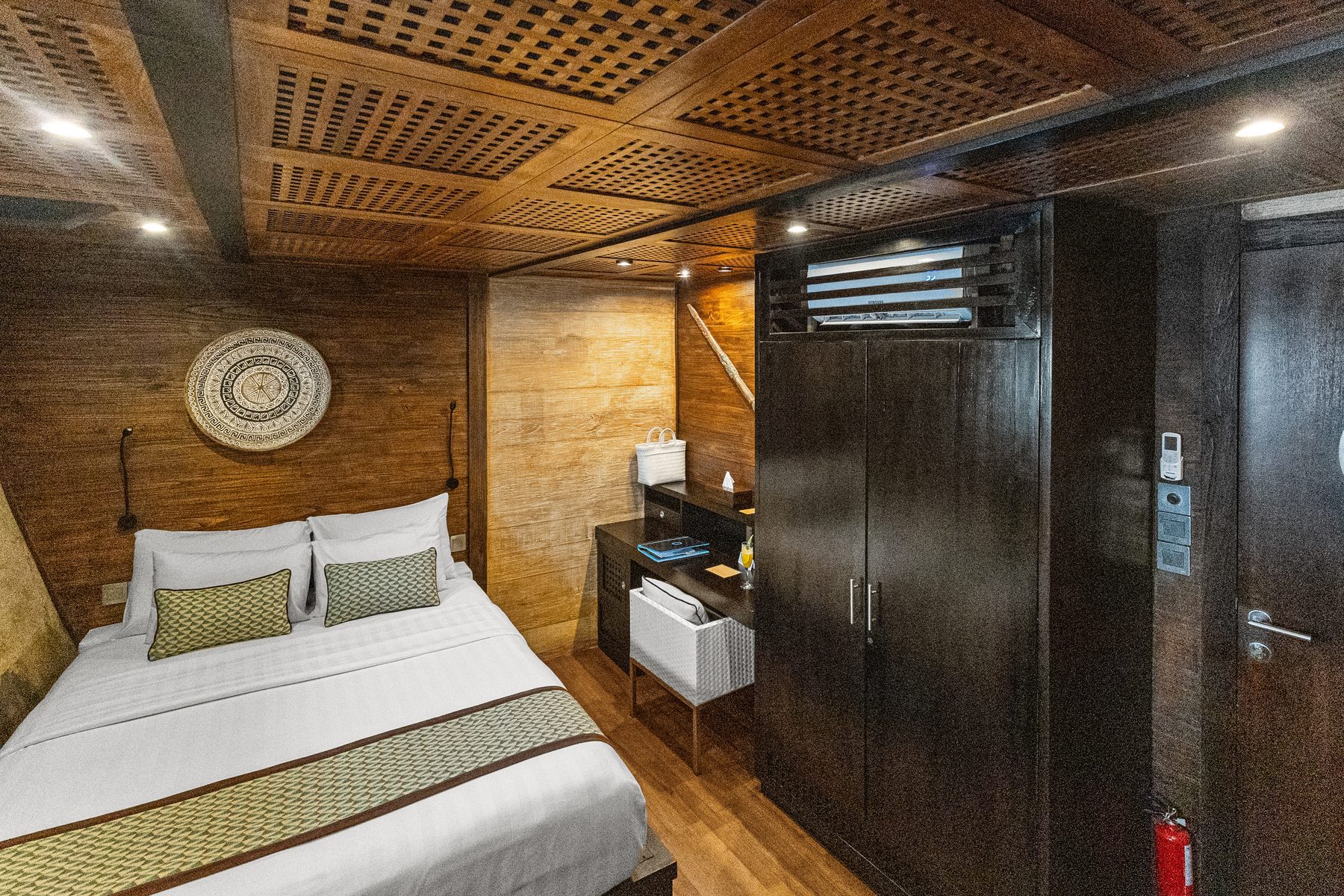
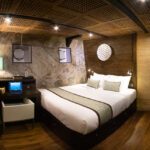
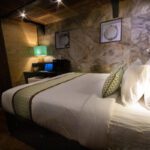
The six Sea Star Suites on the lower deck are the entry-level cabins, and they are where most guests sleep. I stayed in Sea Star number 2 in 2022 and number 4 in 2026, and they are very similar. At about 16 square meters they are generous for an Indonesian wooden boat, and the ceiling height is the detail nobody mentions: at over two meters (7 feet) it is higher than on most liveaboards, and it gives the cabin a feeling of space you do not expect below deck.
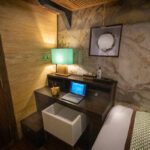
Each cabin can be set up with two twin beds or a double. The joinery is exotic hardwood with handmade Balinese decoration. Besides the bed there is a small sofa and a writing desk, with the safe built into the desk. Storage is the best I have seen on a boat: a large wardrobe, cupboards under the bed, under the sofa and in the bathroom. Bathrobes for the spa and for walking to the dhoni hang in the wardrobe. Two portholes let in daylight; the lighting is on a dimmer with several settings, and there are plenty of charging points with international adaptors built in.
INSIDER TIP
Which Sea Star to ask for? Number 4. The even numbers, 2, 4 and 6, are on the port side, away from the engine exhaust and from where the dhoni ties up, so they are quieter and get no diesel smell at anchor. Cabins 1 and 2 are the closest to the engine room; I slept in 2 in 2022 and it was fine, the boat is well soundproofed, but 4 is the same cabin a few meters further from the engines, so if you get a choice, ask for that one.
The bathroom
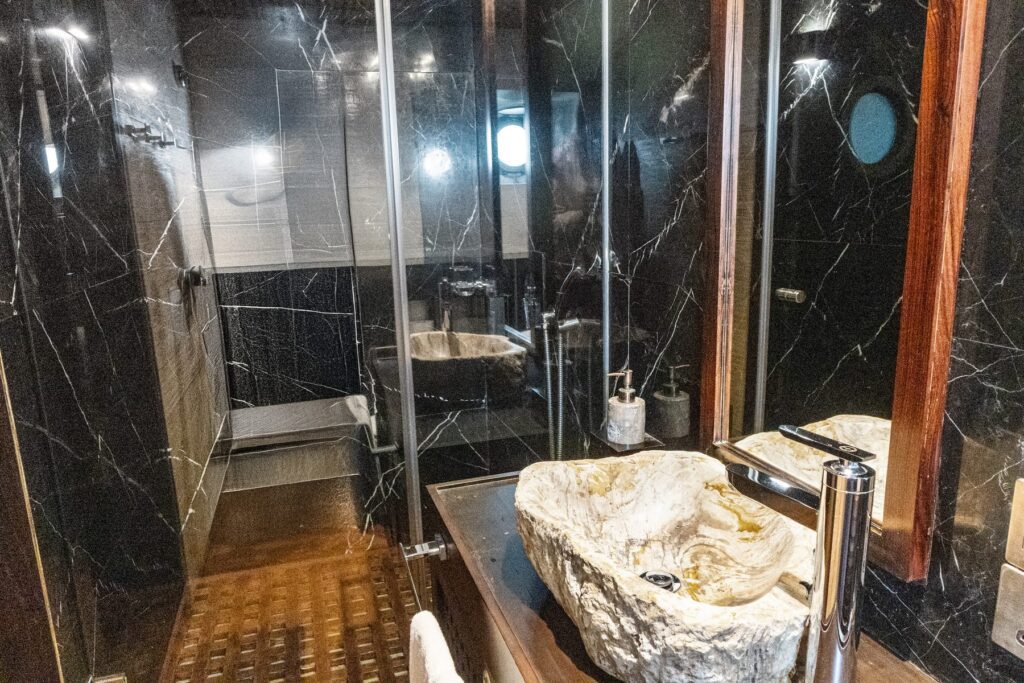
Every cabin has a private bathroom with a shower, finished in petrified wood, marble and onyx with Balinese handmade details. Shower gel, shampoo and conditioner are provided; the lemongrass shower gel smells wonderful. The toilet is an electric marine toilet, so do not put any paper in it or you will block the system.

INSIDER TIP
If the shower water feels tepid, turn the tap all the way to the left and it gets properly hot.
Food on the Scubaspa Zen
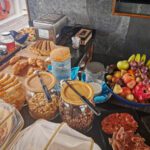
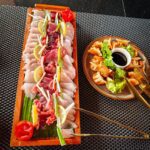
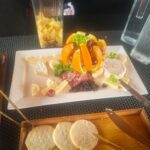
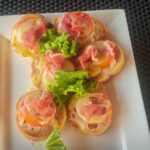
You will not go hungry on the Zen: there is food five times a day. The day starts with a light breakfast around 5.30 or 6 am before the first dive, with bread, cakes, fruit and cereals, and a proper coffee machine for the caffeine-dependent. Unlike many Indonesian liveaboards, premium coffees are included with breakfast; tea and coffee are chargeable after that.
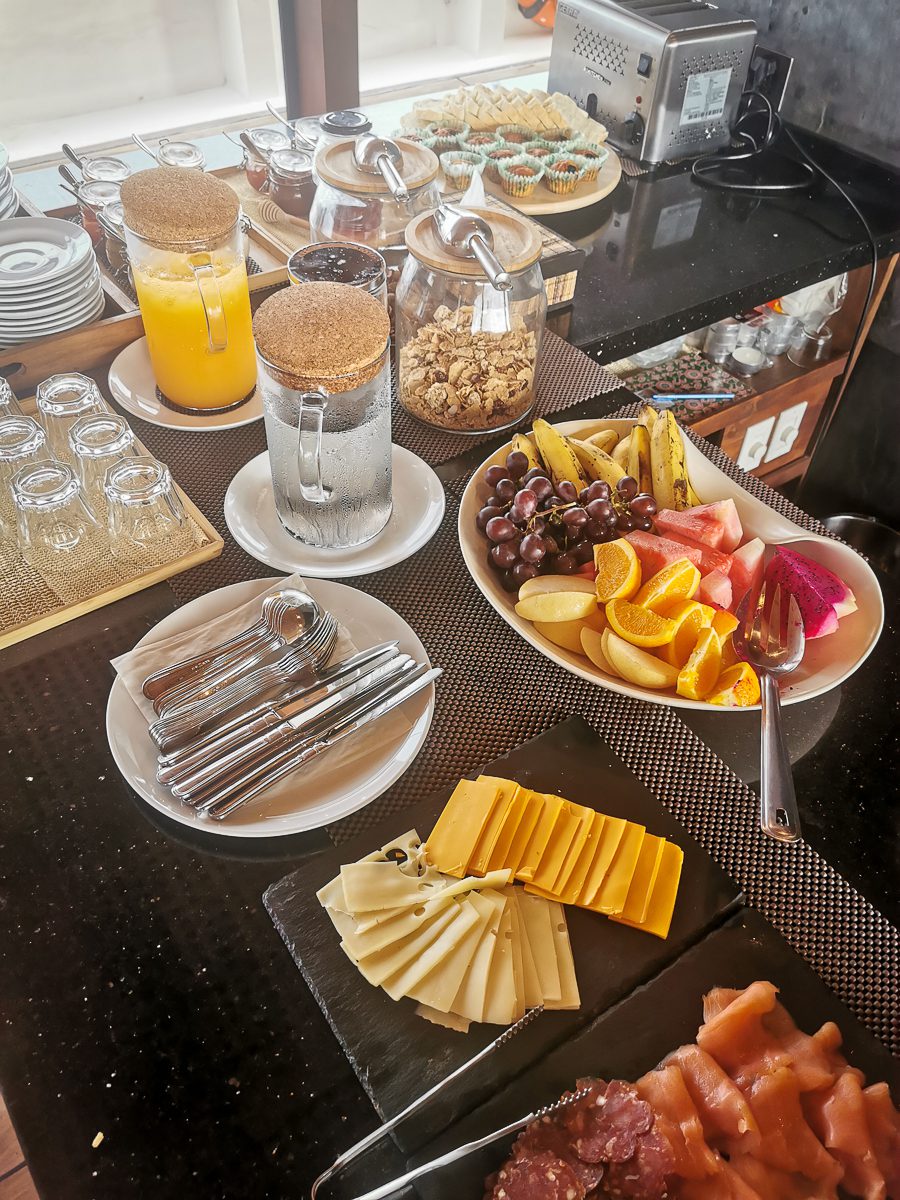
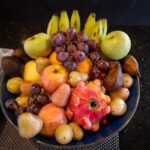
The full breakfast after the first dive is a cooked affair: toast and croissants, an egg station where the chef cooks your eggs to order, and a selection of hot dishes that changes every day, plus cold cuts, cheese and a tropical fruit platter. My one disappointment on the whole trip was the bread, which is a common complaint on Indonesian boats and no worse here than elsewhere.
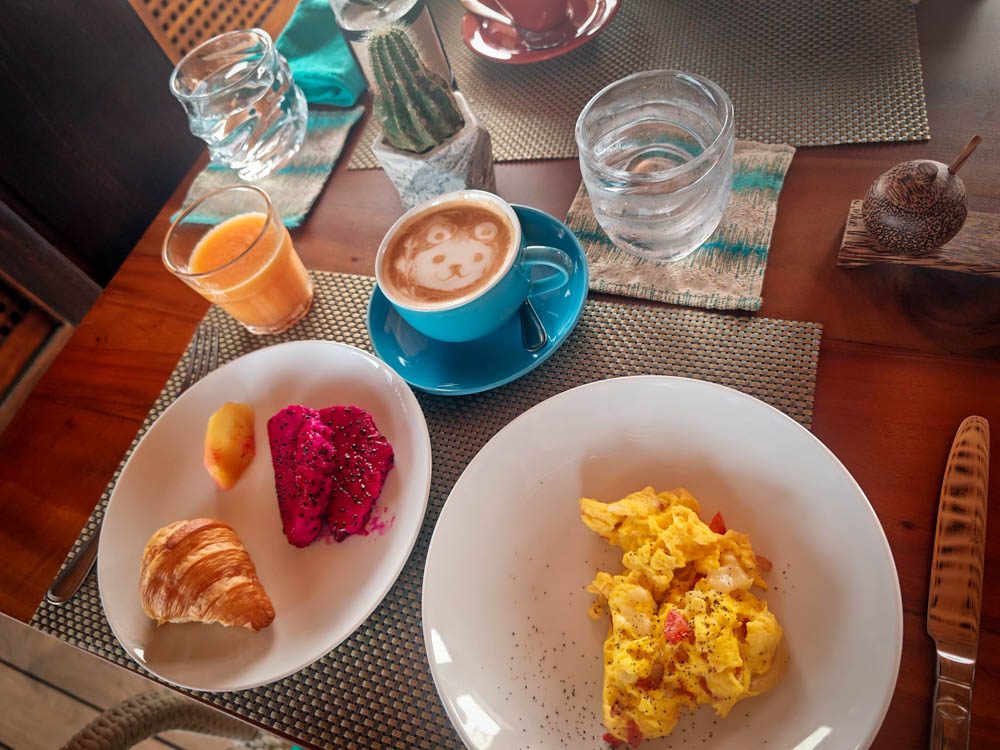
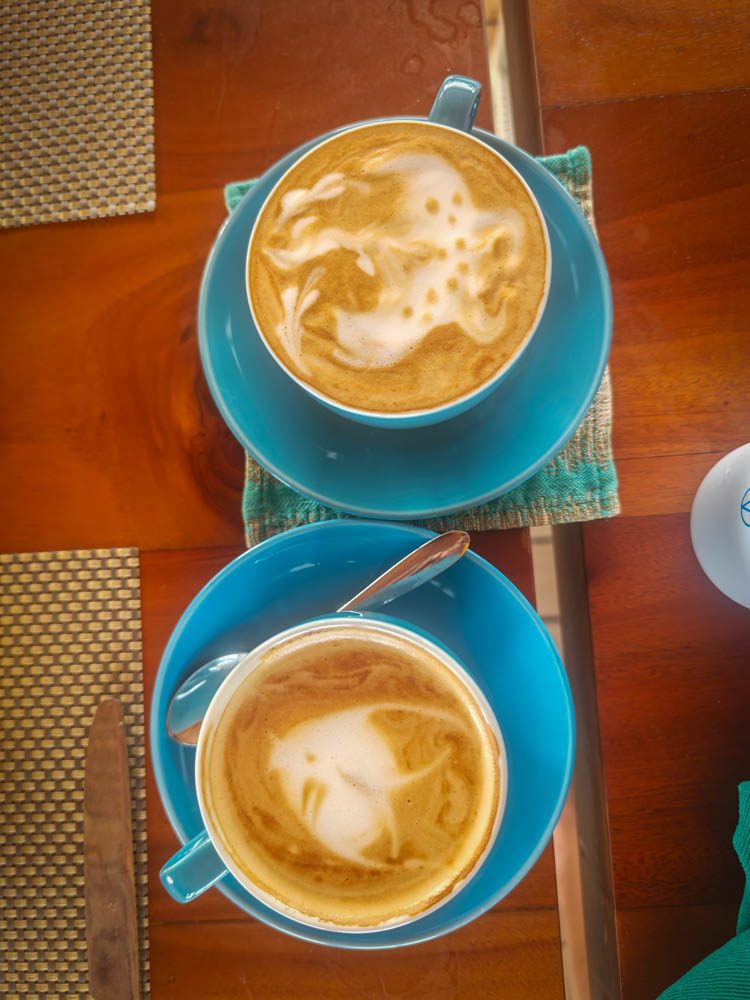
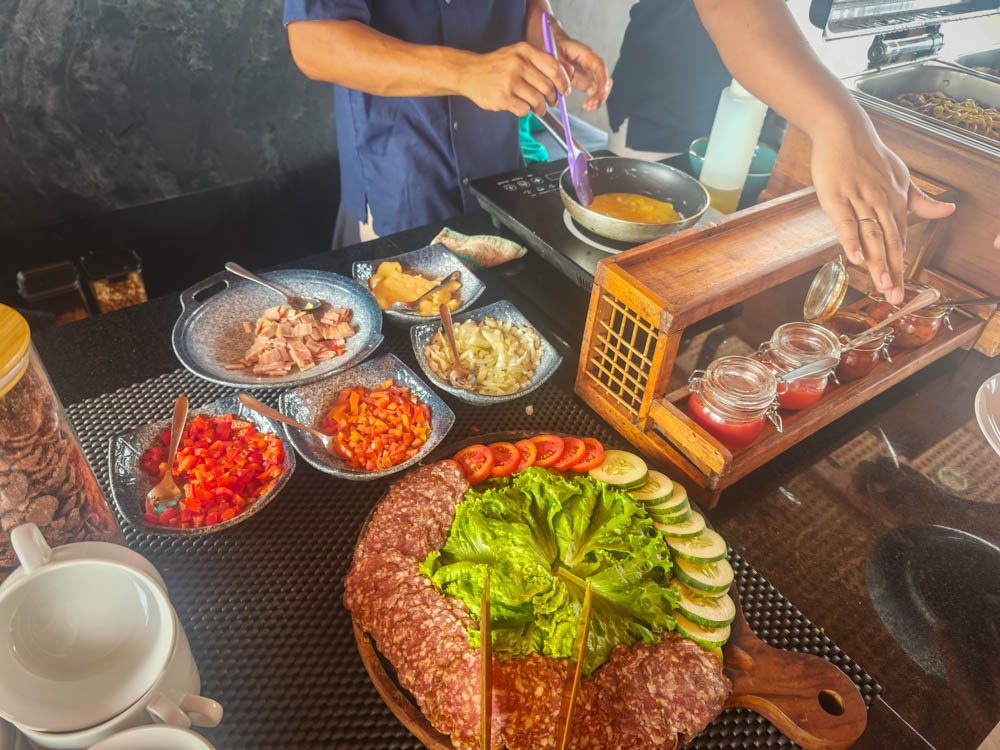
Breakfast in 2022
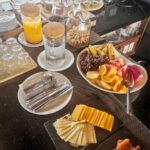
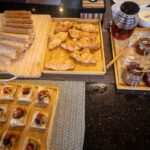
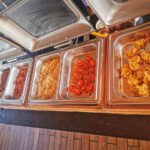
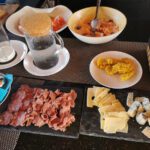
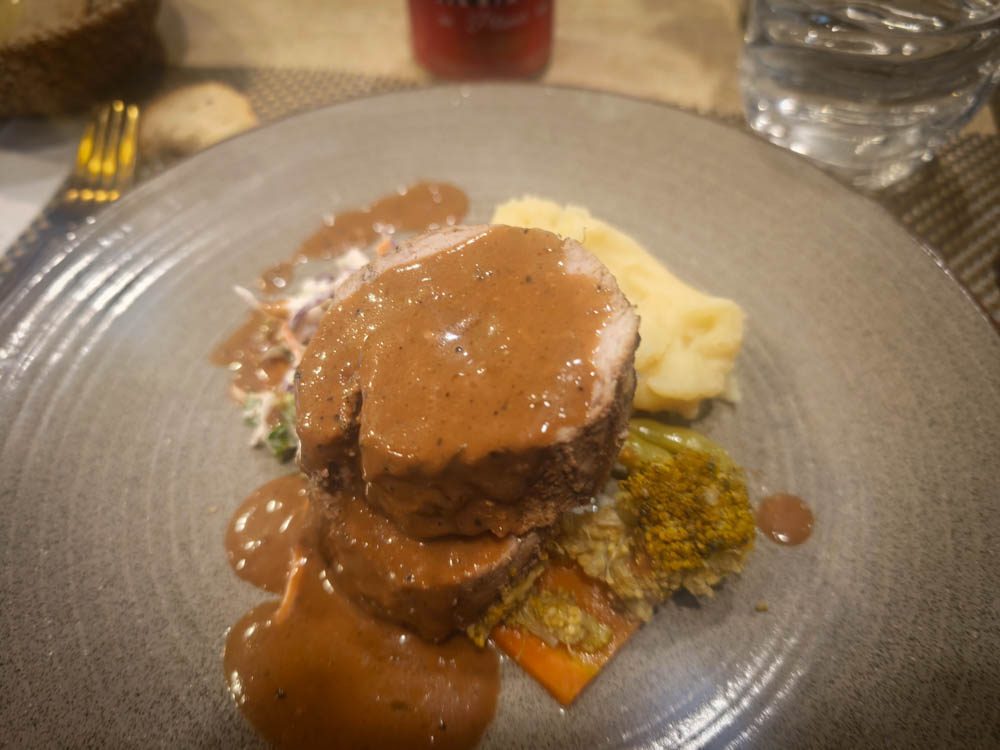
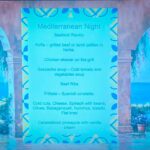
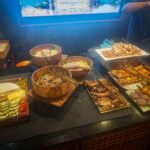
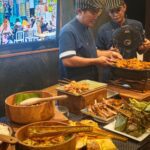
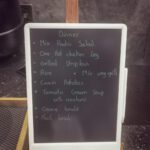
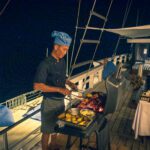
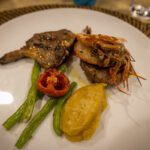
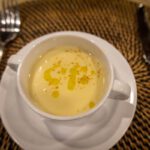
Lunch is a buffet, usually built around a meat dish and a fish dish, with lots of salads and vegetables. Dinner is more sophisticated. On most nights it is à la carte: a printed menu arrives at lunch with a soup, three mains and a dessert, you tell the crew what you want, and the plate arrives at your table in the evening. To give you an idea of the standard, the menus on my 2026 trip included grilled beef roulade or pan-seared black pepper tuna with wasabi aioli, followed by crème brûlée; grilled duck in black pepper sauce or pan-seared salmon in saffron cream, with chocolate brownies and vanilla ice cream; chicken cordon bleu or steamed fish in caper sauce with Lyonnaise potatoes; grilled king prawns in butter cream or duck with mashed potatoes and vanilla panna cotta; and, on the last night, grilled lobster with Indonesian tomato salsa or tenderloin steak in rosemary sauce. There is always a vegetarian main, from lentil bolognese to vegetable cannelloni. On the other nights there is a themed buffet instead: on our trip a Mediterranean night, an Indian night and an Indonesian night.
The food was good in 2022, and it is better now. The beef roulades on the first night of my 2026 trip would not have been out of place in a good restaurant on land, and overall the quality was very good, with dinner the high point. The kitchen is also good at adjusting for intolerances and food preferences; tell them at booking and again on board and it is handled without fuss. The kitchen is run by Suroto, with Nada as sous chef.
Snacks
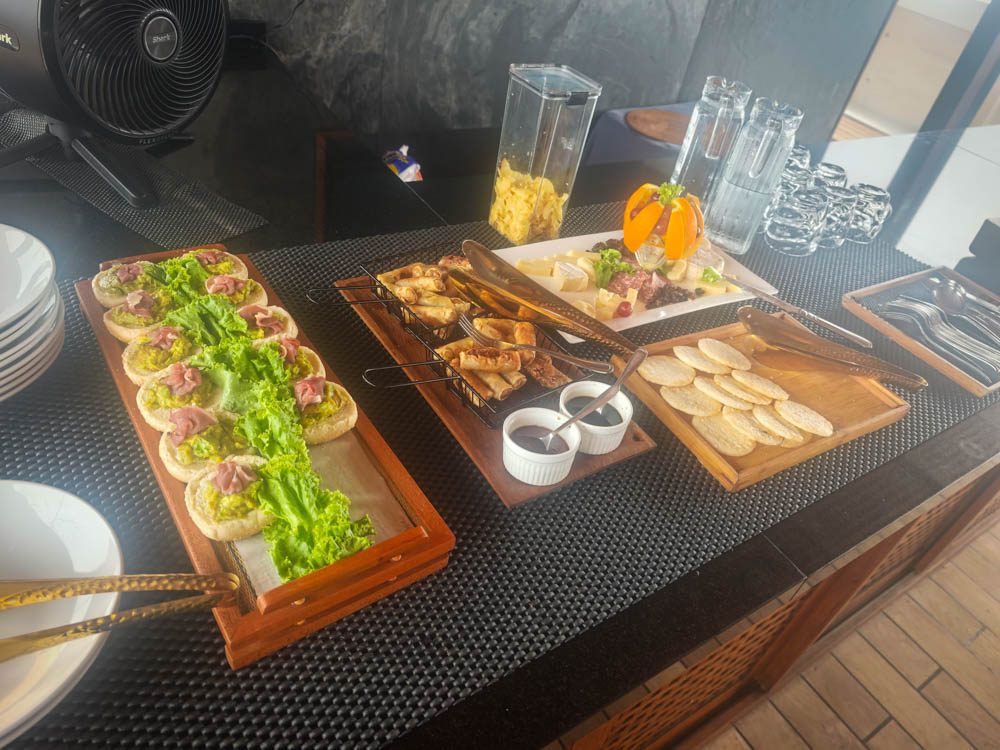

Dinner, including the live-cooking theme nights





Drinks on the Scubaspa Zen
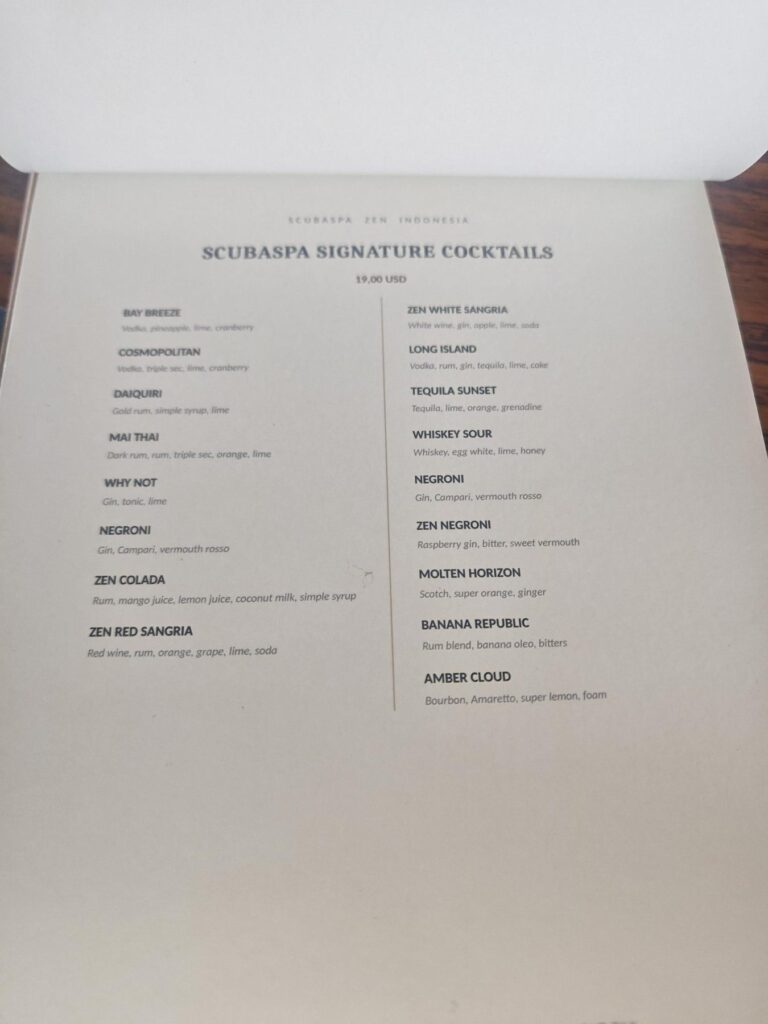
Drinks are the one thing to budget for. Apart from water, and the premium coffees and tea at breakfast, nothing is included in the cruise price, and the bar prices are closer to American than Indonesian: a Bintang is 5 USD and a Kura Kura craft lager 8, fresh juices are 4, smoothies 9, a 25 ml measure of Glenfiddich or Johnnie Walker Black 12, and every cocktail on the signature list is 19 USD, plus tax and service.
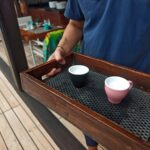
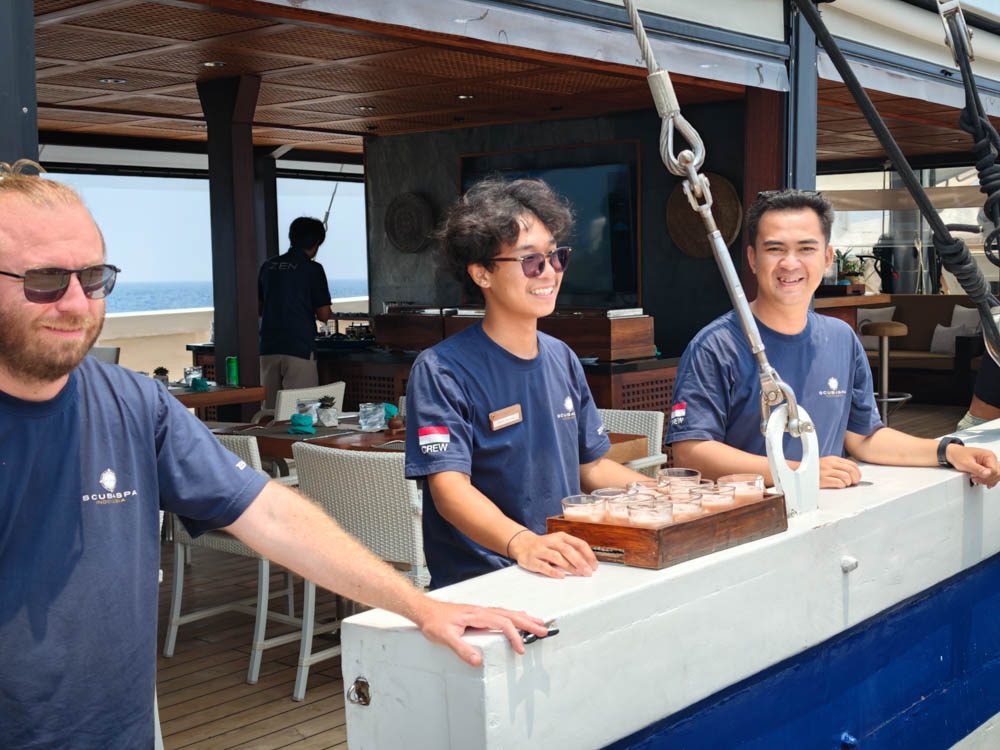
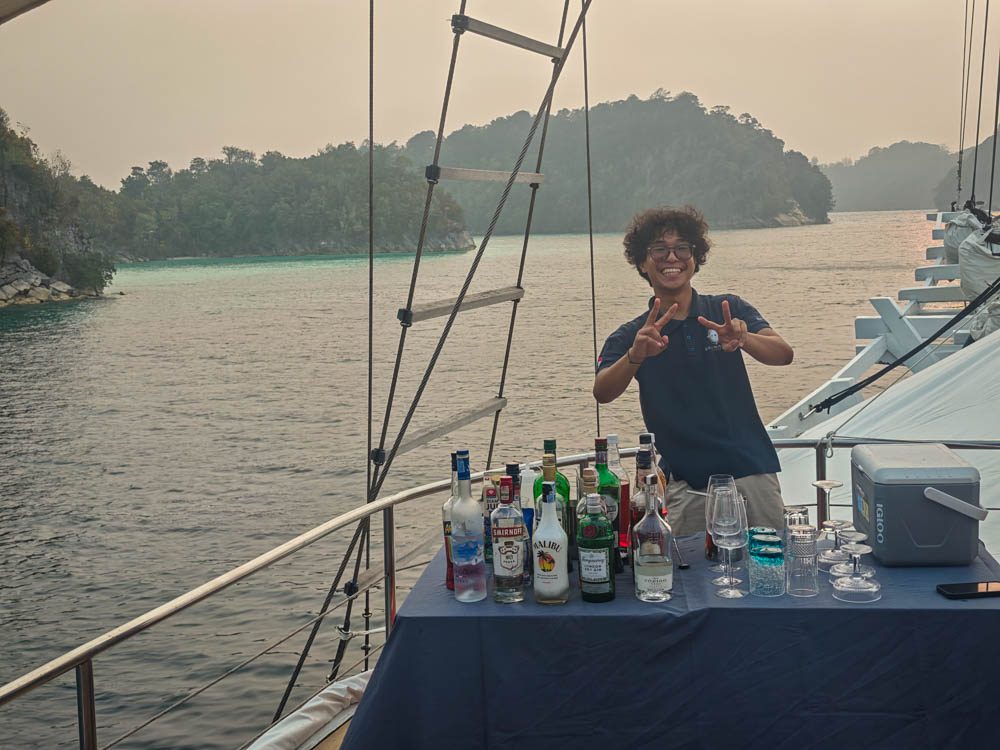
The bar is worth it. The cocktail list reads like a trendy New York bar’s, and it is executed like one, with the classics alongside house creations such as the Zen Negroni with raspberry gin, the Molten Horizon (Scotch, orange and ginger), the Banana Republic (a rum blend with banana oleo and bitters) and the Amber Cloud (bourbon, amaretto, lemon and foam). Yes and Agung, the two barmen, are genuinely creative. Beyond the cocktails, they sent up a different drink after every dive, a mocktail or, on cooler evenings, something warm; my favorite was a ginger and lemongrass latte. You could see the time that went into each one. There is a filtered-water tap near the bar for the refillable bottle you are given on arrival, so there is no reason to add plastic to the ocean.

Service on the Scubaspa Zen
The service is friendly and relaxed rather than formal. With a crew of 27 for a maximum of 20 guests, there is always someone around. On both my trips the cruise director was Dom, an Englishman who has been leading liveaboards in Indonesia for eleven years, with an infectious enthusiasm for diving. He is the reason this boat dives as well as it does. Great diving does not happen by accident: it takes skill to know which site to dive on which tide at which time of year, and Dom has that knowledge for every site on these routes. When the 2026 trip was turned around by the Kaimana closure, he rebuilt the second half from scratch and produced a diving and snorkelling itinerary I could not have improved on. He also knows the snorkelling. Dive sites are mapped and known to everyone; snorkel sites are not, and Dom has snorkelled this area enough himself to know where to send the snorkel boat so that snorkellers get a proper reef rather than the top of a dive site that happens to be deep. On both trips the crew seemed genuinely happy working together, which you feel as a guest.
Who’s who on board (October 2026)
For readers who like to know who they will meet, and because the people are most of the reason the boat works: Dom is the cruise director. Andy is the captain, with Supriadi, Saleh and Nasir as his officers and Anjes running the engine room. The dive dhoni has its own captain, Taufik, and its own engineer, David. The five dive masters are Emelio, Renaldo, Yadi, Jonathan and Gunawan; Renaldo guided my dives. Yes and Agung run the bar, and Agung runs the snorkelling. Suroto is the chef, with Nada and Miri. Ani is in the spa, and Allan and Desi keep the cabins. Crews change, so treat this as a snapshot.
Diving From the Scubaspa Zen
Despite the spa and the wellness packages, the Zen is very much a dive boat, and it will keep experienced divers happy. In 2026 there were only 13 guests on board, and the team still ran five dive groups and one snorkelling group. Most dive groups were two people. That is real luxury.
The dive dhoni
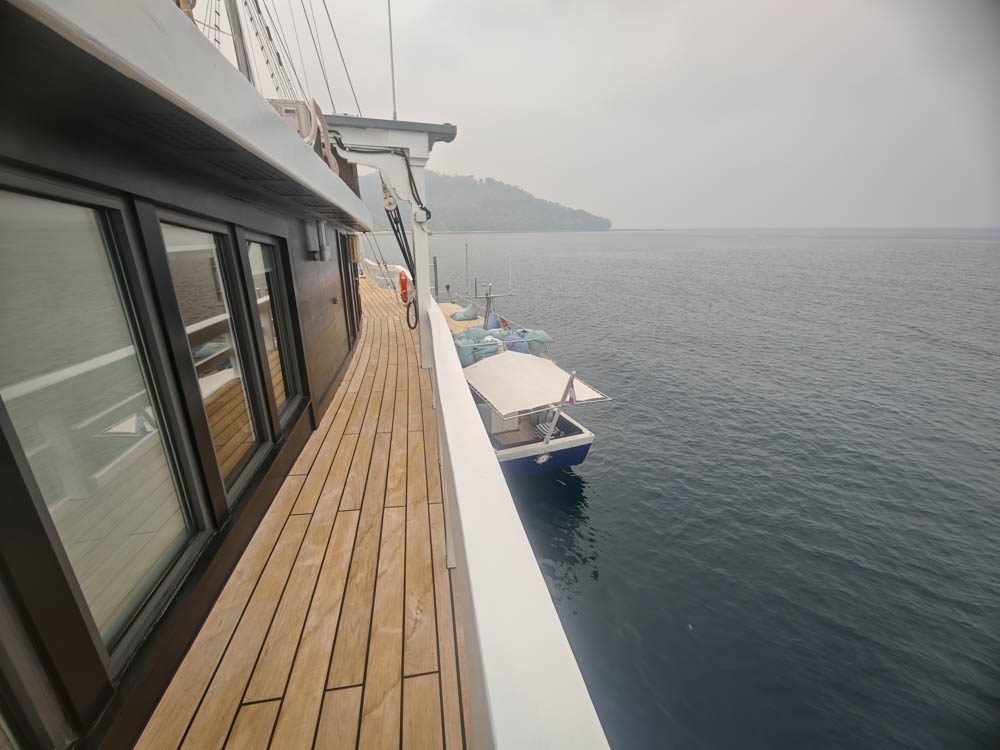
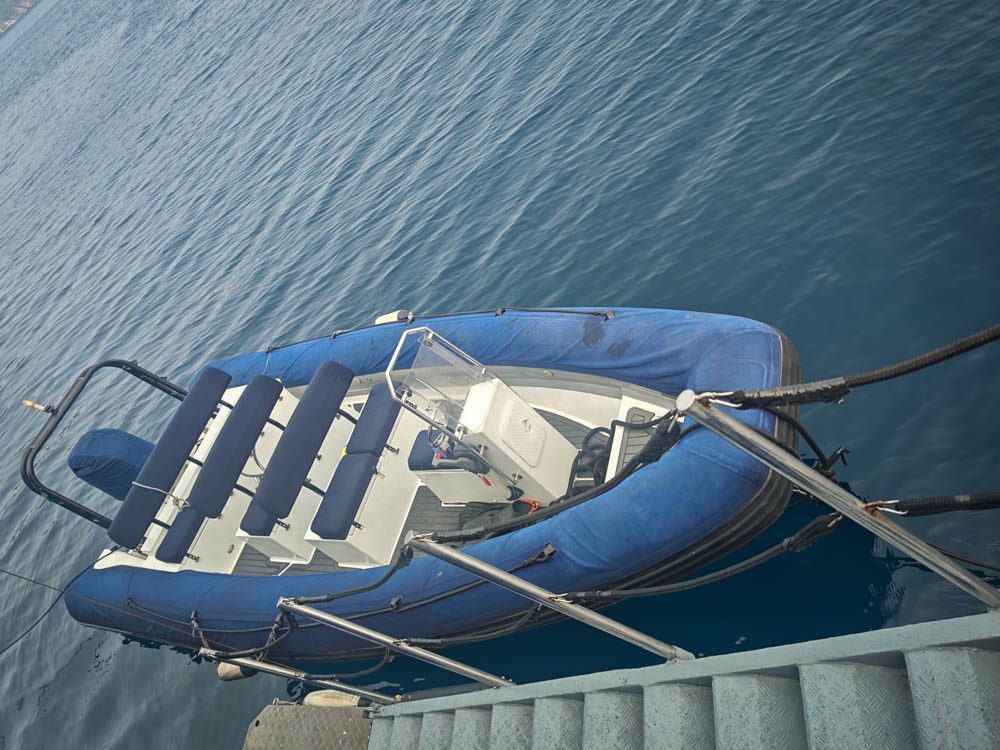
The Zen was the first boat in Indonesia to dive from a second boat. If you have dived in the Maldives you know the idea: a dhoni is a full, independent dive boat that follows the main ship everywhere. The Zen’s dhoni is 21 meters long with its own compressors, a bathroom, a shaded lower deck and a sun deck with beanbags on top.
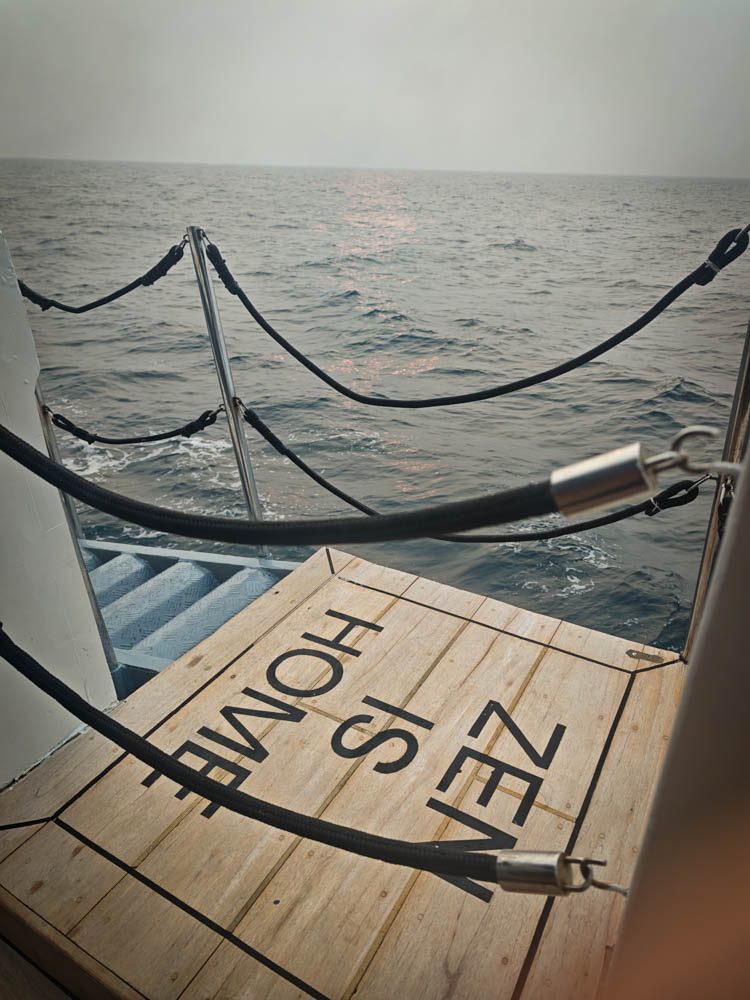
In practice it changes your whole day. All your gear stays on the dhoni. Before each dive you simply walk across from the main boat, and you kit up on the way to the site instead of on a crowded dive deck, which saves 10 to 15 minutes per dive, three times a day. After the dive you peel off your wetsuit, get a towel, cold water and fresh fruit on the way back, and the main boat stays dry, quiet and free of dripping gear. You also never forget anything, because everything stays where you left it. The wooden floor can be slippery when wet, so move slowly in the rain. One honest caveat: when the swell is up, stepping from the main boat across to the dhoni takes timing and a steady hand from the crew, and on two or three mornings in the Banda Sea it was a real step. The crew are good at it, but if you have mobility issues, ask Scubaspa about it before you book. The dhoni crew check your Nitrox, assemble your BCD , and back on the main boat another drink is waiting, tea or fresh juice.

Nitrox and rental equipment
Nitrox is available for a small extra fee, made with a membrane system, and the tanks were filled at 31 or 32 per cent on both trips. Take it. Most dives in Raja Ampat happen at 20 to 25 meters, and at those depths Nitrox is the best way to maximize your bottom time: three dives a day for ten days adds up, and the longer no-decompression limits mean you spend the dive watching the pinnacle rather than your computer. The other benefits are the ones divers on a long trip feel most: shorter surface intervals, a smaller nitrogen load across repetitive dives, and, for many people, less tiredness at the end of a three-dive day. Should you use Nitrox or air on a hammerhead trip? It depends on your style. Given how deep the Banda dives can go, some divers prefer air so they can drop to 40 meters or more if a school appears; I stayed on Nitrox and it was enough for every dive we did. If you are not Nitrox certified you can do the course on board for an extra fee. Rental gear is available for every diver, including side-mount sets.
INSIDER TIP
Booties are not provided, so bring a pair of dive socks or booties to avoid blisters from the fins.
Dive rules and safety
The Zen carries a defibrillator (AED) on board, which is still far from universal on Indonesian liveaboards, as well as oxygen, three life rafts and a fire extinguisher in every cabin. If you or your partner are at an age or in a condition where that matters, this is the boat for you. Every diver is given a Nautilus GPS locator and a surface marker buoy for the trip.
The full safety list, posted in every cabin, is longer than I have seen on most Indonesian boats: radar, sounder and GPS tracking; VHF, DSC and SSB radio plus a satellite phone; an EPIRB emergency beacon, flares and a searchlight; smoke detectors, a bilge-pump alarm and fire-fighting equipment; life jackets (in the drawers under the bed on the lower deck, in the wardrobe on the main deck), life rings, a first-aid and trauma kit, and emergency escape ladders and lighting on both decks. Two details matter more than the list. The dive dhoni doubles as the evacuation vessel, so the boat always has a second, fully crewed vessel alongside it, which no single-hull liveaboard can say. And the systems are checked and renewed every year during the dry-dock maintenance. Nobody books a liveaboard for its bilge-pump alarm, but on a wooden boat two days from the nearest hospital, this is the list I want to see.
The dive rules are sensible rather than strict: maximum depth 30 meters unless there is a good reason to go deeper, no decompression diving, surface with at least 50 bar at the safety stop, and a maximum dive time of 60 minutes. The 60 minutes is flexible if there is a good reason to stay longer, as long as you do not do it on every dive and delay the boat’s schedule.
Dive schedule
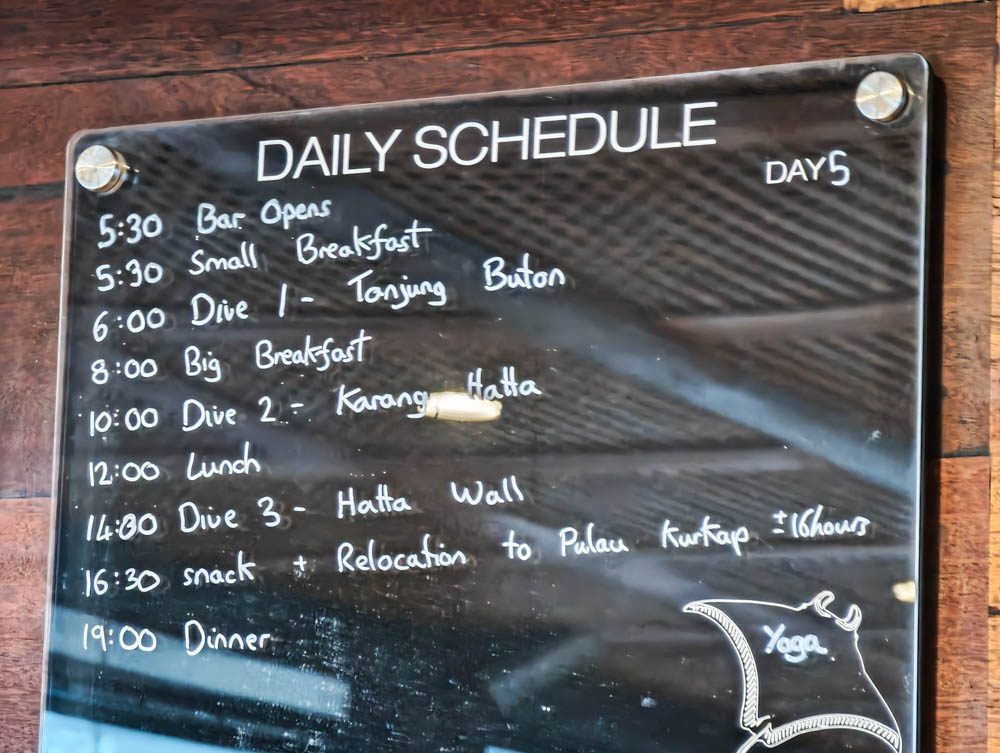
The Zen normally runs three dives a day, typically at 6 am, 10.30 am and 2.30 pm, with night dives offered a couple of times per trip. The day is written up on a glass board by the bar every evening, and a real one looked like this on our Hatta day: bar and small breakfast 05.30, dive one at 06.00 (Tanjung Buton), big breakfast 08.00, dive two at 10.00 (Karang Hatta), lunch 12.00, dive three at 14.00 (Hatta Wall), snack at 16.30 and a 16-hour relocation to Pulau Kurkap, dinner 19.00. In Misool, where the sites are closer, the first dive moved to 07.30 and the day ended with the beach barbecue at 18.30. The early start matters more than it sounds: at the popular Banda Sea sites we were regularly the first group in the water, which makes a real difference when you are hoping for hammerheads or mantas. The team adjusts the schedule to conditions, and on both trips they scheduled dawn dives specifically to improve our chances with the hammerheads. Dive times are generous too: most of our dives ran 60 minutes, not the 45 or 50 some boats impose.
The water in Misool and Triton Bay in October and November is warm, 27 to 30°C, so a 3 mm wetsuit is enough for most people there. The Banda Sea is another matter: in October 2026 we recorded 24°C at the Banda sites, which is cold for Indonesia, so a 5 mm suit or two layers is a good idea for the Banda leg if you feel the cold, especially on three dives a day. On both trips we recorded 30°C at many Raja Ampat sites, which is comfortable for divers but worrying for the coral, and in 2022 we saw bleaching starting.

Dive guides
On my first trip most guests were very experienced divers, several of them instructors, and we had two guides for six divers. Our guide, Jack, had a sharp eye for critters and spotted hammerheads before anyone else; he had been diving Komodo, Raja Ampat and Banda for years. In 2026, with 13 guests on board, the ratio was even better, with most groups at two divers per guide; when the boat is full, groups are four divers per guide. My guide was Renaldo, and the five dive masters between them covered the whole boat without anyone ever feeling rushed.
The Spa and the Packages
What makes Scubaspa Zen unique in Indonesia is a real spa at sea, with two full-time therapists working from the top deck. Every guest chooses one of three packages when booking, and the choice decides how your days are structured:
| Nights | Scuba | Scuba & Spa | Spa (active wellness) |
|---|---|---|---|
| 7 | up to 19 dives | 10 dives + 5 treatments | 8 treatments + guided snorkelling |
| 10 | up to 26 dives | 14 dives + 7 treatments | 11 treatments + guided snorkelling |
| 12 | up to 30 dives | 18 dives + 9 treatments | 13 treatments + guided snorkelling |
Source: Scubaspa’s 2026 package list. Every package includes morning yoga, snorkelling with gear, excursions, a beach barbecue, airport transfers and 1 GB of Wi-Fi.
On my 2026 Banda Sea trip, the 10-night Scuba & Spa package gave me 12 dives, 7 spa treatments and as much snorkelling as I wanted. The treatments are flexible: you can take them as seven massages or as seven hours of anything on the spa menu. If you are on the Scuba package you can still book treatments for a fee; the regular menu runs from about $90 for a 60-minute Balinese, Swedish or sport massage to $120 for the 90-minute Zen Signature massage, plus 11 per cent tax, and there is a “Dive Delight” massage designed for divers, a gentle post-dive massage for tired muscles. Treatments are booked on the same glass board as the dive schedule: seven slots a day, from 10.00 to 18.30, and you write your name against the one you want.
If you dive but also want to snorkel and use the spa, book the Scuba & Spa package: I found 12 dives over ten nights was plenty when I was also snorkelling the shallow sites and taking a treatment most afternoons. I review the spa, the yoga and the snorkelling program in full in my guide to the best snorkelling liveaboard in Indonesia.
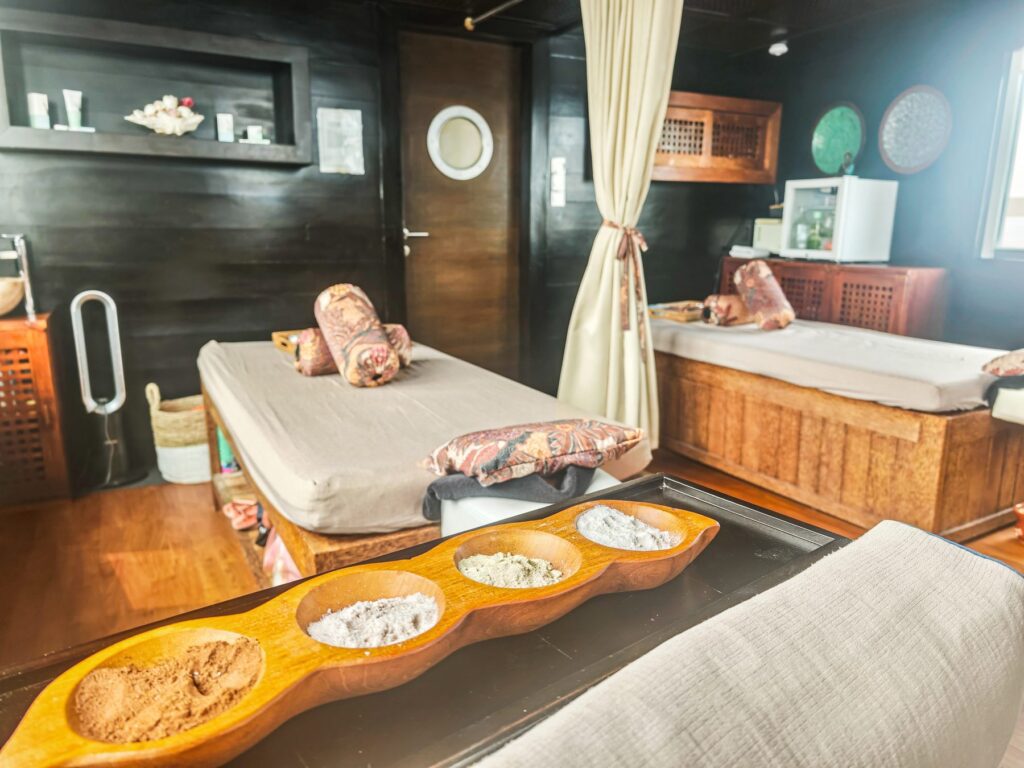
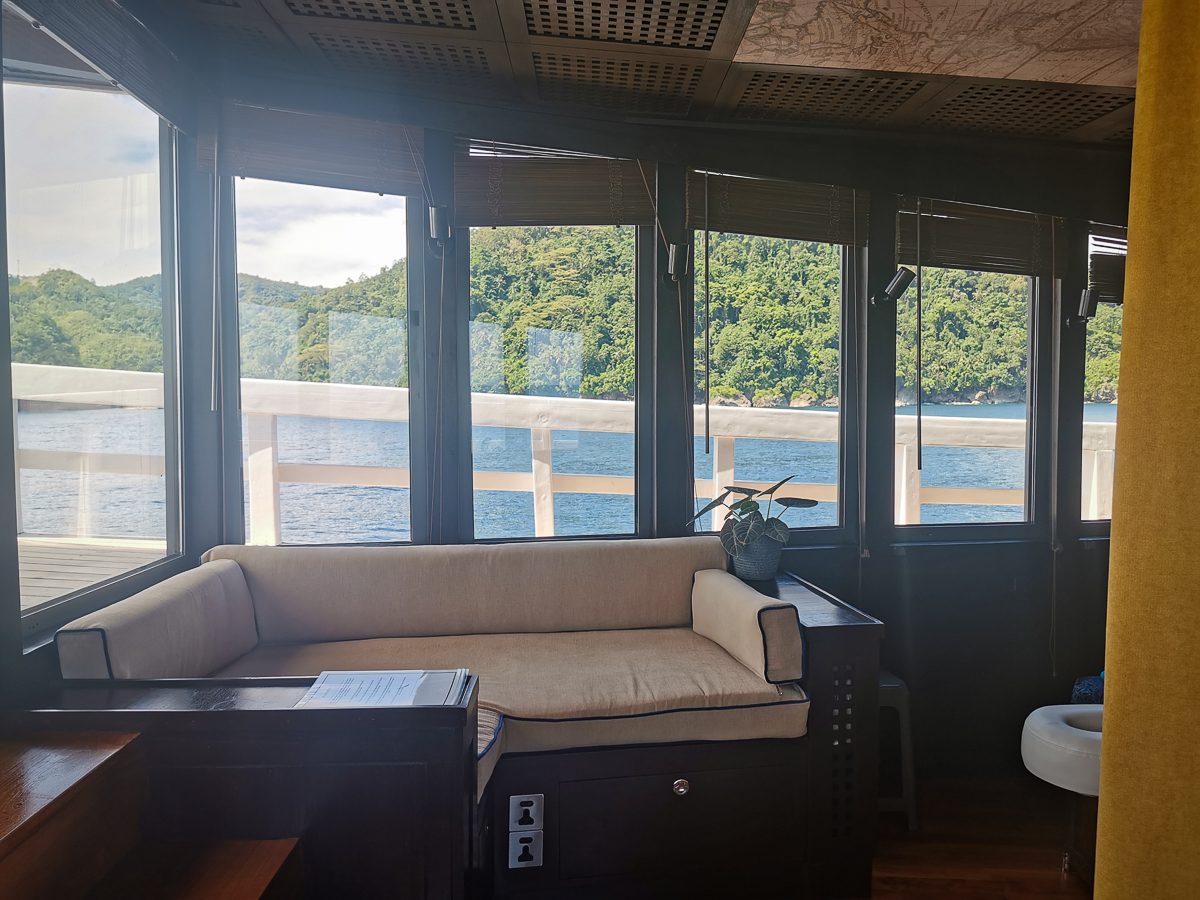
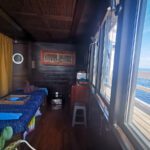
The spa and its menu in 2022
Internet on Board: Starlink
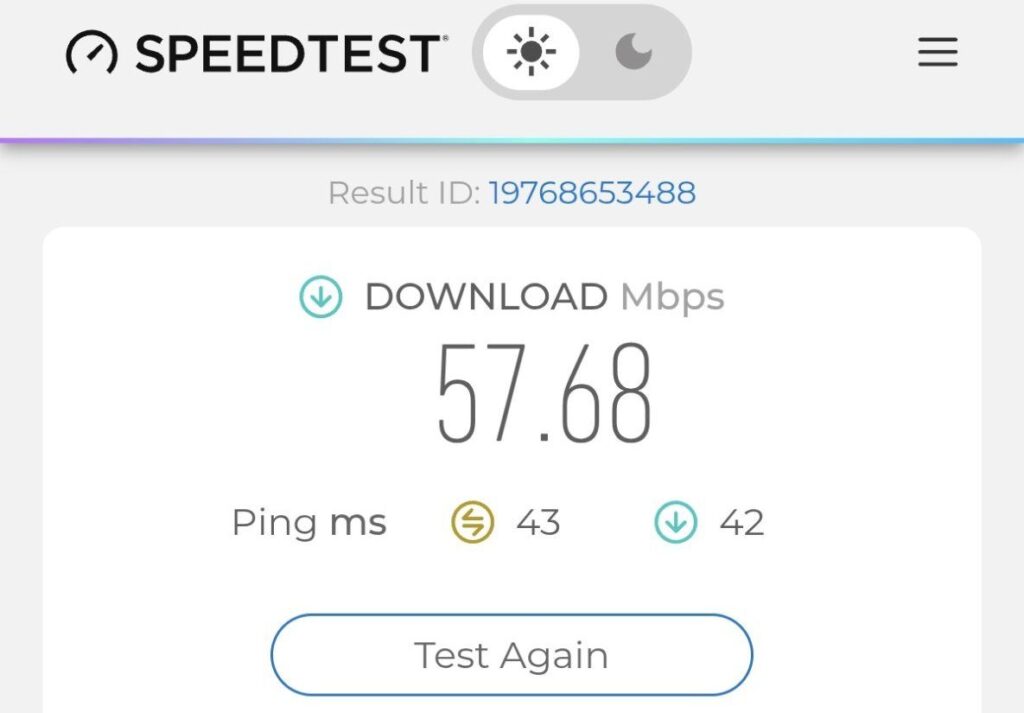
Scubaspa Zen now has Starlink satellite internet, with two dishes on board. The second dish is not a gimmick: if one fails you still have the other, so the connection was reliable throughout my 2026 trip. The speed is good. I ran a test in the middle of the open sea on the crossing to the Banda Islands, with no phone signal anywhere, and got 57.68 Mbps download with a 43 ms ping, which is enough for video calls and streaming.
The Wi-Fi is not unlimited: every guest gets 1 GB free, and you can buy more credit on board, at 50 USD for 10 GB. If you want cheaper data near land, bring an eSIM or buy a Telkomsel SIM on arrival (bring a passport copy to register it). On the 2026 itinerary we had phone coverage on about half the days. The coverage notes from my first trip still hold:
- Ambon: excellent 4G, enough to stream video.
- Molana and Nusa Laut: 4G, a little hit-and-miss.
- The Banda Sea crossing and Suanggi: no signal.
- Banda Neira: good enough for WhatsApp video calls.
- Manuk: nothing.
- Koon: weak.
- The east coast of Seram on the way to Misool: a good 4G signal for a few hours.
- Misool: almost nothing, apart from a weak signal at the viewpoints near Four Kings and at the ranger station near Yuliet.
- Raja Ampat (2026 leg): Misool is a Starlink-only zone; signal returns a few hours out of Sorong.
Phone signal is always better the higher you are on the boat: it often did not work in my lower-deck cabin but did on the sundeck.
Scubaspa Zen Itineraries: Where It Sails
The Zen follows the Indonesian seasons. The 2026–27 schedule is dominated by Raja Ampat (7-night expeditions and 10-night Best of Raja Ampat trips from Sorong, including Christmas and New Year departures), with a Raja Ampat and Halmahera expedition in March 2027, Komodo in the middle of the year, and the Banda Sea and Triton Bay crossings (Ambon to Kaimana, Kaimana to Sorong, Sorong to Ambon, Alor to Ambon) in the shoulder months of April and October.
For divers I rate the Banda Sea crossings the highest, because they pair the hammerhead season (roughly mid-September to mid-November, and again around April) with either Raja Ampat or Triton Bay at the other end.
What happened in October 2026: the Kaimana reroute
Every liveaboard itinerary is a plan until the sea, or the weather, has its say. This trip showed what happens next. On the crossing east from Banda, the boat was told that the forest fires burning across Indonesia had closed Kaimana airport and pushed the air around Triton Bay to unhealthy levels. Kaimana was our disembarkation port. Rather than deliver 13 guests to a town they could not fly out of, into air they should not be breathing, Scubaspa turned the boat north and rewrote the second half of the trip: Raja Ampat instead of Triton Bay, ending in Sorong, where flights were still operating. Nobody lost a dive day, and the Raja Ampat leg turned out to be some of the best diving I have had there in years. One honest note: rebooking the flights out of Kaimana onto Sorong was left to each guest, so keep your airline’s app and a credit card handy on a trip like this, and have the boat’s Starlink to thank that it was possible at all.
Indonesia’s forest fires: should you cancel your trip?
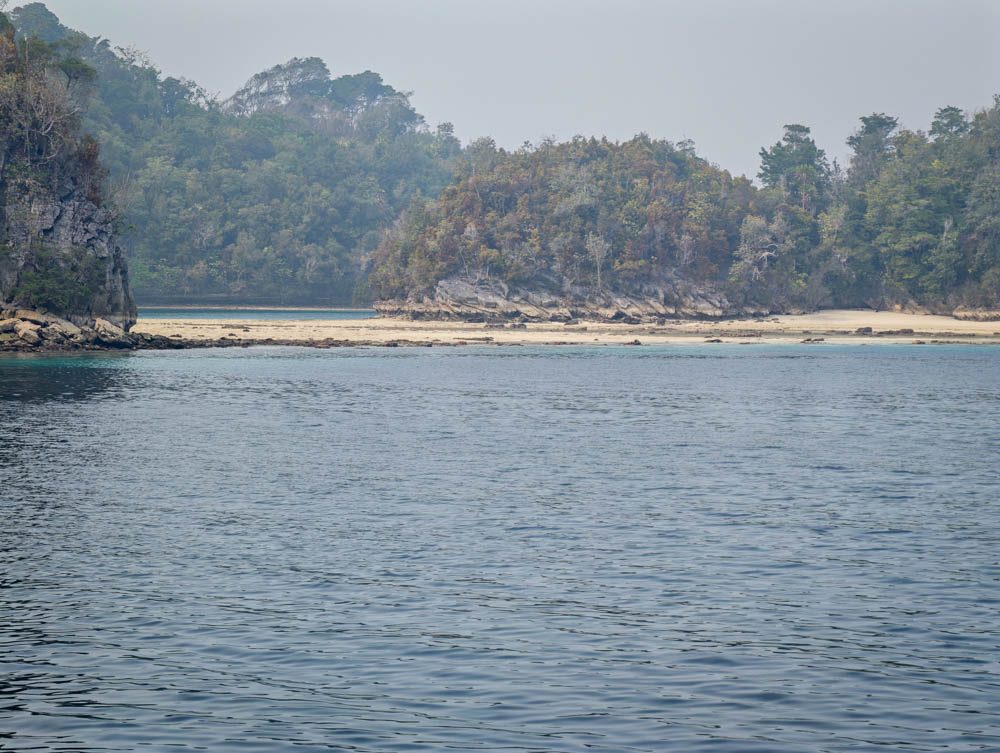
Some context, because this is the question I was asked most when I got home. 2026 is an El Niño year, forecast to be one of the strongest on record, and Indonesia’s forest and peat fires were on course to match 2015, the worst fire year this century. In October the smoke sat over the whole eastern archipelago. From the day we left Ambon the sky was gray, every day; we could smell the smoke at sea, a small fire was burning on Suanggi island itself, and at Pulau Kurkap, our closest point to Kaimana, the smell was strong enough to notice at the dinner table. Flights across Papua were being delayed, rerouted or cancelled that week. I cover what the fires mean for divers, and how to check the air before you travel, in my guide to Indonesia’s forest fires and diving.
What that meant in practice, honestly:
The cons. If you are dreaming of turquoise water under a blue sky, you will not get it while the fires burn; the light was flat, we did not get a single proper sunset in ten days, and the landscape views, the karst islands of Misool especially, lost their tropical-postcard quality. The smell was real near Kaimana. Flights are the bigger risk: when the smoke is thick, regional flights get delayed, rescheduled or cancelled with little notice, so build one or two buffer days before your cruise departure and before your international flight home for possible flight delays and cancellations. And accept that your itinerary may change, as ours did.
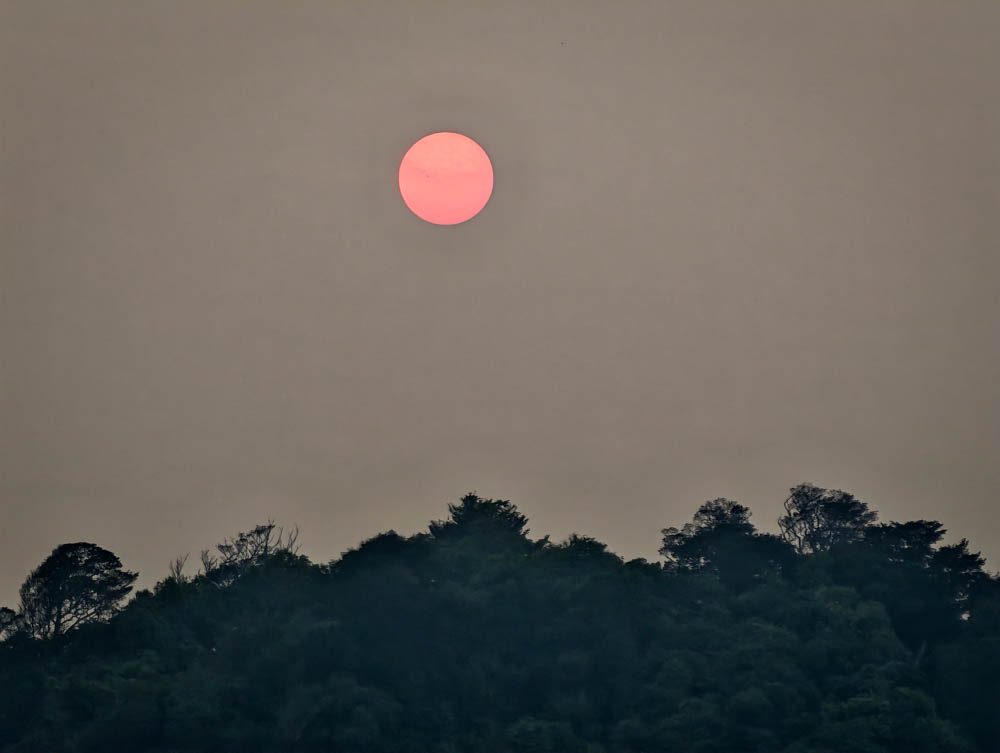
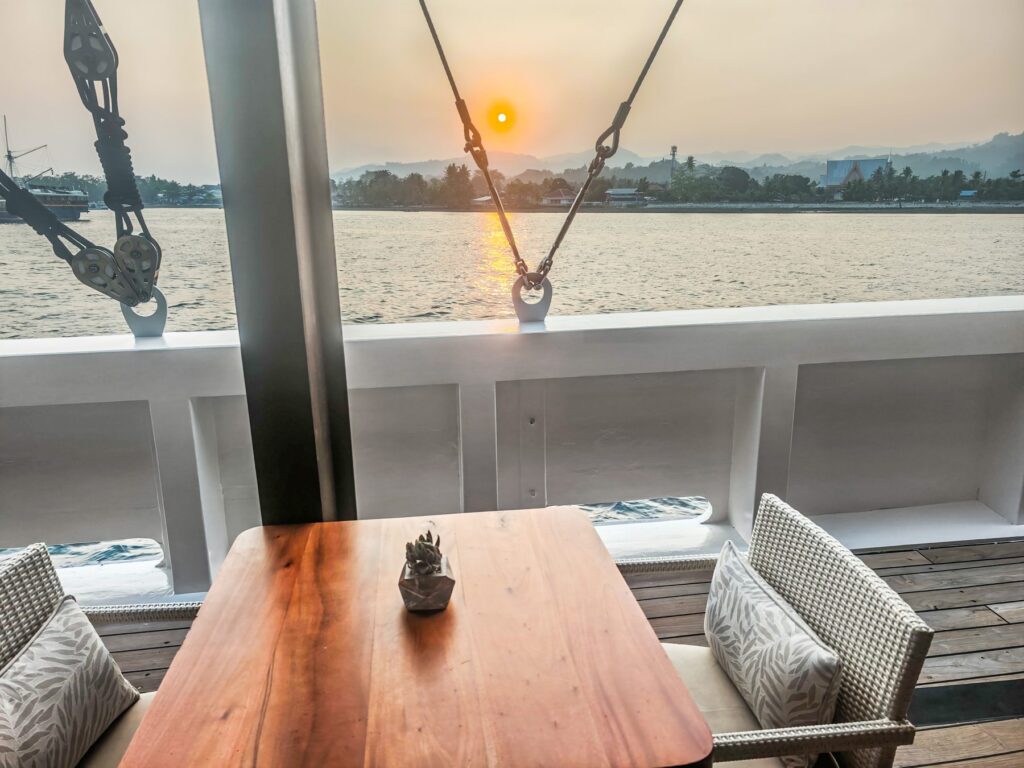
The pros. The smoke did not affect the diving. Once we had moved north into Raja Ampat the air improved a lot and never felt unhealthy. There was still enough light for the corals to shine, visibility was better than usual for October, and we did not get a single drop of rain all week, which is unusual for Raja Ampat; I have had trips there where it rained every day. The sites themselves delivered some of the best dives I have had in Raja Ampat in a long time.
So, should you cancel? If the trip is about the diving, no. Go, with buffer days and an open mind about the route. If the trip is about the scenery and the photographs above the surface, wait for the rains to come back.
Two practical notes. You can check the air quality for Sorong, Ambon, Kaimana or any Indonesian town day by day on IQAir, which is what the boat and I were watching; the numbers change fast with the wind. And the better operators are adapting: Scubaspa has bought air purifiers for the Zen’s cabins and plans to install them in the coming weeks, so that at least the air you sleep in is clean.
Two Trips, the Same Sites, Four Years Apart
Here is something I did not plan. My November 2022 trip went Ambon, Nusa Laut, Suanggi, Banda, Hatta, Koon, Misool, Sorong. My October 2026 trip was sold as a different route, and after the reroute it went Ambon, Nusa Laut, Suanggi, Run, Banda, Hatta, Pulau Pisang, Misool, Sorong. Same season, four years apart, and at least eight of the same dive sites, several of them to the meter: Suanggi’s pinnacles, Tanjung Buton at Hatta, Gorgonian Passage, Four Kings, Puri Pinnacle, Magic Mountain.
What we saw was completely different. Suanggi gave me two distant hammerheads in 2022 and eleven in one dive in 2026. Magic Mountain gave me no mantas at all in 2022 and two oceanic mantas for a whole dive in 2026, and reef mantas turned up at Pulau Pisang and Nudi Rock as well. Puri Pinnacle gave me a pod of a hundred dolphins in 2022 and fifteen mobulas and four hundred barracuda in 2026. Gorgonian Passage gave the 2026 divers a wobbegong and a wedgefish I have never seen in twenty years of Raja Ampat. That is the magic of diving, and the reason I keep coming back to the same places: the reef is the stage, but the cast changes every day, and nobody, not the cruise director, not the guide with twenty seasons here, knows what will walk on. You never know what you will get. Book the route for the sites; the sea decides the rest.
| Site | Nov 2022 | Oct 2026 | 2026: dive or snorkel |
|---|---|---|---|
| Nusa Laut | 1 hammerhead at 40 m, jacks, juvenile barracuda | Fusiliers, turtle, blacktip reef shark from the surface | Snorkel |
| Suanggi | 2 distant hammerheads in a poor year | 0, then 1, then 11 hammerheads at Jackpot; dolphins and a bait ball at lunch | 3 dives (25 m, 26 m, 36 m) |
| Run / Nailaka | Not visited | No hammerheads at Tanjung Rhun (31 m); beautiful shallow reef; big coral garden at Nailaka | 1 dive, 1 snorkel |
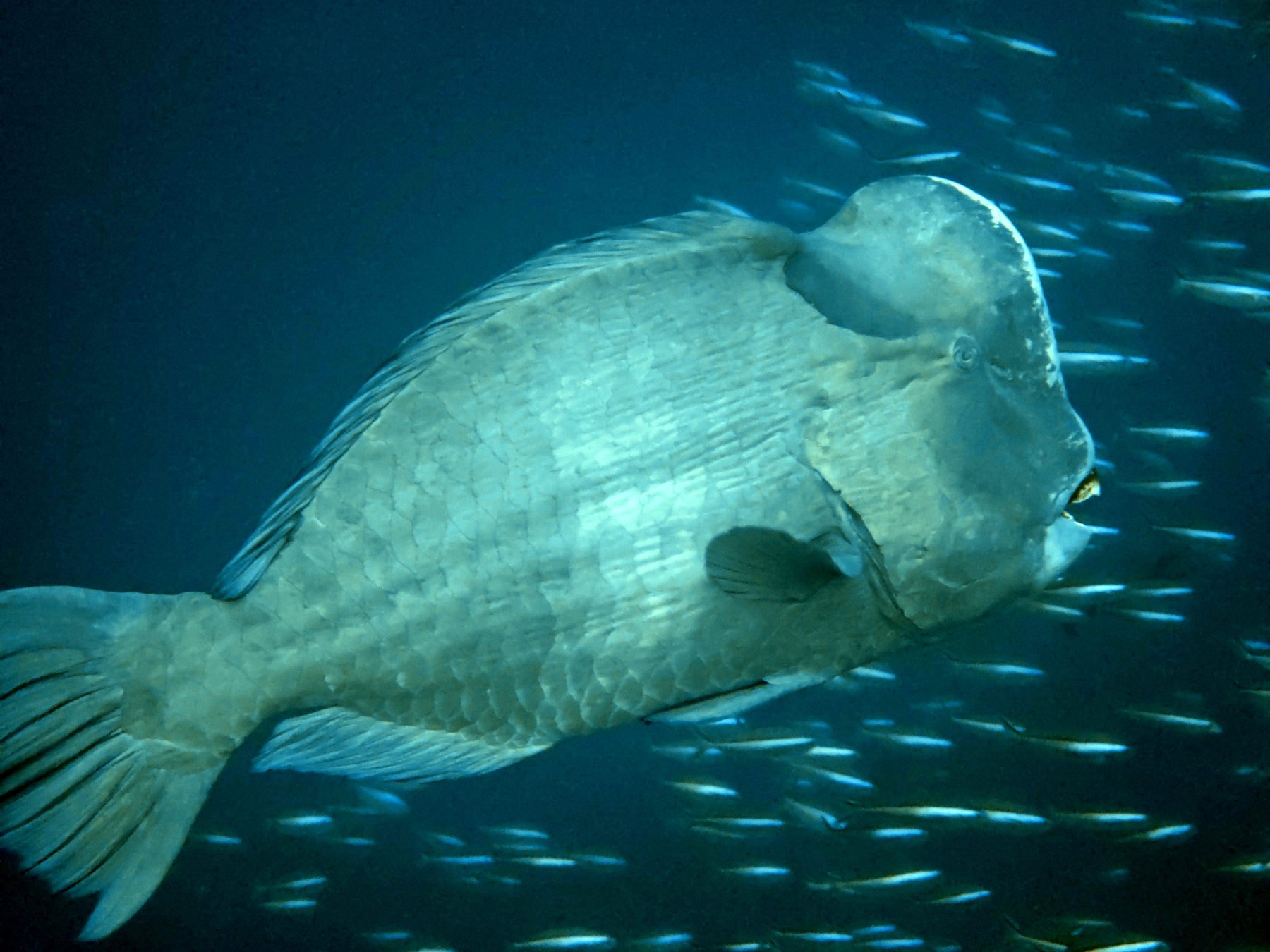
| Hatta, Tanjung Buton | No hammerheads; barracuda, blacktip, turtles, bumpheads | No hammerheads; the same wall, 20 m, plus Hatta Hole from the surface | 1 dive, 1 snorkel |
| Pulau Pisang | Not visited | Silversides, tuna, shark, turtle, napoleon; divers: frogfish, mobulas, 2 reef mantas | 3 snorkels |
| Boo, Tank Rock | Boo Window quiet; pygmy seahorses | 5 mantas feeding at 3–7 m for an hour at Tank Rock | 3 snorkels |
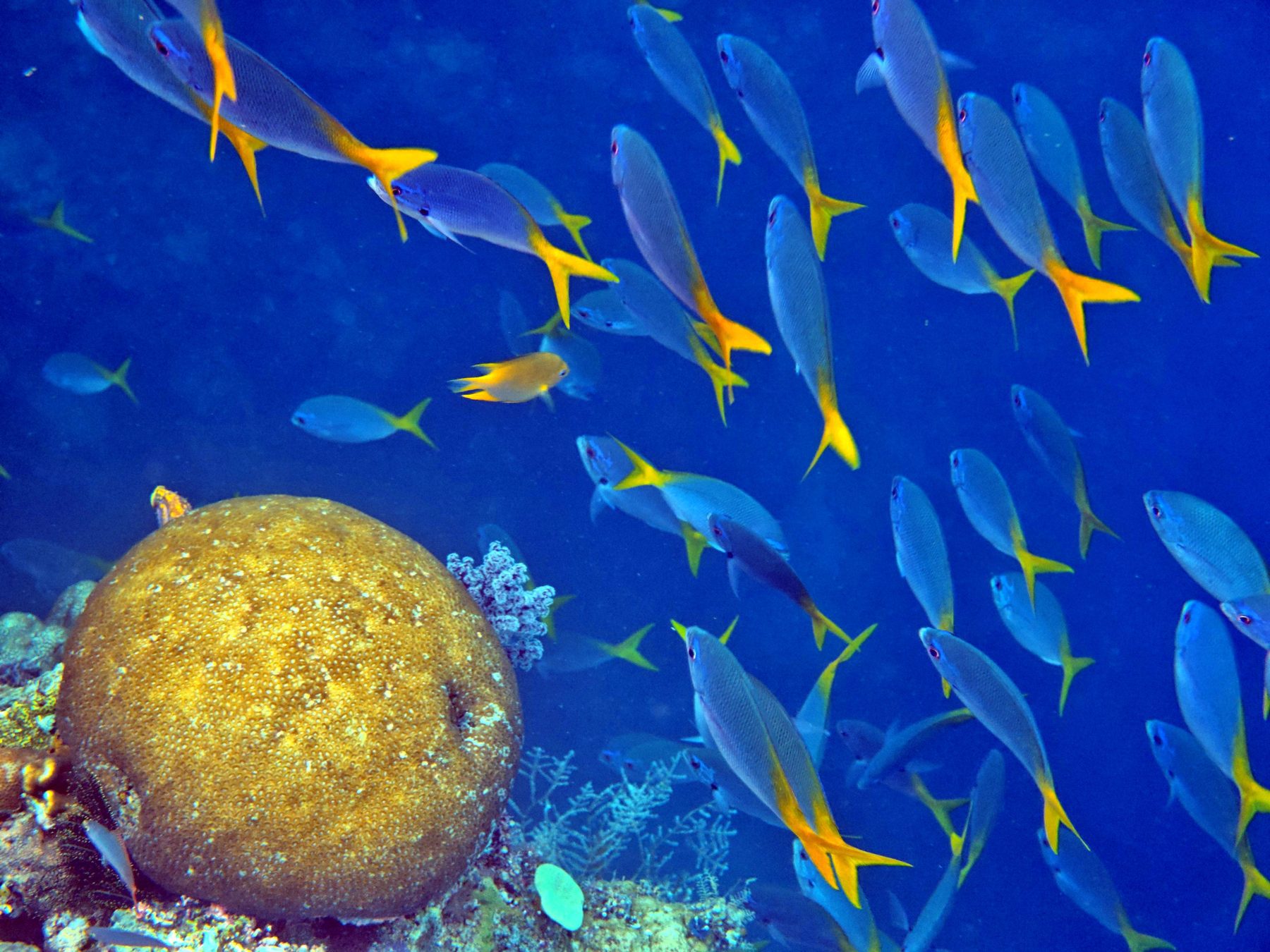
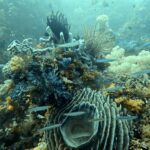
| Gorgonian Passage | Huge gorgonians, best color 10–16 m | Bumpheads and the trip’s best coral from the surface; divers: wobbegong, white-spotted wedgefish | Snorkel |
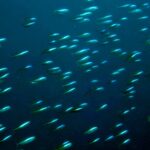
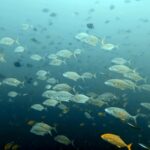
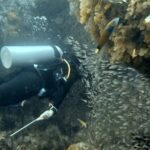
| Four Kings | Jacks and barracuda hunting anchovies at 6 am | Pinnacles wrapped in silversides; barracuda, jacks, yellow snapper | Dive, 25 m |
| Puri Pinnacle | Anchovy bait balls; 100 dolphins passing seen from the surface | 15 mobulas, 2 schools of 200 barracuda, tuna, groupers, napoleon | Dive, 20 m |
| Magic Mountain | No mantas; batfish, GTs, napoleons, barracuda | Wobbegong, 2 oceanic mantas for the whole dive, 10 sharks, a leopard shark | Dive, 20 m |
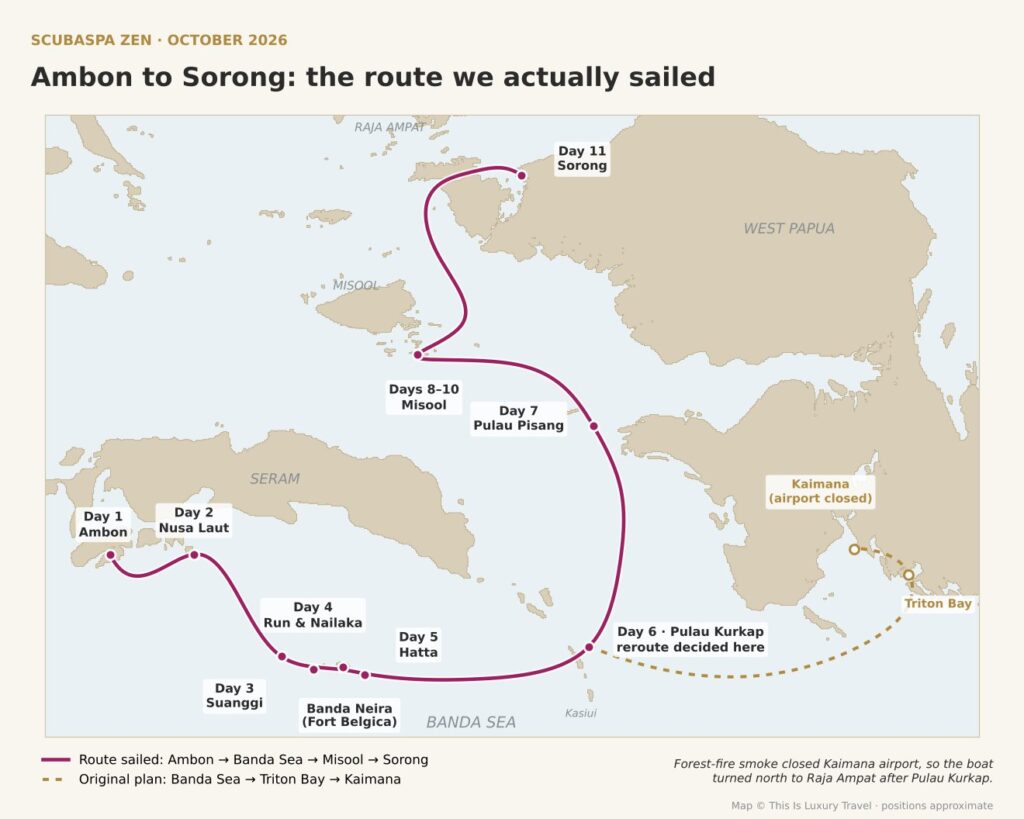
The October 2026 route: what we sailed (solid) and the original plan to Kaimana via Triton Bay (dotted).
On the 2026 Scuba & Spa package, I logged eight dives and ten snorkels. The package allowed twelve dives; I did not do them all because of ear trouble mid-trip, and the snorkelling more than made up for it. I enjoyed my snorkelling sessions as much as any dive, which is exactly the point of the Scuba & Spa package. Below, the 2026 trip day by day. The 2022 trip has its own day-by-day log: Ambon to Sorong by liveaboard: my Banda Sea and Misool dive log.
My 2026 Dive Log: Ambon to Sorong via the Banda Sea and Misool (October 2026)
Eight dives and ten snorkels, sold as Ambon to Kaimana and rerouted to Raja Ampat on day six. Photos are from 2026 unless captioned otherwise.
Day 1: Ambon, and straight to sea
No diving in Ambon this time: we boarded in the afternoon, met the crew over the welcome coconut, and sailed for Nusa Laut while we unpacked. The beef roulades at dinner set the tone for the food.
Day 2: Nusa Laut, from the surface
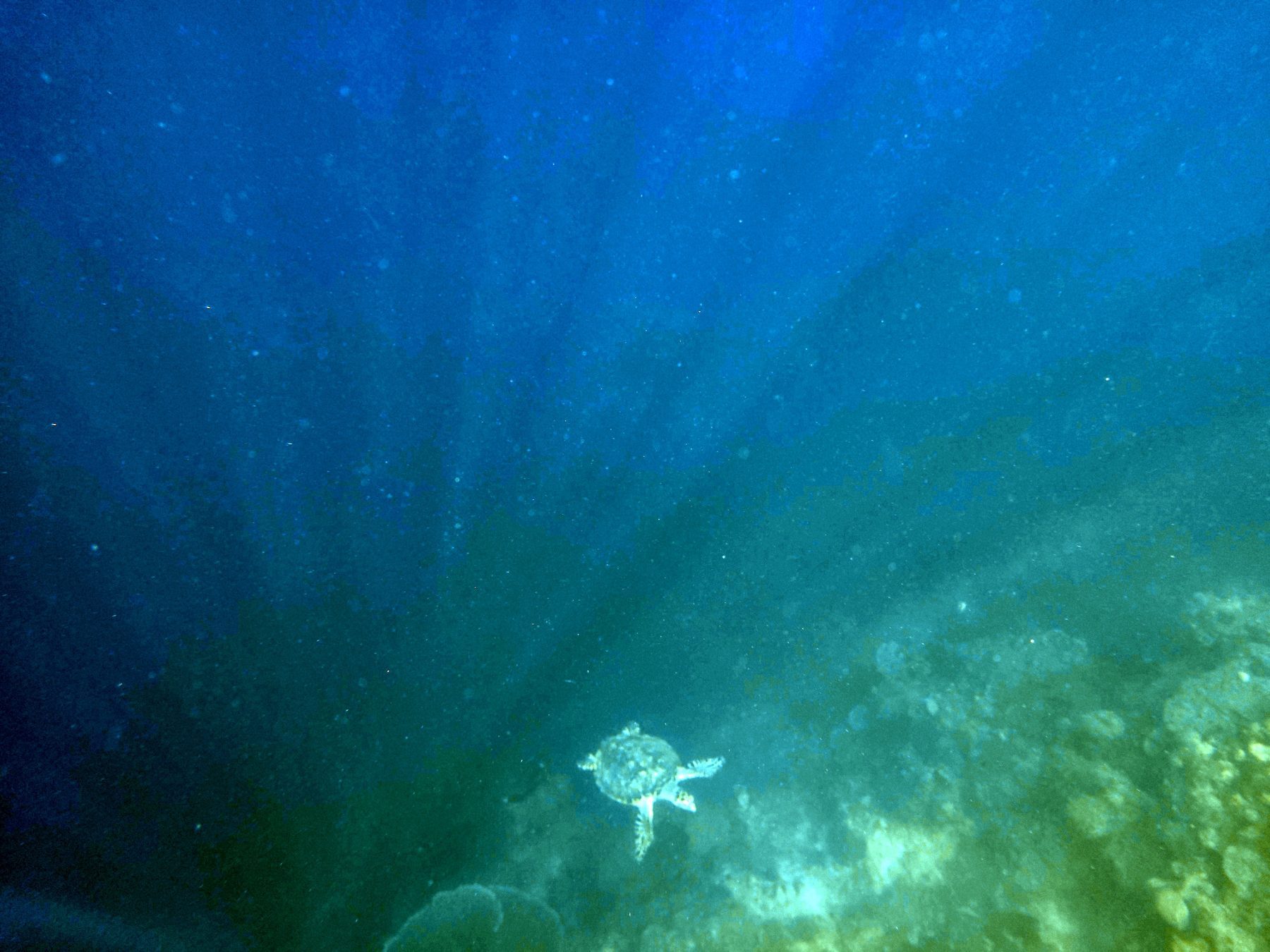
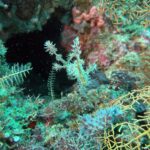
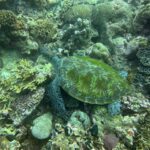
I snorkelled the Nusa Laut wall instead of diving it. Visibility was poor, but the reef was busy: clouds of fusiliers, a turtle and a blacktip reef shark within minutes of getting in. The divers went deep at the corner; no hammerheads. In the afternoon we began the overnight crossing to Suanggi.
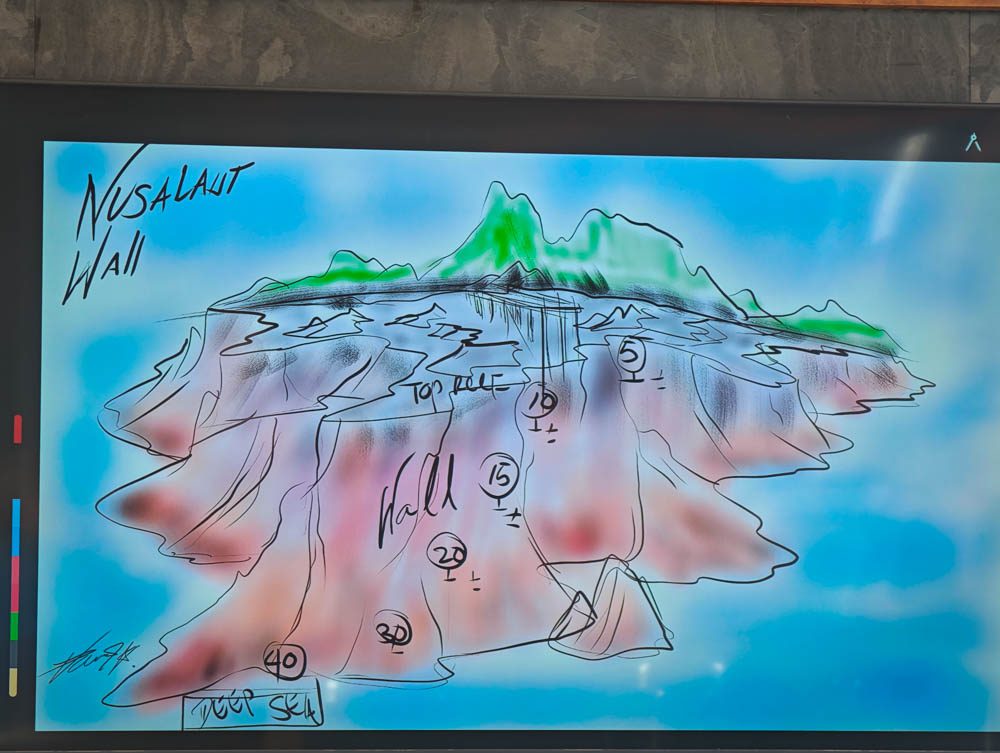
Nusa Laut, October 2026

Day 3: Suanggi, three dives, eleven hammerheads
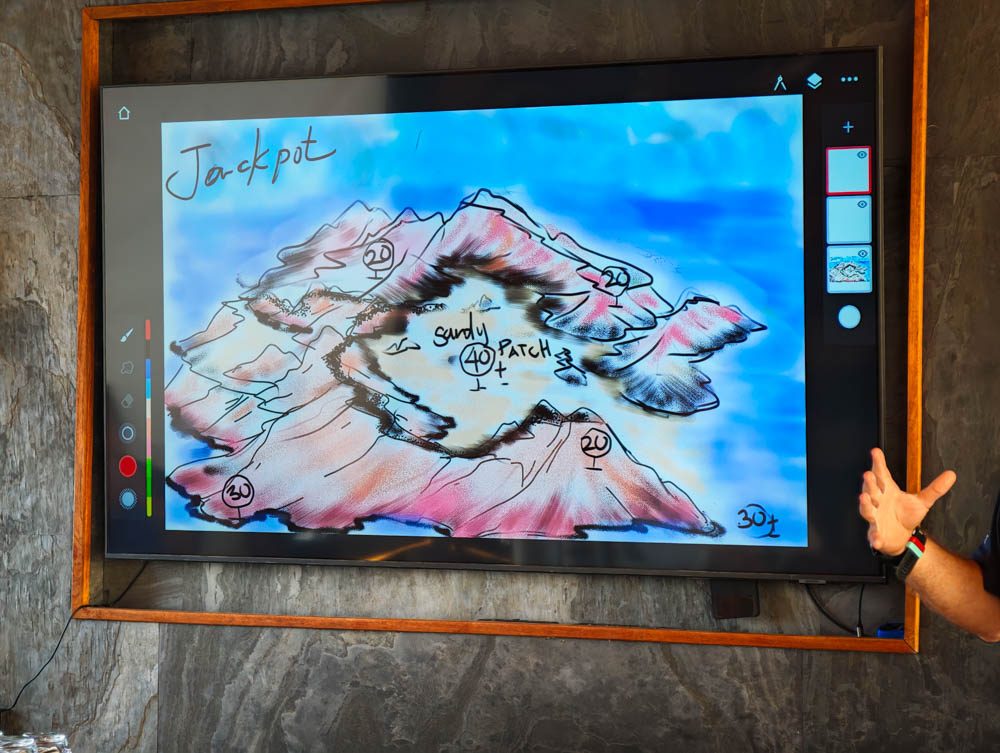
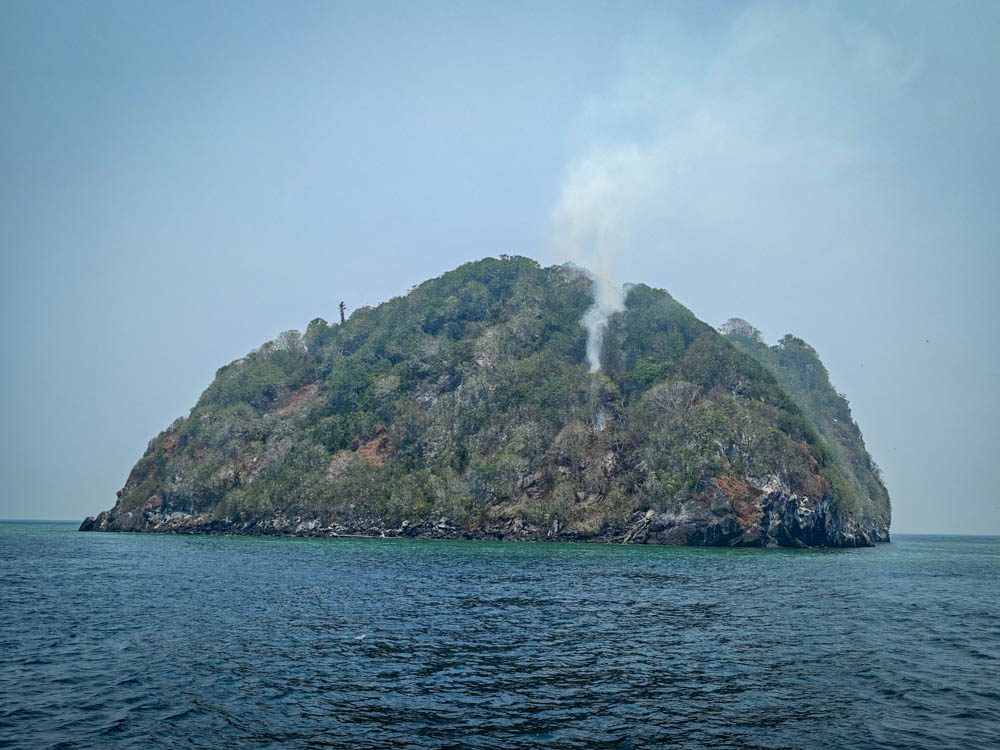
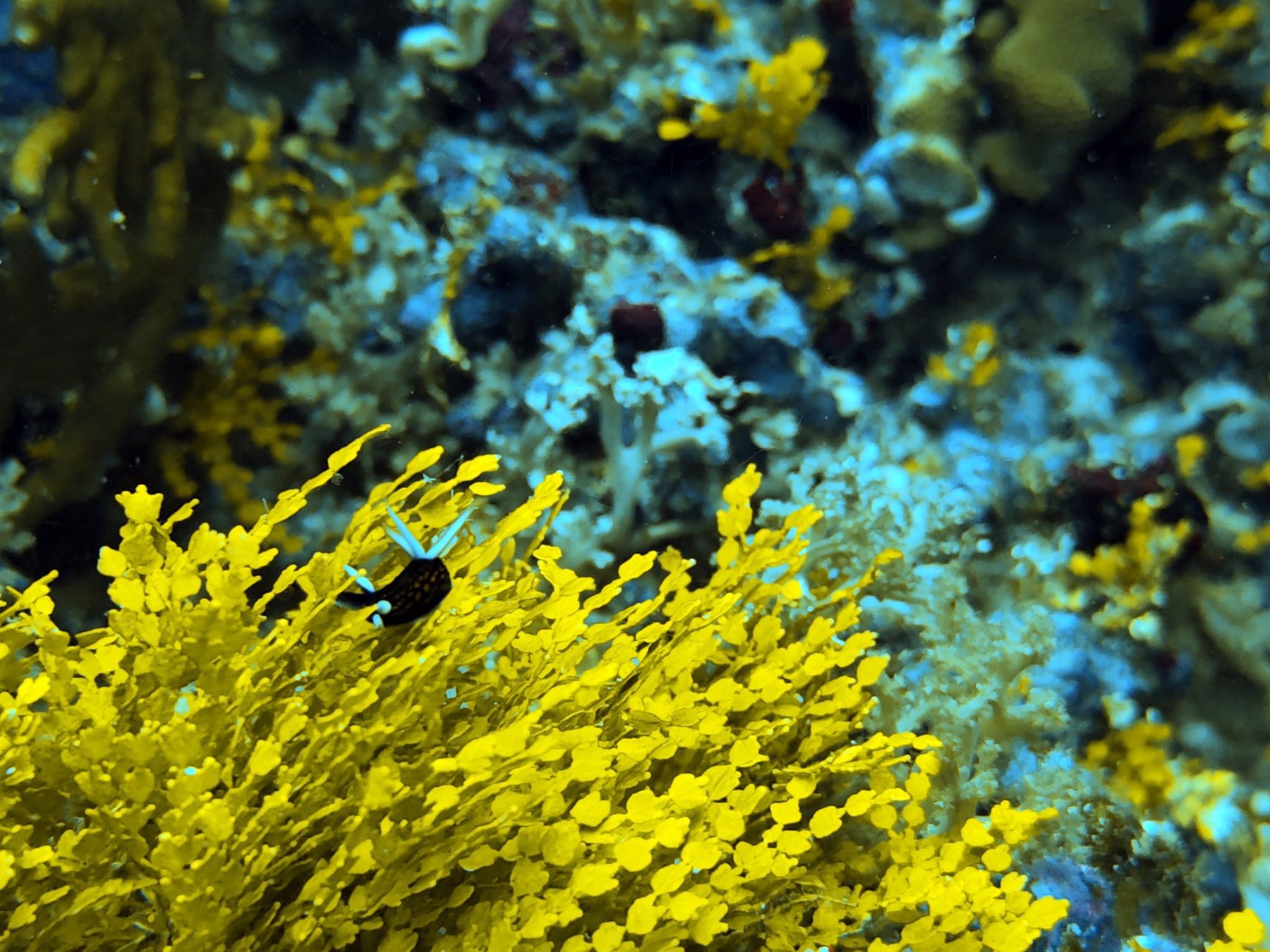
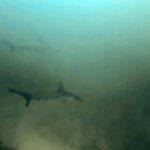
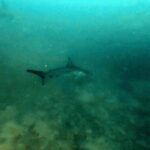
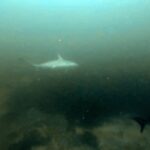
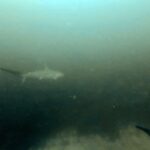
Suanggi was the opposite story to 2022. The first dive was empty of sharks, the second produced one hammerhead, and the third, on the Jackpot pinnacle, lived up to its name: eleven hammerheads in five separate encounters, in poor visibility, with the certainty that many more were out in the blue. Lunch was interrupted by dolphins, a bait ball and diving birds beside the boat. On my Sea Safari 6 trip I saw schools of around 200 hammerheads here. Suanggi is the best hammerhead site I know in Indonesia, and it is never guaranteed.
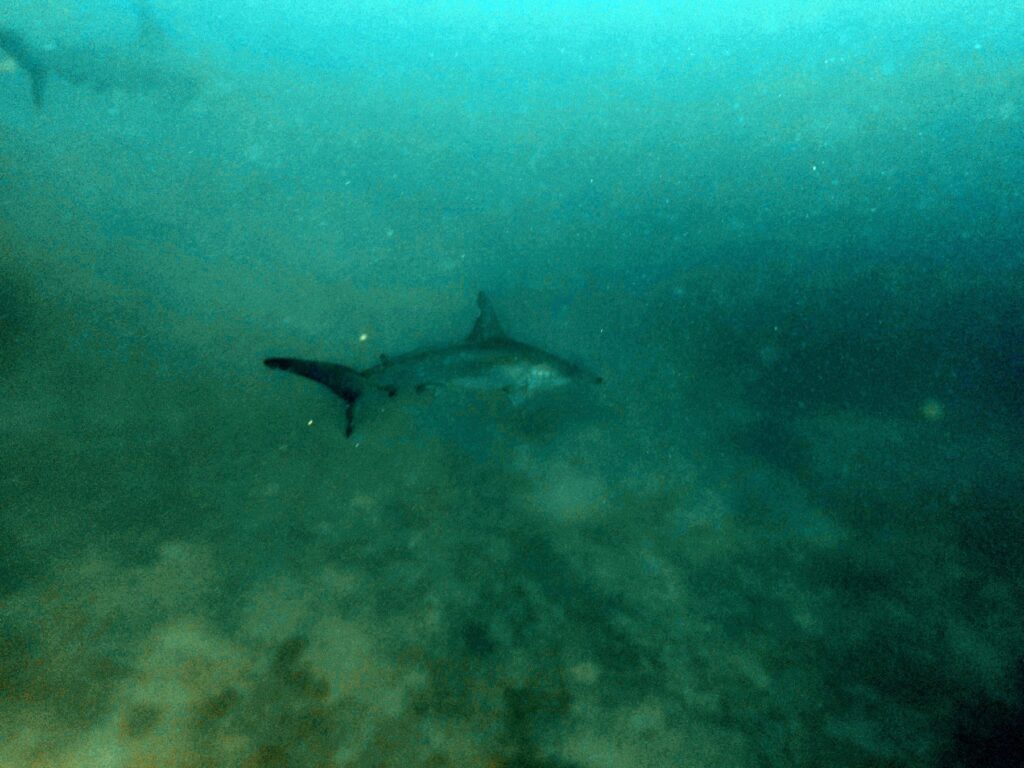
Here is the video I filmed at Suanggi:
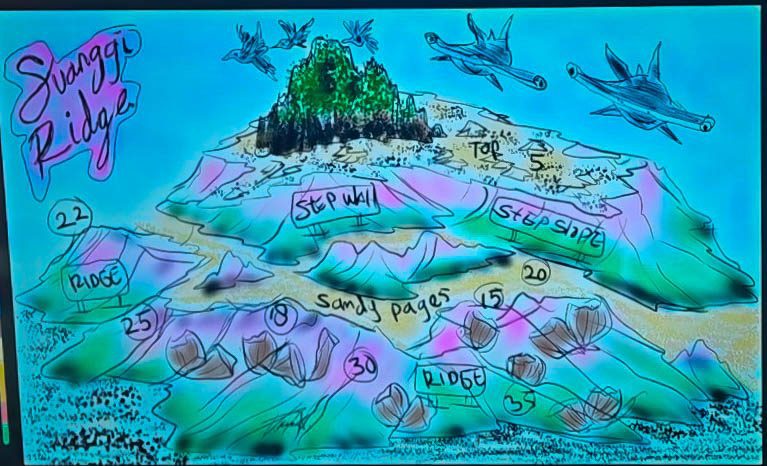
Suanggi, October 2026
Day 4: Run at dawn, Nailaka, and the Fort Belgica party
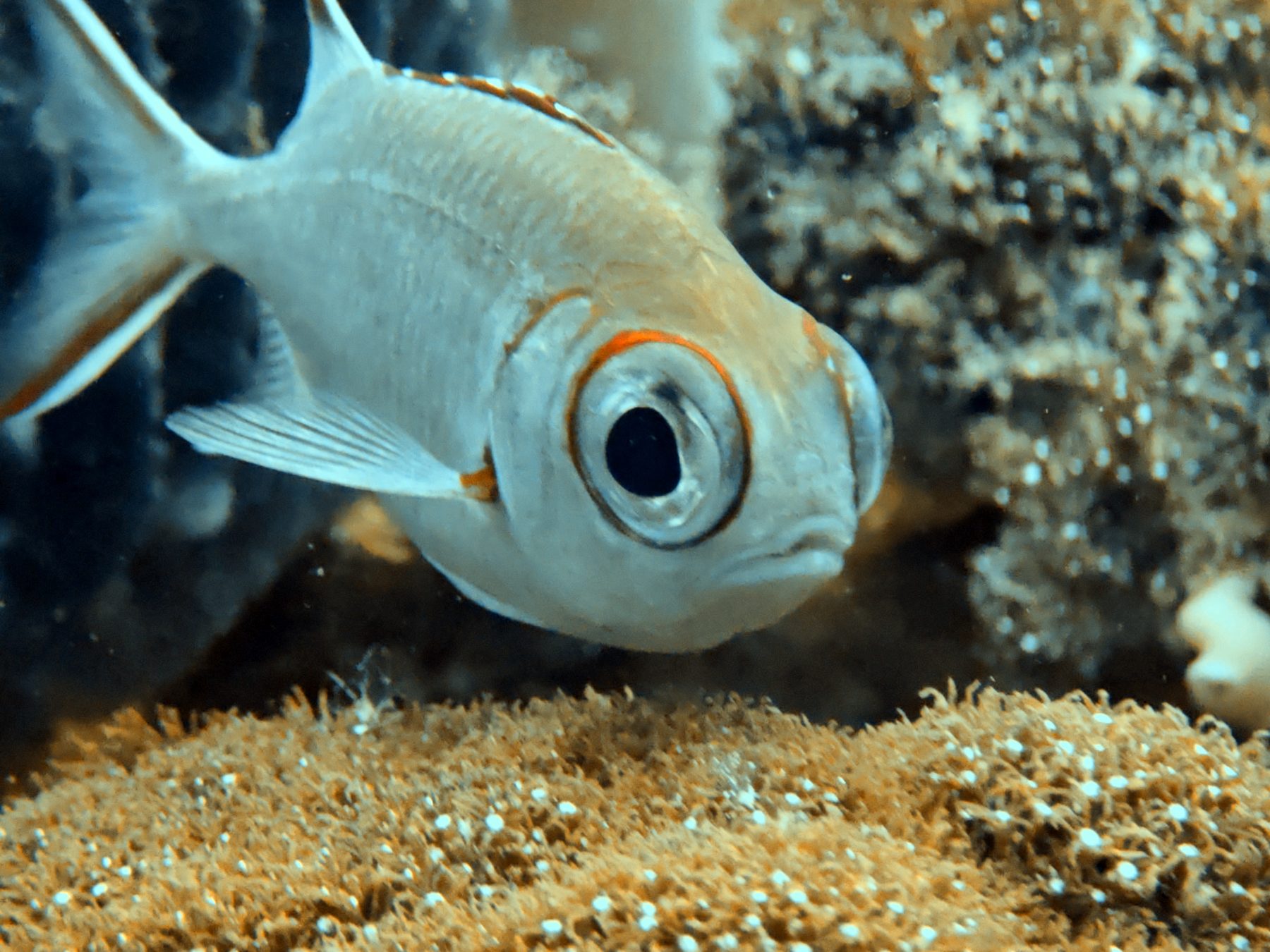
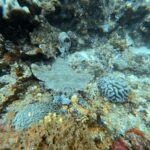
A 6 am dive at Tanjung Rhun looking for hammerheads found none, but the shallow reef on the way up was beautiful. I skipped the second dive for a snorkel at Pulau Nailaka, the little island beside Run: a very large shallow reef, a stunning diversity of coral, schooling triggerfish and fusiliers. The afternoon was Banda Neira.
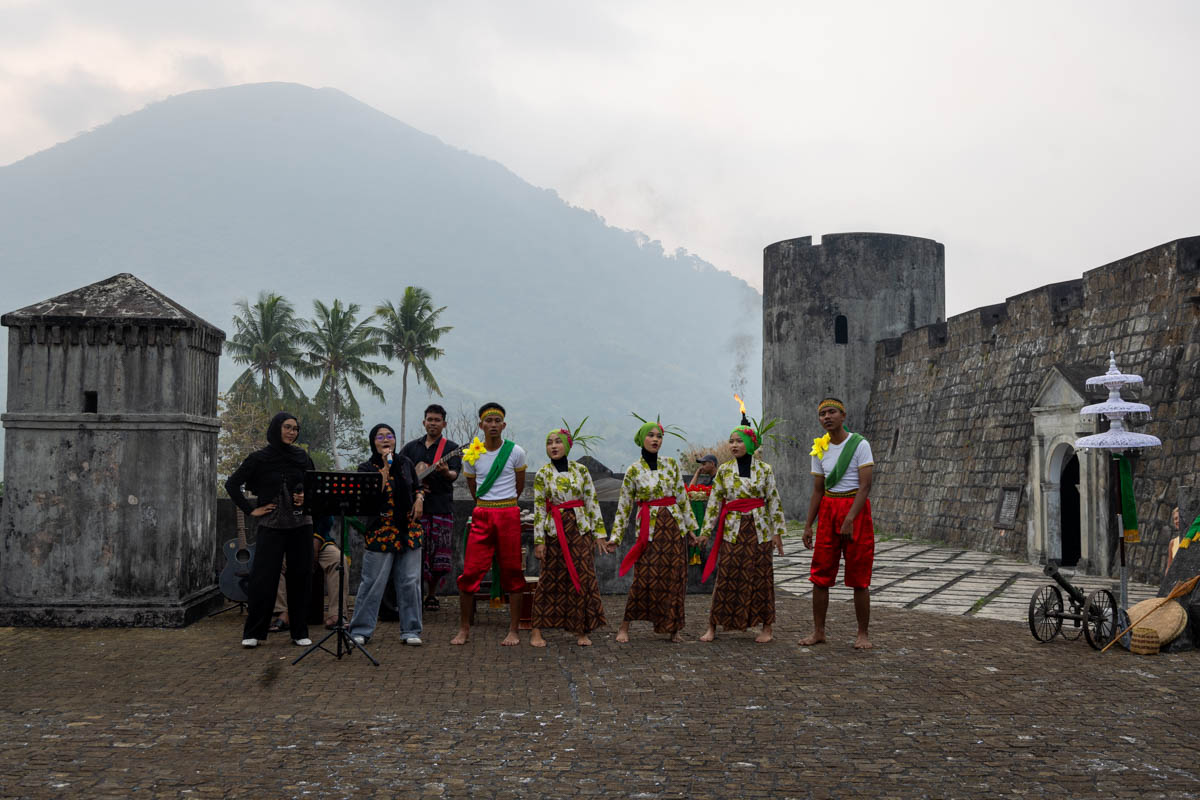
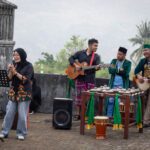
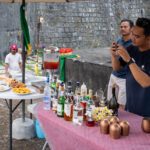
The visit showed what Scubaspa does differently. It started like every liveaboard tour of Banda Neira: the museum, the old church and a walk through the nutmeg plantations. Then we climbed to Fort Belgica, and the crew had organized a cocktail party at the foot of the fort, with food and drinks laid out for us. The highlight was a band of ten musicians and dancers from Banda. They performed traditional Bandanese dances, then switched to Western music for us, ABBA included. The sun set over the fort, the Gunung Api volcano and the sea, the guests started singing and dancing with the band, and the evening turned into a big party before we went back to the boat for dinner. It was one of the best moments of either trip, and the kind of touch you will not get on most dive boats. Do not miss Banda Neira.
The Fort Belgica show, Banda Neira, October 2026
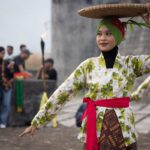
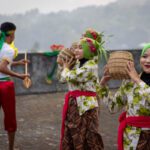
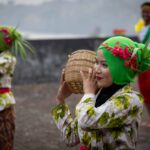
A night dive in Banda Neira harbor was offered; I skipped it.
Run and Nailaka, October 2026




Day 5: Hatta Island
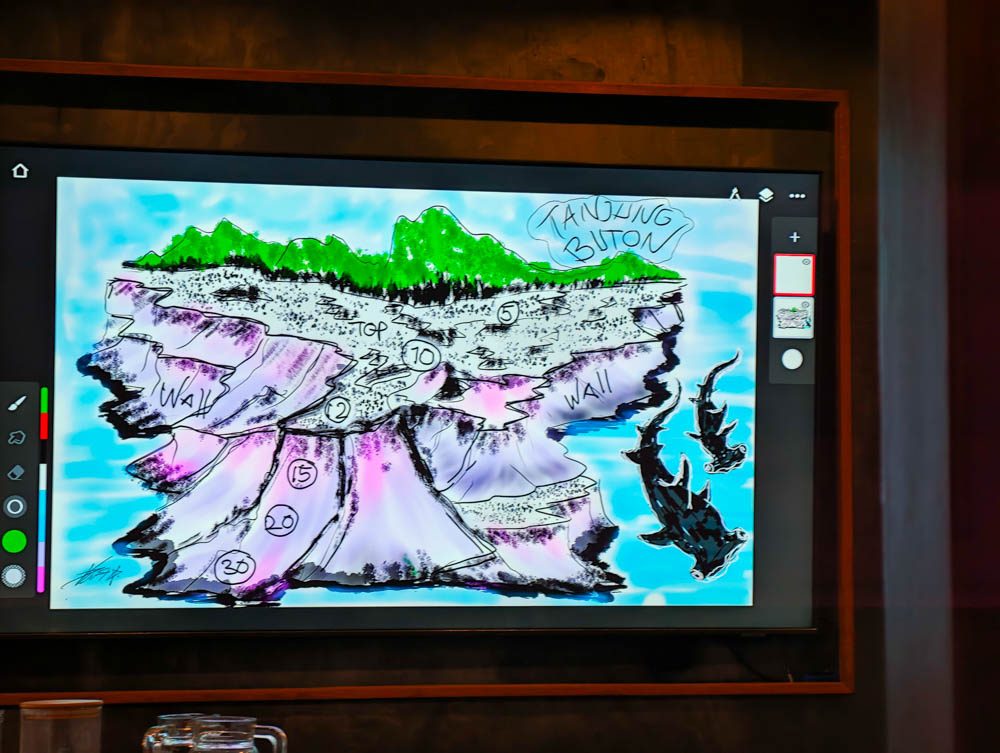
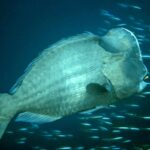
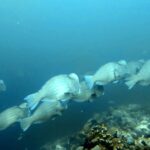
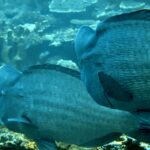
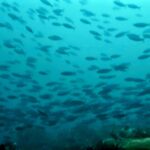
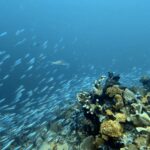
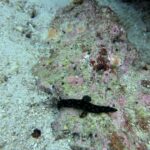
I dived Tanjung Buton again, to 20 meters for 40 minutes, and snorkelled Hatta Hole in the afternoon. Same wall, same month, four years on: still no hammerheads at the corner, still one of the prettiest walls in the Banda Sea. The water here was 24°C, the coldest of the trip.
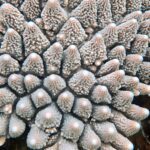
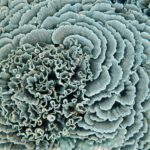
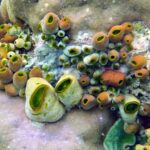
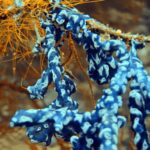
REEF NOTE: TUNICATES
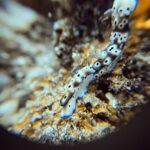
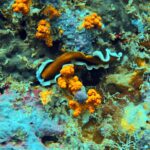
A word about those tunicates, because divers swim past them for years without knowing what they are. The little translucent vases, the blue-and-white “bluebell” clusters and the ink-spotted golden barrels on Indonesian walls are sea squirts, and they have one of the strangest life stories on the reef. A tunicate larva looks like a tadpole and has a notochord, the stiffening rod that in our ancestors became a backbone, which makes tunicates the closest living invertebrate relatives of vertebrates: closer to you and me than to the sponges and corals they sit among. They are also one of the oldest animal lineages still alive: tunicate fossils go back about 500 million years to the Cambrian, the explosion of life that produced almost every animal body plan we know, so the little vase on the wall belongs to a design that has outlasted the dinosaurs several times over. Then the larva finds a spot on the wall, glues itself down head first, absorbs its own tail and most of its larval nervous system, and spends the rest of its life as a filter pump, drawing water in through one siphon and out of the other. Some species are solitary; some form colonies with shared outflows; and the salps the snorkellers see drifting in open water on this route are their free-swimming cousins. Tunicates are found in every ocean, but the reefs of the Coral Triangle, and Raja Ampat and the Banda Sea in particular, carry them in a density and a range of color you will not see in the Red Sea or the Caribbean. Once you start noticing them, every wall dive in Indonesia has a second, smaller layer of life on it.
Hatta, October 2026
Day 6: Pulau Kurkap, and the news from Kaimana
A 16-hour overnight run from Hatta brought us to Pulau Kurkap, the closest we came to Kaimana. A snorkel stop there, which I sat out, and then the message that changed the trip: Kaimana airport closed, the air near Triton Bay unhealthy. Dom turned the boat north. We could smell the smoke here more than anywhere else on the route.
Pulau Kurkap, October 2026

Day 7: Pulau Pisang
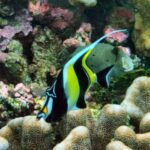
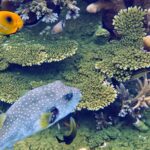
Banana Island, Pulau Pisang, is a site few boats visit. The divers logged three dives there with frogfish, mobula rays and two reef mantas; I snorkelled all three sessions and had silversides in their thousands with tuna, a shark, a turtle and a napoleon hunting through them. Back on board the crew put the slide out, then served cocktails on the sundeck for sunset before the overnight run to Misool.
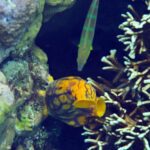
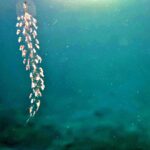
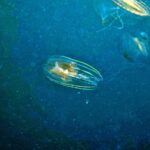
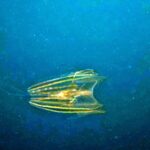
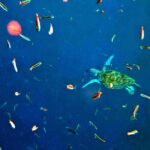
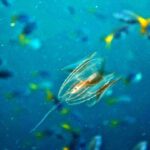
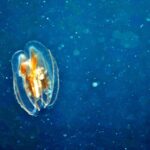
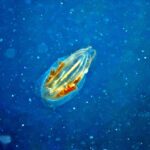
Our trip had one more surprise. During our snorkeling tours in Pulau Pisang and Misool, we kept meeting comb jellies. They look like jellyfish but belong to a completely separate group of animals; the rainbow running down their bodies is light scattering off eight rows of beating hairs, and they don’t sting. Here is that video:
Pulau Pisang, October 2026
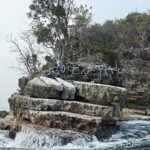
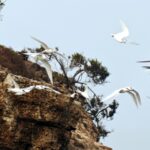
Day 8: Misool, Boo West, Boo East and Tank Rock
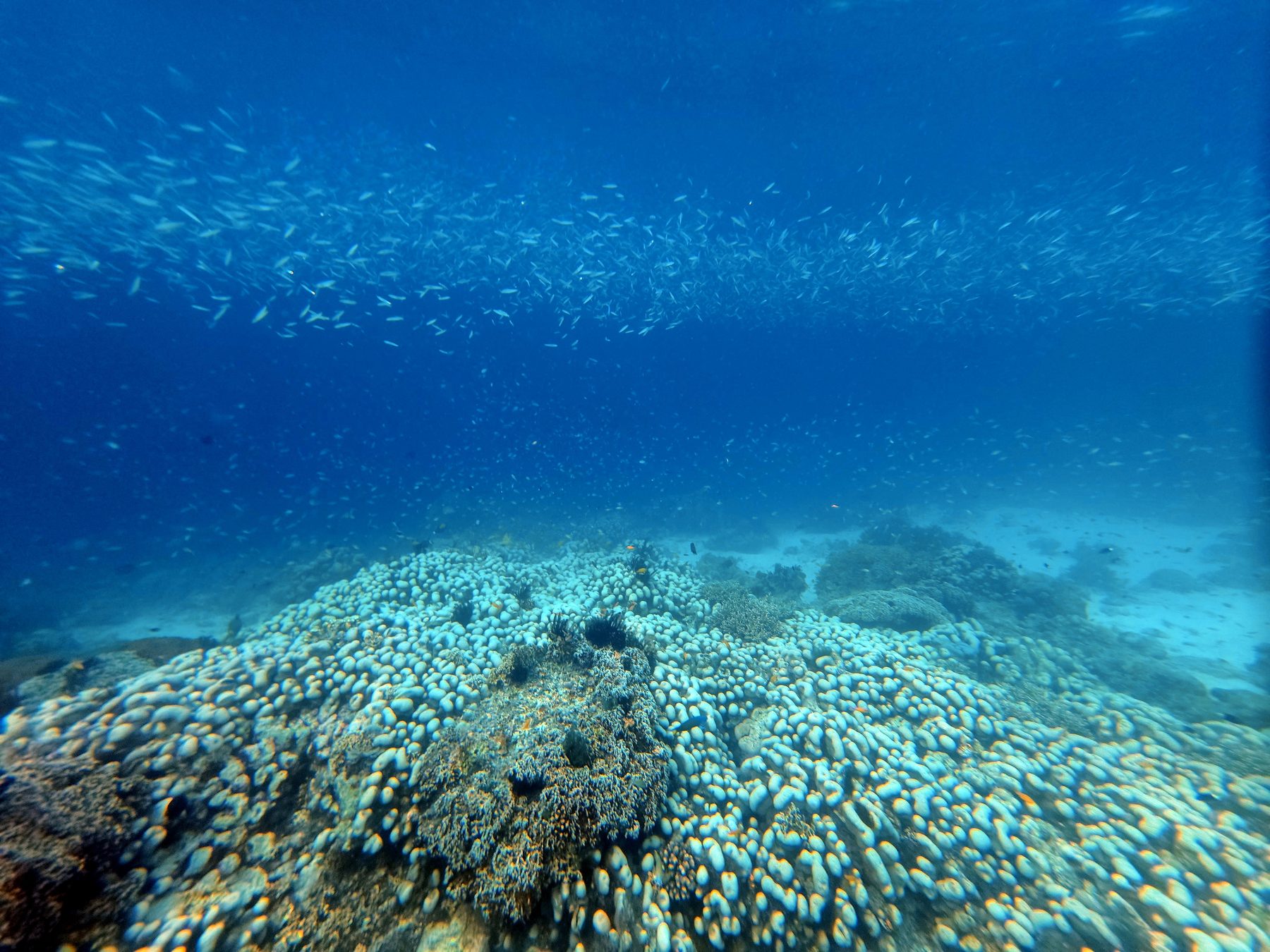
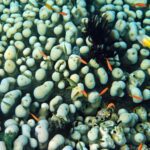
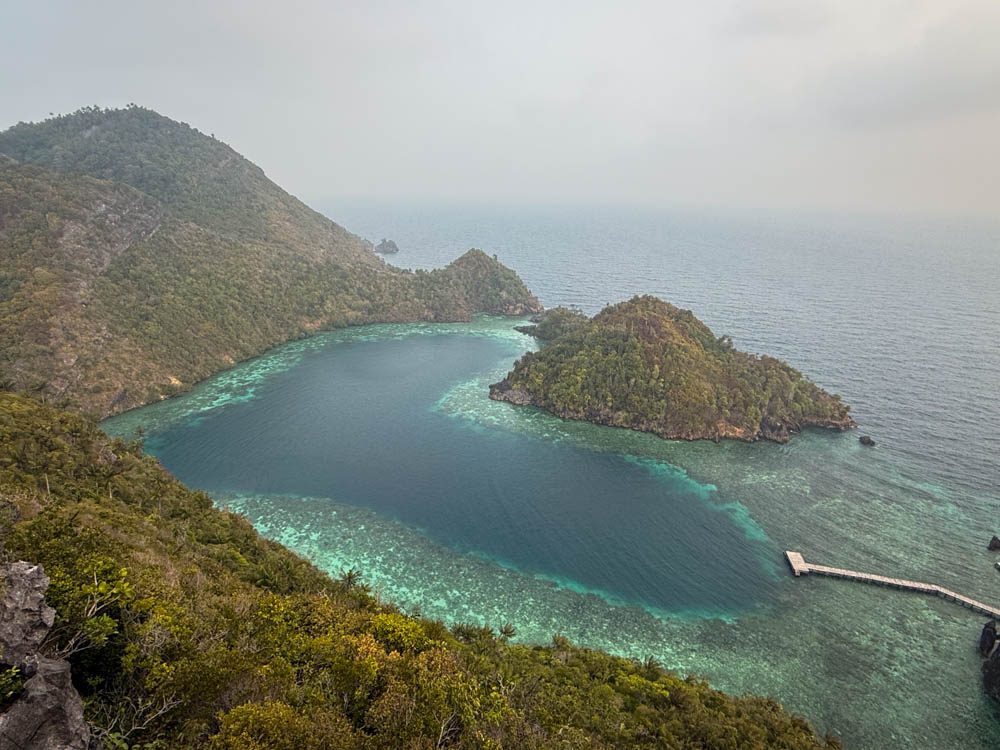
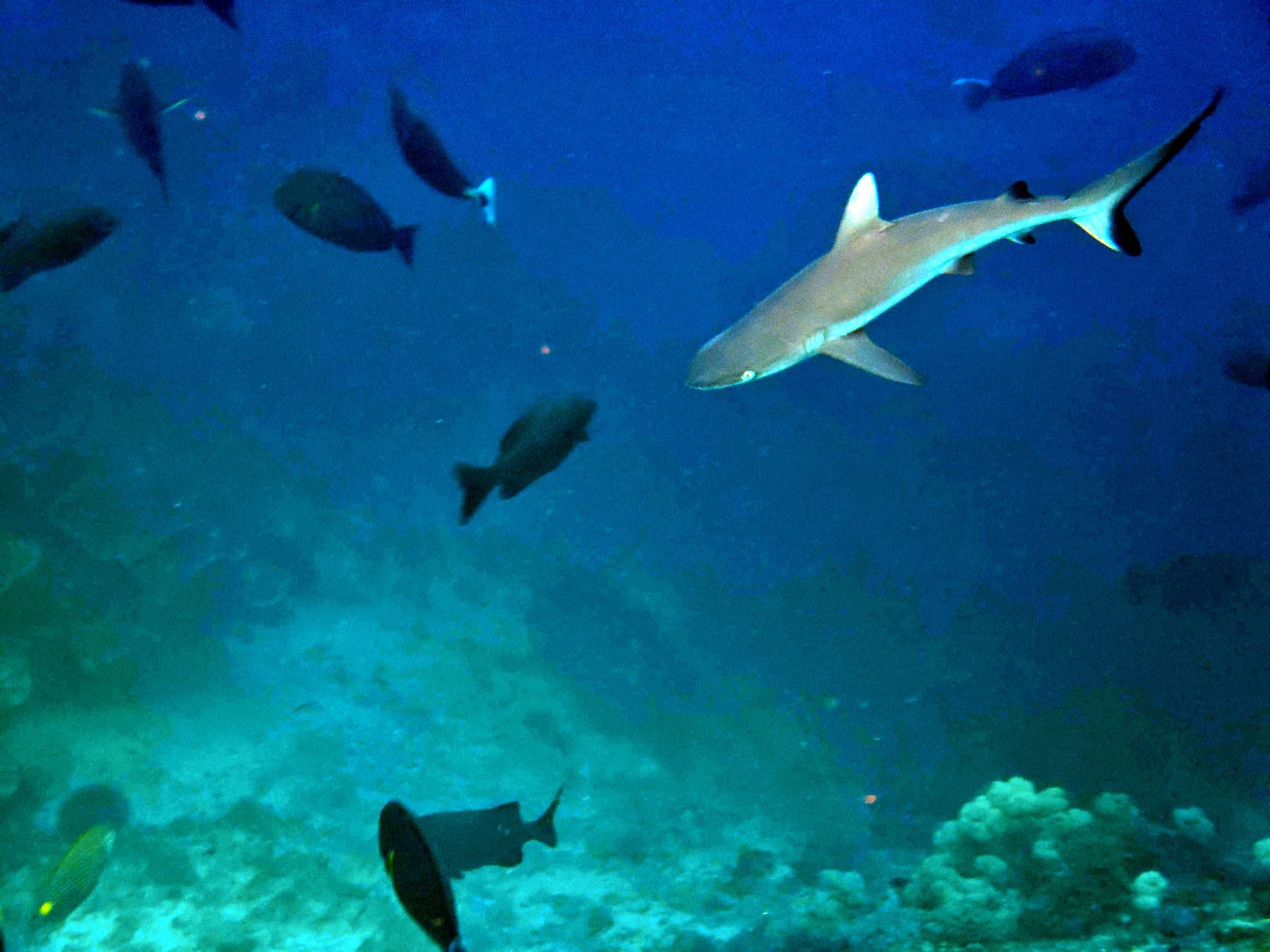
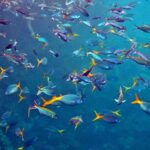
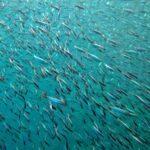
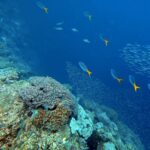
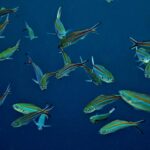
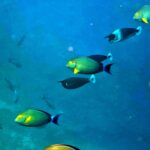
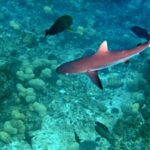
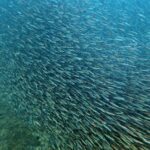
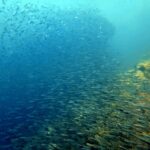
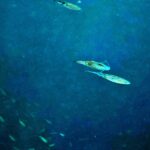
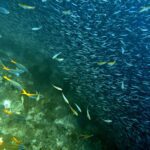
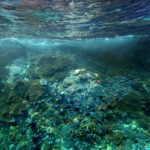
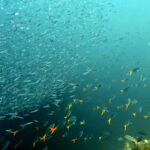
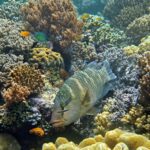
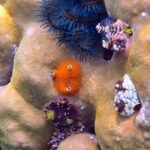
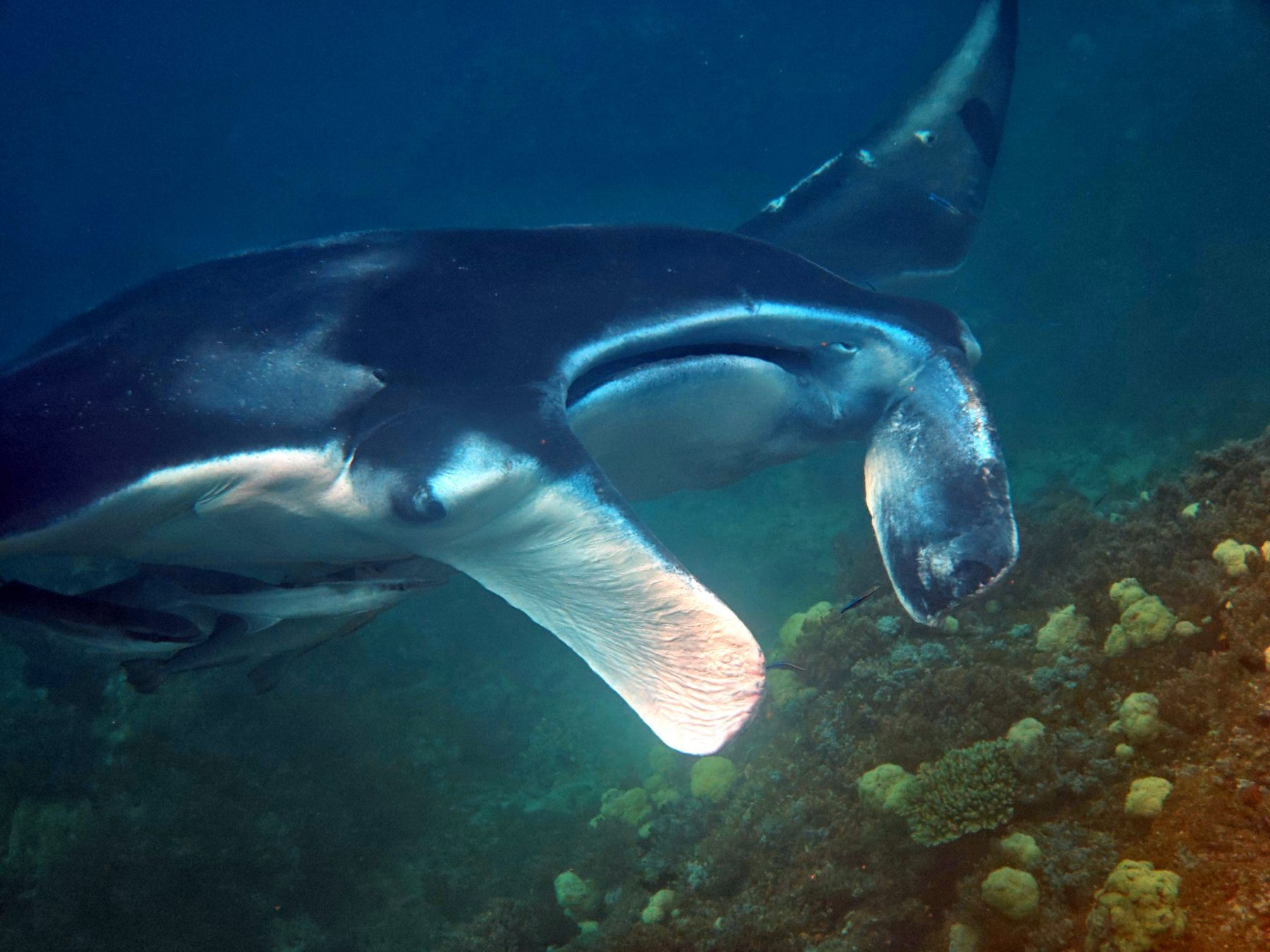
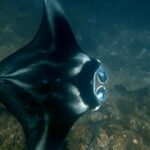
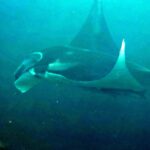
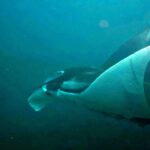
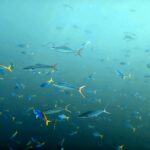
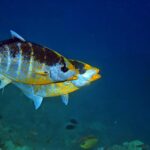
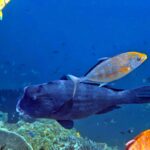
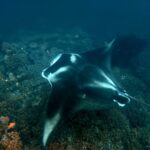
I snorkelled all three. Boo West was a firework of silversides with jacks and giant trevallies hunting through them, a blacktip, a turtle, a great barracuda and a school of batfish; Boo East was almost as busy. Tank Rock gave me five reef mantas feeding and cleaning at three to seven meters for over an hour, alone, which I would put against most manta dives I have done. The divers had the same sites from below. In the late afternoon the team climbed to the Love Lagoon viewpoint, and a night dive was offered on top of it all.
Here is the video I filmed with the five mantas at Tank Rock:
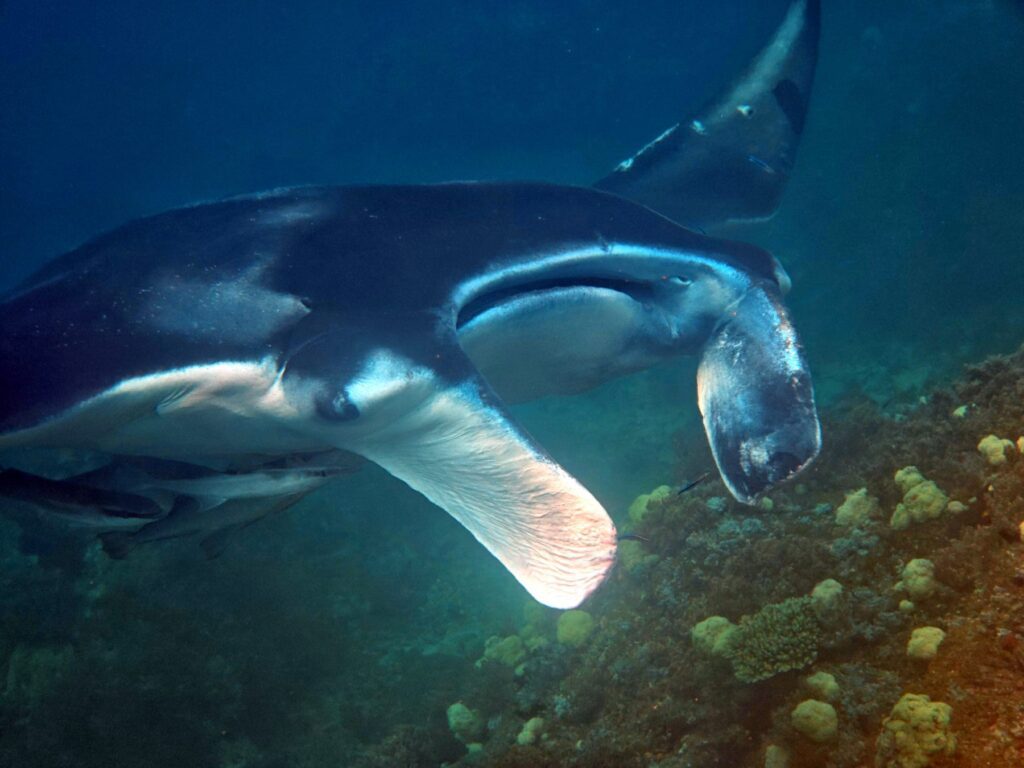
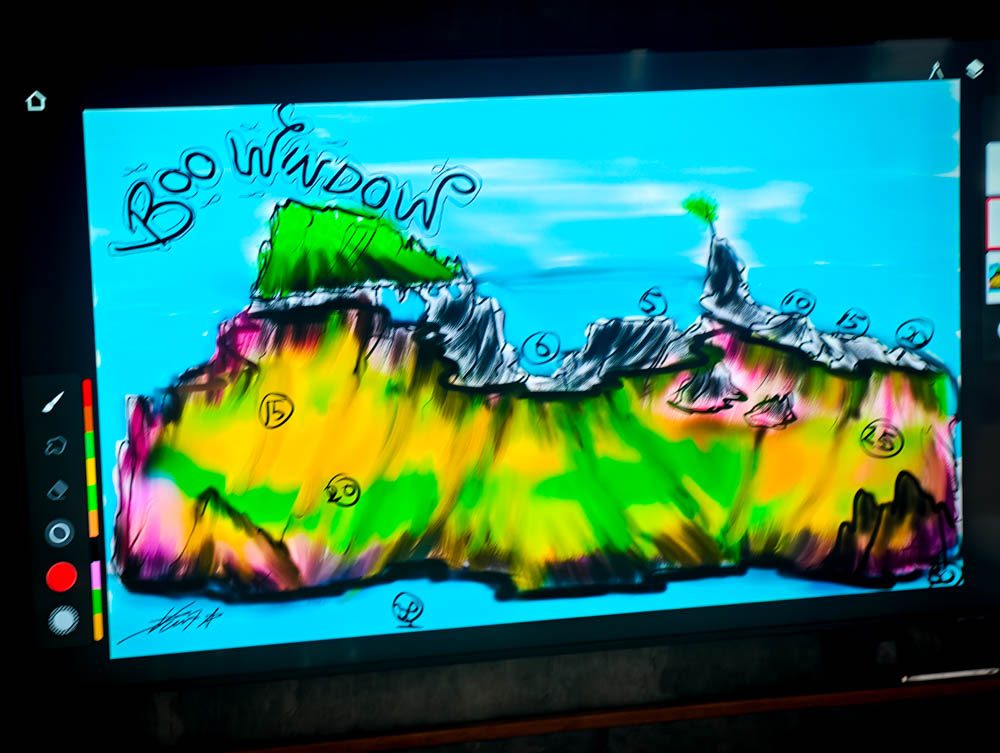
Boo West and Boo East, snorkelling
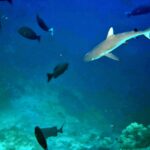
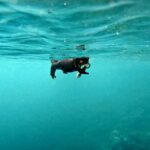
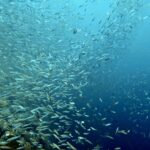
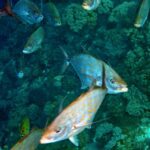




Tank Rock, snorkelling with mantas







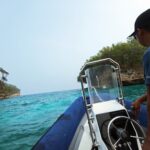
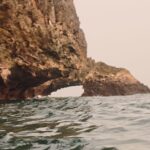
Misool above the water
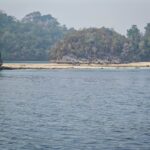
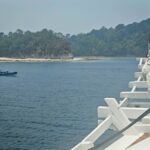
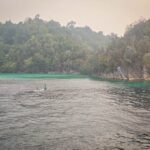
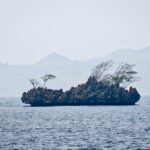
Day 9: Gorgonian Passage, Wayil Lagoon and Four Kings
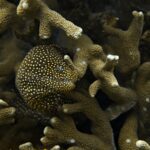
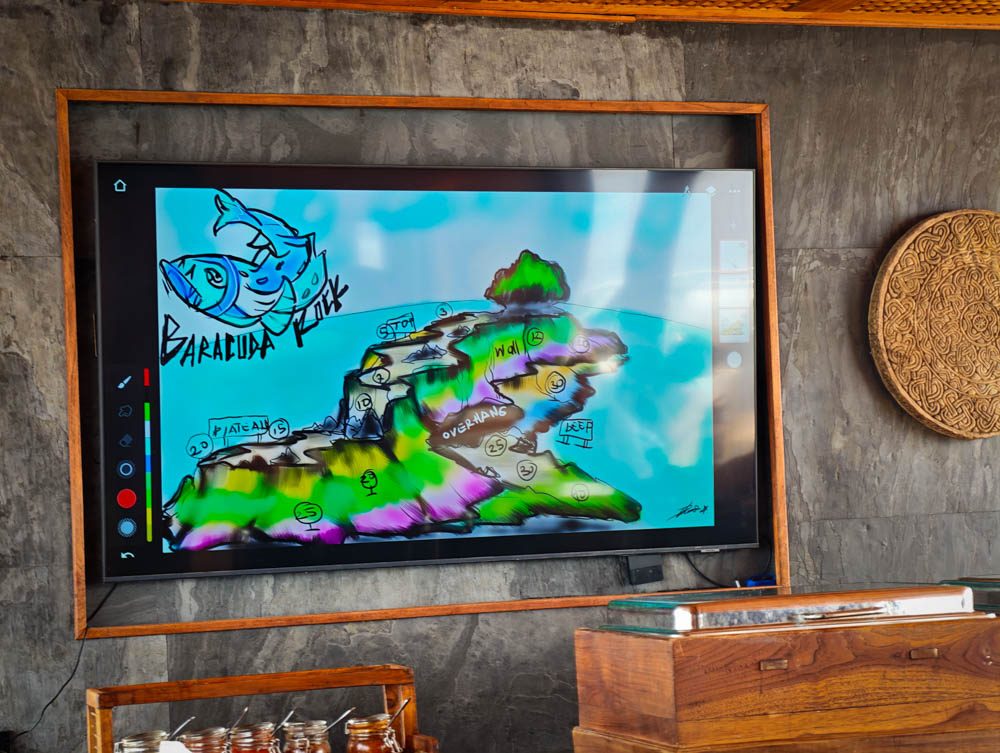
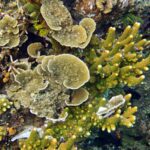
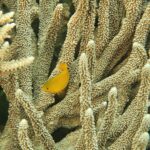
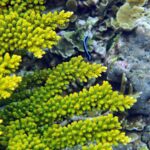
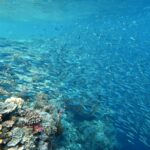
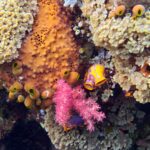
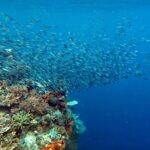
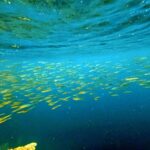
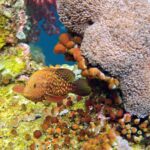
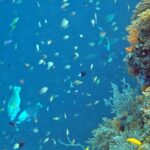
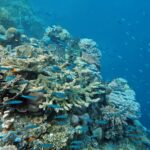
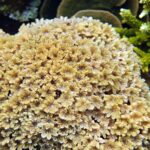
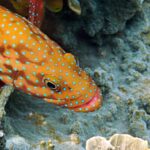
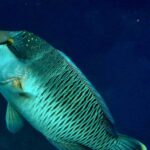
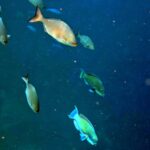
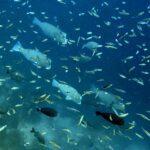
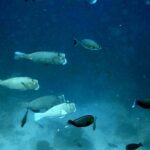
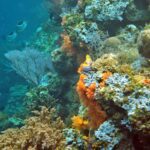
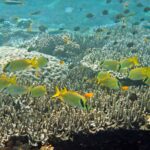
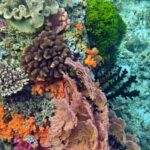
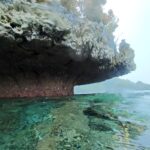
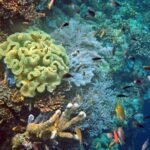
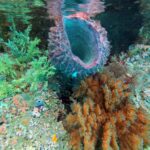
I snorkelled Gorgonian Passage and the karst islands of Wayil Lagoon off Barracuda Rock, also called Barracuda Point (the drift along the shallow side of Gorgonian Passage and the karst islands off Barracuda Rock were among the best snorkels of the trip, and are in the non-divers guide) and kept a dive for Four Kings. The divers at Gorgonian Passage found a wobbegong and a white-spotted wedgefish, a critically endangered guitarfish relative that I have never seen in twenty years of diving Raja Ampat; Barracuda Rock gave them no barracuda but some good macro.
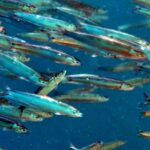
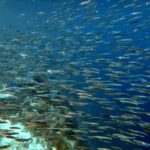
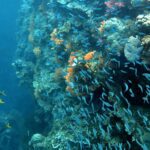
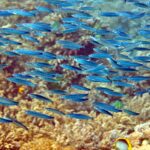
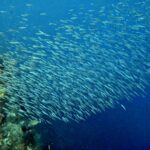
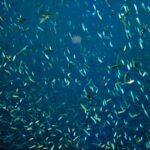
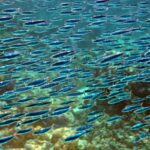
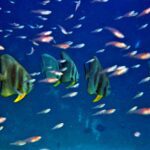
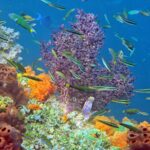
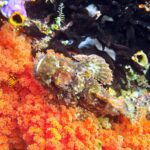
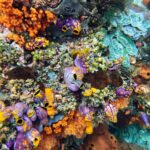
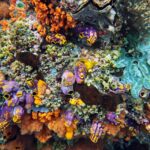
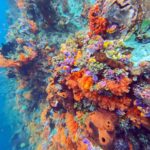
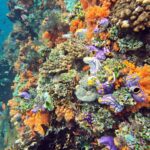
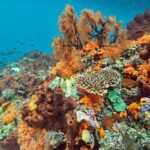
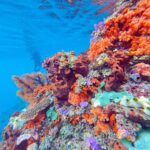
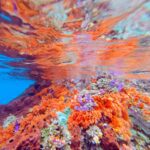
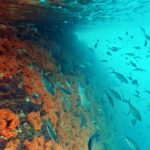
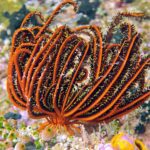
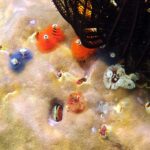
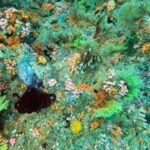
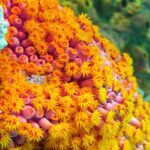
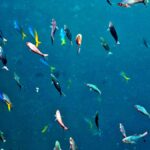
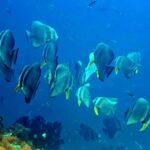
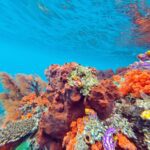
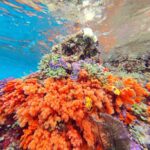
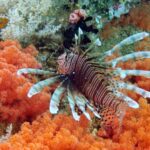
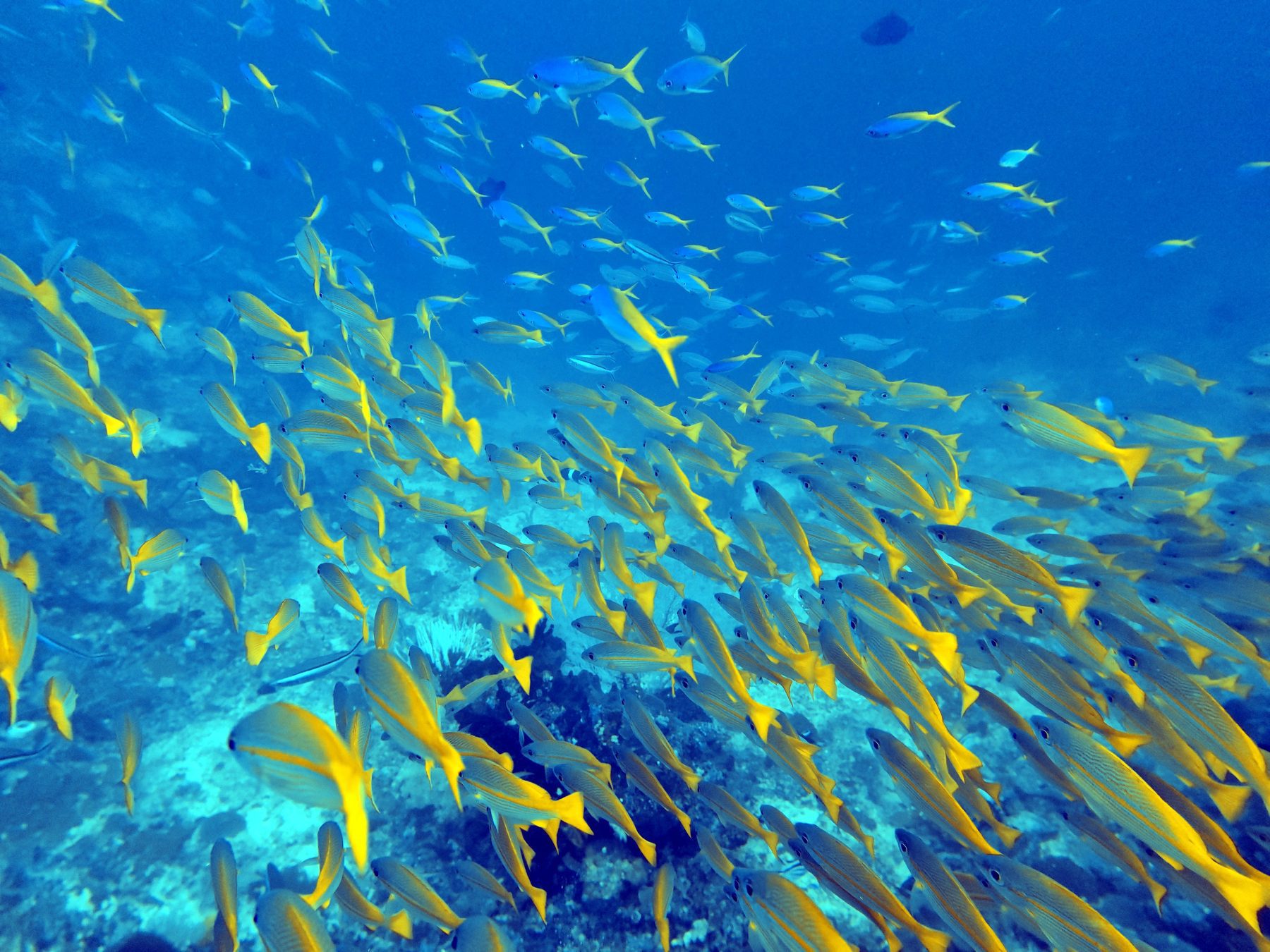
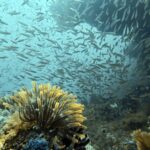
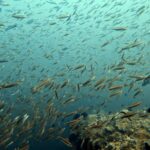
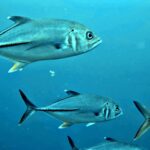
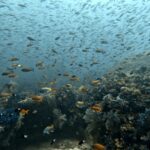
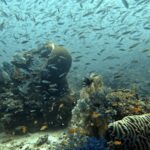
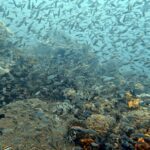
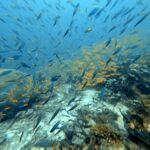
Four Kings is one of the most famous dives in Raja Ampat and it took about a minute to see why. Four pinnacles rise from the sea floor in a line, each one wrapped in silversides so dense that the rock disappears, and everything that eats silversides was working them: schooling barracuda, a huge school of jacks, a big school of yellow snapper moving as one. The temptation is to hang in the blue and watch the hunt, and you should, but leave time for the pinnacles themselves. The coral on them is fabulous, and there are swim-throughs cut into the rock that are packed solid with glassfish; you push through a curtain of them and come out the other side. It was an amazing dive, and it is the one I would tell a Scuba & Spa guest to spend a dive on if they only had one left. Four Kings is also where, in 2022, we started the day at 6 am with jacks and barracuda hunting anchovies, so it has now delivered twice.
Here is the video I filmed at Four Kings:
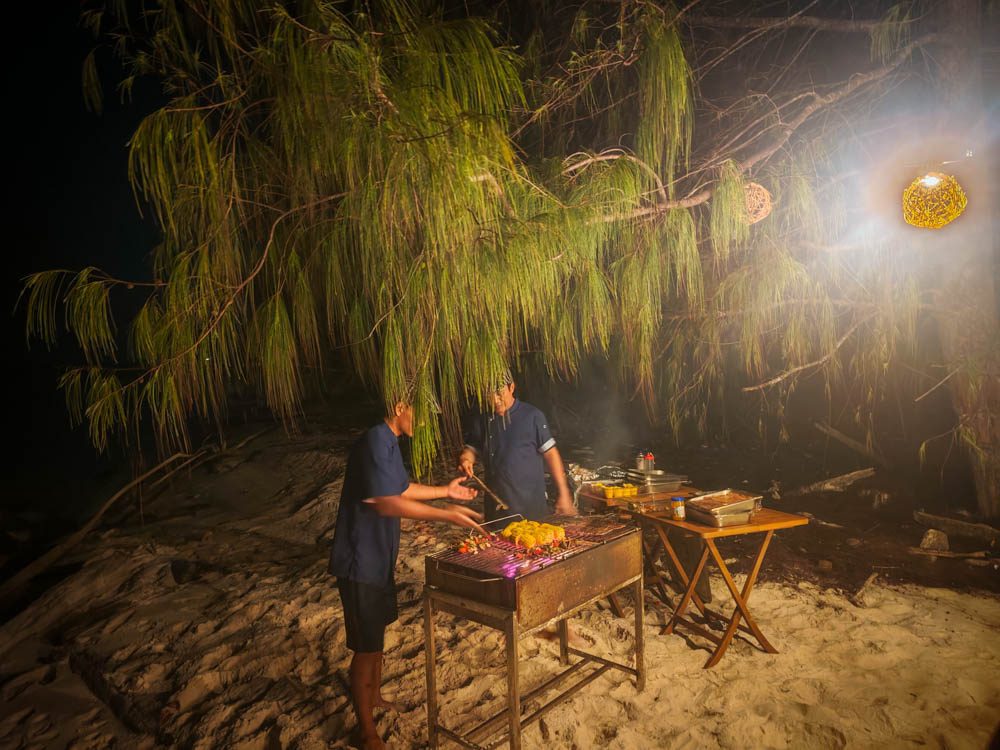
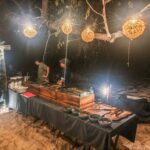
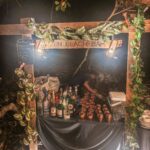
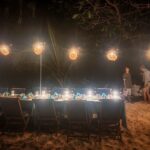
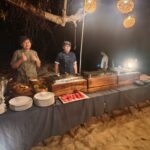
The evening was a beach barbecue.
Gorgonian Passage, snorkelling
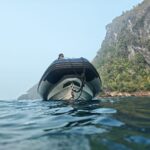


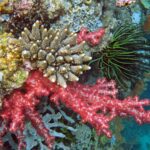
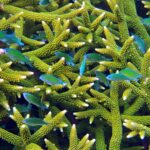







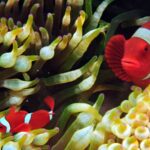
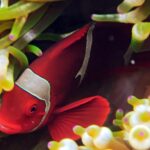
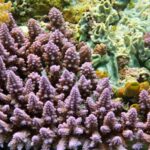
Karst islands off Barracuda Rock, snorkelling
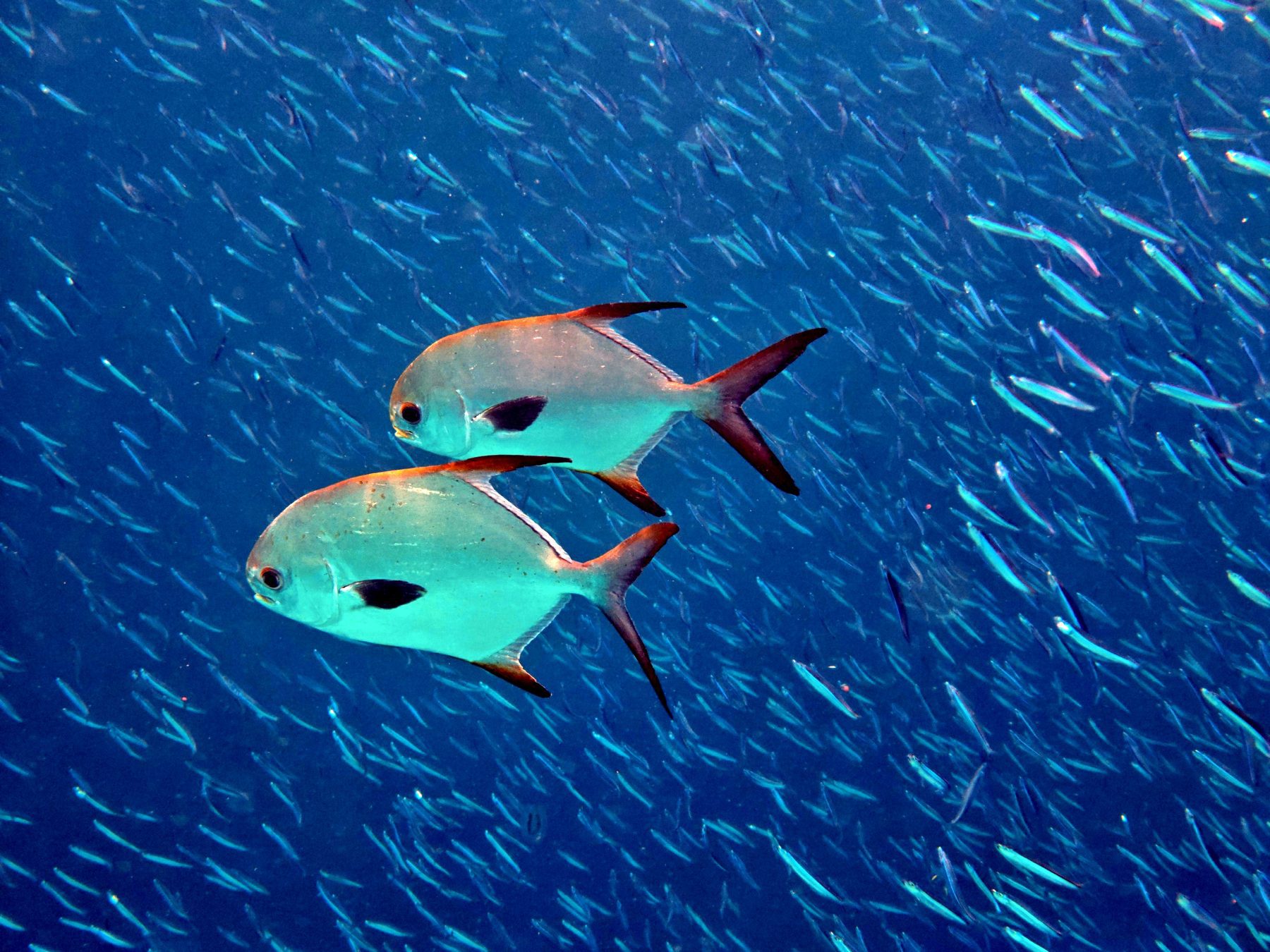











Four Kings, diving
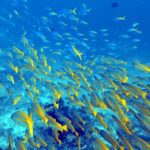
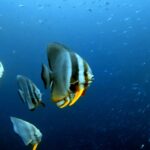
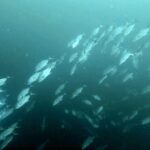
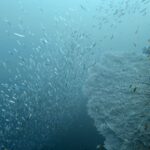
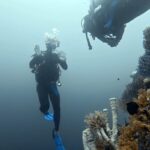
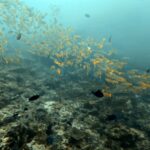

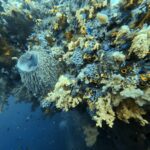
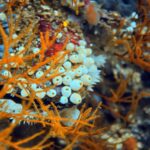
The beach barbecue in Misool

Day 10: Puri Pinnacle and Magic Mountain
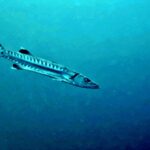
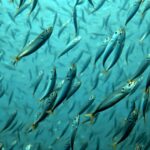
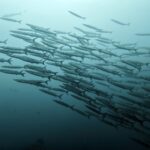
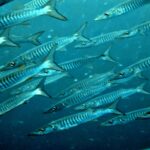
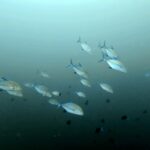
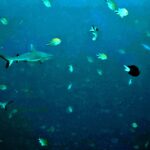
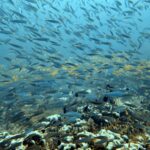
These were my two best dives of the year, back to back. Puri Pinnacle was fully switched on. The plateau was wrapped in silversides, millions of them, and the whole food chain had arrived to eat: a school of fifteen mobula rays swept through the bait like a single animal, two separate schools of around two hundred barracuda hung just behind, waiting, and groupers, a napoleon and schooling tuna joined the hunt. There was so much going on that it was hard to know where to look. Dolphins were at the surface when we came up; they never came onto the site, but they did not need to. Total madness, in the best sense.
Here is the video I filmed on that dive at Puri Pinnacle:
Puri Pinnacle, diving
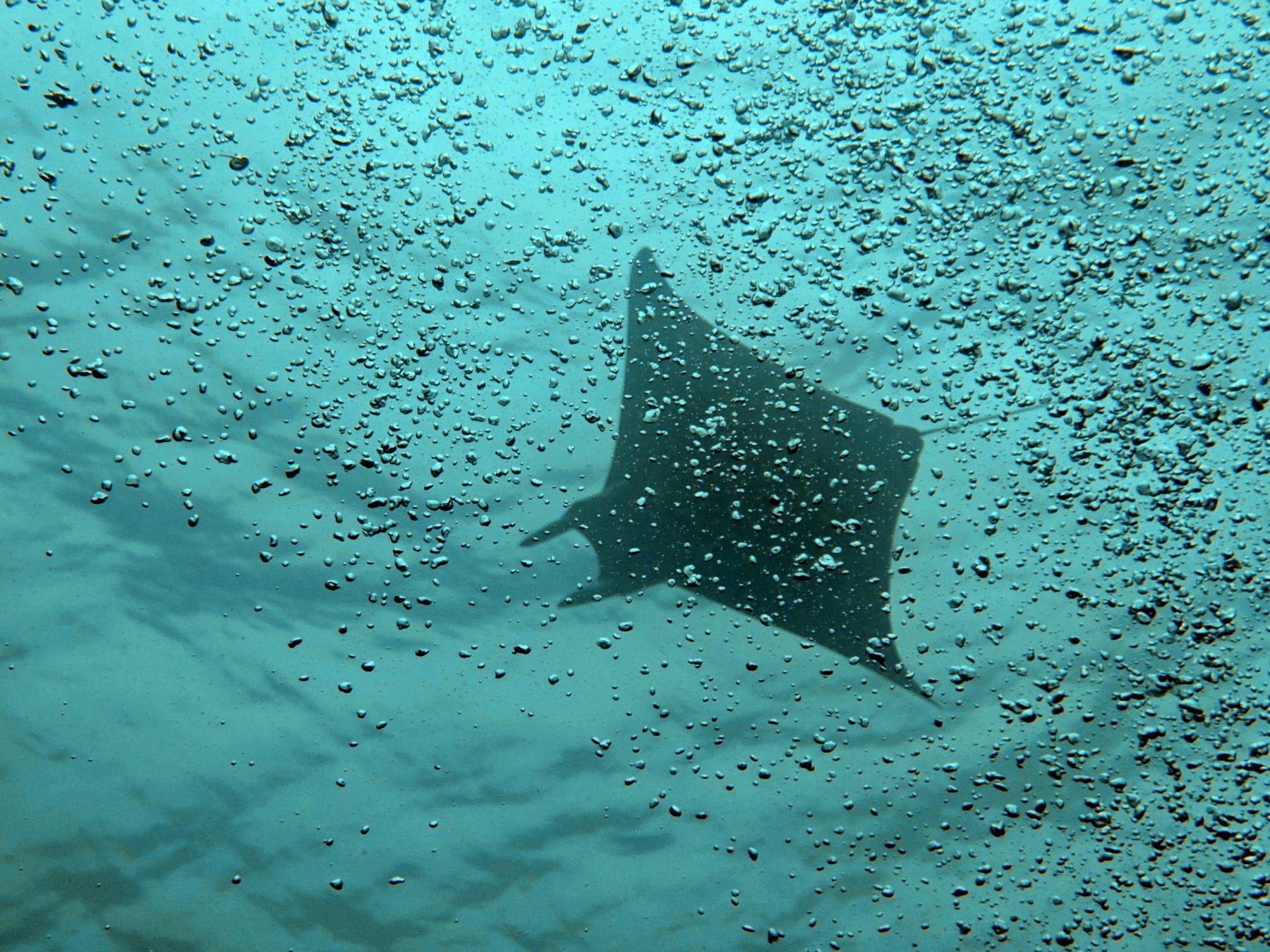

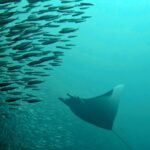

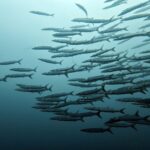




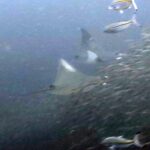
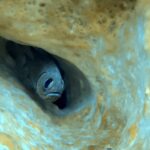
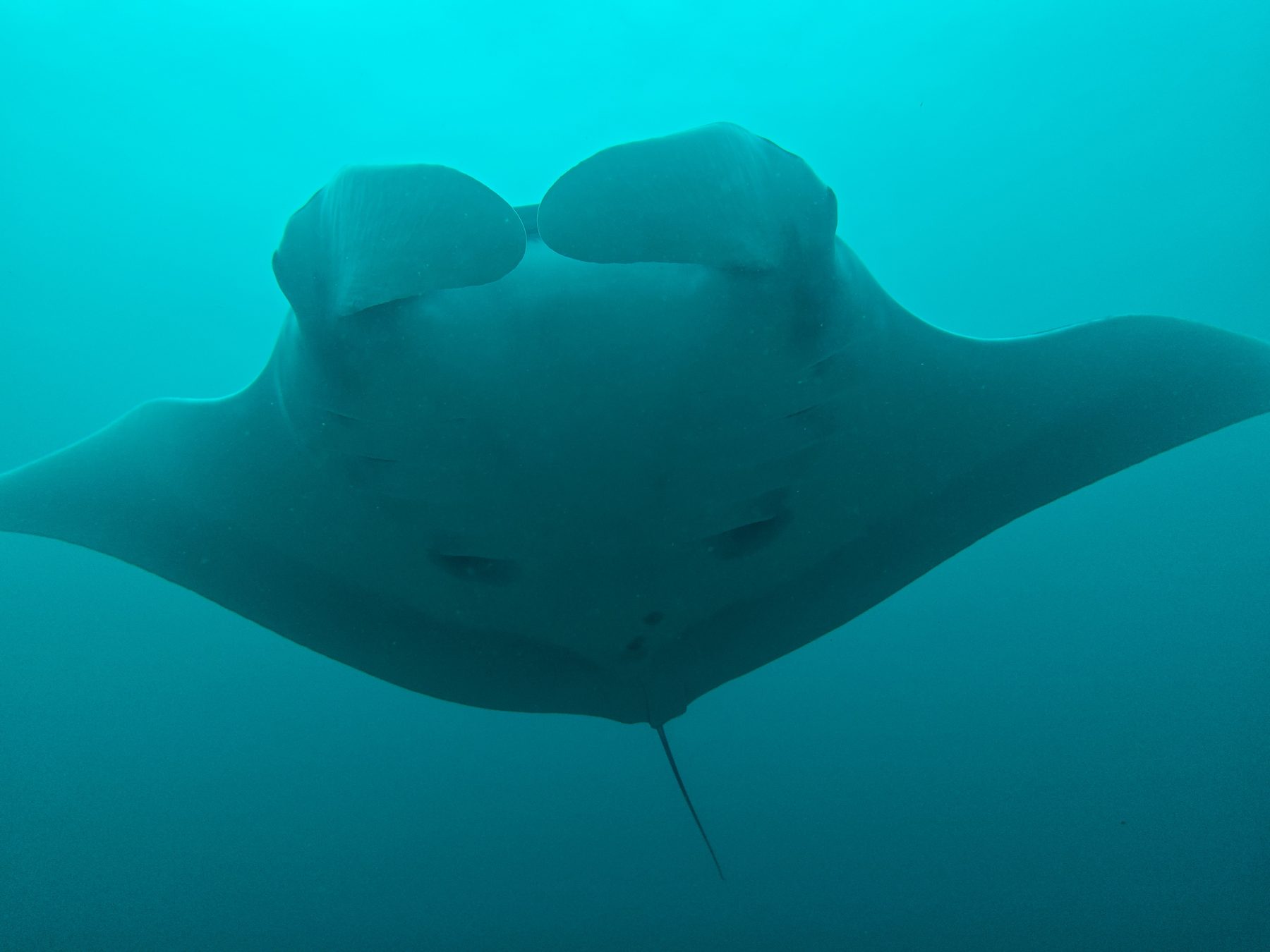
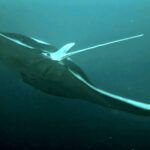
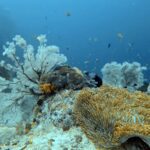
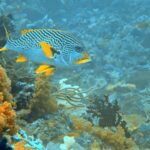
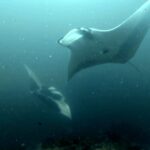
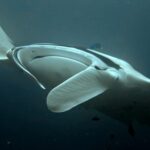
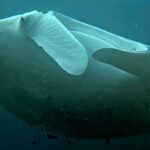
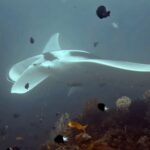
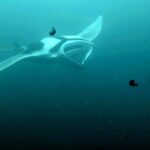
If it is possible, the next dive was better. Magic Mountain, probably the most famous dive site in Raja Ampat (the crew write it up by its Indonesian name, Karang Bayangan), is a seamount with a shallow top pinnacle and a deeper one, joined by a ridge, and liveaboards are allowed to dive it once per trip. As we came down onto the top pinnacle, the first thing we saw was a wobbegong shark. Within a minute, two oceanic mantas appeared and stayed with us for the entire dive, moving from diver to diver and checking each of us out, close enough to see their eyes move. That interaction was the moment of the trip. I went down to the bottom pinnacle and found about ten reef sharks; other divers saw a leopard shark there too. Schools of jacks were hunting, there were giant barracuda and oceanic triggerfish, fusiliers by the hundred, and, as if that were not enough, a sea snake, mantis shrimps, octopuses and countless nudibranchs. What a dive to finish on. In 2022 the same site gave us no mantas at all. That is the point.
Here is the video I filmed on that dive at Magic Mountain:
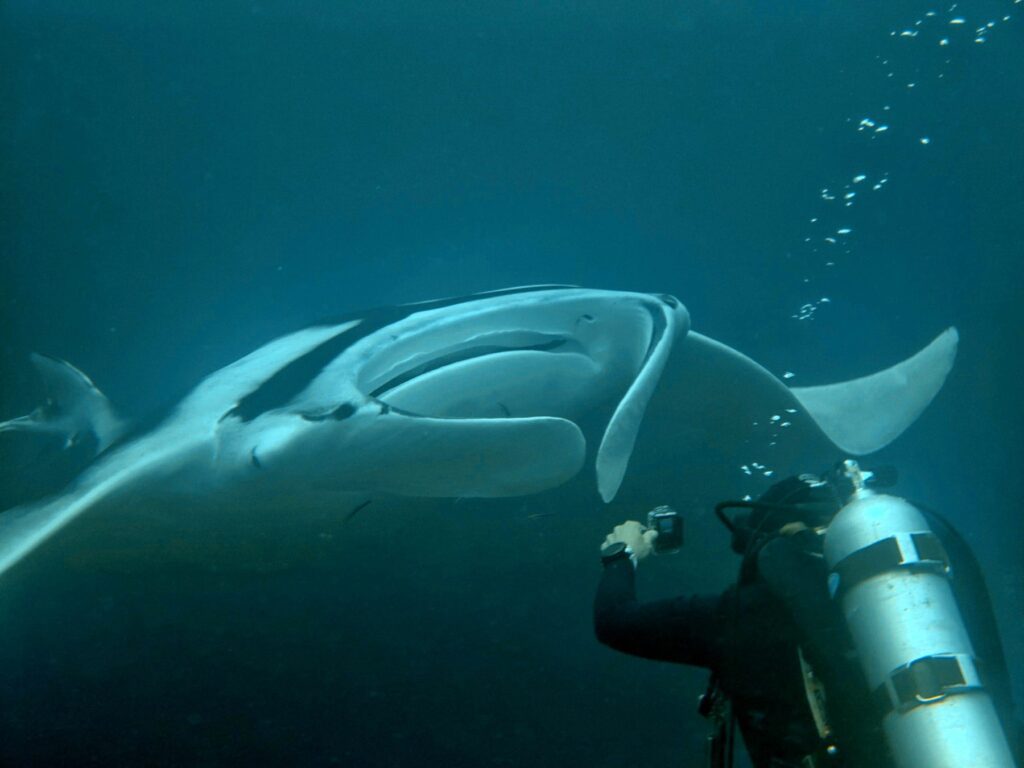
Magic Mountain (Karang Bayangan), diving





Why October Is the Best Time to Dive Misool
Most guides will tell you that the peak season for Raja Ampat is January and February. I disagree, and this trip is why. October is very early in the season, and that is exactly the point.
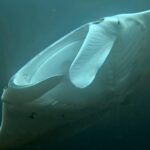
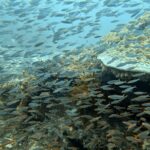
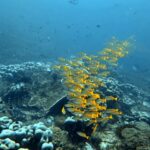
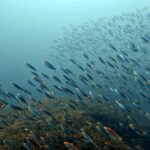
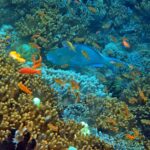
First, the mantas. Mantas tend to leave sites that are crowded with divers, and in October the Misool sites have not seen a diver for months, so they are all there: five at Tank Rock, two oceanic mantas for a whole dive at Magic Mountain. Second, the silversides. The bait that makes Puri Pinnacle and Four Kings explode with life is still on the sites in October, because the fishing bagans, the lift-net platforms that target exactly these fish, have not yet moved into the Misool area. Each platform takes around two tons of fish a day, and once they arrive they can empty a dive site surprisingly fast. Diving these pinnacles while the silversides are still there, with the mobulas, barracuda and tuna hunting through them, is very, very special. Third, the boats: in October most of the liveaboard fleet is still in the Banda Sea and the Ring of Fire chasing hammerheads, so Misool is almost empty, which will matter even more under the new booking system described below.
The risk is the sea. October is the end of the south-east monsoon and the crossing to Misool can be rough; there is a small chance that Misool is not accessible in the particular week you choose. If that happens, the boat relocates to central and north Raja Ampat, which is no hardship. On balance, if you can only do Raja Ampat once, I would book October over February.
The new Raja Ampat dive-site booking system
Something to know if you are booking a Raja Ampat liveaboard from now on. Since September 2026 the park has run a reservation system: Raja Ampat has been divided into areas, and every boat must book an area to dive in for every day of its trip. The catch is that only five boats are allowed in any one area on a given day. Do the arithmetic on a seven-day week and you get a maximum of 35 boats a week able to dive the most popular sites, Magic Mountain, Blue Magic or Four Kings. Liveaboard.com alone lists 61 boats for Raja Ampat, and in peak season there are around a hundred in the park, so the system is going to leave a lot of disappointed divers. It is good news for the reefs and for the divers who do get in, and it means two things for you. First, the itinerary your boat advertises is now a plan, not a promise, so ask before you book how the operator handles it. Second, going slightly off-season, October, or May and June, gives you a much better chance of diving the best sites, because far fewer boats are competing for the five slots.
The last day: Sorong
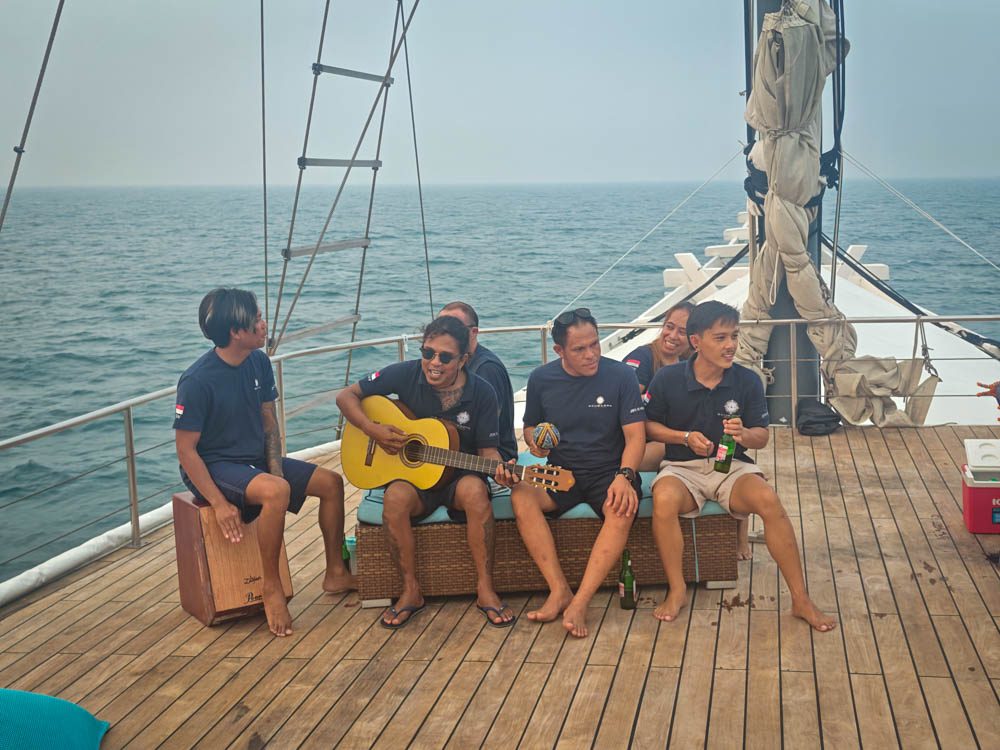
We started back towards Sorong around lunchtime on the last diving day and sailed for twelve hours. The afternoon was spent on deck doing nothing in particular, watching the waves, and at sunset, as the board promised (“sunset cocktails + live band”), the Scubaspa Zen band, the crew with their instruments, came up to play for us, and it turned into a very festive last evening. We reached Sorong in the early evening and anchored for the night.
Checkout is where the Zen beats most of the fleet. Some boats make you leave at 9 am and wait at a hotel in town or at the airport for an afternoon flight. Not here: we disembarked at 11.30, so there was time in the morning to pack, have a last breakfast and relax.
INSIDER TIP
If you want to do the last two dives, book a flight out of Sorong after midday on departure day.
Sorong’s airport is not fancy, but there is one good place to wait: the Arvac Lounge and Coffee by Pawai Hawai Bakery, a restaurant after security that doubles as a lounge, with a smoking room, good food, fresh juices and genuinely delicious tea and coffee; they sell the coffee by the bag to take home. You can use it as a lounge with a minimum spend of 85,000 rupiah (about 5 USD), and it is the best place in the building to sit out a delay.
BUDGET TIP
Scubaspa charges a flat 70 USD per person per day to cover all the port, park and visit fees on the trip, settled on board; there is no need for cash, everything can go on a credit card. Budget for it, because on a 10-night cruise it adds 700 USD to the cost of the trip, up from about 400 USD in 2022. The Raja Ampat marine park fee of 1,000,000 rupiah is included in that amount, and it is valid for a year, so if you plan to be back in Raja Ampat within twelve months, ask for your park card and keep it.
Zen, Yin or Yang: Which Scubaspa Boat?
The Scubaspa fleet spans two countries. The Zen sails Indonesia; the Yin and Yang are in the Maldives, and I have sailed with Scubaspa there twice: see my Scubaspa Maldives central atolls review and my Scubaspa Maldives Far North review. The spa-plus-diving formula is the same on all three, so choose by destination, not by boat. If you want hammerheads, mantas, Triton Bay’s soft coral and Raja Ampat’s reefs, that is the Zen.
Conclusion: Is Scubaspa Zen the Boat for You?
After two trips four years apart, my view of the Scubaspa Zen has only improved. The two-boat system is still unique in Indonesia and it is one of the most comfortable ways I know to do three dives a day. The cabins are taller and roomier than the competition, the sundeck has become a proper outdoor lounge, the food has gone from good to very good, and Starlink has fixed the one real weakness of the 2022 boat. The spa and the packages mean a couple where only one person dives can both have the holiday they want on the same boat.
Book the Zen if you want serious diving with real comfort around it, if you are travelling with a non-diver, or if the small things matter to you: a defibrillator on board, small dive groups of four at most, a call button on your lounger. Look elsewhere if you want four dives a day and nothing else, or if you cannot live without air-conditioned lounges. For everyone else, this is the best spa liveaboard in Indonesia, and one of the best liveaboards in Indonesia full stop.
Back in 2022 I wrote that the Zen was a welcome addition to the Indonesian liveaboard market, that the second dive boat was a first in Indonesia and let Scubaspa offer an extremely comfortable diving experience, and that I would love to sail with them again. Four years and a second trip later, I stand by every word.
To book, check the dates and current rates on Scubaspa’s own website, or compare availability and prices on Liveaboard.com.
Planning a trip to Raja Ampat? For more information, these guides will help:
- The 12 best Raja Ampat liveaboards, tested and reviewed, and how to plan a more meaningful Raja Ampat liveaboard trip
- Other boats I have reviewed in Raja Ampat: Emperor Harmoni, Seahorse, Coralia and Dewi Nusantara
- If you would rather stay on land, my reviews of the two resorts I know best: Misool Resort and Papua Explorers

Scubaspa Zen FAQ
Is Scubaspa Zen a good liveaboard?
Yes. After two 10-night trips, in 2022 and 2026, I rate Scubaspa Zen 5/5. Its separate dive dhoni, large cabins, onboard spa and Starlink internet make it one of the most comfortable liveaboards in Indonesia, and the dive team runs small groups, dawn dives and Nitrox.
Is Scubaspa Zen good for non-divers?
Yes, better than any other Indonesian liveaboard I have sailed on. Non-divers get a dedicated snorkelling guide and their own speedboat, a spa package with one treatment a day, morning yoga and shore excursions. I wrote a separate guide to Scubaspa Zen for non-divers.
What packages does Scubaspa Zen offer?
Three: Scuba (up to 26 dives on 10 nights), Scuba & Spa (14 dives and 7 treatments on 10 nights; I got 12 dives on my 2026 Banda Sea trip) and Spa / active wellness (11 treatments plus guided snorkelling on 10 nights). All include yoga, snorkelling, excursions and 1 GB of Wi-Fi.
Where does Scubaspa Zen sail?
Raja Ampat (most of the season), the Banda Sea and Triton Bay (Ambon to Kaimana and Kaimana to Sorong in October, Sorong to Ambon and Alor to Ambon in spring), Komodo, Halmahera, Cenderawasih Bay and the Forgotten Islands; the boat’s own destination list is Raja Ampat, Cenderawasih Bay, Triton Bay, the Maluku Islands and Komodo, with the schedule planned around the monsoon and tidal cycles. Check the current schedule on Liveaboard.com.
Does Scubaspa Zen have internet?
Yes. Starlink satellite Wi-Fi with two dishes. Each guest gets 1 GB free and can buy more at 50 USD per 10 GB. I measured 57.68 Mbps download in the open Banda Sea in October 2026.
Does Scubaspa Zen have air-conditioning?
The nine cabins are individually air-conditioned. All the common areas, including the restaurant, bar, sundeck and spa, are open-air.
How many dives a day on Scubaspa Zen?
Three as standard (around 6 am, 10.30 am and 2.30 pm), plus occasional night dives. Maximum dive time is 60 minutes, applied flexibly; maximum depth 30 meters unless there is a good reason to go deeper; no decompression diving.
Does Scubaspa Zen have Nitrox?
Yes, from a membrane system, consistently filled at 31 per cent on both my trips, for a small extra fee. The Nitrox course is available on board.
Which is the best cabin on Scubaspa Zen?
The Owner’s Manta Suite, about 60 m² at the stern of the main deck with what is probably the nicest private terrace on any dive liveaboard in Indonesia. It sells out first. The six Sea Star Suites on the lower deck are the standard cabins and are roomier and taller than most of the competition.
When is the best time to see hammerheads on a Scubaspa Zen Banda Sea trip?
The Banda Sea hammerhead season runs roughly from mid-September to mid-November and again around April, when the Zen runs its Banda crossings. Suanggi island is the best site; I saw eleven hammerheads in one dive there in October 2026, and none at all on the first dive of the same day. Sightings are never guaranteed.
Should I cancel my Indonesia liveaboard because of the forest fires?
Not if the trip is about the diving. On my October 2026 Scubaspa Zen trip, during one of Indonesia’s worst fire years, the sky was gray every day and Kaimana airport closed, but the smoke did not affect the dives: visibility was better than usual, there was enough light for the corals, and Raja Ampat delivered some of my best dives there in years. Book one or two buffer days before the cruise and before your international flight home, because regional flights get cancelled when the smoke is thick, and accept that the boat may change the route. If you want blue skies and postcard views above the water, wait for the rains.
Is October a good time to dive Raja Ampat?
Yes, and for Misool I think it is the best month. The sites have not seen divers for months so the mantas are all on them, the silversides are still on the pinnacles because the fishing bagans have not yet arrived, and most liveaboards are still in the Banda Sea, so the sites are empty. The risk is rough seas on the crossing to Misool; if the boat cannot get there, it relocates to central and north Raja Ampat.
Do Indonesian liveaboards carry a defibrillator (AED)?
Some do, and it is worth asking before you book. Scubaspa Zen carries one, with oxygen and three life rafts. Among the boats whose safety listings I checked in October 2026, The Seven Seas, Pindito, La Galigo and the Aggressor boats also list an AED, so it is no longer rare at the top of the market, but it is still far from universal on Indonesian phinisi, and many smaller boats carry oxygen and a first-aid kit only. If you or a partner are at an age or in a condition where it matters, make it a question on your booking checklist.
Disclosure: this article contains affiliate links. If you book through them, I earn a small commission at no extra cost to you. Read my full disclosure policy.
Read more about how I review, or visit my Work With Me page.