The short answer: Galapagos diving is big-animal diving in cold, current-swept water, and the best of it can only be reached by liveaboard. The two famous islands are Darwin and Wolf in the far north, where scalloped hammerheads school all year and whale sharks pass from June to November. The western islands of Isabela and Fernandina add mola mola, oceanic mantas, hunting sea lions and penguins, and the central islands around Santa Cruz and San Cristobal can also be dived on day trips. December to May brings warmer water (about 22 to 26°C) and calmer seas; June to November is colder (about 16 to 23°C), rougher and the season for whale sharks. Plan on Advanced Open Water, 50 or more logged dives, a 7 mm wetsuit and from about $568 a day on a liveaboard.
I dived the Galapagos for a week on the Galapagos Sky liveaboard in March 2024, straight after a week snorkelling and hiking the islands on Ecoventura’s Origin, Theory and Evolve yachts. I have been diving for more than 25 years, with more than 1,500 logged dives and more than 40 liveaboard trips behind me, and the Galapagos is where I have seen more fish than anywhere else I have ever dived. This guide covers each area and its dive sites, the seasons, the boats and what a trip really costs. My own notes are marked From my logbook.
The Galapagos is number two in my ranking of the best dive destinations in the world, behind only Raja Ampat. It doesn’t have Indonesia’s coral or critters, but nowhere else has given me hammerheads, oceanic mantas, a mola mola, penguins and sea lions in a single week.
Galapagos Diving at a Glance
| Area | Best for | How to dive it | Level |
|---|---|---|---|
| Darwin and Wolf (far north) | Schooling hammerheads, Galapagos and silky sharks, dolphins, whale sharks from June to November | Liveaboard only, after an overnight crossing | Advanced |
| Western islands: Isabela and Fernandina | Mola mola, oceanic mantas, penguins, marine iguanas, cold thermoclines | Liveaboard only, and only boats with the permit | Advanced |
| Central islands: Santa Cruz, San Cristobal, Bartolome | Sea lions, whitetip sharks, schooling rays, turtles, hammerheads at Gordon Rocks | Liveaboard, or day boats from Puerto Ayora and Puerto Baquerizo Moreno | Intermediate to advanced |
| Snorkelling from a small expedition yacht | Sea lions, penguins, turtles, reef sharks, plus the islands above water | Naturalist cruise such as Origin, Theory and Evolve | Non-divers and families |
The three areas of Galapagos diving: what each is known for
1. Darwin and Wolf: the far north
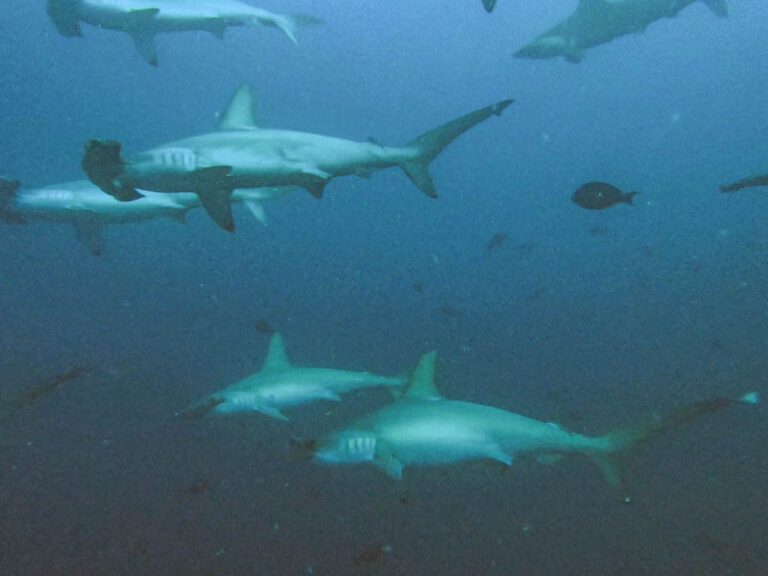
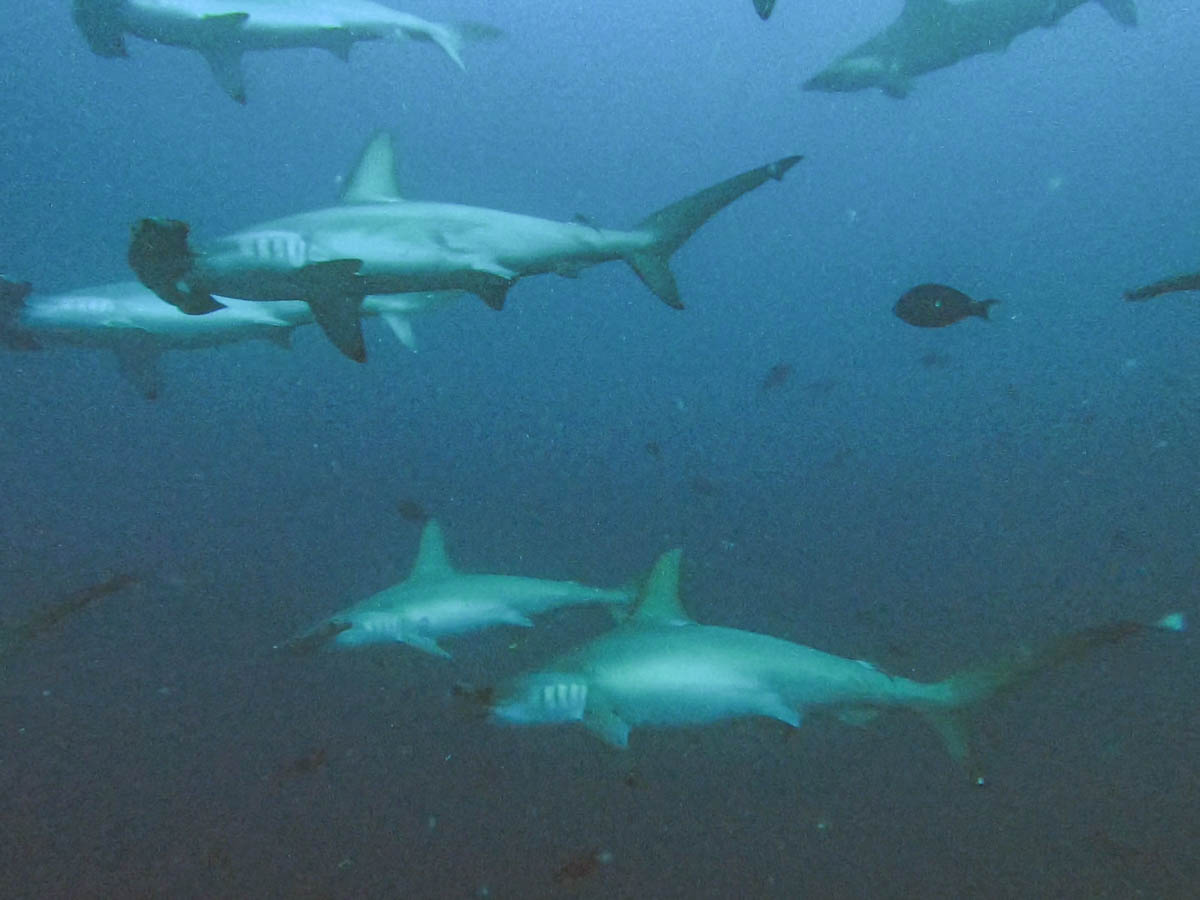
Darwin Arch · Shark Bay at Wolf · hammerhead schools · whale sharks June to November · liveaboard only
2. The western islands: Isabela and Fernandina
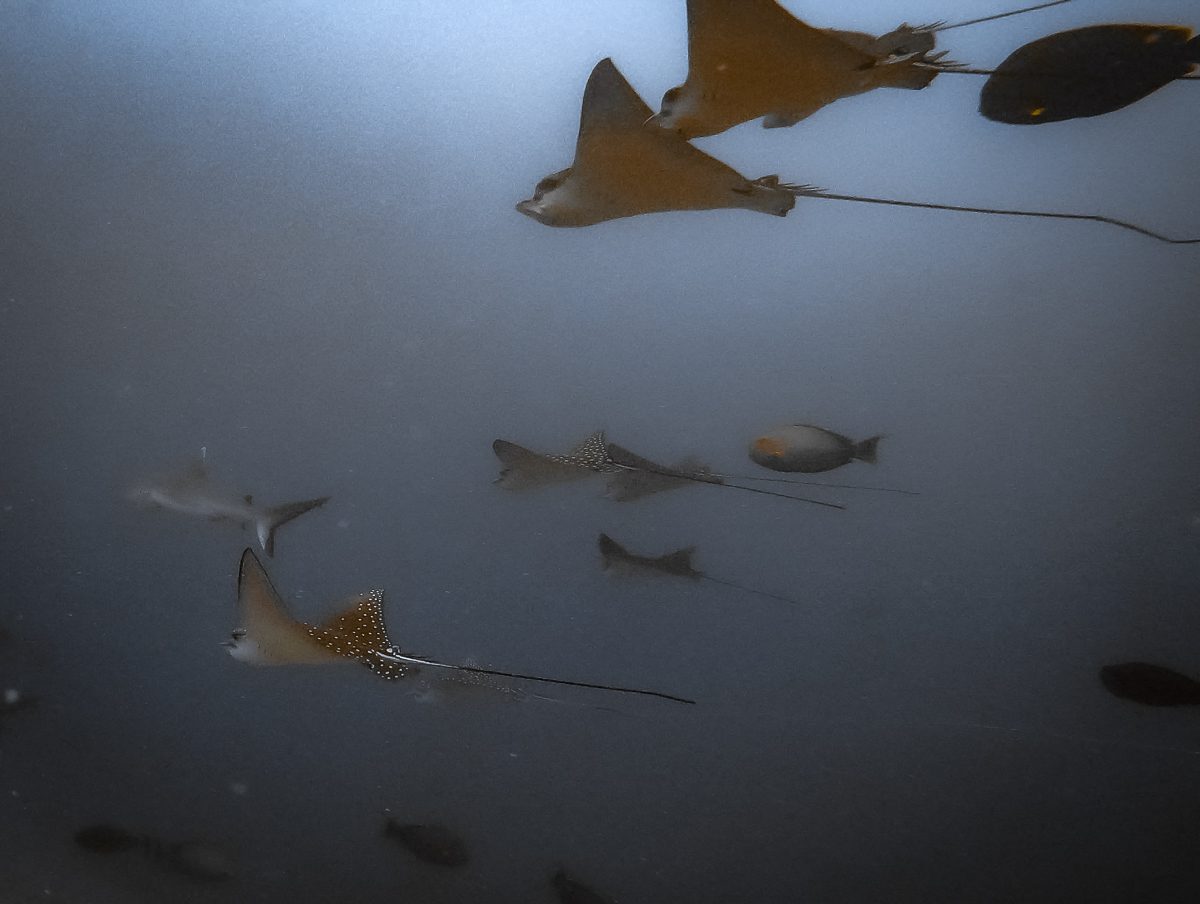
Punta Vicente Roca · Cape Marshall · Cabo Douglas · mola mola, oceanic mantas, penguins, marine iguanas · liveaboard only
3. The central islands
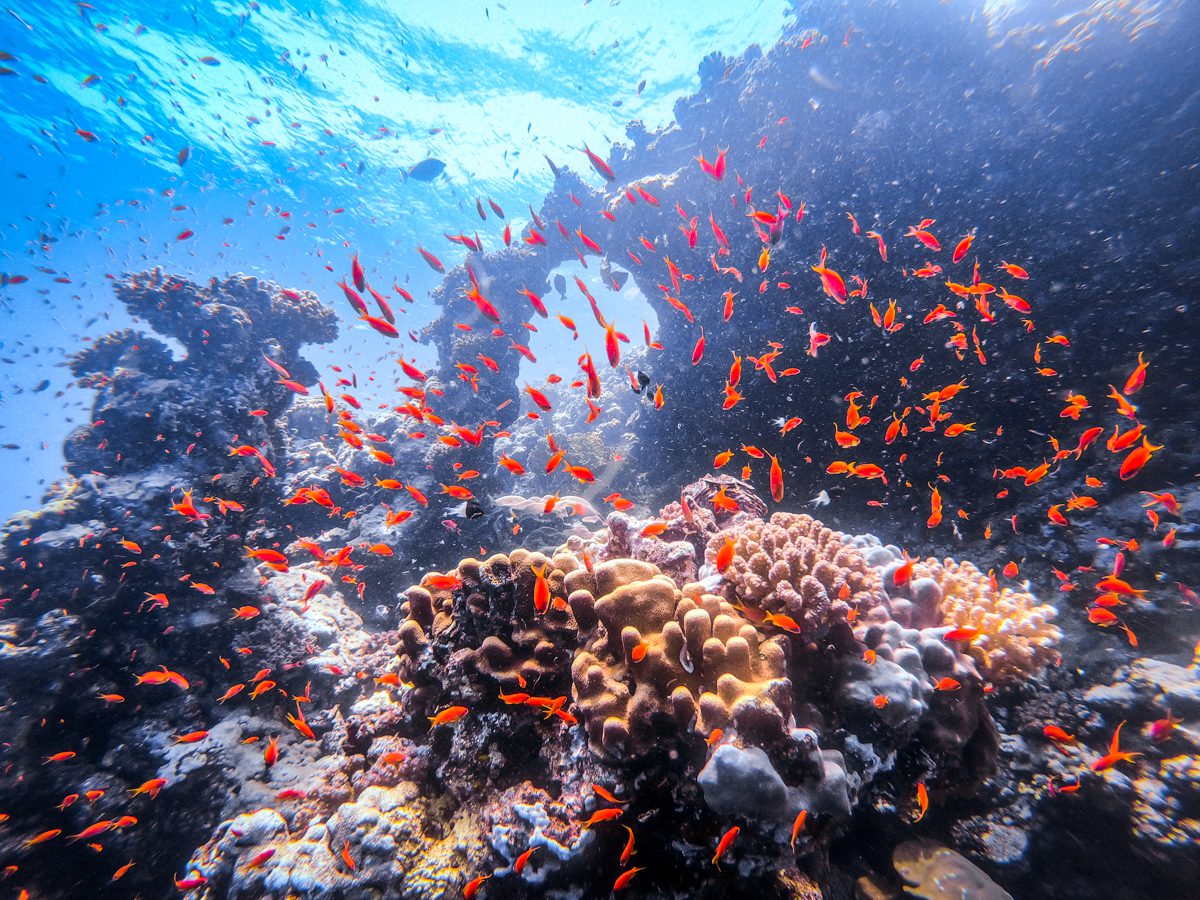
Bartolome · Cousin’s Rock · Pinzon · Gordon Rocks · Kicker Rock · liveaboard starts and day boats
Where to Dive in the Galapagos: The Three Areas
The Galapagos Marine Reserve has more than 80 dive sites: walls, pinnacles, blue-water drifts and even caves. The Galapagos National Park issues every boat an annual permit that fixes which sites it may dive, on which days, how many dives, how long and how deep, so the boats are spread out and rarely share a site. The same permit makes itineraries rigid: a boat can’t swap sites because of the weather. Before you book, check the itinerary, because not every boat has a permit for the best sites.
From my logbook: because of the permit system, we were the only boat at every dive site we visited all week. If you have dived the busy sites of Egypt, the Maldives or Indonesia, you will understand why that felt like the real luxury of the trip.
1. Darwin and Wolf: The Hammerhead Islands
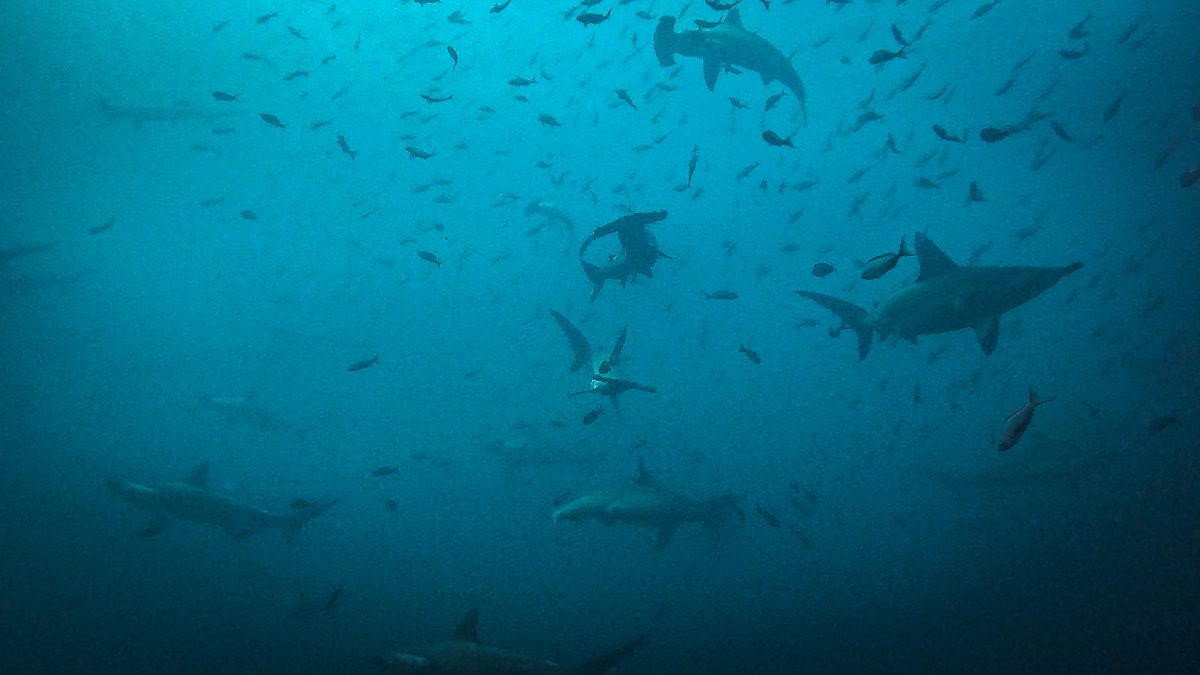
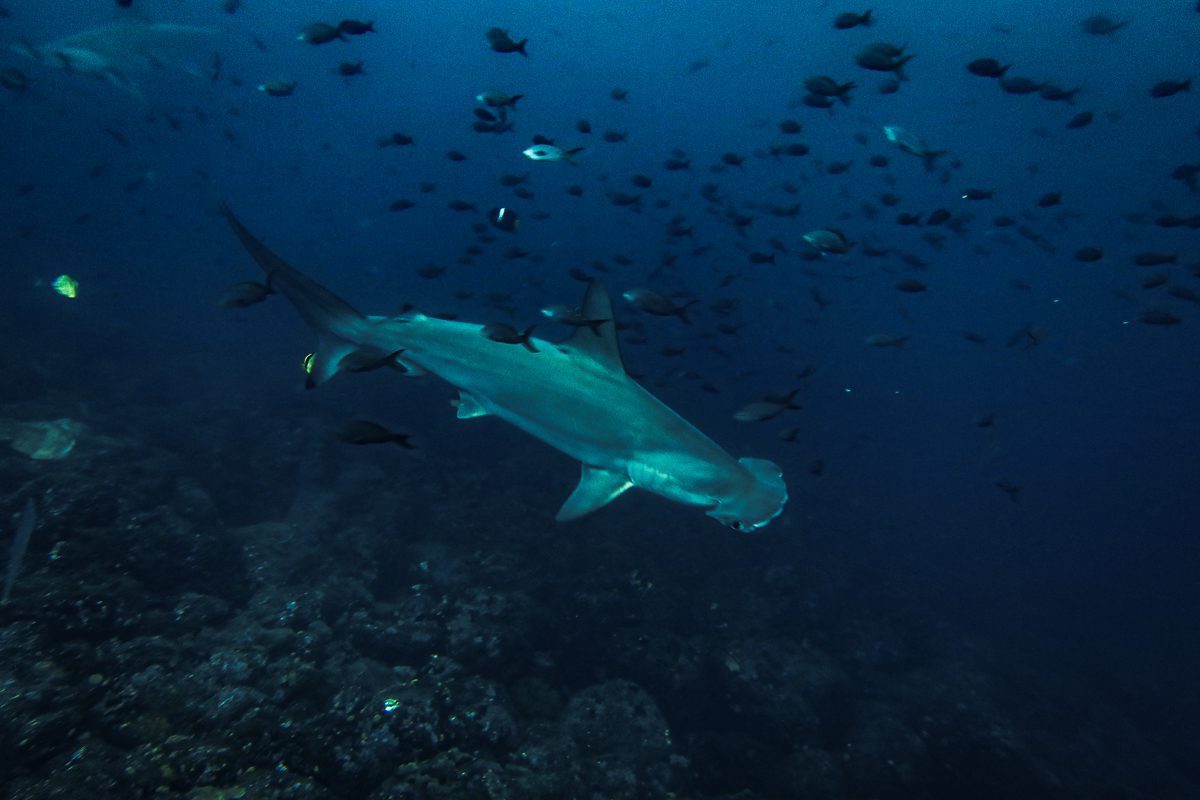
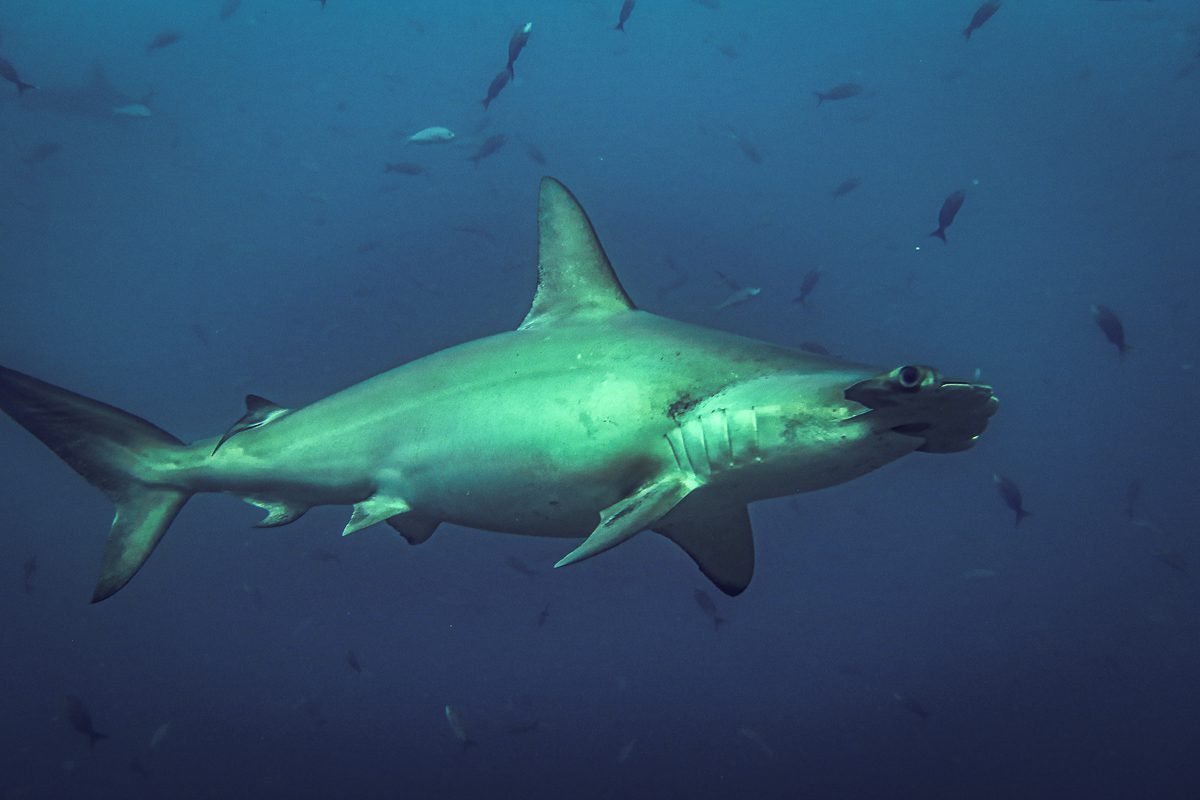
Darwin and Wolf are two small, uninhabited islands at the northern edge of the archipelago. They can only be reached by liveaboard, landings are not allowed, and Darwin lies about 180 kilometres north of Isabela, a full night’s sail. The islands sit on the route scalloped hammerheads travel between the Galapagos and Cocos Island in Costa Rica, which is why the schools here are some of the largest in the world. Galapagos sharks, silky sharks, dolphins, eagle rays and huge tuna are regulars, and from June to November whale sharks pass through, especially at Darwin. Surge and current are often strong, and most dives are spent tucked behind the rocks or hanging in the blue, so both islands are for advanced divers.
- Darwin Arch: the most famous dive in the Galapagos, on the rocky platforms beneath what was Darwin’s Arch. The arch collapsed in 2021 and only its pillars remain, but the dive is unchanged: large boulders step down to sand, forming balconies where you settle in and watch the show in the blue.
- Shark Bay, Wolf: a slope of large volcanic boulders along the south-east coast of Wolf, with three cleaning stations. The boulders shelter fish and grow some of the best coral in the Galapagos, but people come for the hammerheads.
- Other Wolf sites: Landslide and The Caves appear on many Wolf itineraries; which sites you dive depends on your boat’s permit and the current on the day.
From my logbook, Darwin: within one minute of our first dive on the north-east corner of the arch, the first hammerhead swam past. They stayed with us over all four dives, including a school of about 25. Galapagos sharks patrolled the rocks, an eagle ray came to check us out, and I saw the biggest tuna of my life: the schools of fish ignored the hammerheads but scattered the moment the tuna appeared. Dolphins and silky sharks circled the boat all day, and on the last dive we could hear the dolphins singing underwater.
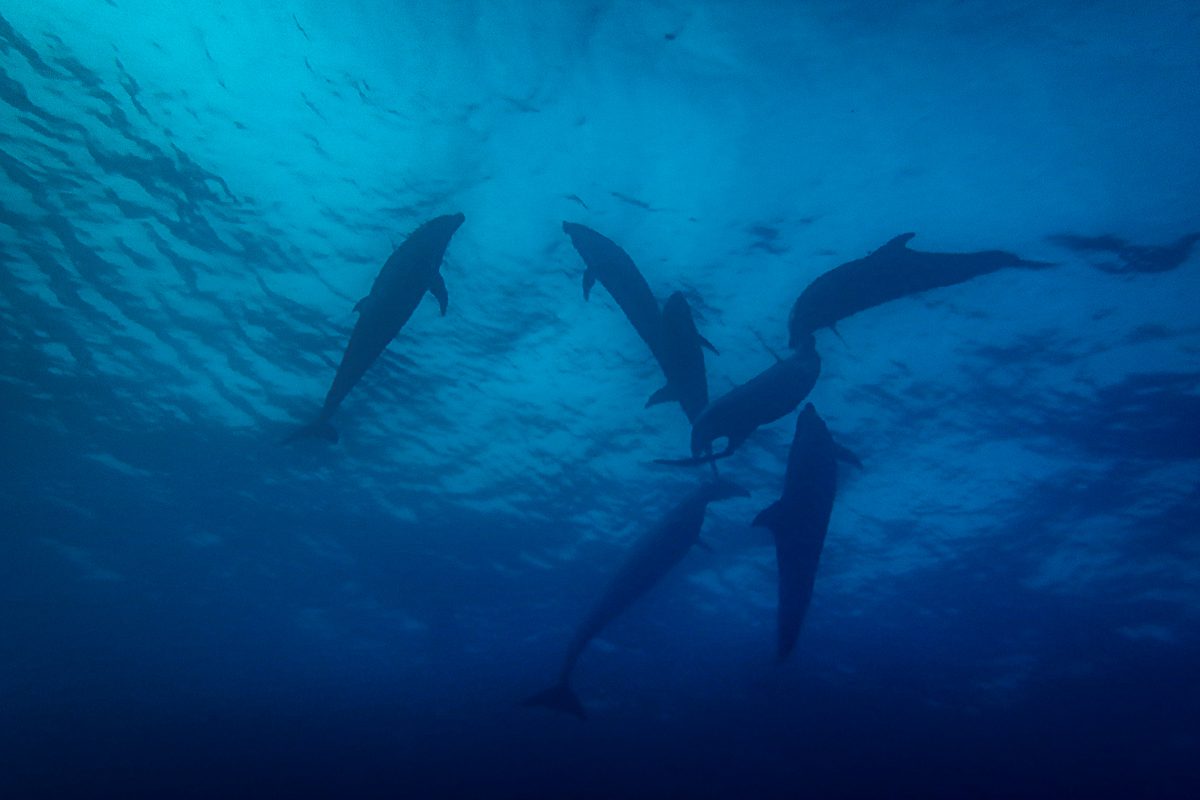
From my logbook, Wolf: I woke before sunrise to thousands of frigatebirds and red-footed boobies leaving the cliffs. We did four dives in Shark Bay, at the corner where the south-east current pushed the fish together. Galapagos sharks were there from the start and hammerheads kept appearing in the distance, but it took until the end of the third dive for the moment we were waiting for: a school of about 30 hammerheads swimming straight towards us. The boulders also had the best coral of my week, and playful sea lions rode the swell by the cliff. My tip: look into the blue, where most of the action is, and don’t forget to look up, as dolphins and whale sharks sometimes pass overhead.
2. The Western Islands: Isabela and Fernandina
The west is the coldest and most volcanic part of the Galapagos. The Cromwell Current wells up from the deep against Isabela and Fernandina, creating sharp thermoclines and feeding animals you won’t meet in the warm north: mola mola, Galapagos penguins, flightless cormorants and marine iguanas that graze algae underwater. Off the north of Isabela the seabed drops to around 3,000 metres, which is probably why big pelagics such as mola mola and hammerheads gather here. These sites are liveaboard only, and only boats with the right permit can dive them.
- Punta Vicente Roca (Isabela): dramatic cliffs and volcanic formations on Isabela’s north-west coast, known for mola mola in cold, deep water.
- Cape Marshall (Isabela): on Isabela’s north-east coast beneath Wolf Volcano, whose 2022 lava still lies bare on the shore. Boulders slope from the shore to sandy patches and small seamounts at 15 to 20 metres, and it is a reliable spot for oceanic mantas.
- Fernandina: the youngest island in the archipelago, known for marine iguanas feeding underwater. Cabo Douglas is the famous site, and it isn’t on every boat’s permit.
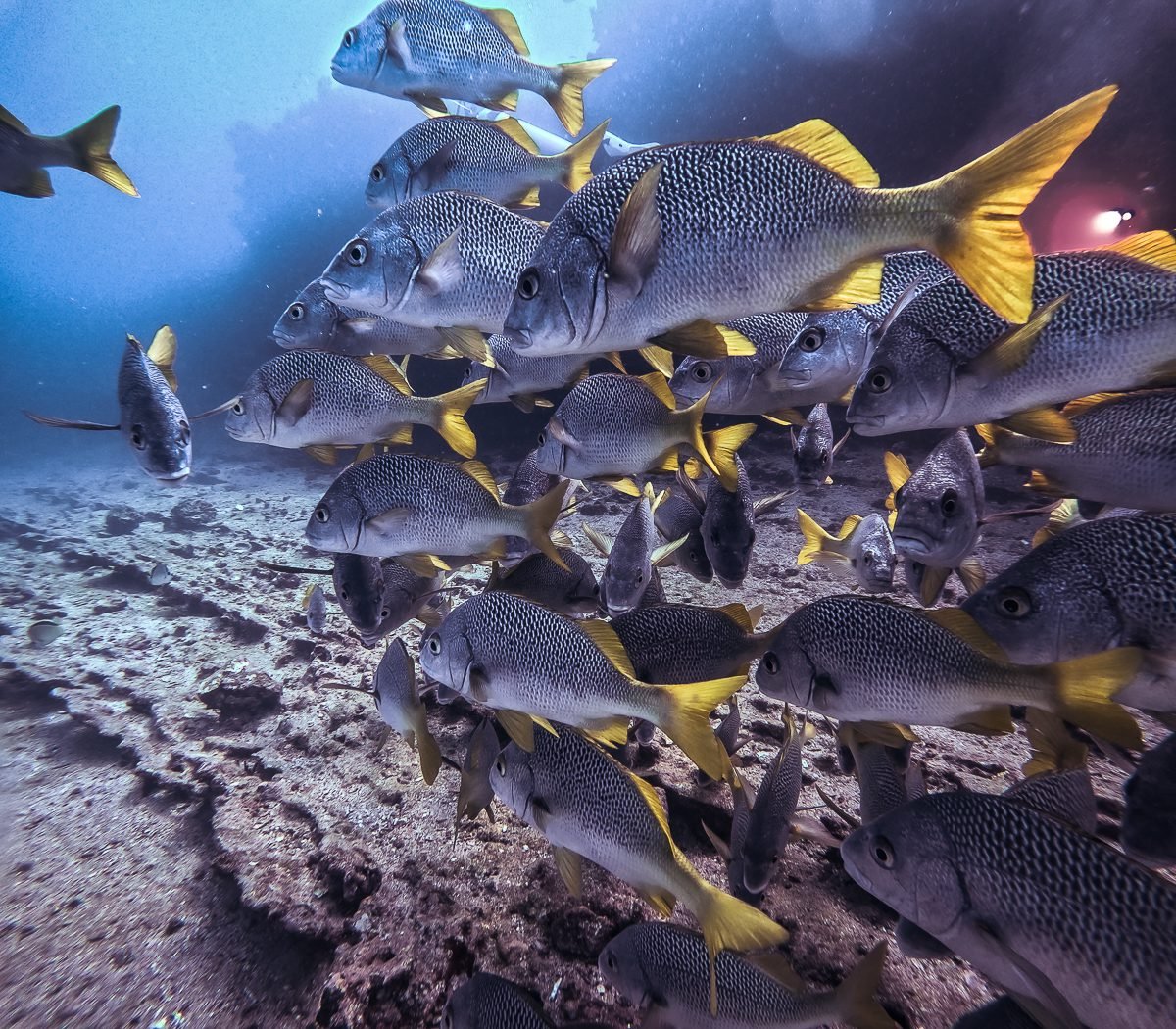
From my logbook, Punta Vicente Roca: we dropped straight to 30 metres hoping for mola mola. Two Galapagos sharks and a marbled ray came first, then a mola cruised past. Down there the water was 14°C: within two metres it fell from 24°C to 14°C, the strongest thermocline I have ever felt, so wear your thickest suit. On the way up we swam through a huge school of salema, found more than 15 turtles at a cleaning station, and watched three sea lions and a flightless cormorant tear into the fish. When we surfaced, three or four Bryde’s whales were breaching nearby, with mobulas and molas jumping, and the dive turned into 30 minutes of whale watching from the zodiac.
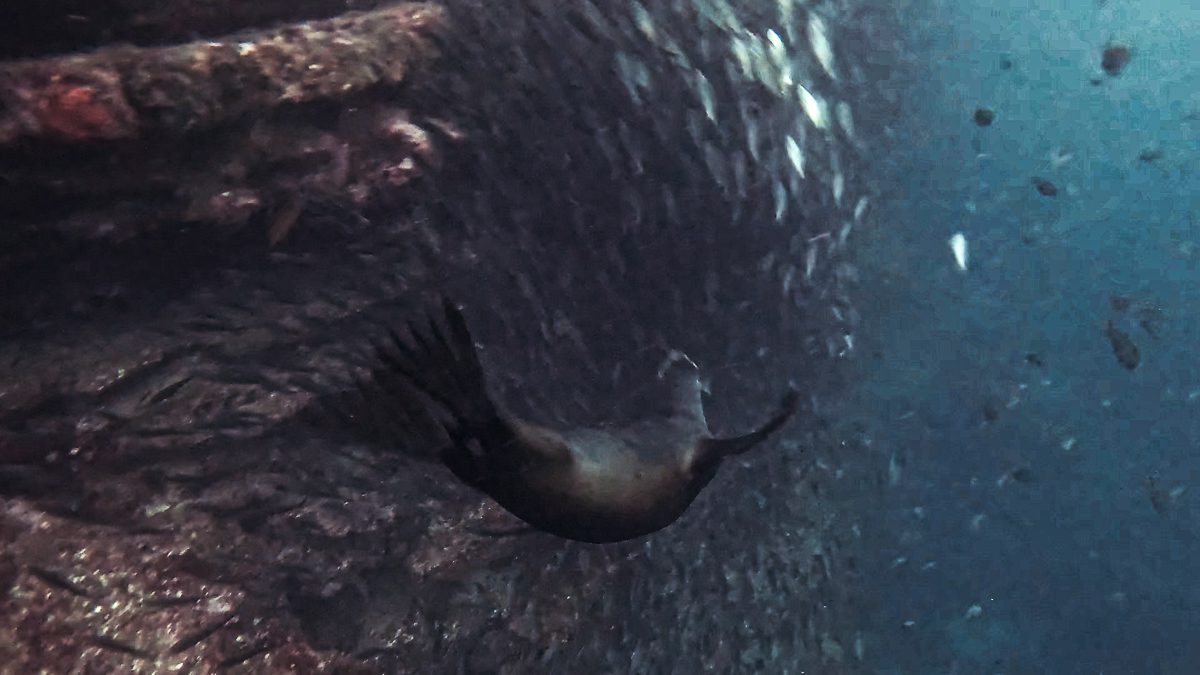
From my logbook, Cape Marshall: after a 160-kilometre night crossing from Wolf, we did three dives beneath Wolf Volcano, and it was one of the best days of my week. The schools of grunts, yellow snappers, chromis and surgeonfish were bigger than any I had seen before. Four oceanic mantas appeared, and two came close and circled us. Mobula and eagle rays glided past, a yellowfin tuna hunted through the salema, a sea lion and bluefin trevally joined in, and we crossed a school of more than 1,000 barracuda, with whitetip reef sharks everywhere. Cape Marshall is often overshadowed by Darwin and Wolf, but for us it delivered just as much.
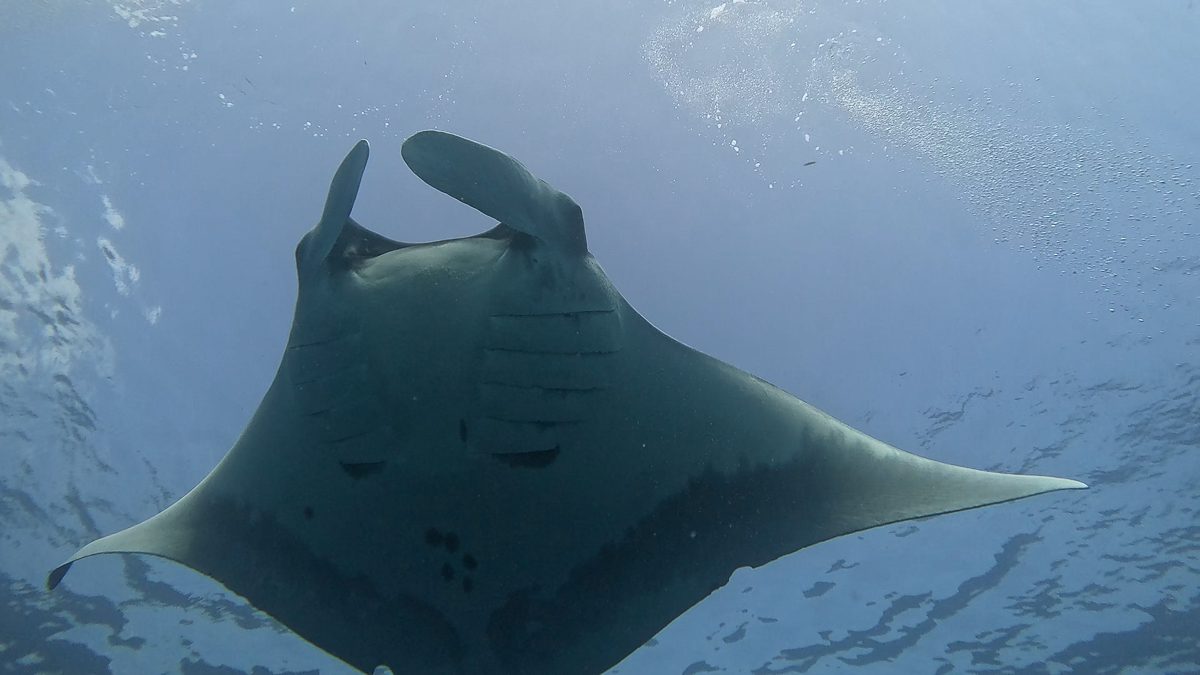
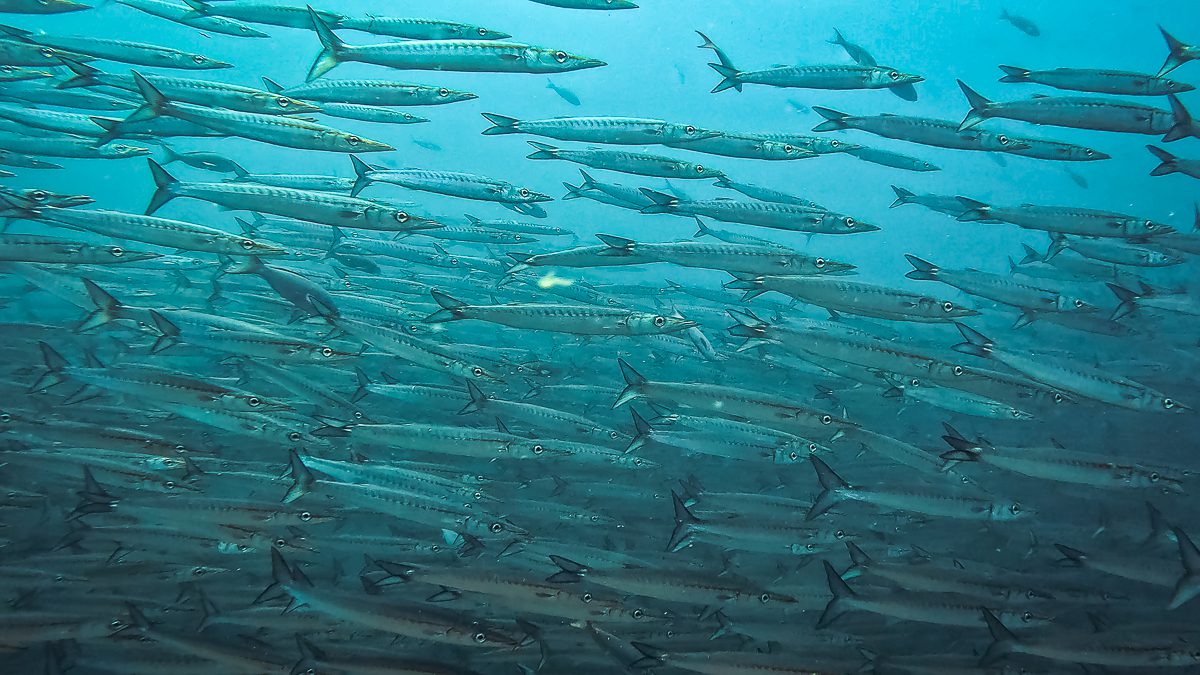
From my logbook, Fernandina: two dives among big rocks, with surge and poor visibility. The marine iguanas didn’t show for us, but some of the group saw a mola mola and a penguin, and there were playful sea lions and turtles.
3. The Central Islands: Santa Cruz, San Cristobal and Bartolome
The central islands are where most liveaboards start and finish, and where land-based divers go out on day boats from Puerto Ayora on Santa Cruz and Puerto Baquerizo Moreno on San Cristobal. The water is usually warmer than in the west and the currents gentler than at Darwin and Wolf, though the best-known day sites can still be demanding.
- Bartolome (La Punta): a sandy bottom at about 10 metres with a cleaning station, then open blue where rays school.
- Cousin’s Rock: an underwater plateau from 2 metres down to more than 80 metres, with a wall on one side and a gentle slope on the other, covered in black coral that glows green underwater.
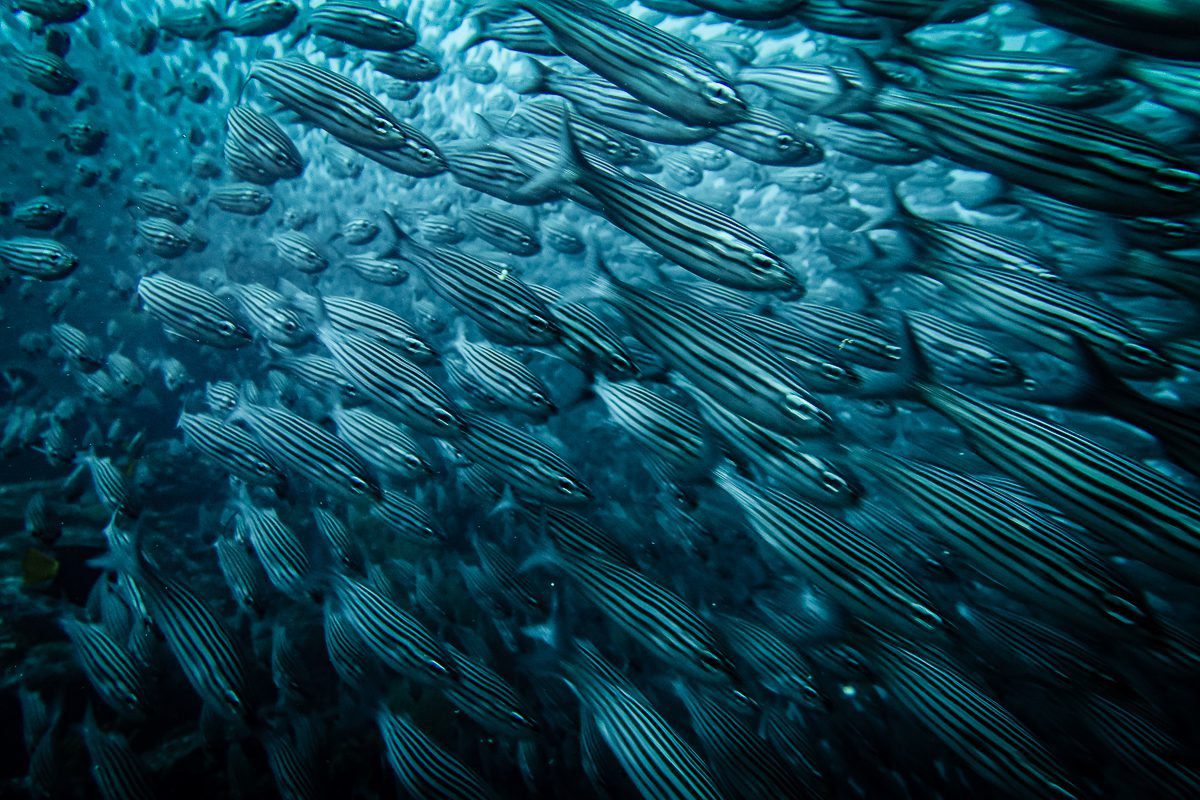
- Pinzon and Dumb Rock: a channel between Pinzon Island and a small pinnacle, with sand at about 15 metres and huge schools of salema.
- Gordon Rocks (Santa Cruz): the eroded crater of an extinct volcano off north-east Santa Cruz, with a sandy floor at about 32 metres inside the crater and currents strong enough to earn it the nickname “the washing machine”. It is the best-known day dive from Puerto Ayora for hammerheads, eagle rays and Galapagos sharks, and operators ask for previous experience.
- Kicker Rock (León Dormido, San Cristobal): a split volcanic rock off San Cristobal whose Spanish name means “sleeping lion”, dived and snorkelled on day trips from Puerto Baquerizo Moreno for sea lions, turtles and sharks.
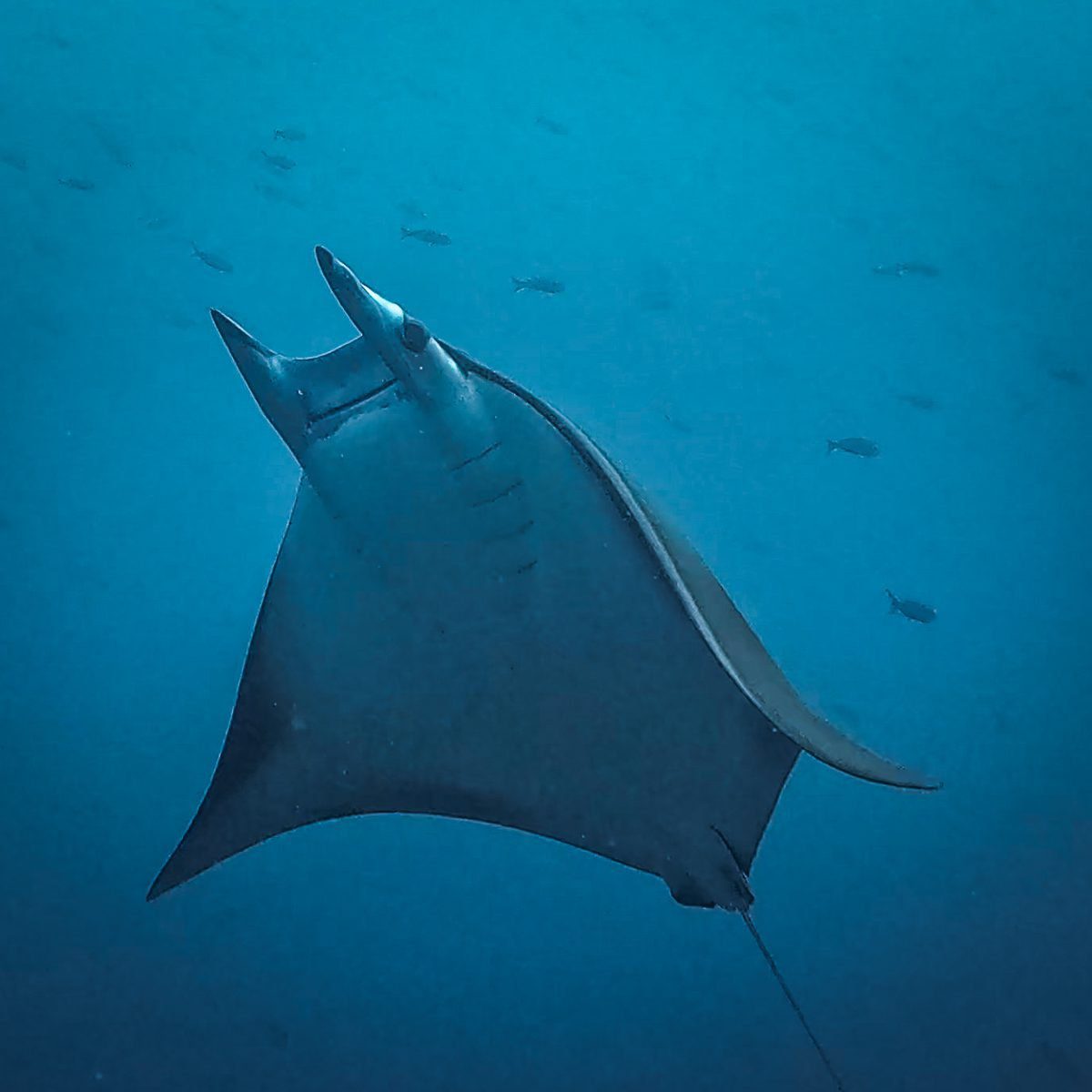
From my logbook, Bartolome: our first real dive was an extraordinary introduction. Two curious turtles waited at the cleaning station, about ten whitetip reef sharks patrolled the sand, and out in the blue we were surrounded by a massive school of mobulas, eagle rays and golden rays, a playful sea lion and four hammerheads that kept coming back for the schooling fish. Before the dive we hiked to the top of Bartolome, an easy climb on wooden steps to one of the best views in the islands.
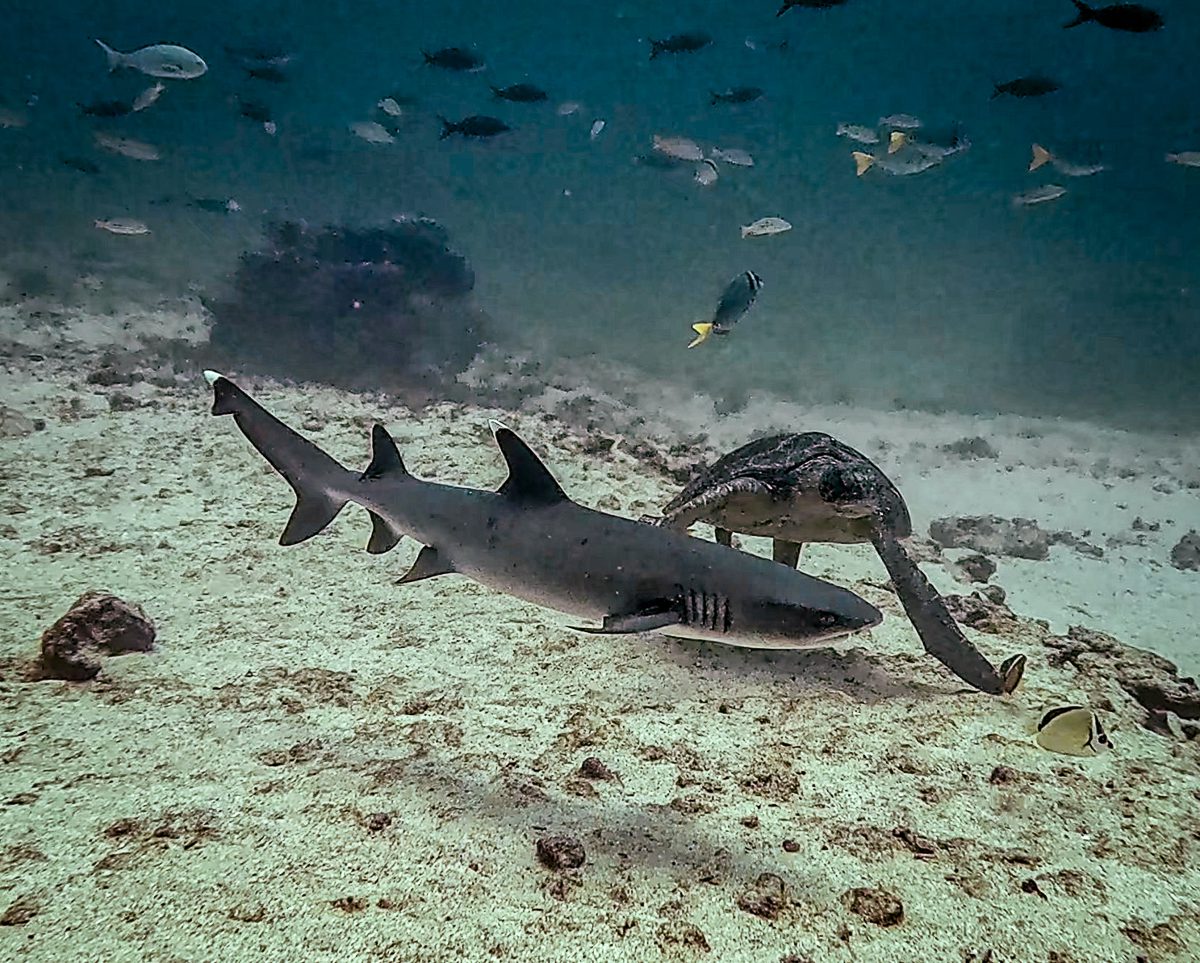
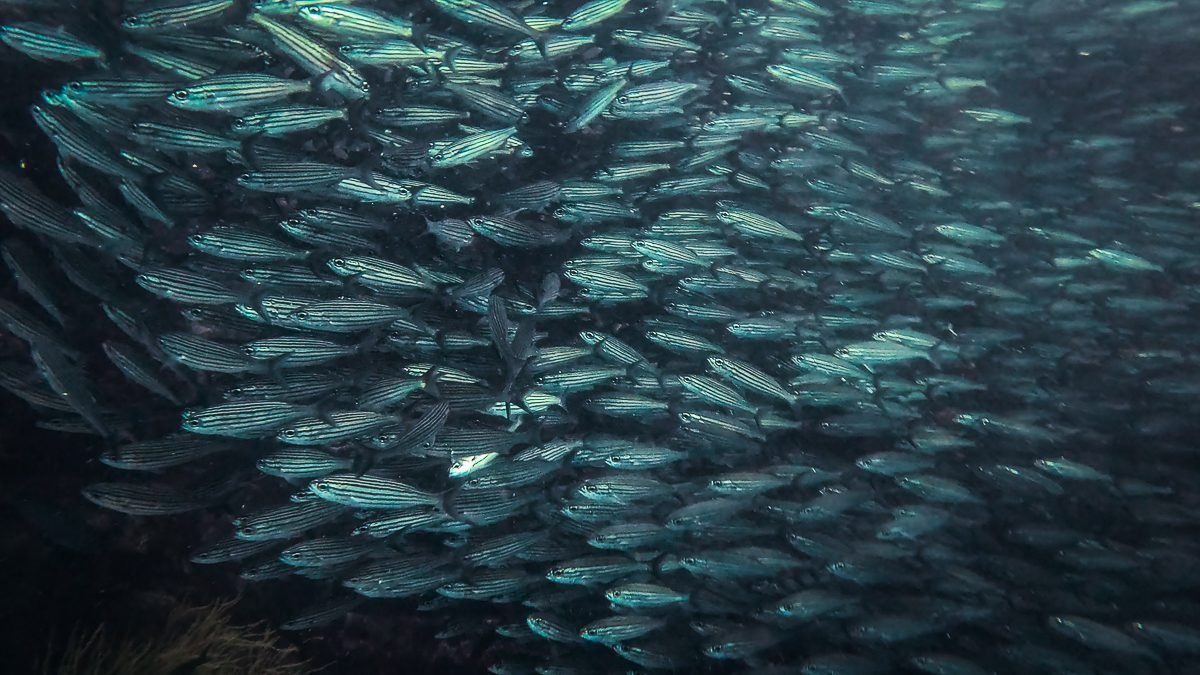
From my logbook, Cousin’s Rock and Pinzon: Cousin’s Rock had almost no current on our dives, with whitetips on the edges, green turtles asleep in alcoves in the wall, and tuna and jacks hunting beyond the small barracuda. Pinzon was our last dive of the trip, a single dive to leave 24 hours before flying. The promised batfish and octopus didn’t show, but jacks, tuna, two eagle rays and two turtles did, then a school of thousands of salema so dense that swimming into it felt like entering a dark cave. Bring a torch.
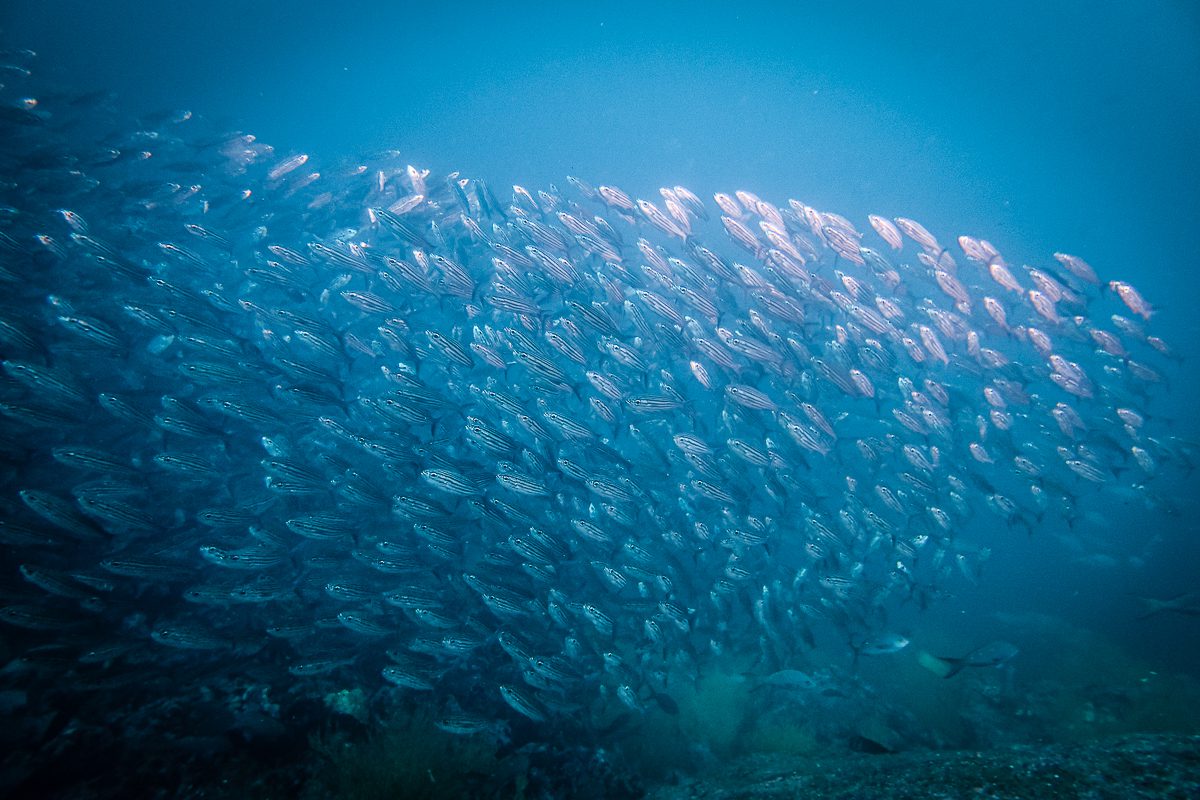
I haven’t dived Gordon Rocks or Kicker Rock myself; on the Theory we circled Kicker Rock at sunset from the deck.
The 7 Best Galapagos Dive Sites I Have Dived
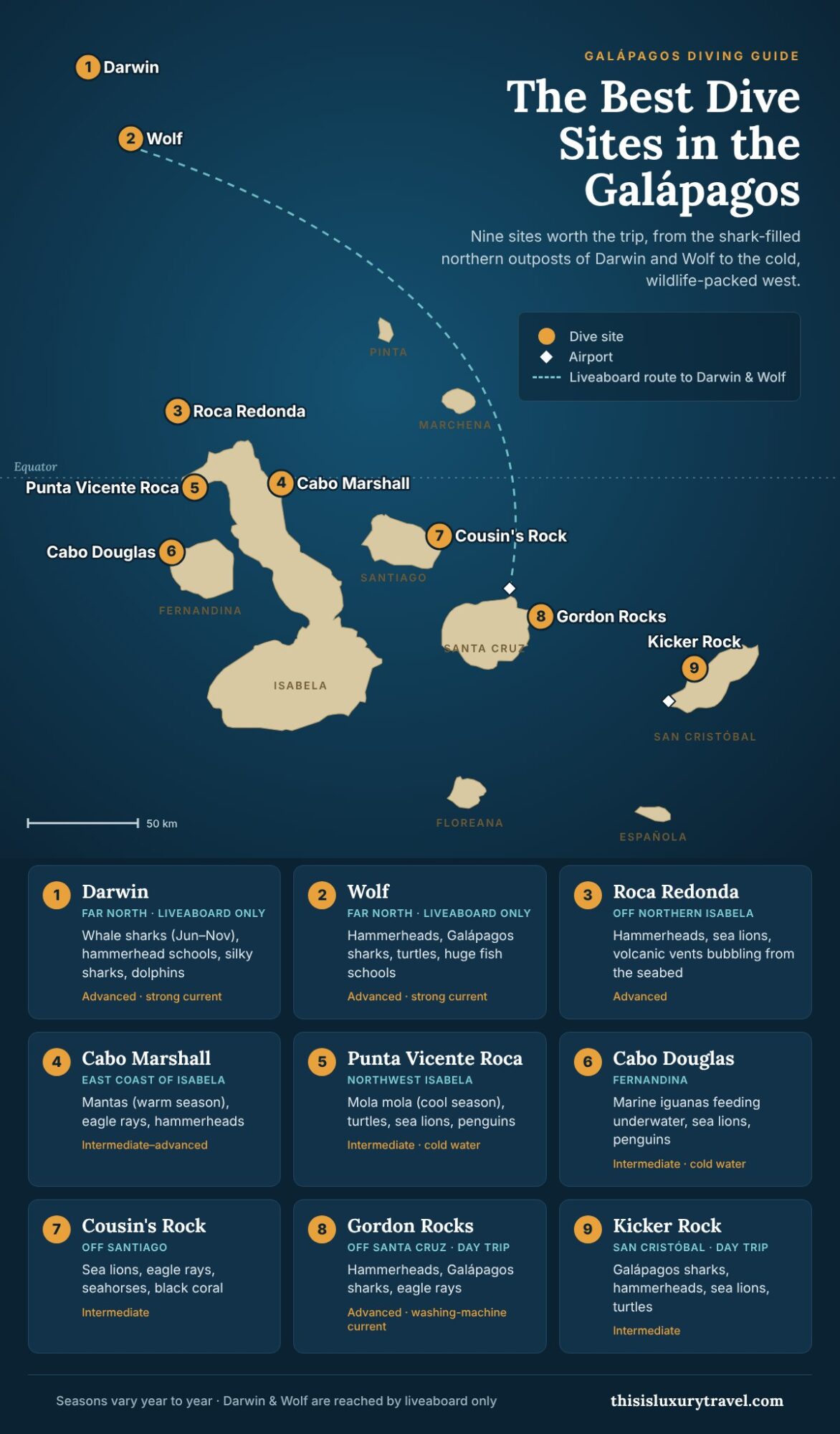
Ranked from my own logbook.
- Darwin Arch: a hammerhead within the first minute, a school of about 25, Galapagos sharks and the biggest tuna I have ever seen. Advanced, liveaboard only.
- Shark Bay, Wolf: a school of about 30 hammerheads swimming straight at us, and the best coral of the week. Advanced, liveaboard only.
- Cape Marshall, Isabela: four oceanic mantas, more than 1,000 barracuda and a hunting yellowfin tuna. Advanced, liveaboard only.
- Punta Vicente Roca, Isabela: a mola mola at 30 metres, a 14°C thermocline and Bryde’s whales at the surface. Advanced, cold.
- Bartolome (La Punta): whitetips, a cleaning station, schools of mobulas and eagle rays, and four hammerheads. Intermediate.
- Pinzon and Dumb Rock: swimming inside a salema fish ball. Intermediate.
- Cousin’s Rock: black coral, sleeping turtles and hunting jacks in almost no current. Intermediate.
Best Time to Dive the Galapagos
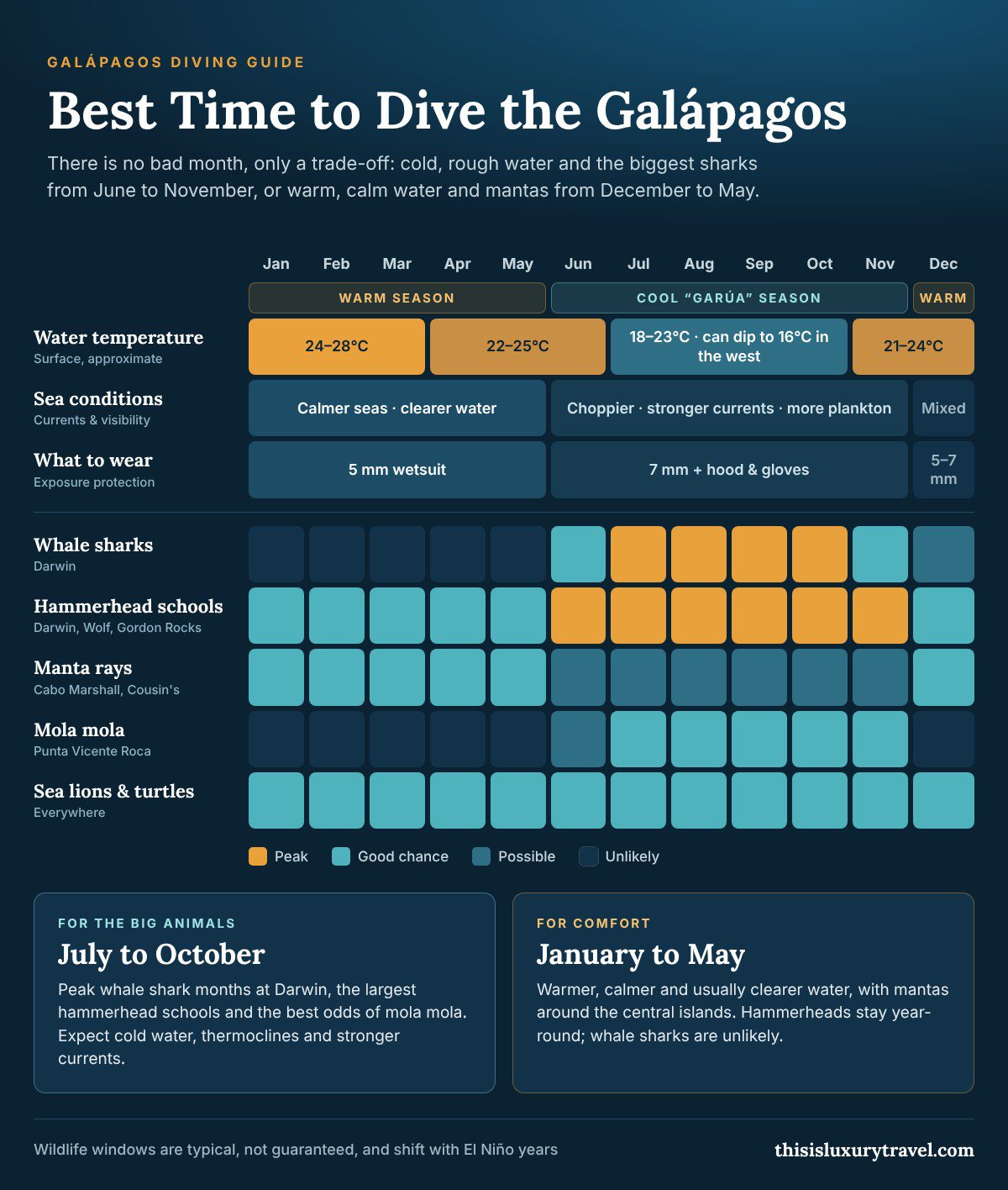
There is no bad time to dive the Galapagos: the hammerheads and the fish are there all year. What changes is the water. The islands sit where three currents meet: the warm Panama Current from the north (about 23 to 28°C), the cold Humboldt Current from the south (about 16 to 25°C) and the deep Cromwell Current from the west, which wells up against Isabela and Fernandina and creates thermoclines. That gives the Galapagos two diving seasons.
| Season | Months | Water | Seas and visibility | Big animals | Best for |
|---|---|---|---|---|---|
| Warm season | December to May | About 22–26°C, colder in the west | Calmer seas, lighter currents, visibility often 20–30 m | Hammerheads, Galapagos and silky sharks, mantas from about March | A first Galapagos trip and smoother crossings |
| Cool season | June to November | About 16–23°C, with colder thermoclines | Rougher seas, stronger currents, visibility 15–20 m | Whale sharks at Darwin and Wolf, hammerheads | Whale sharks, for experienced divers in a 7 mm suit |
Water temperatures are the typical ranges published by Liveaboard.com and Galapagos Sky. The west is colder in every month, and thermoclines can drop well below these figures.
- Hammerheads: they school at Darwin and Wolf all year. Some operators say the biggest schools come in the cool season, others point to the warm season; I saw schools of about 25 and 30 in March, so I wouldn’t plan a trip around it.
- Whale sharks: June to November, mostly at Darwin.
- Manta rays: the warm season, from about March, when I saw four oceanic mantas at Cape Marshall.
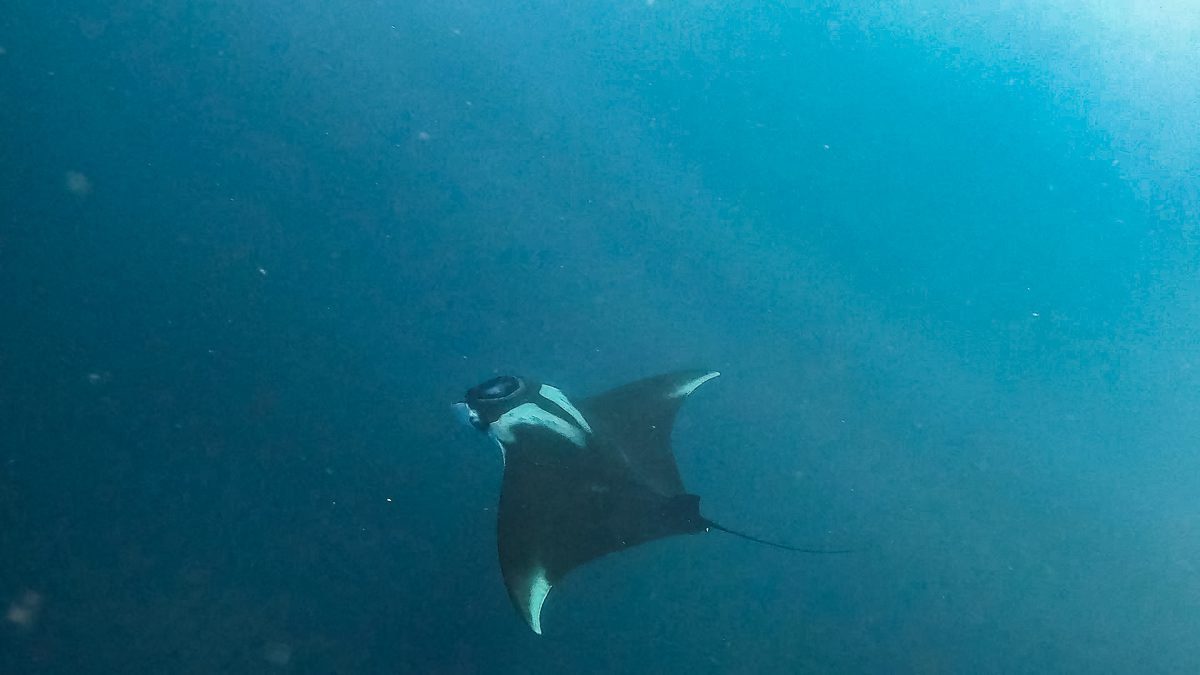
From my logbook: I dived at the end of March, in the rainy, warm season. We had mostly sunny days with very little rain, although on the Theory the week before it had rained heavily for four days. The crew told us the water was unusually warm: 27 to 29°C on many sites, but 20 to 22°C at Punta Vicente Roca, with a 14°C thermocline at 25 metres. Visibility tends to be a little better in the warm season. We didn’t see a whale shark, although the boat had seen one the week before.
What Wetsuit Do You Need for the Galapagos?
Bring layers, because the temperature can change by 10°C on a single dive. I wore a 3 mm full suit for most dives in March and rented a 7 mm from the Galapagos Sky for the four dives the crew expected to be cold, and I was very glad of it at 14°C. The crew was good at predicting the temperature at each site. In the cool season, most liveaboards recommend a 7 mm suit and a hood. My scuba gear list covers what I travel with.
El Niño in 2026–27: What It Means for Galapagos Diving
If you are planning a Galapagos dive trip for late 2026 or early 2027, check the El Niño forecast first. On 8 October 2026, NOAA’s Climate Prediction Center kept its El Niño Advisory in place and said a strong to very strong El Niño is likely through January to March 2027. El Niño weakens the cold, nutrient-rich upwelling that feeds the Galapagos, so the water warms up and the big animals can go deeper or move away. Reports from boats this year have been mixed:
- May 2026: Bluewater Dive Travel’s group trip found unusually warm water and fewer sharks than hoped at Wolf and Darwin.
- June 2026: a diver on an Aggressor Fleet trip reported schooling hammerheads on one day, but said the warm water kept most big animals deep.
- August 2026: the Galapagos Aggressor III’s update, published by ZuBlu, described poor conditions in May and June, then better visibility from mid-July, with whale sharks and schooling hammerheads back and “top notch” diving since early August.
My take: El Niño changes the odds, not the destination. Warmer water means a thinner wetsuit, but expect the big animals to be less predictable, choose a boat that spends its days at Darwin and Wolf, and buy travel insurance that covers both cancellation and diving.
What You Can See: Galapagos Marine Life
My Galapagos diving week in numbers
- Sharks I saw: scalloped hammerheads in schools of about 25 at Darwin and 30 at Wolf, Galapagos sharks on most northern dives, silky sharks around the boat at Darwin, and about ten whitetip reef sharks on one Bartolome dive.
- Rays: four oceanic mantas at Cape Marshall, schools of mobulas, spotted eagle rays, golden rays and marbled rays.
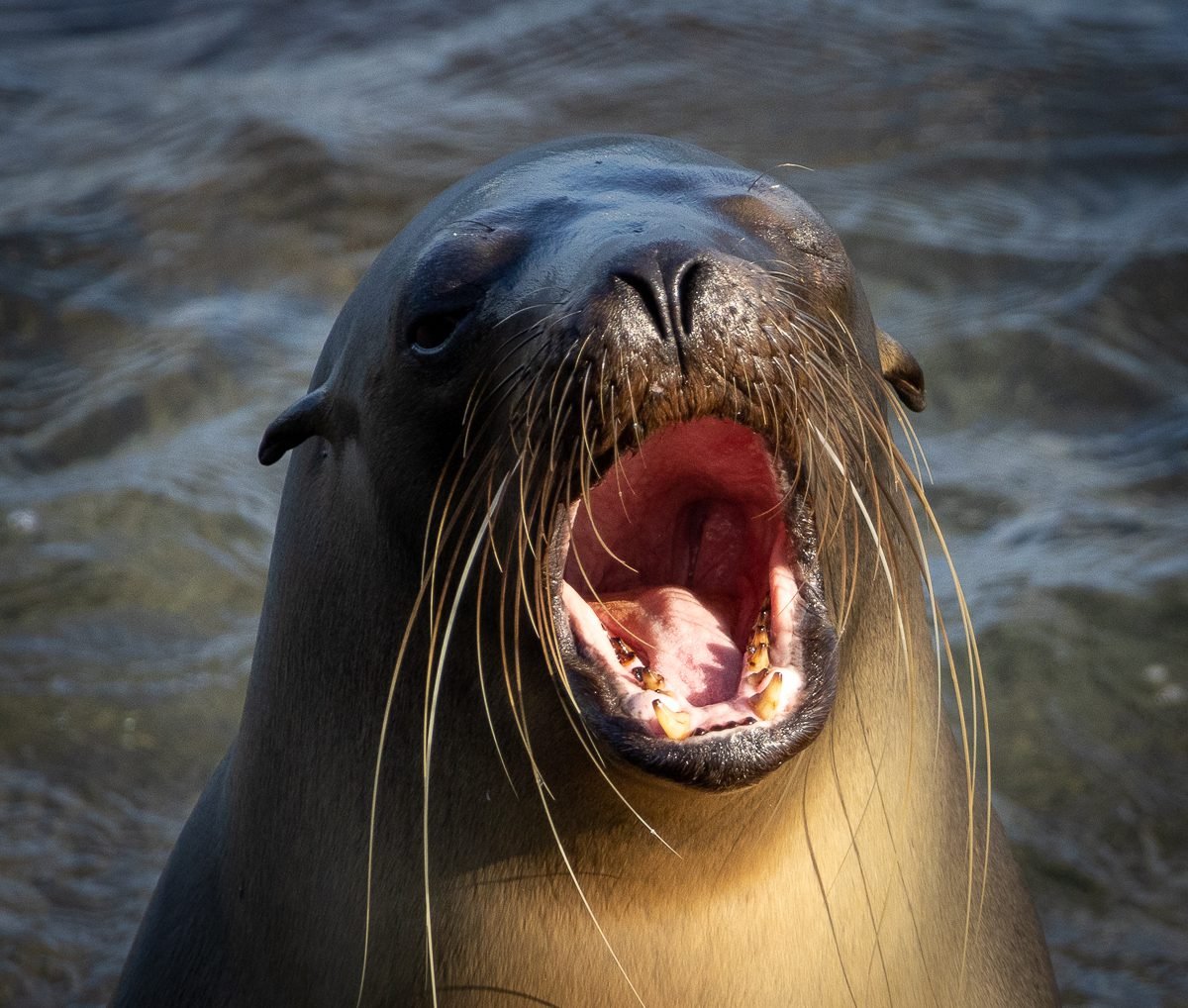
- The Galapagos specials: a mola mola at Punta Vicente Roca, Galapagos penguins, flightless cormorants hunting underwater, and marine iguanas, which feed underwater off Fernandina.
- Marine mammals: Galapagos sea lions on almost every dive, singing dolphins at Darwin, and Bryde’s whales at the surface off Isabela.
- Fish: yellowfin tuna, a school of more than 1,000 barracuda, salema fish balls by the thousand, and huge schools of grunts, snappers and surgeonfish.
- Possible, not seen by me: whale sharks, from June to November at Darwin and Wolf.
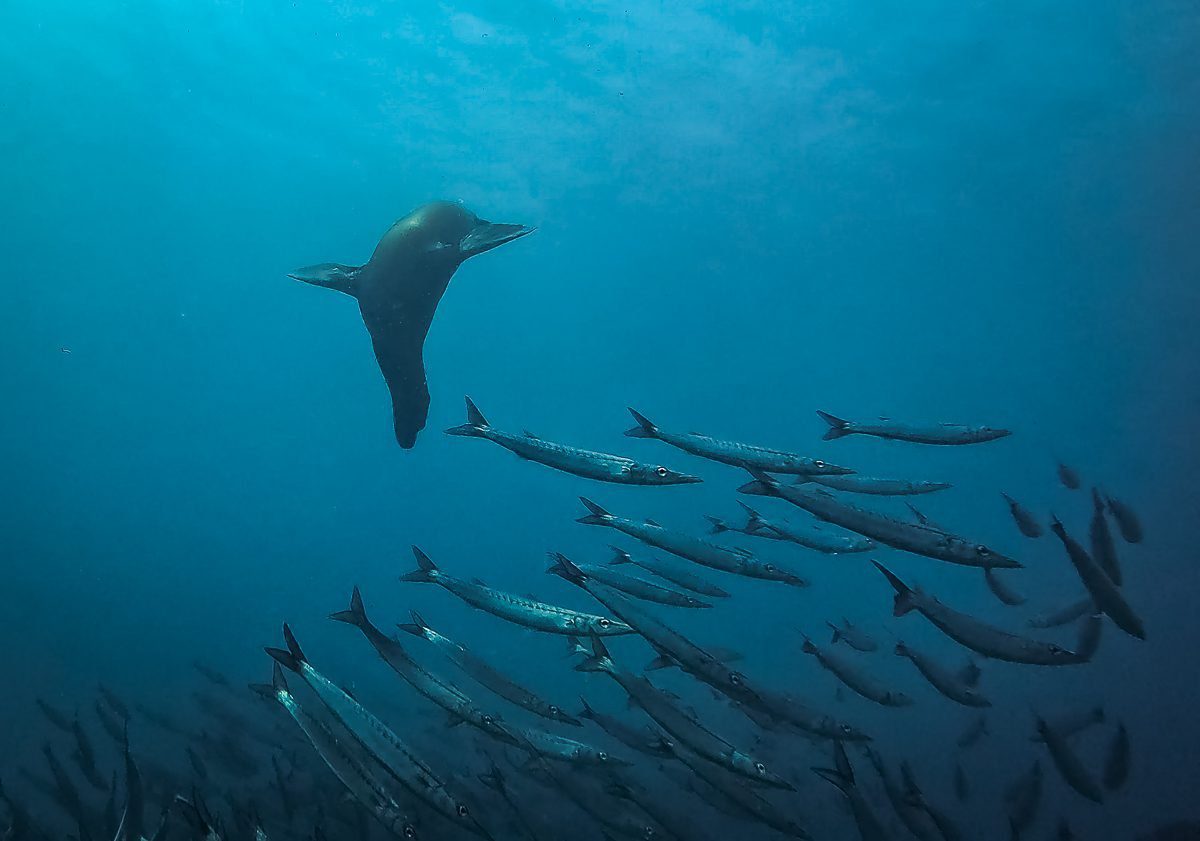
What the Galapagos doesn’t have is Indonesia’s coral and critters: macro life is thin, and the reefs are rock and boulder rather than coral gardens. It is a wide-angle destination.
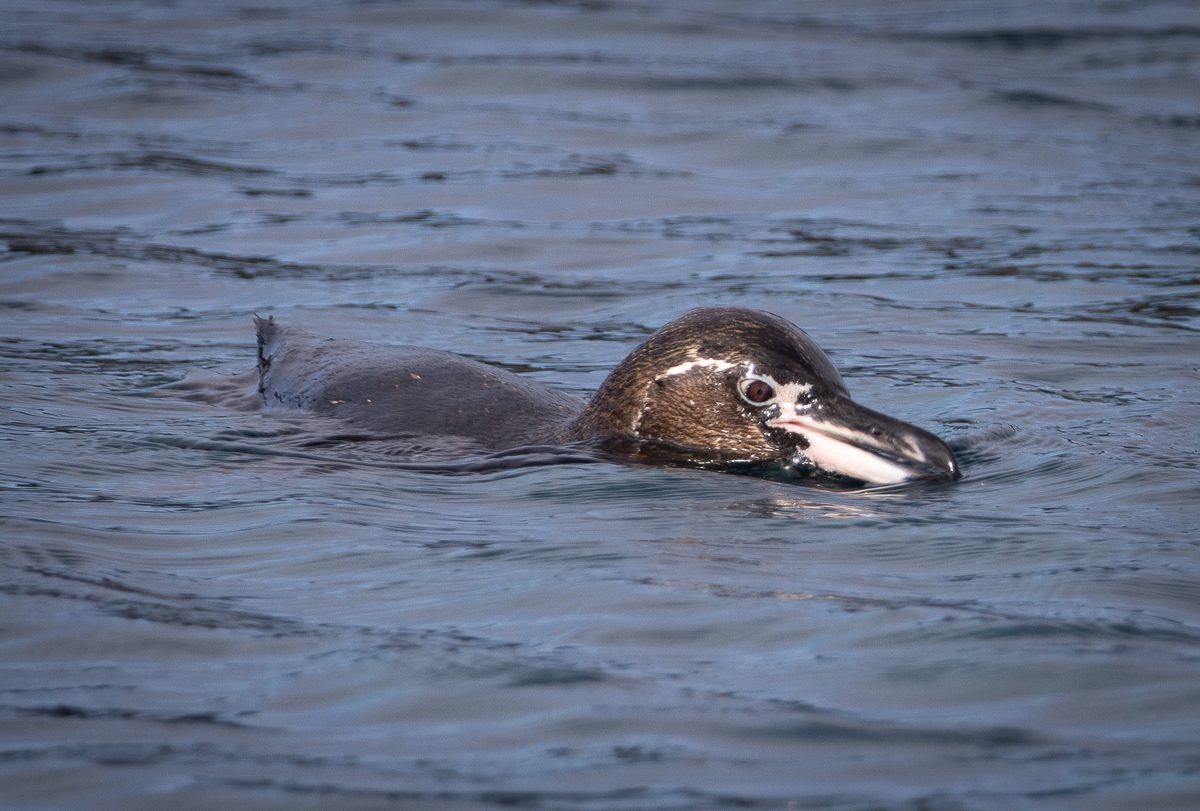
How Hard Is Galapagos Diving?
The Galapagos is not for new divers. Currents can be strong, some entries are negative, the water is cold, and you need calm buoyancy when a school of hammerheads or a manta comes close. It is one of the most rewarding dive destinations in the world, and well worth building the experience for.
Galapagos sites by difficulty (from my dives)
Snorkelling from a yacht: Gardner Bay, Lobos Island, North Seymour · easy, but cold water and some current
Cousin’s Rock, Pinzon and Dumb Rock · intermediate, little current on my dives
Bartolome, Gordon Rocks · intermediate to advanced: current, surge and depth
Darwin, Wolf, Punta Vicente Roca, Cape Marshall · advanced: surge, open blue, negative entries and cold thermoclines
- Experience: the Galapagos Sky recommended 50 to 100 logged dives and some experience in current. Most Galapagos liveaboards ask for Advanced Open Water and at least 50 logged dives.
- Park rules on my boat: a maximum depth of 30 metres, a maximum dive time of 50 minutes, a mandatory 3-minute safety stop at 5 metres, a dive computer for every diver, and no approaching animals closer than 2 metres. Sea lions and dolphins don’t know the rule and will come right up to your mask.
- Buddy pairs: a buddy team surfaces as soon as the first diver runs low on air, so pair up with someone whose air consumption matches yours.
- Entries: every dive is from a panga (zodiac), and you board it wearing your tank. Some dives start with a negative backroll entry, so practise before you go.
- Safety kit: the Galapagos Sky gave every diver a Nautilus GPS locator, a surface marker buoy and a horn, in case the current carried us away.
- Nitrox: most of my dives were between 15 and 25 metres, so nitrox gives you significantly more bottom time. Everyone on my trip used it.
- Your feet: the current and swell mean hard finning, so wear dive socks to avoid blisters.
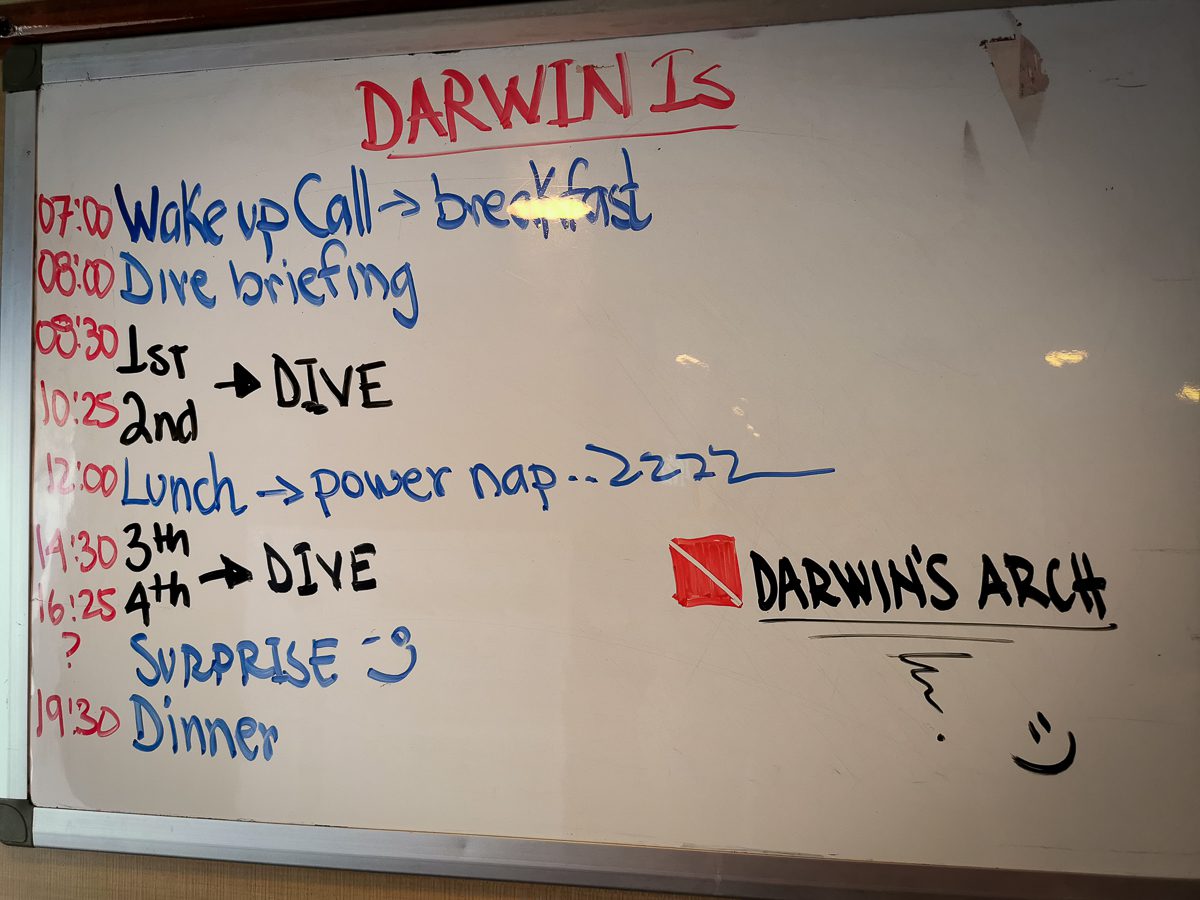
Liveaboard, Land-Based or Snorkelling Cruise?
There are three ways to see the Galapagos underwater, and which one suits you depends on how much diving you want and who you are travelling with.
- A dive liveaboard is the only way to reach Darwin, Wolf and the western islands. Trips are usually 7 nights, with three to four dives a day and the crossings done at night.
- Land-based day diving from Puerto Ayora or Puerto Baquerizo Moreno gets you to Gordon Rocks, Kicker Rock and the central sites, and suits a mixed group or a shorter trip, but it can’t reach Darwin and Wolf.
- A naturalist yacht shows you the islands above water, with snorkelling at most stops. Dive liveaboards like the Galapagos Sky don’t take snorkellers: the panga drivers follow the divers’ bubbles and have no time to watch people at the surface.
- Do both, as I did: a week on the Theory, then a week on the Galapagos Sky. The two boats belong to the same company, so my bags went straight from one to the other while I was taken on a morning tour of the San Cristobal highlands.
| If you want… | Do this |
|---|---|
| Hammerhead schools | A 7-night Darwin and Wolf liveaboard, in any month |
| Whale sharks | A Darwin and Wolf liveaboard from June to November |
| Mola mola, mantas and penguins | A liveaboard with Punta Vicente Roca and Cape Marshall on its permit |
| To travel with a non-diving partner | A naturalist yacht such as Origin, Theory and Evolve, or a week on each boat |
| Some diving on a shorter or cheaper trip | Day boats from Puerto Ayora to Gordon Rocks |
| A first big-animal trip with fewer than 50 dives | Build experience elsewhere first, or snorkel the islands from a yacht |
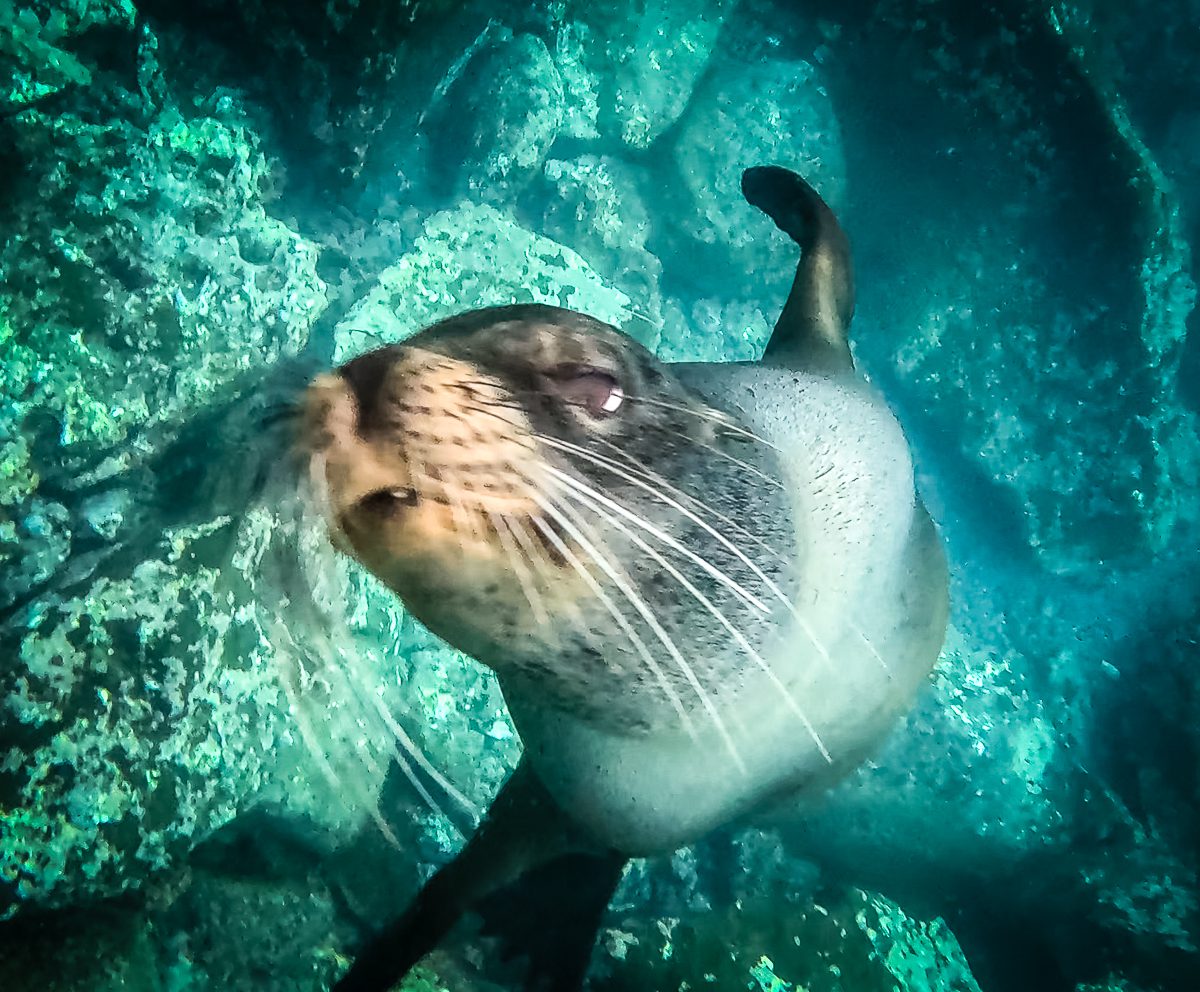
The Best Galapagos Liveaboards
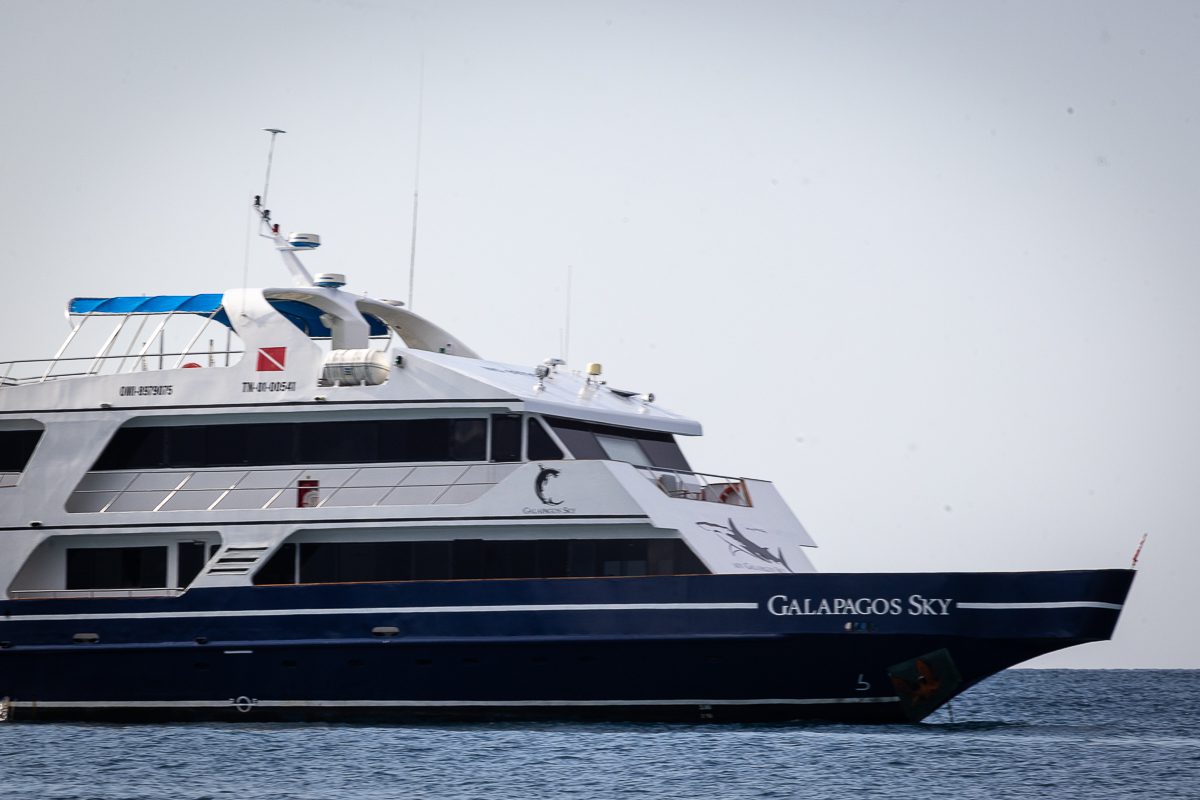
Galapagos Sky: My Pick for Darwin and Wolf
The Galapagos Sky is the boat I dived from, and I rated it 5 out of 5: world-class diving on a wonderful boat. Built in 2001 and refurbished in April 2025, it takes a maximum of 16 divers in two groups of eight; there were only ten of us on my trip, so it never felt crowded. Its 7-night itinerary from San Cristobal takes in the central and western islands as well as Darwin and Wolf, and its permit includes Punta Vicente Roca and Cabo Douglas, which not every boat has.
- The diving: three to four dives a day from pangas, and no night dives. The crew carries your gear, helps you into a 7 mm suit, and greets you after every dive with a towel, a hot drink and snacks. Our guides, Quike and Natasha, had an instinct for where the action would be.
- Cabins: book a deluxe cabin on the top deck early for its panoramic sea window. I was in a standard cabin below deck: comfortable, with two twin beds that can’t be joined, sealed portholes and a single 110 V US-type socket.
- Food: buffet breakfasts and lunches, and a four-course dinner where you choose your main course at lunch.
- Downsides: no option for snorkellers, standard cabins that won’t win beauty prizes, and the park’s 50-minute limit, which felt short on shallow dives when I was surfacing with 100 to 140 bar.
When I checked Liveaboard.com in October 2026, the Galapagos Sky was listed from $808 a day and rated 9.5 from 65 verified reviews.
Check Galapagos Sky dates and prices on Liveaboard.com · Read my full Galapagos Sky review.
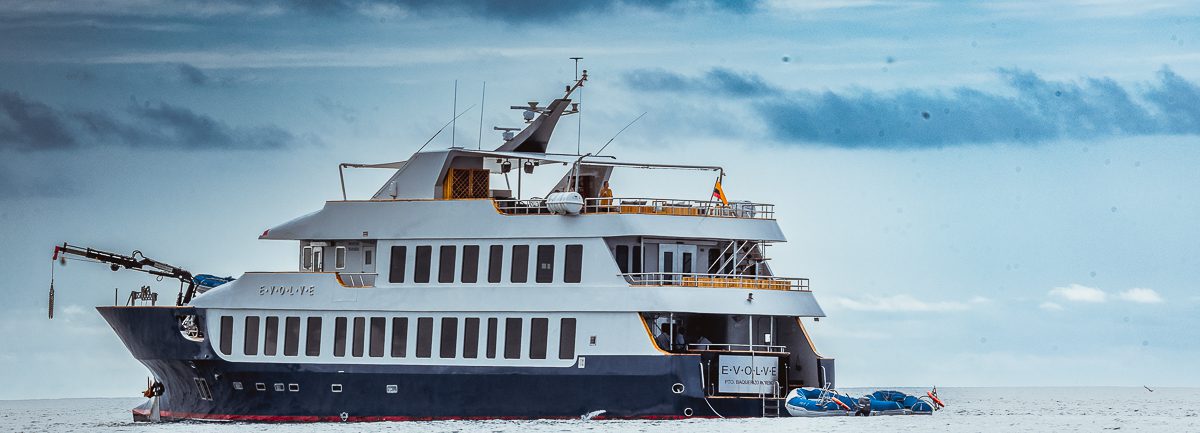
Origin, Theory and Evolve: For Snorkellers and Non-Divers
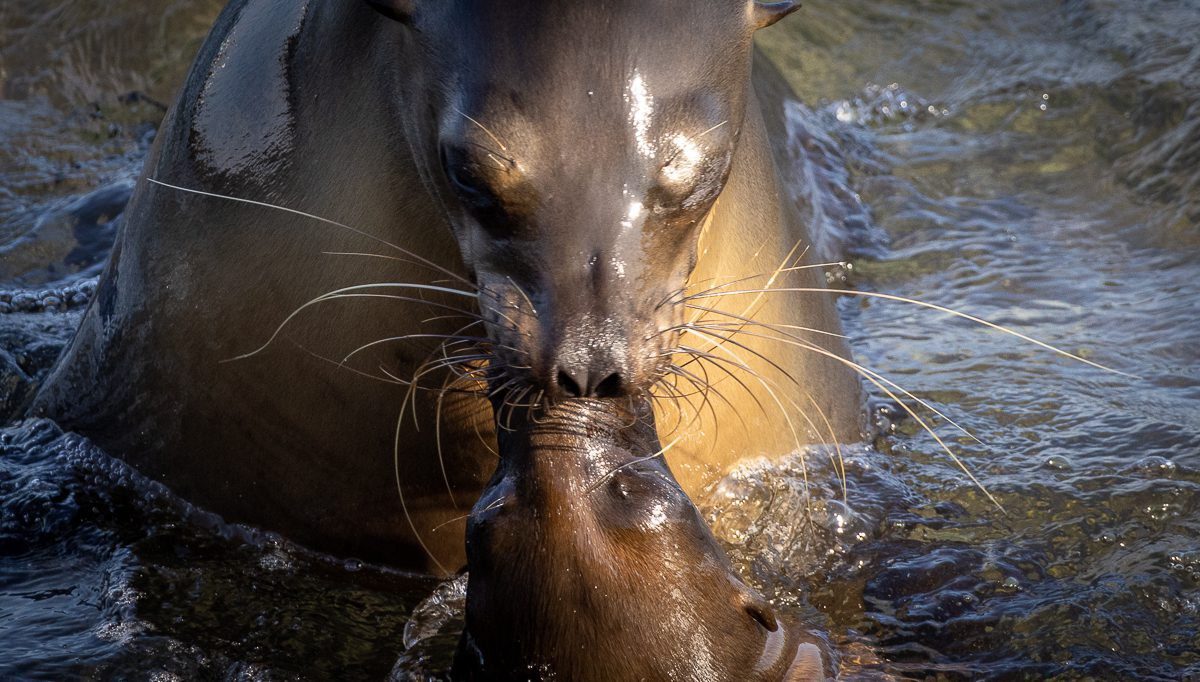
If you or your partner don’t dive, or you want to see the islands above water too, Ecoventura’s three identical yachts are the most luxurious small-ship way to do it, and I rated my week on the Theory 4.5 out of 5. Each yacht carries a maximum of 20 guests in 10 cabins, with up to four excursions a day: hikes, zodiac rides, kayaking and snorkelling, with snorkel gear and wetsuits included. I snorkelled with sea lions for an hour at Gardner Bay on Española, played with a baby sea lion off Floreana, and saw a whitetip reef shark and two mobulas at North Seymour. The same company runs the Galapagos Sky, which makes a week on each easy to combine.
Check Origin, Theory and Evolve prices on Liveaboard.com · Read my full Origin, Theory and Evolve review.
Galapagos Dive Liveaboards Compared
Every boat below runs 7-night trips that include Darwin and Wolf with a maximum of 16 guests. I have only sailed the Galapagos Sky; the others are listed from Liveaboard.com, with prices and ratings as I found them in October 2026.
| Boat | From (per day) | Guests | Built / renovated | Liveaboard.com rating | Book |
|---|---|---|---|---|---|
| Galapagos Sky (my pick, 5/5) | $808 | 16 | 2001 / 2025 | 9.5 (65 reviews) | Check dates |
| Tiburon Explorer | $909 | 16 | 2020 | 9.7 (97 reviews) | Check dates |
| Galaxy Diver II | $769 | 16 | Renovated 2023 | 9.5 (71 reviews) | Check dates |
| Galapagos Aggressor III | $689 | 16 | Not listed | 9.1 (132 reviews) | Check dates |
| Aqua | $584 | 16 | 1998 / 2023 | 9.1 (192 reviews) | Check dates |
| Danubio Azul | $568 | 16 | 2007 / 2020 | 8.2 (10 reviews) | Check dates |
The Tiburon Explorer also runs 10-night trips. For every boat and date, compare them all on Liveaboard.com.
Check Galápagos dates and prices
How Much Does Galapagos Diving Cost?
The Galapagos is the most expensive liveaboard destination I have dived. When I checked Liveaboard.com in October 2026, Galapagos dive liveaboards started from about $568 per person per day (Danubio Azul) and went up to $909 a day (Tiburon Explorer), with the Galapagos Sky at $808 a day and full 7-night trips listed between about $4,789 and $9,994. For comparison, the cheapest liveaboards started from about $104 a day in Egypt, $245 in the Maldives and $312 in Indonesia. The difference comes from the strict permits, the small number of boats allowed, the remote logistics and the park fees. Check current Galapagos liveaboard prices here.
Budget separately for the extras, most of which are not in the cruise fare:
| Extra | What to budget |
|---|---|
| Galapagos National Park entrance fee | $200 per adult and $100 for children aged 11 and under, as at August 2026; it doubled from $100 in August 2024 |
| Transit Control Card | $20 per person, issued at the airport in Quito or Guayaquil |
| Return flight from the mainland | Ecoventura published $550 return from Quito and $525 from Guayaquil for its designated flight, as at August 2026 |
| Nitrox | $200 for the trip on the Galapagos Sky when I sailed, with consistent 32% fills |
| 15-litre tank | $60 for the week on the Galapagos Sky; with a 50-minute limit and generous fills you may not need one |
| Crew tips | About $400 per guest for a week on the Origin, Theory and Evolve; ask your dive boat for its guideline |
| A night in Quito or Guayaquil | Needed before most trips, because the island flights leave in the morning |
Land-based day diving costs much less per day: two dives at Gordon Rocks were listed at around $250 to $260 by the Santa Cruz operators I checked in October 2026.
Getting to the Galapagos
- Flights: there are no international flights to the islands. Fly into Quito (UIO) or Guayaquil (GYE) in mainland Ecuador, then take a domestic flight to one of the two Galapagos airports: San Cristobal (SCY) or Baltra (GPS). Check which one your boat uses before you book: the Galapagos Sky leaves from San Cristobal.
- The boat’s flight: most of my group flew on the flight recommended by the Galapagos Sky, and were met at the airport and driven straight to the pier. For the Origin, Theory and Evolve, Ecoventura’s designated flight is Avianca AV1630 on Sundays, landing at San Cristobal, and booking it means your island transfers, park fee and Transit Control Card are handled for you. Book your own flight and you pay both fees on arrival, in cash.
- At the mainland airport: arrive early. You pay the Transit Control Card and have your bags scanned for biosecurity before check-in, which can add 30 to 45 minutes.
- The night before: Ecoventura requires guests on its Origin, Theory and Evolve yachts to stay overnight in Quito or Guayaquil before sailing, and suggests two nights to absorb any delay. In Quito, sleep by the airport: the plateau at Tababela sits at 2,400 metres against 2,850 metres in the city, and you avoid a pre-dawn drive for a 6:00 am check-in.
- The last day: the Galapagos Sky did a single dive on the last diving day, to leave 24 hours before flying. I stayed an extra night in San Cristobal and walked the trail behind the Interpretation Center to Frigatebird Hill and Punta Carola beach, where sea lions sleep on the sand, then snorkelled at Tijeretas.
I start every flight search on Aviasales, which shows the lowest fares from reliable agencies with no added fees and tells you when nearby dates are cheaper, then cross-check Kiwi.com, which combines airlines that don’t sell tickets together. Search flights to Quito and Guayaquil on Aviasales · Compare on Kiwi.com
Where to Stay Before or After Your Dive Trip
Enchanted Galapagos Lodge, Santa Cruz
I spent a few days at Enchanted Galapagos Lodge in the highlands of Santa Cruz before my first cruise, and it was the perfect place to be close to nature and slow down. Galapagos cruises are exhilarating but intense, so a few quiet days on land before or after are worth planning. My review lists a Queen Room with Garden View from around $207 a night and a Deluxe Double Room from about $270, and rates swing by 10 to 20% between sites for the same dates: check the rate on Booking.com, compare on Trip.com or see it on Expedia.
Quito and Guayaquil
For the night before your island flight, stay by Quito airport: check the Wyndham Quito Airport on Booking.com, which has a free 24-hour shuttle about a kilometre from the terminal, or compare other Quito hotels on Trip.com. Guayaquil is the alternative gateway, with a shorter flight to the islands: compare Guayaquil hotels on Booking.com. Save Quito’s old town for the way home, when there is no early flight to catch: see Casa Gangotena on Booking.com, the only Relais & Châteaux in the city, on Plaza San Francisco.
How the Galapagos Compares for hammerheads
For hammerheads in big numbers, the Galapagos has two serious rivals in my logbook, and the Red Sea is the easy option closer to Europe.
| Destination | Hammerheads I counted | What else stood out | Read more |
|---|---|---|---|
| Galapagos, Ecuador | Schools of about 25 at Darwin and 30 at Wolf | Oceanic mantas, mola mola, penguins, sea lions and more fish than anywhere else I have dived | Galapagos Sky review |
| Cocos Island, Costa Rica | More than 70 on one dive | A remote Pacific island reached only by liveaboard | Okeanos Cocos Aggressor review |
| Banda Sea, Indonesia | More than 200 in a week in October | A remote Indonesian sea, dived by liveaboard | Sea Safari 6 review |
| Red Sea, Egypt | 3 at Daedalus and 2 at Elphinstone | Silky sharks, dolphins, wrecks and liveaboards from about $104 a day | Red Sea diving guide |
For pure hammerhead numbers, Cocos and the Banda Sea beat the Galapagos on my dives. What the Galapagos has that nowhere else matches is the combination: hammerheads, oceanic mantas, mola mola, penguins, sea lions and marine iguanas in a single week, in water thick with fish. It is also the most expensive of the four, and if coral and critters matter more to you than big animals, Raja Ampat, my number one, is the better trip.
Galapagos Diving Planning Checklist
- Get Advanced Open Water and nitrox certification and at least 50 logged dives, ideally some of them in current.
- Practise negative entries and backroll entries from a small boat.
- Bring your own dive computer: it is mandatory in the national park.
- Pack or plan to rent a 7 mm wetsuit, plus a hood in the cool season and dive socks against blisters.
- Bring a torch for the fish balls and a surface marker buoy.
- Use reef-safe sunscreen, now a national park rule: see my guide to reef-safe sunscreen for divers.
- Carry cash for the park fee if you book your own island flight, and a US plug adaptor: the Galapagos Sky runs on 110 V.
- Take seasickness tablets for the long crossings to Darwin and Wolf, especially from June to November.
- My liveaboard packing list covers everything else.
Frequently Asked Questions About Galapagos Diving
Is Galapagos diving worth it?
Yes, if you are an experienced diver. On one 7-night trip I saw schools of about 25 and 30 hammerheads, four oceanic mantas, a mola mola, more than 1,000 barracuda, penguins and sea lions, and more fish than anywhere else in more than 1,500 dives. It is cold, current-swept and expensive, and it does not have the coral or macro life of Indonesia.
When is the best time to dive the Galapagos?
There is no bad month. December to May brings warmer water (about 22 to 26°C), calmer seas and manta rays; June to November is colder (about 16 to 23°C) and rougher, but it is whale-shark season at Darwin and Wolf. Hammerheads school there all year.
Can you dive Darwin and Wolf without a liveaboard?
No. Darwin and Wolf are a night’s sail north of the central islands, landings are not allowed, and only liveaboards with a park permit can dive them. Day boats from Santa Cruz and San Cristobal reach central sites such as Gordon Rocks and Kicker Rock instead.
What certification do you need to dive the Galapagos?
Most Galapagos liveaboards ask for Advanced Open Water and at least 50 logged dives, and the Galapagos Sky recommended 50 to 100 dives with some experience in current. Expect strong currents, surge, negative entries, cold thermoclines and blue-water safety stops.
How cold is the water in the Galapagos?
Typically about 22 to 26°C from December to May and 16 to 23°C from June to November, and colder in the west. In March I had 27 to 29°C on many sites but a 14°C thermocline at Punta Vicente Roca. Bring a 7 mm wetsuit or rent one on board.
When can you see hammerheads in the Galapagos?
All year at Darwin and Wolf. In March I saw a school of about 25 at Darwin Arch and about 30 at Wolf. Gordon Rocks off Santa Cruz is the best-known place to look for them on a day trip.
When can you see whale sharks in the Galapagos?
From June to November, mostly around Darwin Island. I dived in March and did not see one, although the boat had seen one the week before.
How much does a Galapagos dive trip cost?
When I checked Liveaboard.com in October 2026, Galapagos liveaboards started from about $568 per person per day and went up to $909, with full 7-night trips listed between about $4,789 and $9,994. Add the $200 national park fee, the $20 Transit Control Card, flights from Quito or Guayaquil, nitrox and tips.
Can beginners or snorkellers enjoy the Galapagos?
Snorkellers, yes: naturalist yachts such as the Origin, Theory and Evolve snorkel with sea lions, turtles, rays and sometimes penguins on most days, with gear included. New divers should build experience first, and dive liveaboards such as the Galapagos Sky do not take snorkellers.
Will El Niño affect Galapagos diving in 2026 and 2027?
It may. On 8 October 2026 NOAA said a strong to very strong El Niño is likely through January to March 2027. Warmer water can push the big animals deeper or away: boats reported fewer sharks in May and June 2026, then whale sharks and schooling hammerheads returning from mid-July.
Do you need nitrox in the Galapagos?
It is not required, but I recommend it. Most of my dives were between 15 and 25 metres, where nitrox gives significantly more bottom time, and everyone on my trip used it. It cost $200 for the week on the Galapagos Sky.
Galapagos or Cocos Island for hammerheads?
For pure numbers, Cocos won on my dives, with more than 70 hammerheads on a single dive. The Galapagos wins on variety: hammerheads, oceanic mantas, mola mola, penguins, sea lions and marine iguanas in one week, with more fish than anywhere else I have dived.
Disclosure: this article contains affiliate links. If you book through them, I earn a small commission at no extra cost to you. Read my full disclosure policy.
Some of the underwater photos in this guide were taken on my trip by Galapagos Sky dive guide Quike Moran and are used with thanks.
Every note marked From my logbook in this guide is first-hand. Read more about how I review, or visit my Work With Me page.