I joined a Goddess Retreat in Bali for the second time in two years. My first was a healing week at the Seminyak sanctuary; this time I went to explore their Ubud centre, among the rice fields on the edge of the village, and built my week around wellness and creativity. For seven days I carved a mask in a master carver’s studio in Mas, painted with a master artist, mixed my own perfume, sat in a 70°C sauna before a 3°C plunge, and spent the rest of the time in a spa that is open all day, every day, and genuinely unlimited. In between, nineteen women who had arrived as strangers became a circle.
Goddess has run women-only retreats in Bali since 2003, and the Ubud sanctuary is its quieter, more polished sister. The rooms are more upscale than in Seminyak, the spa is better, and the view from the private pool villas, over a lily pond and the rice fields to Mount Agung, does half the work of relaxing you before a single treatment begins. What makes it work is the formula: a week built entirely around you, by a team that rewrites your schedule every evening.
This review covers how an Ubud week works, the sanctuary and the rooms, the unlimited spa, the creative workshops I chose, the two signature treatments I tried, the food and the ceremonies, and what my Fitbit recorded along the way.
My rating: 5/5
AT A GLANCE
What it is: a women-only wellness retreat among the rice fields on the edge of Ubud, Bali, the rural sister of Goddess Retreats Seminyak, run by a company that has hosted women-only retreats in Bali since 2003. Nineteen guests in my week.
Format: seven days, all-inclusive, with three or four experiences of your choice from a menu of 30+, daily yoga, 16 meals and genuinely unlimited spa treatments.
What I did: wood carving, canvas painting and perfume making with Balinese master artisans, plus the Celestial Somatic Sleep Therapy and the Metabolic Booster.
Best for: women who need to rest and reset their nervous system, solo travellers, anyone who wants spa time and nature rather than nightlife; a strong choice for burnout.
Not for: a party week or a strict detox.
Reviewed from: a seven-day stay, 30 September to 6 October 2026, in the Gaia room of the Frangipani Villa, travelling solo.
Why trust this review
I spent seven days at Goddess Retreat Ubud from 30 September to 6 October 2026, in the Gaia room of the Frangipani Villa, travelling solo. I did the workshops, sat through the ceremonies, ate every meal and tracked my own heart-rate data on a Fitbit throughout. I had already stayed a full week at the Seminyak sanctuary on the Healing programme, so this review covers what Ubud is like and what I did there, rather than repeating what Goddess is. Everything here is my own experience, and the photos are mine unless credited otherwise.
How a Goddess Retreat Ubud week works
Goddess works differently from most retreats. You book a seven-day package, choose three or four experiences from a menu of more than 30, and the hostesses build your schedule around you, adjusting it every evening. Nineteen of us arrived from all over the world, and no two women followed the same programme. I built my week around the creative workshops and two of the spa’s signature treatments. Others chose temples, waterfalls, silversmithing, healers, or simply the spa.
This is what my printed schedule looked like, with yoga every morning and lunch at 1pm on every day:
- Wednesday: check-in at 12:30pm, a massage, retreat orientation and the blessing ceremony at sunset, dinner
- Thursday: wood carving with the master carver, 2:30pm to 4:30pm, then the cultural workshop at 6pm
- Friday: the group aromatherapy workshop, 9am to 10:30am; Celestial Somatic Sleep Therapy after dinner
- Saturday: canvas painting with the master artist from 9am; a second yoga class at 5:30pm
- Sunday: the Metabolic Booster, 10am to 1pm; evening out in Ubud with dinner at COMO Uma
- Monday: perfume-making workshop, 10:30am to 12:30pm; closing circle and cacao ceremony at 6pm
- Tuesday: a last morning in the spa, high tea at 1pm, checkout at 3pm
Everything else on the sheet was marked “personal / massage time”, which is the point.
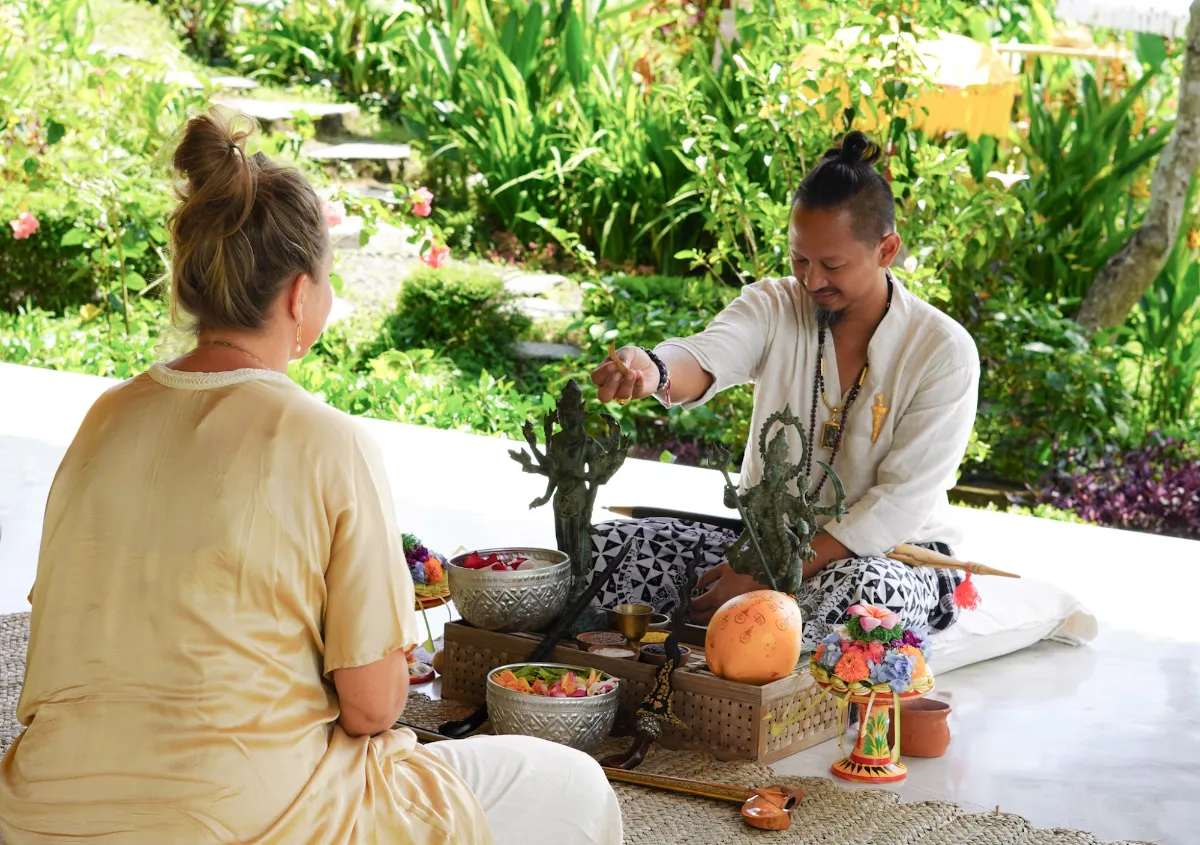
The massages and spa treatments sit outside that count: they are all included, as many as you want, which is not a figure of speech. Some of the women spent five hours a day in the spa. And if the list of 30 activities gives you a fear of missing out, don’t worry. Adding more once you’re there is easy, at around US$70 to US$120 per session for extra tours, healer sessions and visits around Bali. The two I’d recommend above everything are the Tri Desna priest blessing and a healing session with Pak Hendra. Among the more touristic outings, the Eat Pray Love temple tour and the Mount Batur trek were the overwhelming favourites of my group.
INSIDER TIP
Don’t overload your programme. You need time for the unlimited spa, and time at the pool with the other participants is just as valuable: many of the most useful conversations of my week, and most of the insight, came from those poolside afternoons.
Goddess Retreat Ubud or Seminyak?
The two sanctuaries have different personalities. Seminyak has a more urban vibe, is close to the ocean, and runs the widest choice of programmes, including fitness, Pilates, surf weeks, and the full longevity program. Ubud is the rural sister: the retreat sits among rice fields on the edge of the village, with a jungle ravine running along one side, and everything about it is built for spa and wellness. The spa is nicer than Seminyak’s, with individual treatment rooms and deep bathtubs, the rooms are more upscale, and the view from some of the private pool villas is stunning. If you want a week of treatments, nature and quiet, choose Ubud.
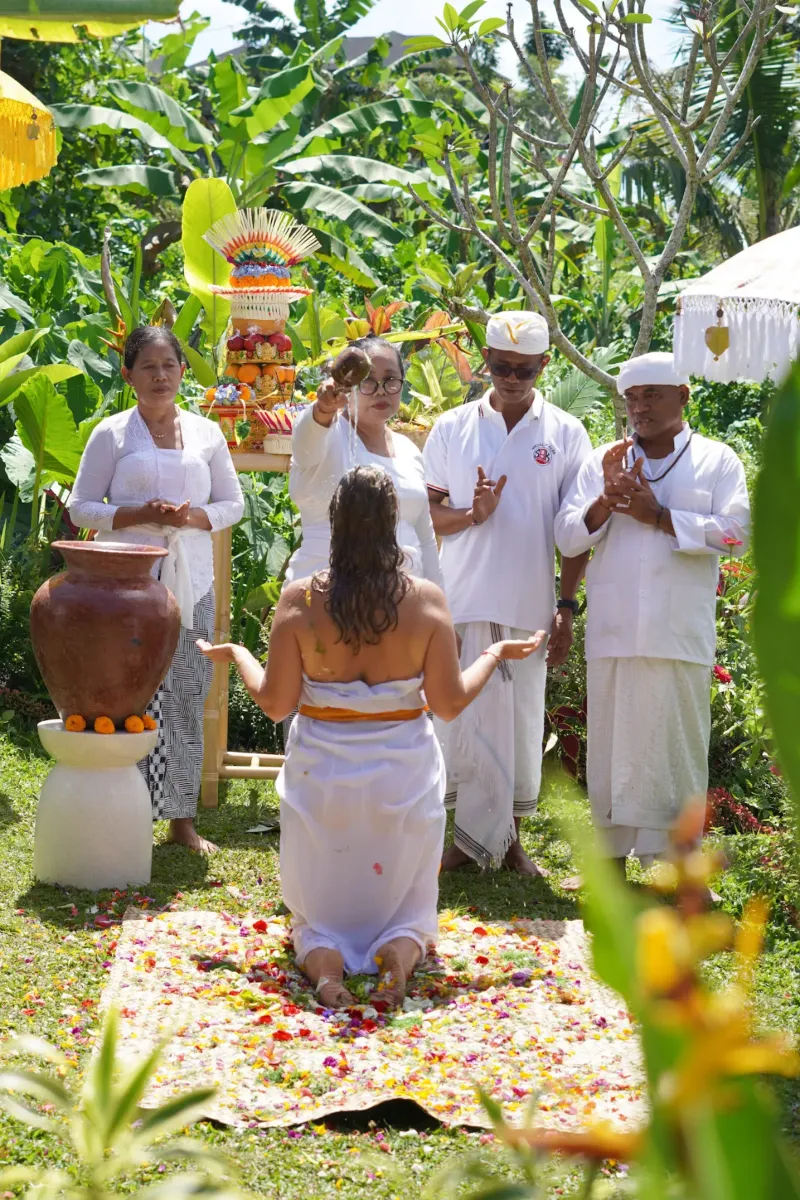
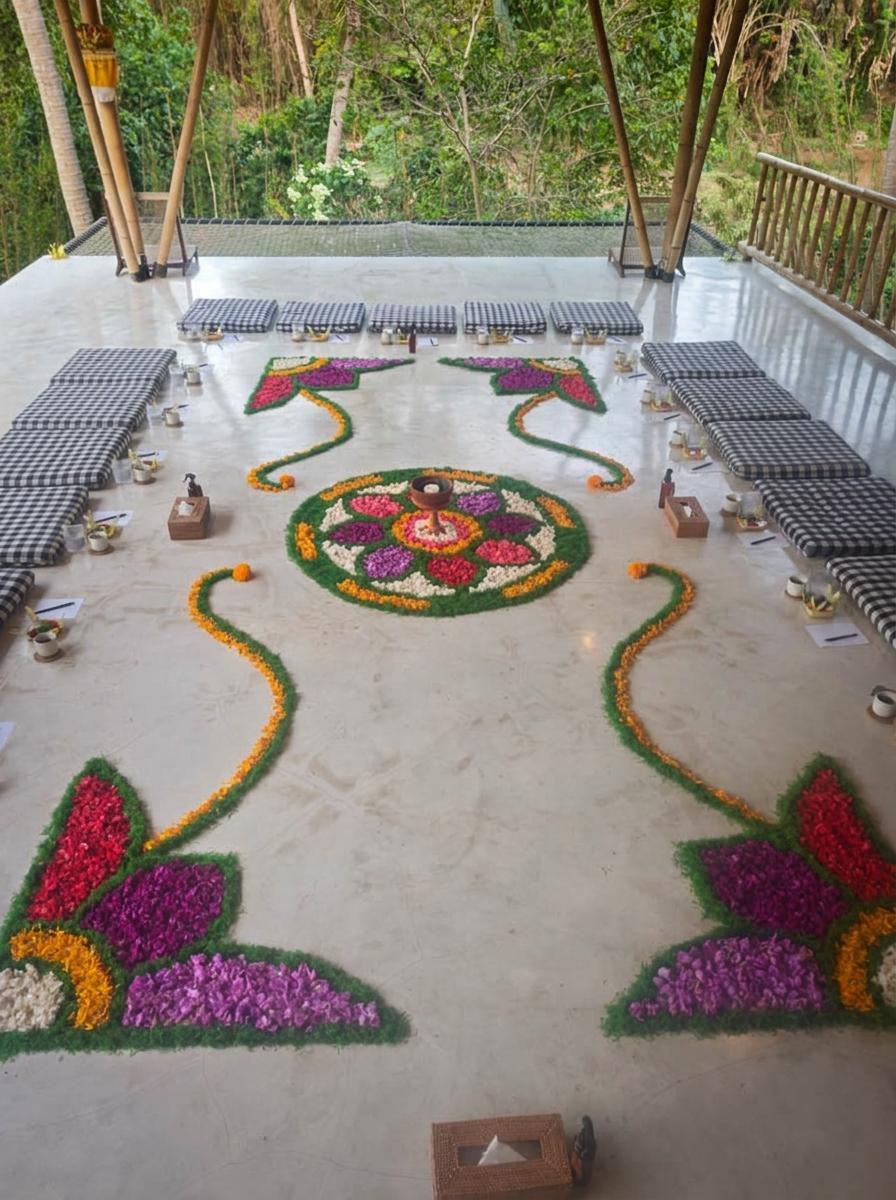
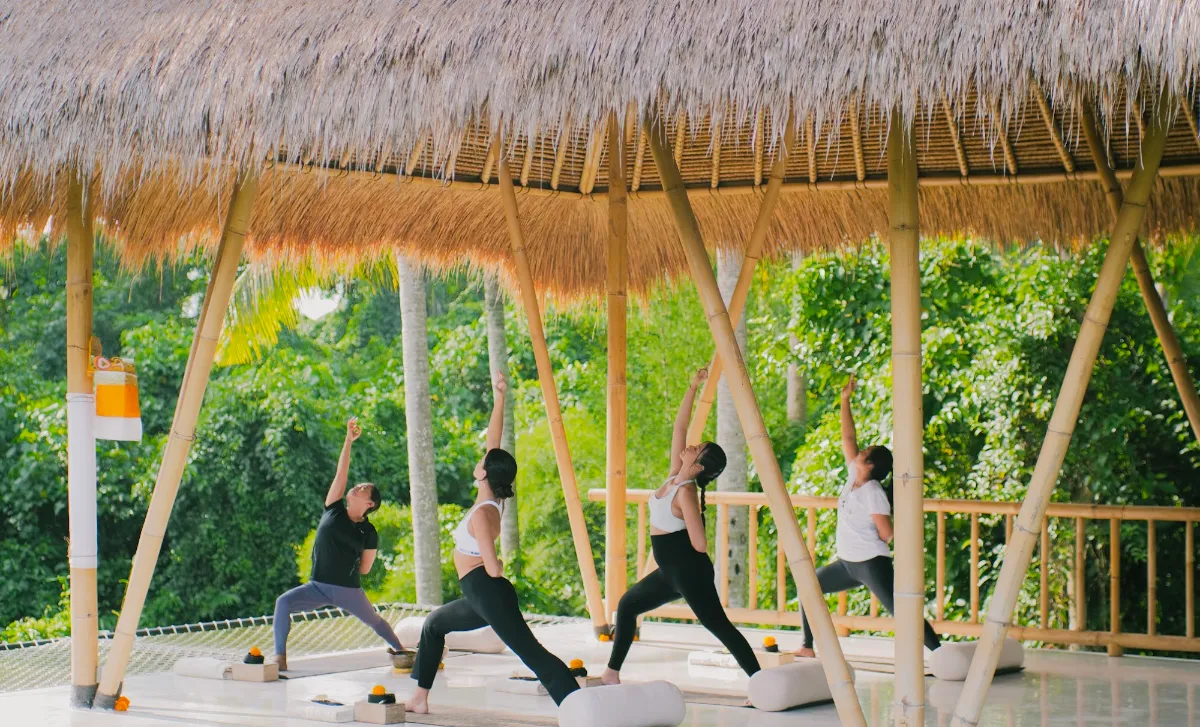
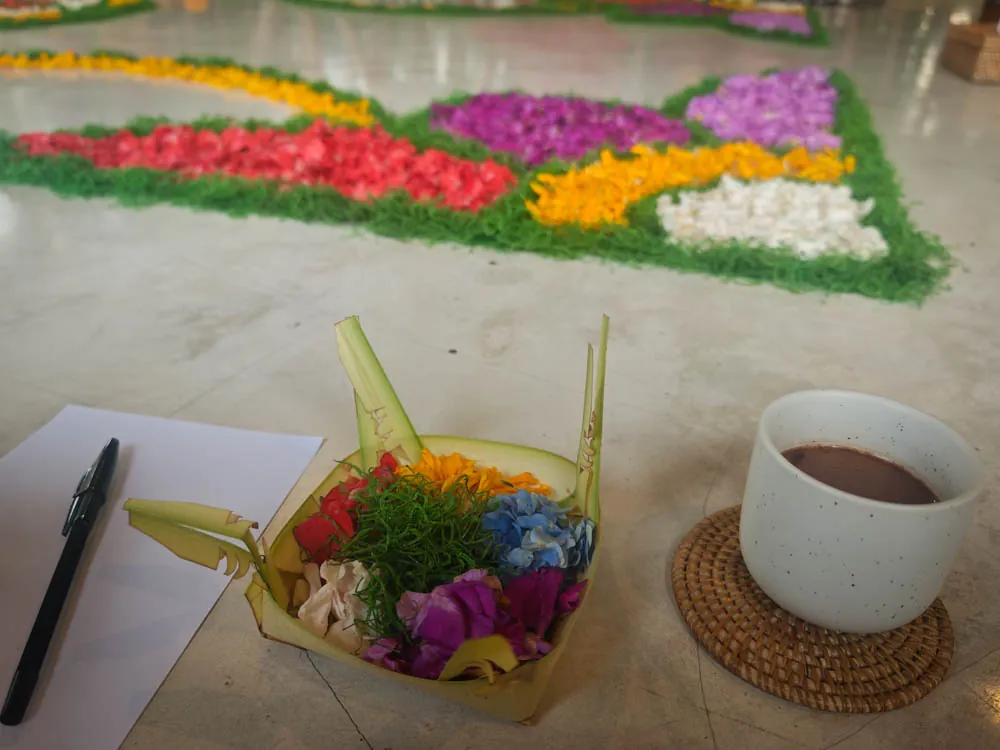
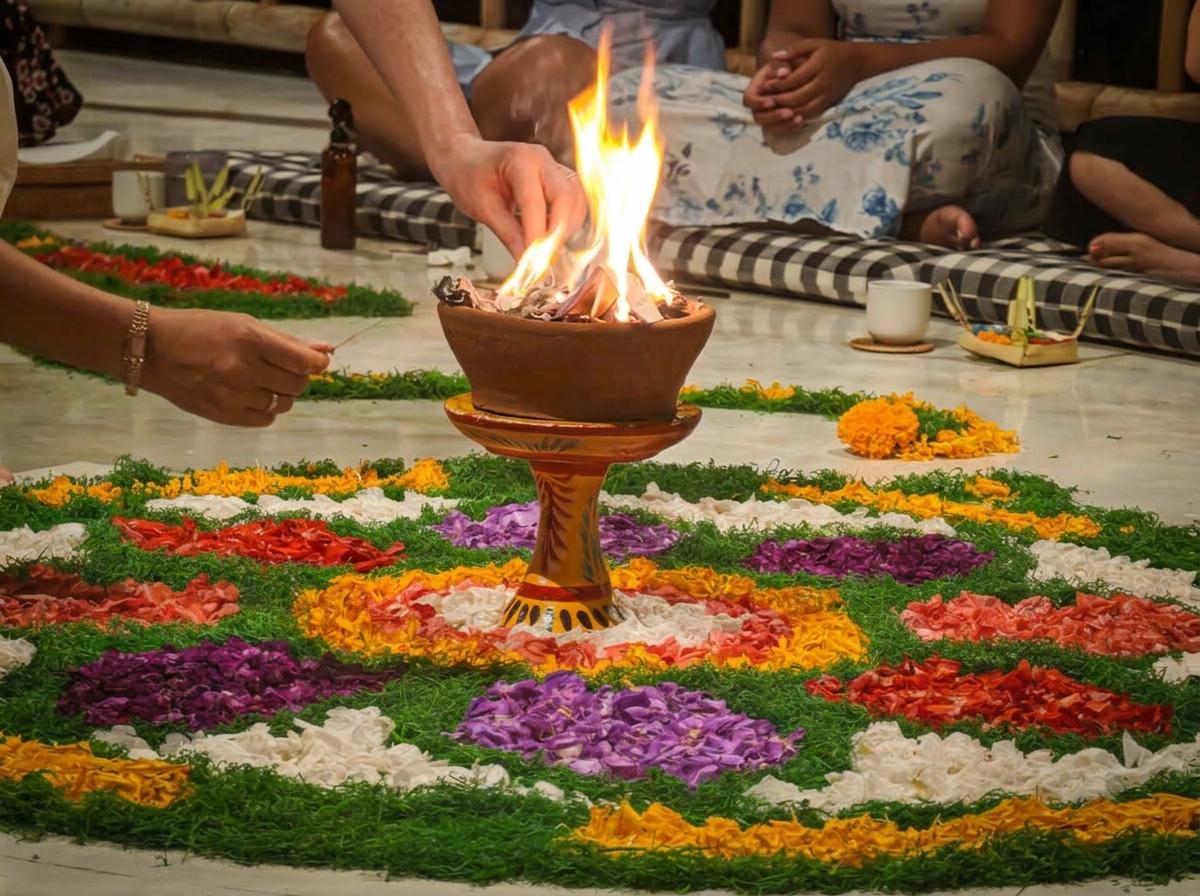
The yoga shala is the heart of it: an open-sided bamboo pavilion under a thatched roof, perched over the river and the tree canopy. Getting there is part of the practice, a five-minute walk through the permaculture garden and the rice fields that has already slowed you down by the time you unroll your mat. On the first evening a flower-petal mandala ran down the centre of the polished floor, with black-and-white poleng cushions around it and a canang sari offering at every seat.
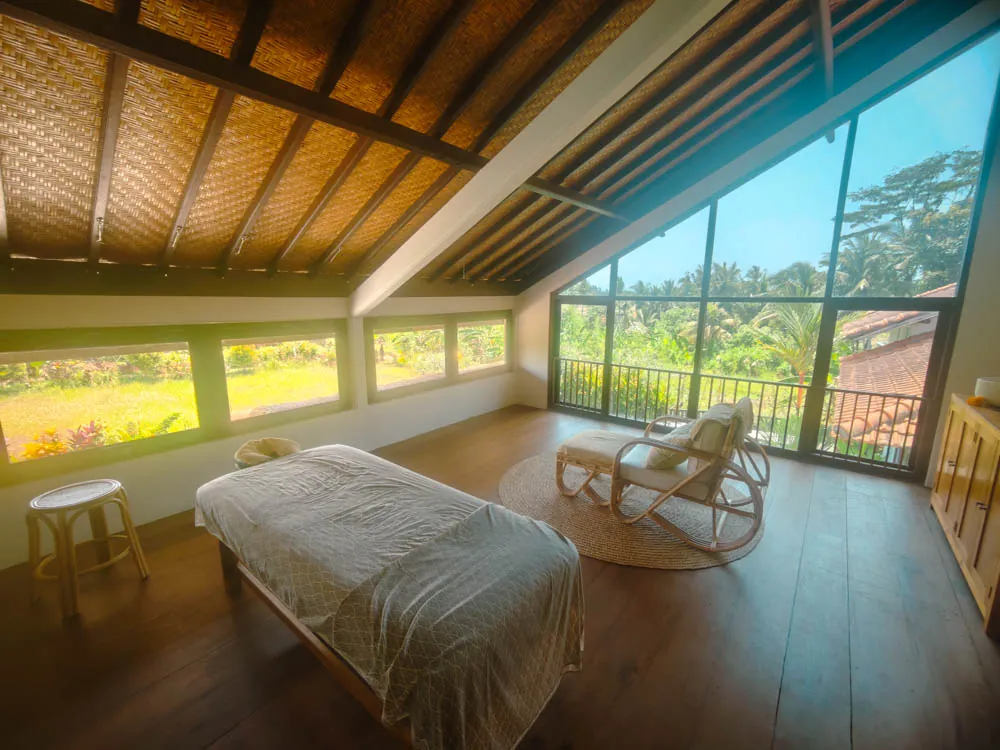
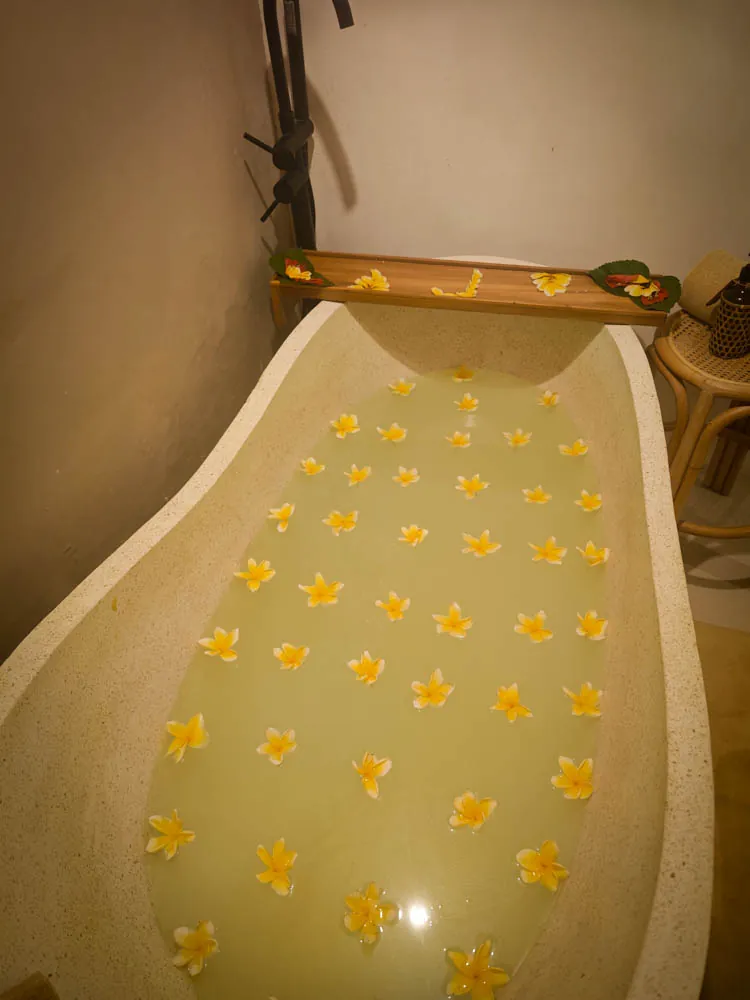
The spa has dedicated treatment and healing rooms with deep egg-shaped tubs for floral baths, a hot-rock Swedish sauna and an ice plunge pool, all open every day, including arrival and departure days. The sauna runs up to 70°C, and the plunge pool was a bracing 3°C when I used it. The guidebook suggests a 15-minute sand-timer round in the sauna before the plunge, repeated two or three times.
The gardens are where the vegetables come from. The retreat’s permaculture food forest feeds the kitchen and the spa products, and the Nature to Table tour, where you harvest what is in season for the chef, is unique to Ubud.
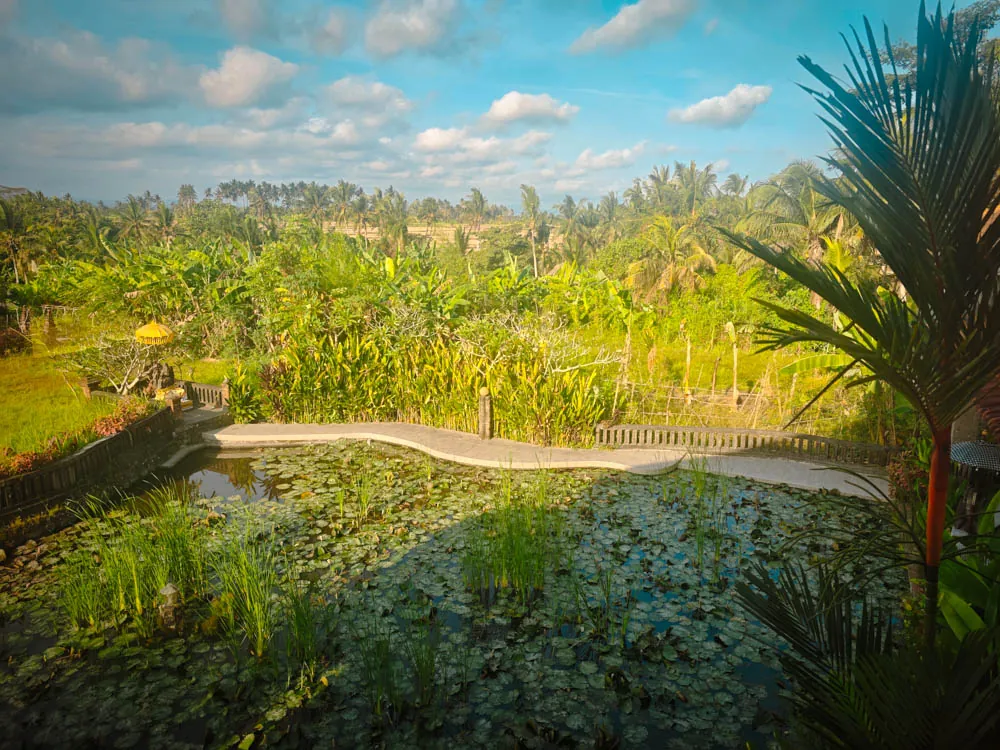
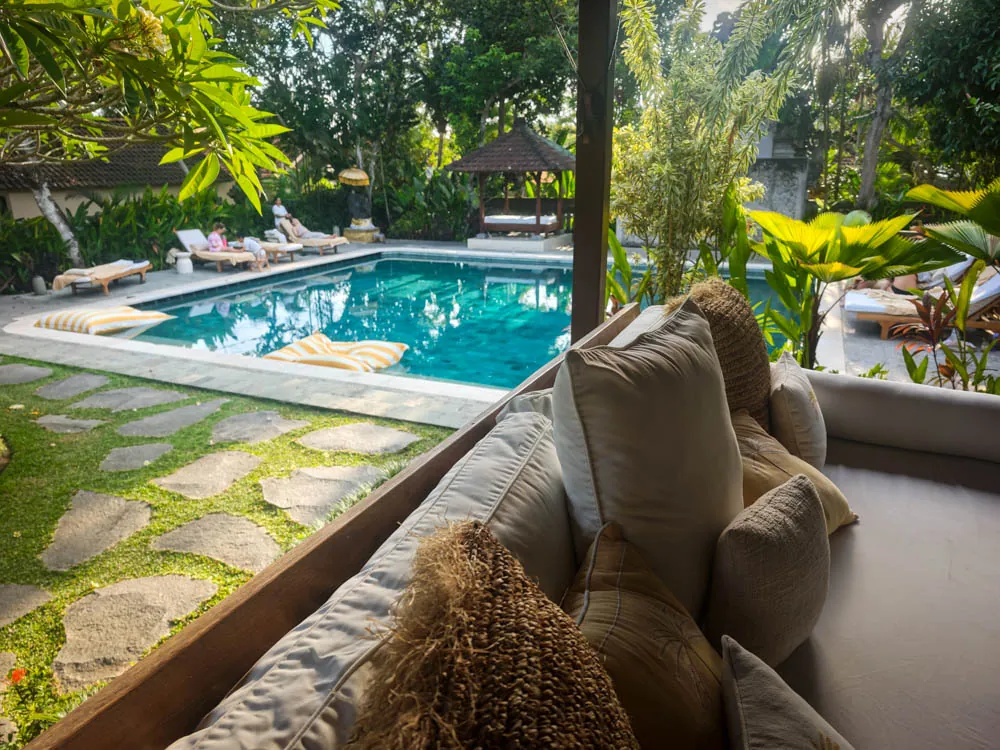
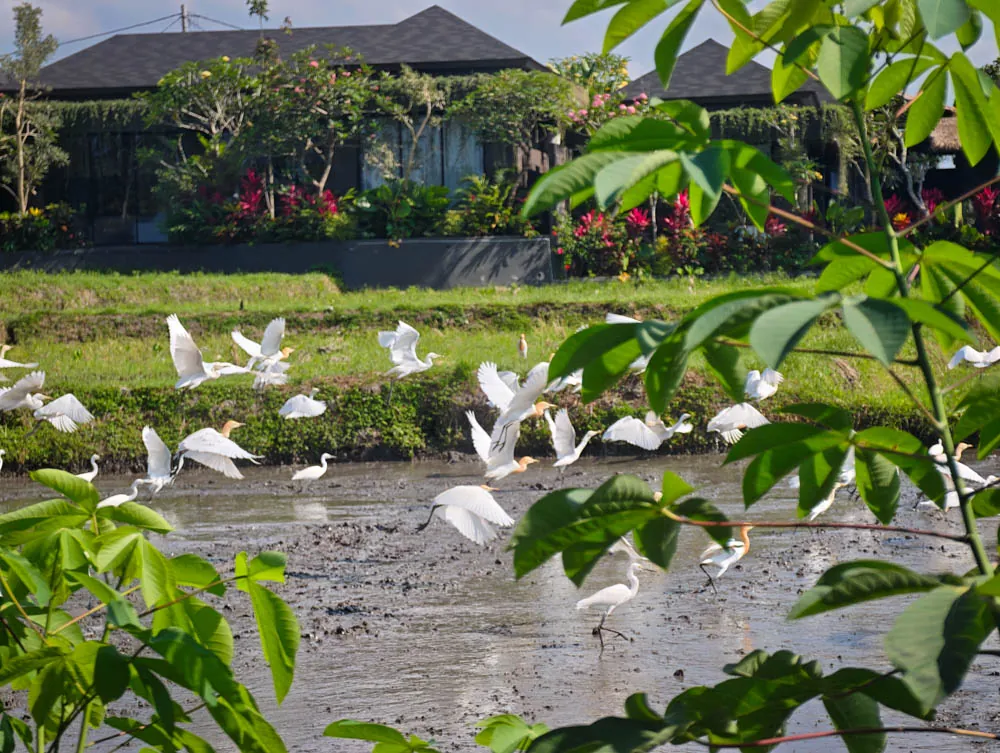
The view. From the Frangipani Villa’s pool you look over a lily pond, across the rice fields and, on a clear day, up to Mount Agung. Around sunset, herons and other birds come down over the fields. Keep binoculars handy.
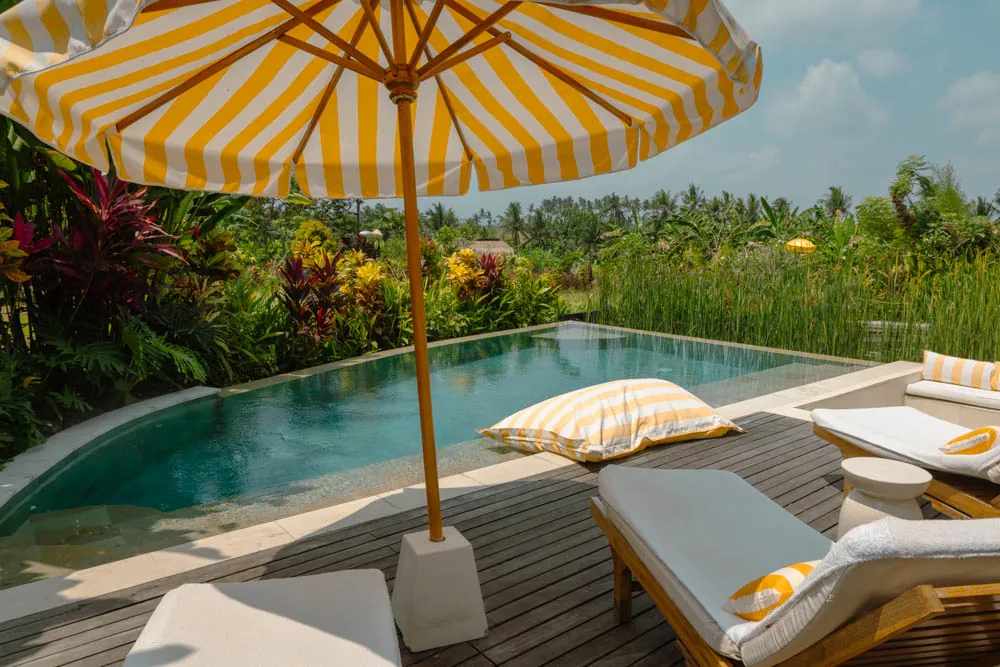
My room: Gaia, in the Frangipani Villa
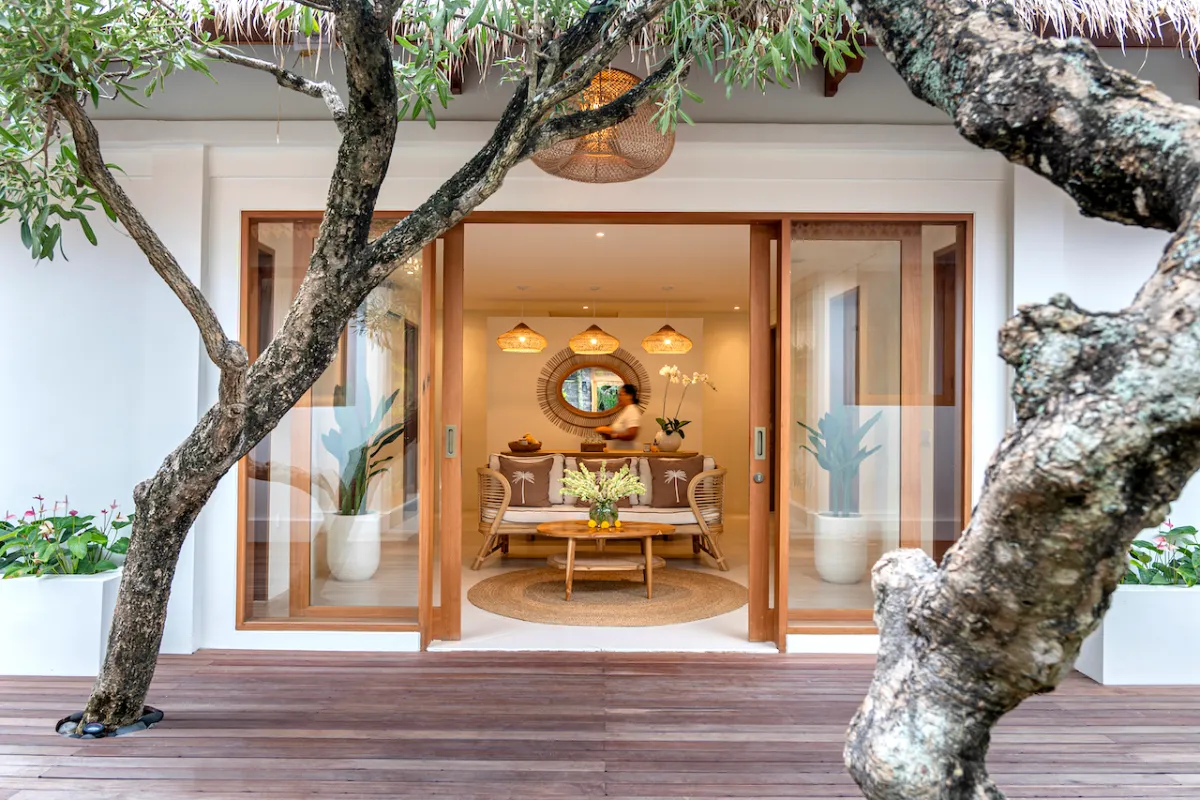
Gaia is one of four bedrooms in the Frangipani Villa, the newest villa on the property, with its own infinity pool over the rice fields and two spa treatment rooms, so your therapist comes to you. The villa sits just outside the main compound, a two- or three-minute walk away.
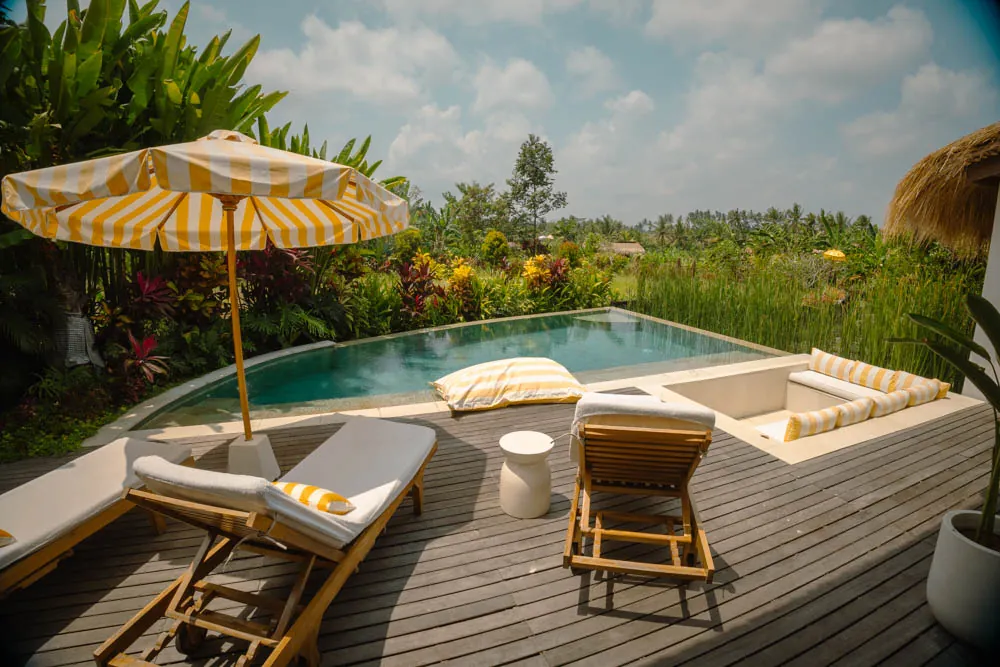
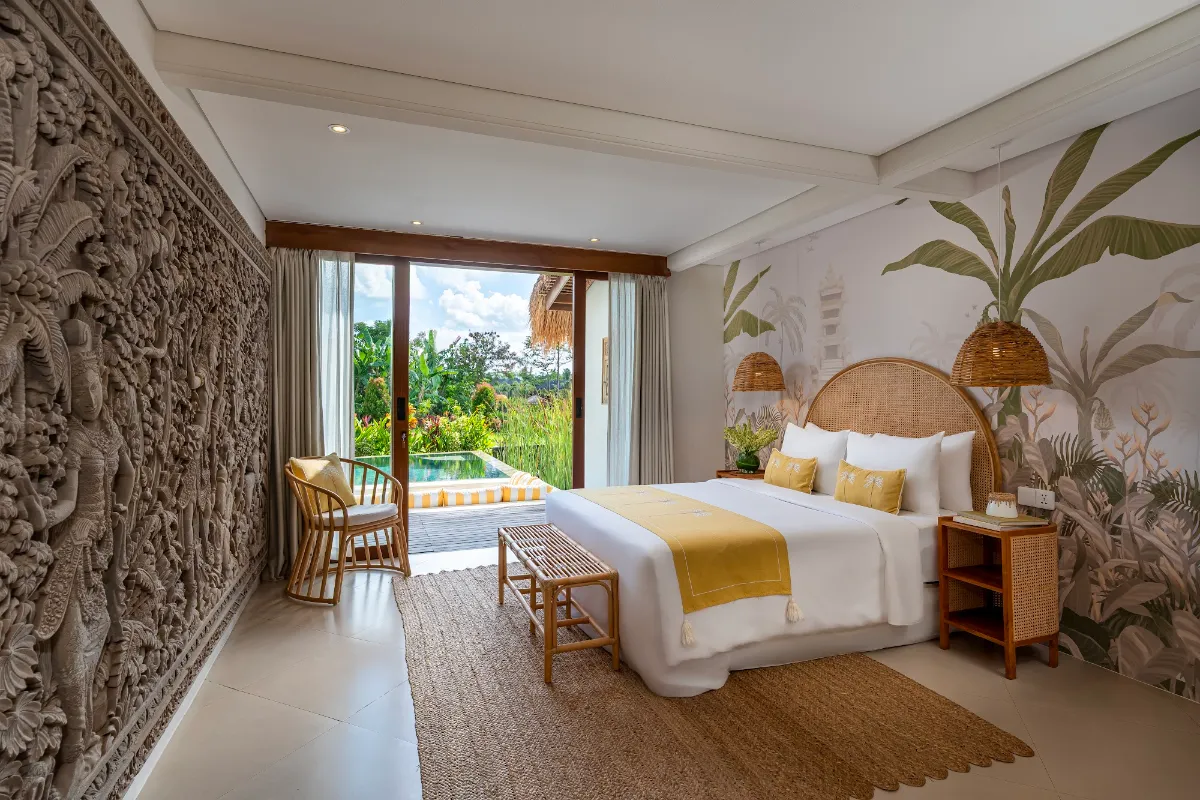
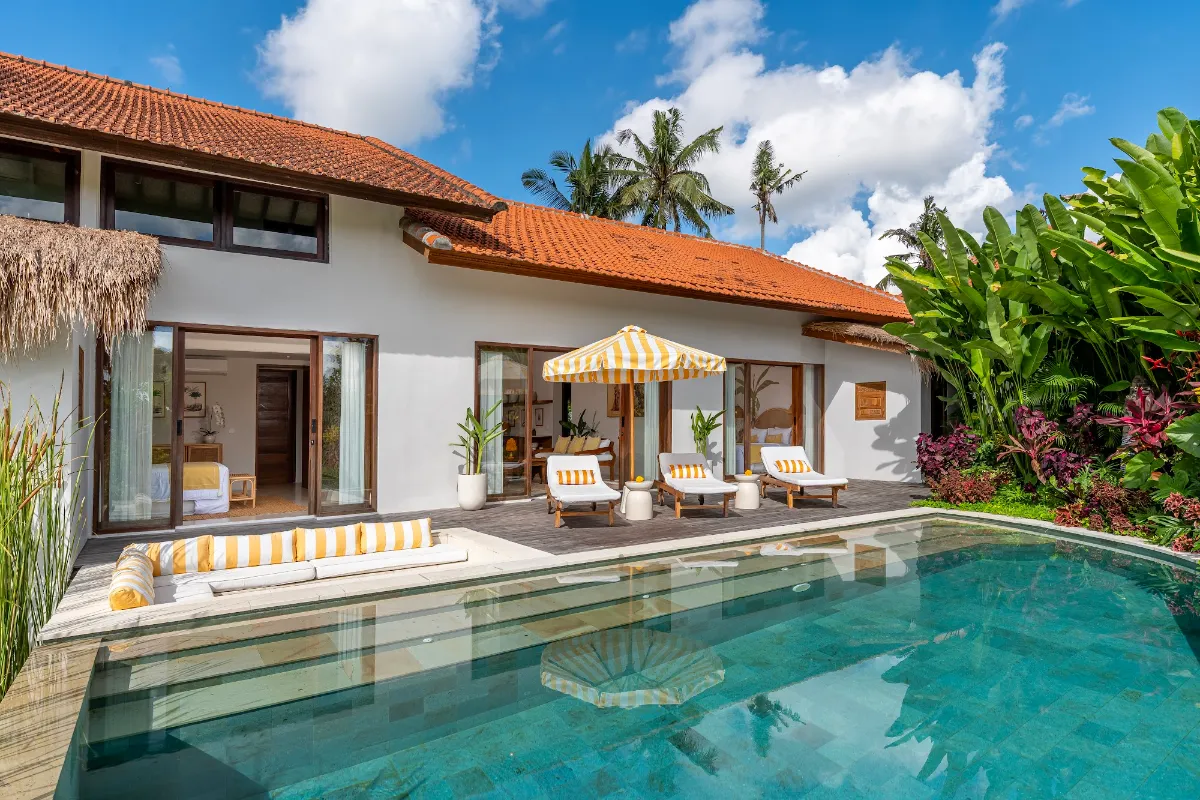
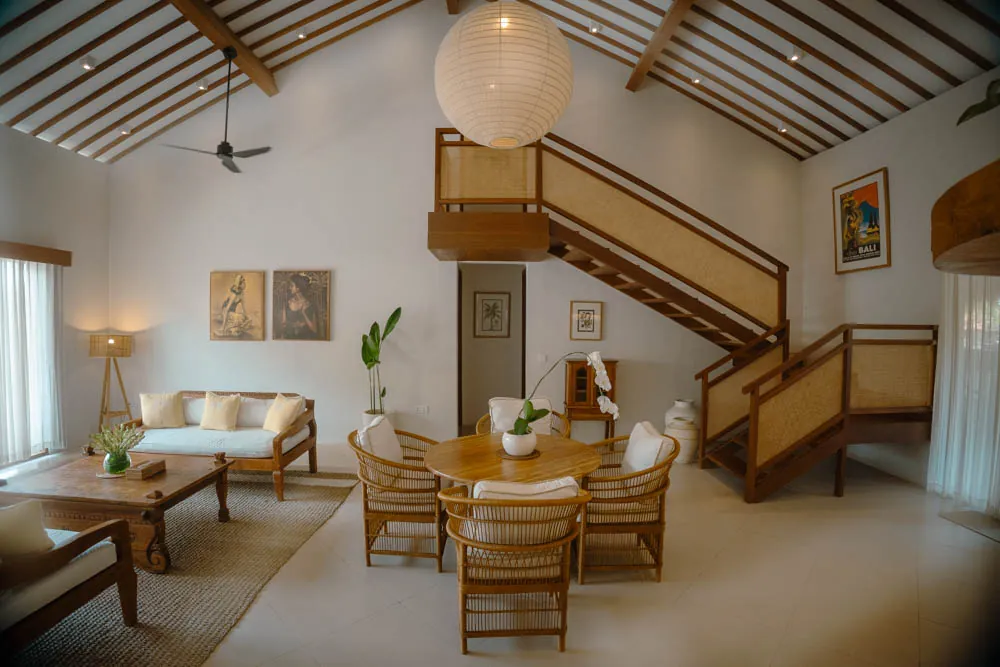
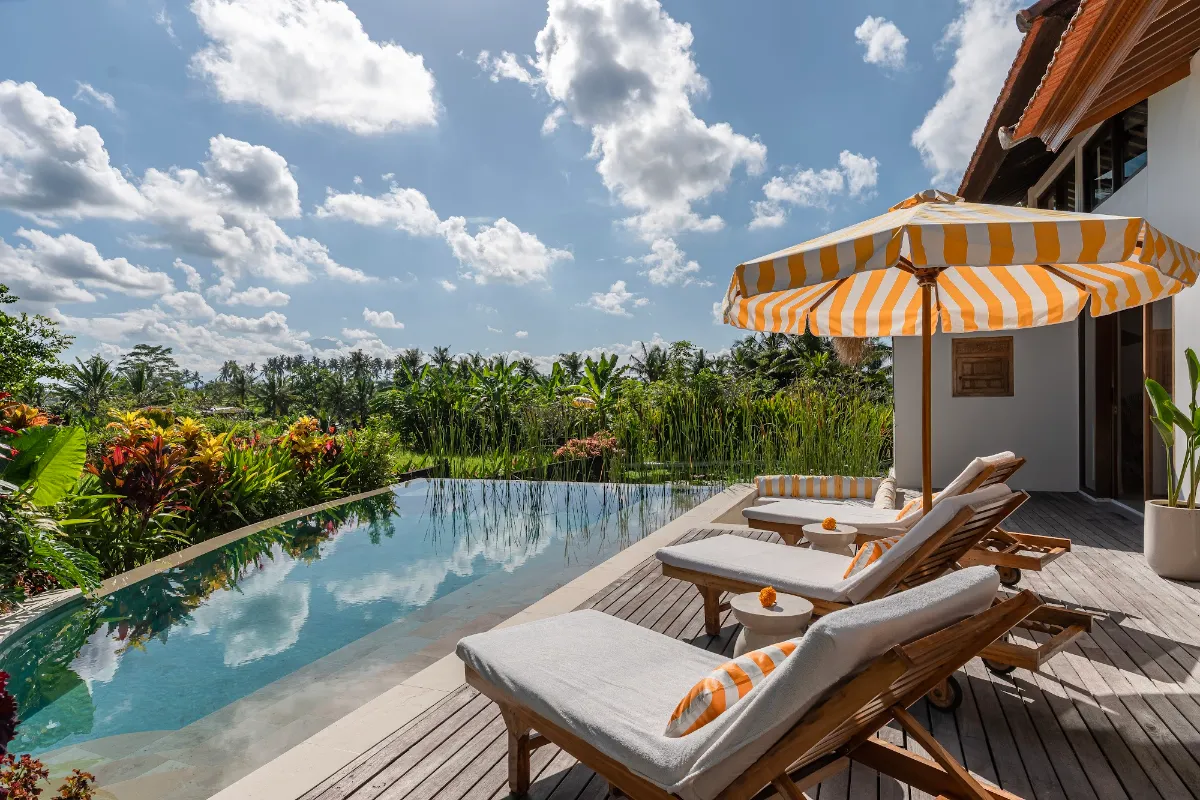
Inside, the style is Balinese with a light, contemporary touch. The living room rises to a double-height pitched ceiling of whitewashed panels and timber battens, with a giant paper-lantern pendant and two ceiling fans. Teak daybed sofas carry white cushions and pale-yellow pillows embroidered with palms, cane chairs circle a round timber dining table, and the walls hold sepia portraits of Balinese women. Sliding glass doors open onto a teak pool deck with a yellow-and-white striped umbrella, the pool edged with crotons and cordylines.
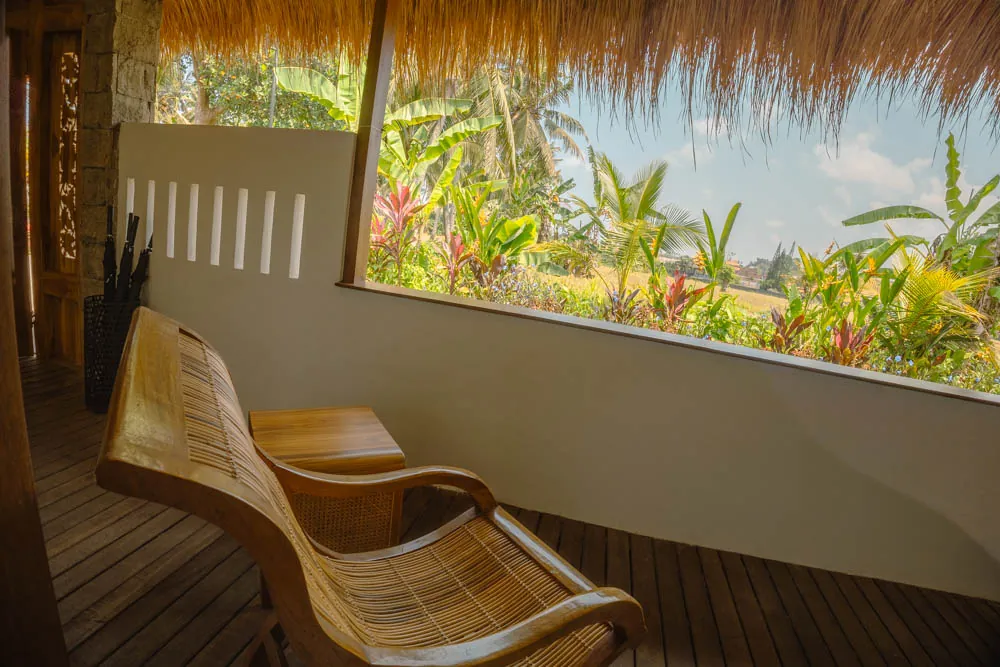
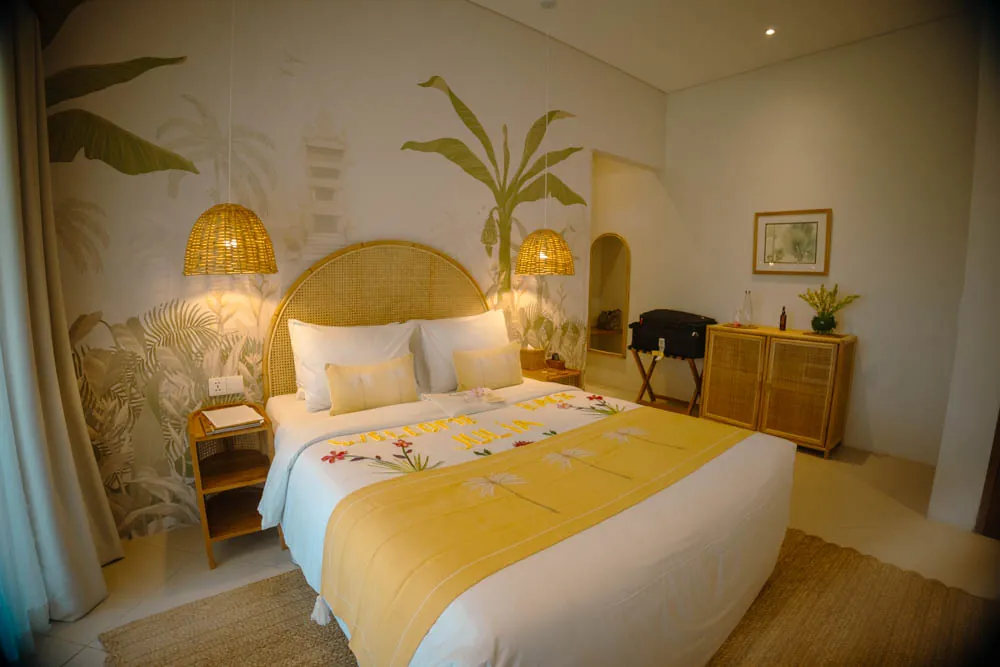
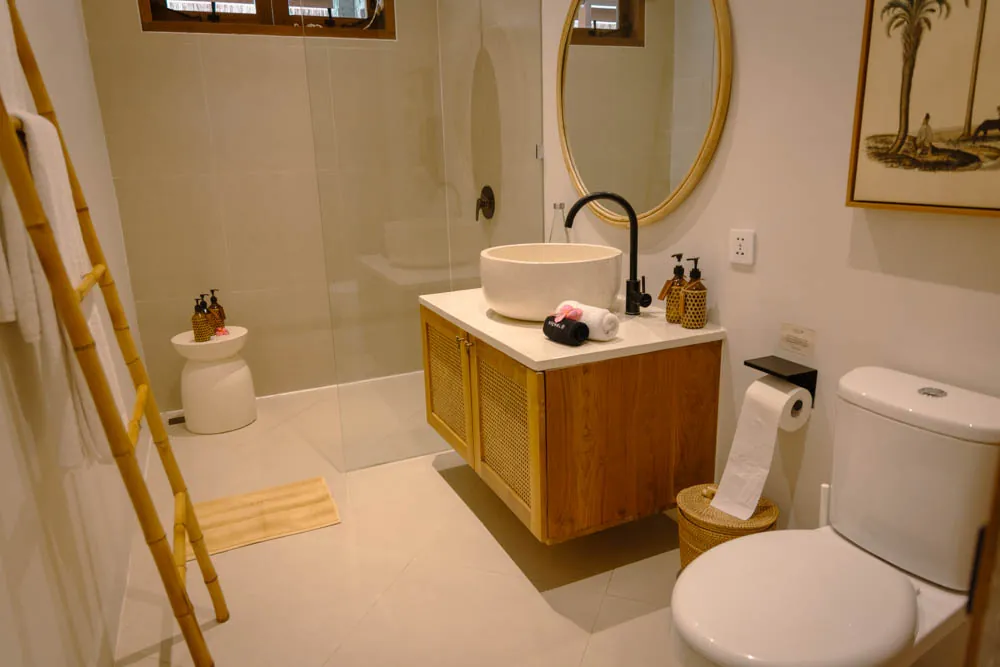
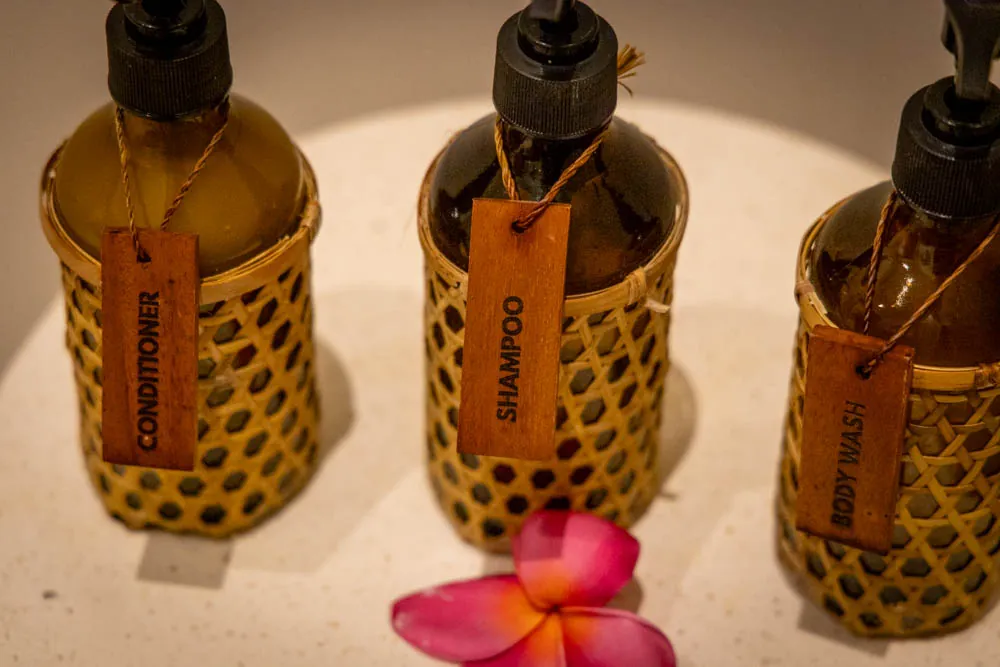
My room was genuinely comfortable and the bed excellent. The details had been thought through: drinking water, mosquito repellent, earplugs (never needed, the room was silent), a fresh flower arrangement on arrival, and fresh flowers on the coffee table. The small terrace faces the lane rather than the fields, so it isn’t a place you’ll linger. The ensuite has a rain shower, a hairdryer, shampoo and conditioner, and there’s a bathrobe, ideal for padding over to the pool or a treatment. The air conditioning is powerful.
INSIDER TIP
Keep the windows closed at night, or insects will find their way in.
INSIDER TIP
If you’re working through something and need private time, choose a private pool villa, so you can retire alone whenever you want to. If you’ve come to be social and meet the other women, the main retreat pool is the social hub of the retreat, and a garden room puts you right beside it.
Arriving at Goddess Retreat Ubud
The Goddess driver collected me in Ubud at noon with a chilled bottle of water and a cold towel, and a few minutes later we pulled into the retreat. The team greeted me by name, whisked my bag to my room, and handed me a fruit drink and a small slice of cake before I had sat down.
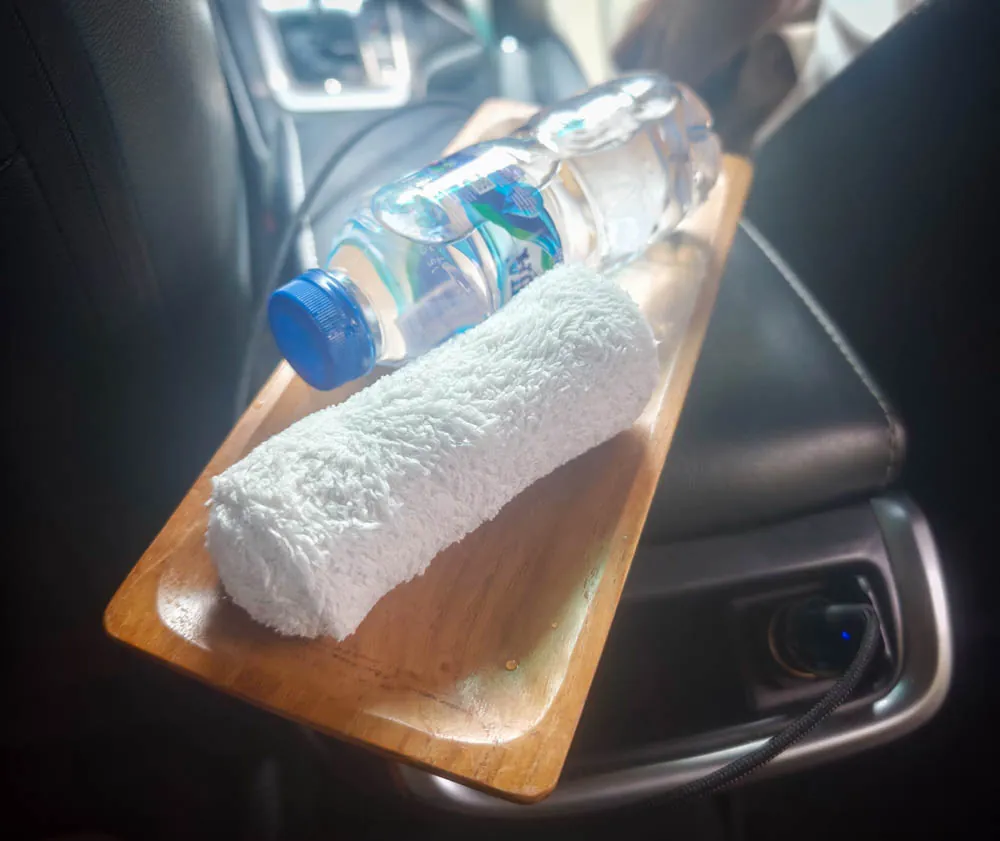
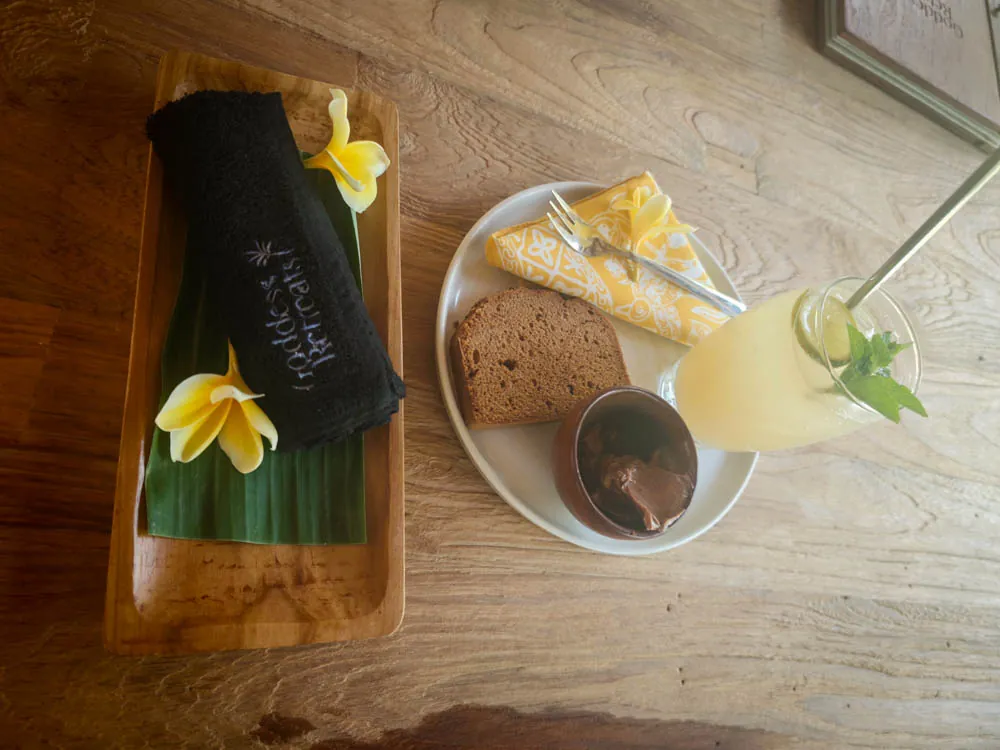
INSIDER TIP
Lunch isn’t served on arrival day, so eat before you come.
The afternoon started with a 90-minute Balinese massage, which is the fastest way I know to actually arrive somewhere. At sunset we gathered in the shala for the opening circle. Most of the 19 women had arrived by then, from all over the world and every age range, and the same story came up again and again: women who had given so much to children, parents and work that they had lost track of themselves. Others were working through a divorce or a job loss, some were close to burnout and wanted to reset their nervous system, and a few simply wanted Bali and the spa in a supportive setting. The hostesses, Dessy, Rima and Ayu, were clear from the start that the week was ours, to do as much or as little as we wanted. The evening closed with an intention-setting ritual using canang sari offerings, then a water blessing.
Yoga starts at 6:30am, and most of the women were there anyway. You practise surrounded by jungle and flowers in every colour, with the day only just starting. Goddess deliberately avoids power vinyasa; the classes are hatha, slow flow, yin and restorative, chosen because most guests arrive from hectic lives and need to come down rather than work harder. On my first morning I followed it with an aromatherapy massage, a facial and a body scrub back to back, and less than 24 hours after arriving, everything ached: sore joints, a stiff neck, shoulders that didn’t want to move. It felt like the tension of the past months leaving all at once, and that kind of release is exactly what a week like this is for.
Why a creative retreat, and why now
A fellow guest on a retreat in Tuscany told the writer Emma Gannon that it was “a new type of girls’ holiday”, and her CN Traveller piece on creative retreats becoming the new girls’ trip explains why: organising a week with old friends has become almost impossible, while a week of workshops with strangers who want the same thing needs no diary juggling at all. Goddess’s founder Chelsea Ross makes a related point. Digital noise, she says, has become overwhelming for many women, and sitting down with a chisel or a brush pulls our minds and bodies out of virtual reality and back into the present. The creative workshops in Ubud are built on that idea: hands-on arts and crafts as a form of moving meditation, grounded in a culture where, historically, Balinese had no single word for “artist” because everyone carved, danced or played.
My art retreat week: the creative workshops I chose
Wood carving with a Balinese master mask maker
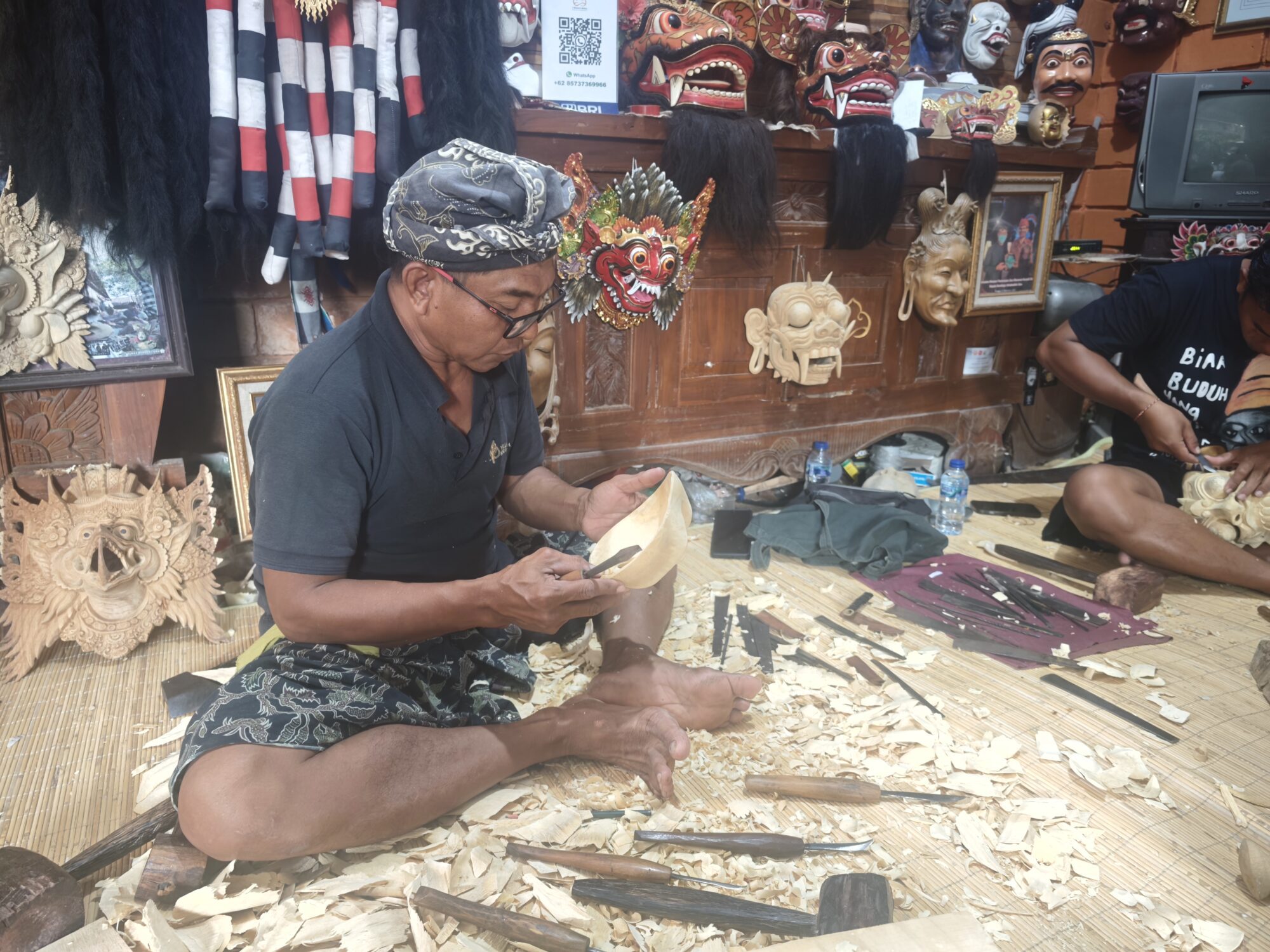
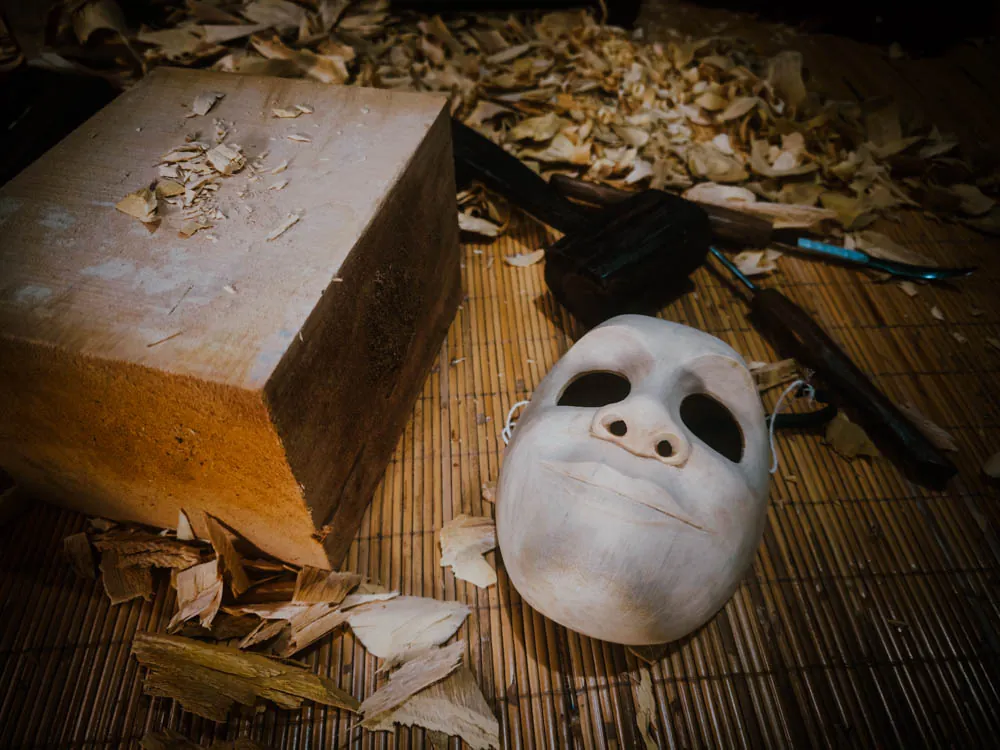
My first creative session took me out of the retreat to Mas, Bali’s woodcarving village, and the home studio of one of its best-known mask makers, Komang IW Muka. We weren’t taken to a workshop set up for tourists. He invited us into his family compound, and we carved a mask alongside him. Mine is a smiling face.
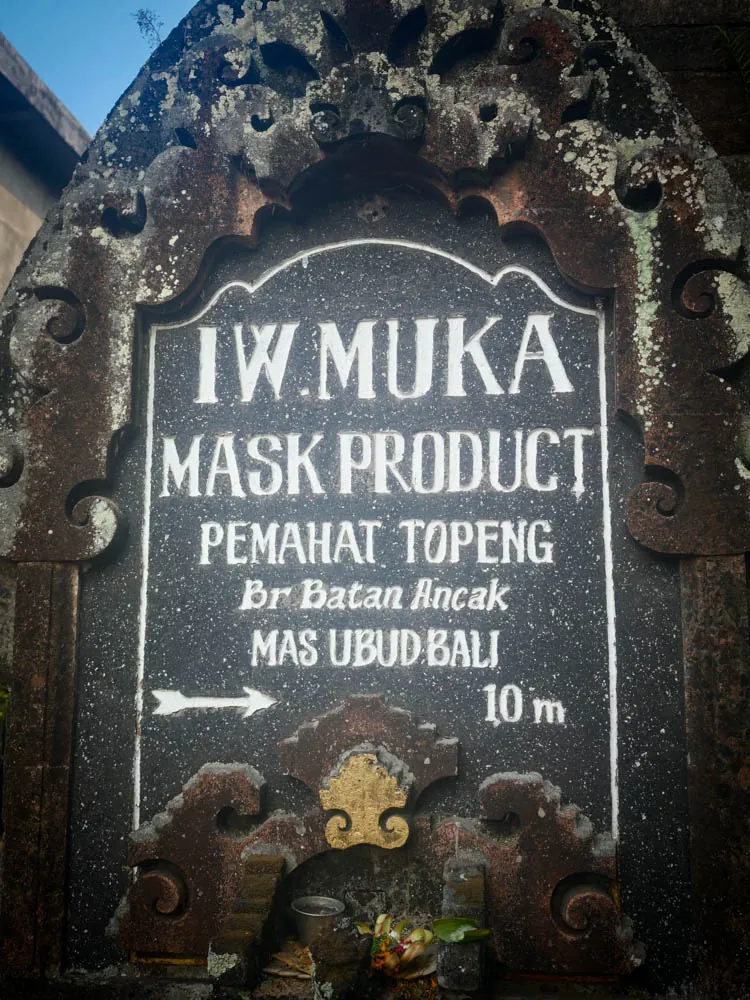
In truth, the master did most of the work. But doing even a small part of it was fascinating: watching a plain block of wood turn into a refined mask, and realising how hard and how skilled the work is. After 30 minutes with the chisel and mallet my shoulder was aching, and I was grateful each time he stepped in to guide the cut. I took the mask home unpainted. It fits my face perfectly, so it has a date with Halloween. I left with deep respect for the craft, and with a thought I’ve kept coming back to. A block of wood holds any shape until someone decides what it will become. A week like this does something similar for the women who come here, starting from the same blank block and leaving with something of their own.
Canvas painting with a Balinese master artist
I hadn’t held a paintbrush since I was 15, so I arrived at this workshop, held in the yoga shala with master painter Sila, wondering how it would go. Sila began with a short introduction to Bali’s painting styles, then guided us through the traditional Balinese method: the composition is first drawn in pencil on the canvas, then filled in with paint. He asked each of us what we wanted to paint and sketched the outline for us. I chose my cat, reimagined as a magical creature.
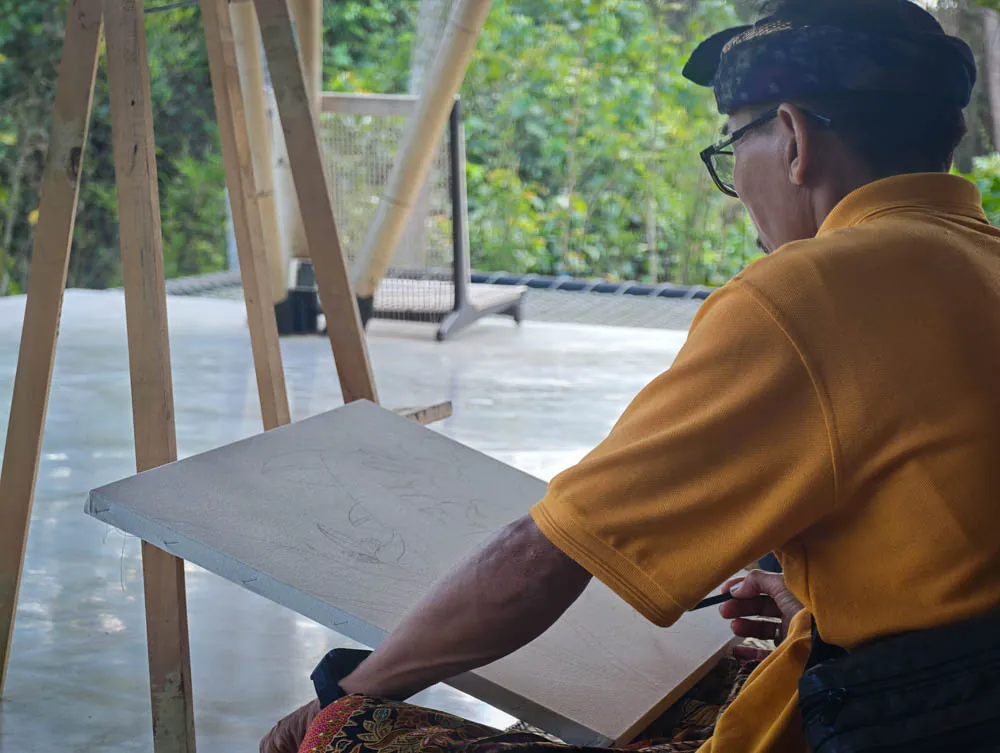
Then came the absorbing part: mixing colours until they were exactly right. Acrylics turned out to be wonderfully versatile. Add more or less water, change brushes, layer the colours in a different order, and the same paint gives an entirely different texture. Sila stepped in for the hardest parts, the face and the clothing, and otherwise let us find our own way. The session was scheduled for two hours, 9am to 11am. We were so absorbed that it ran to four.
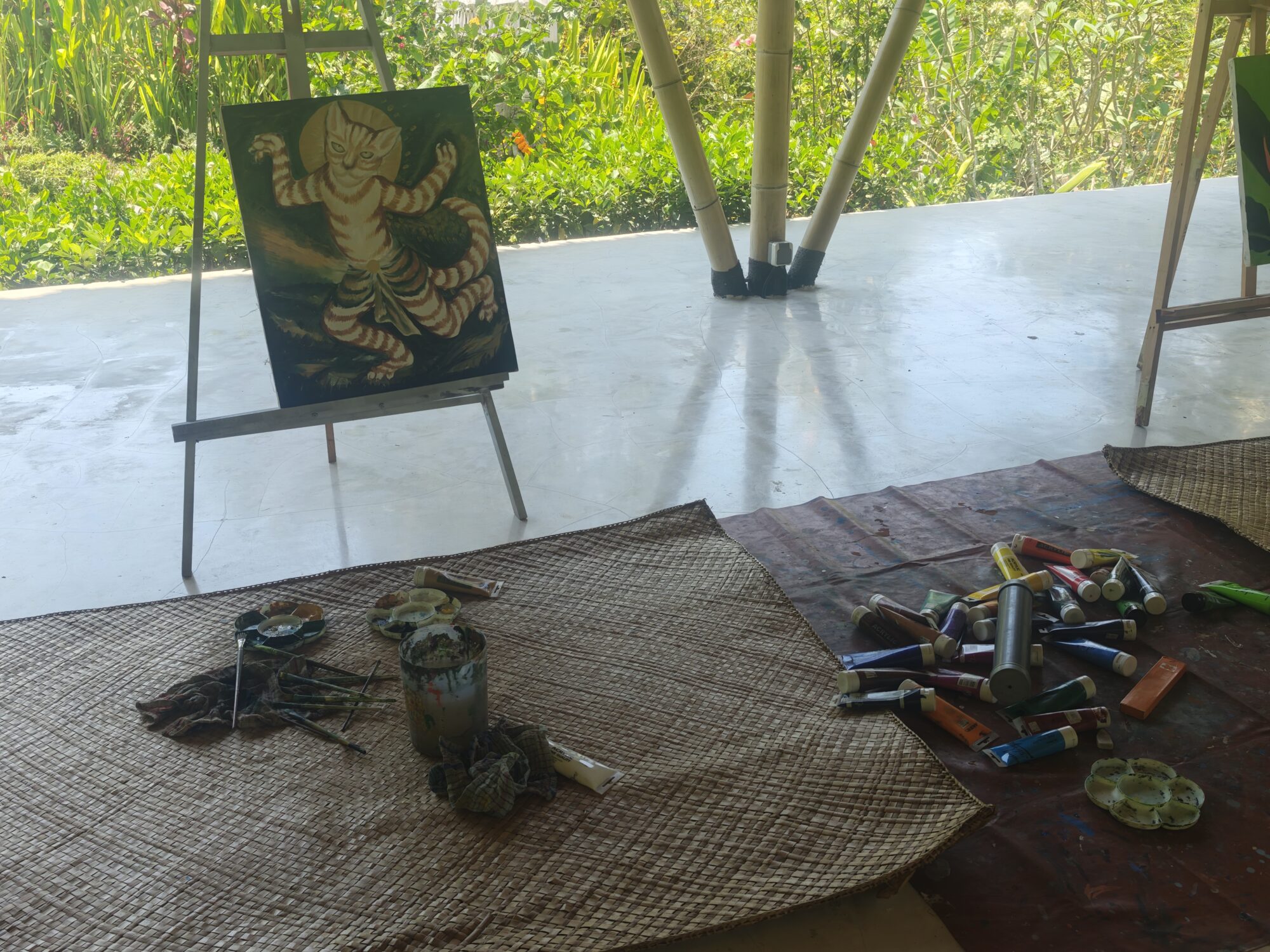
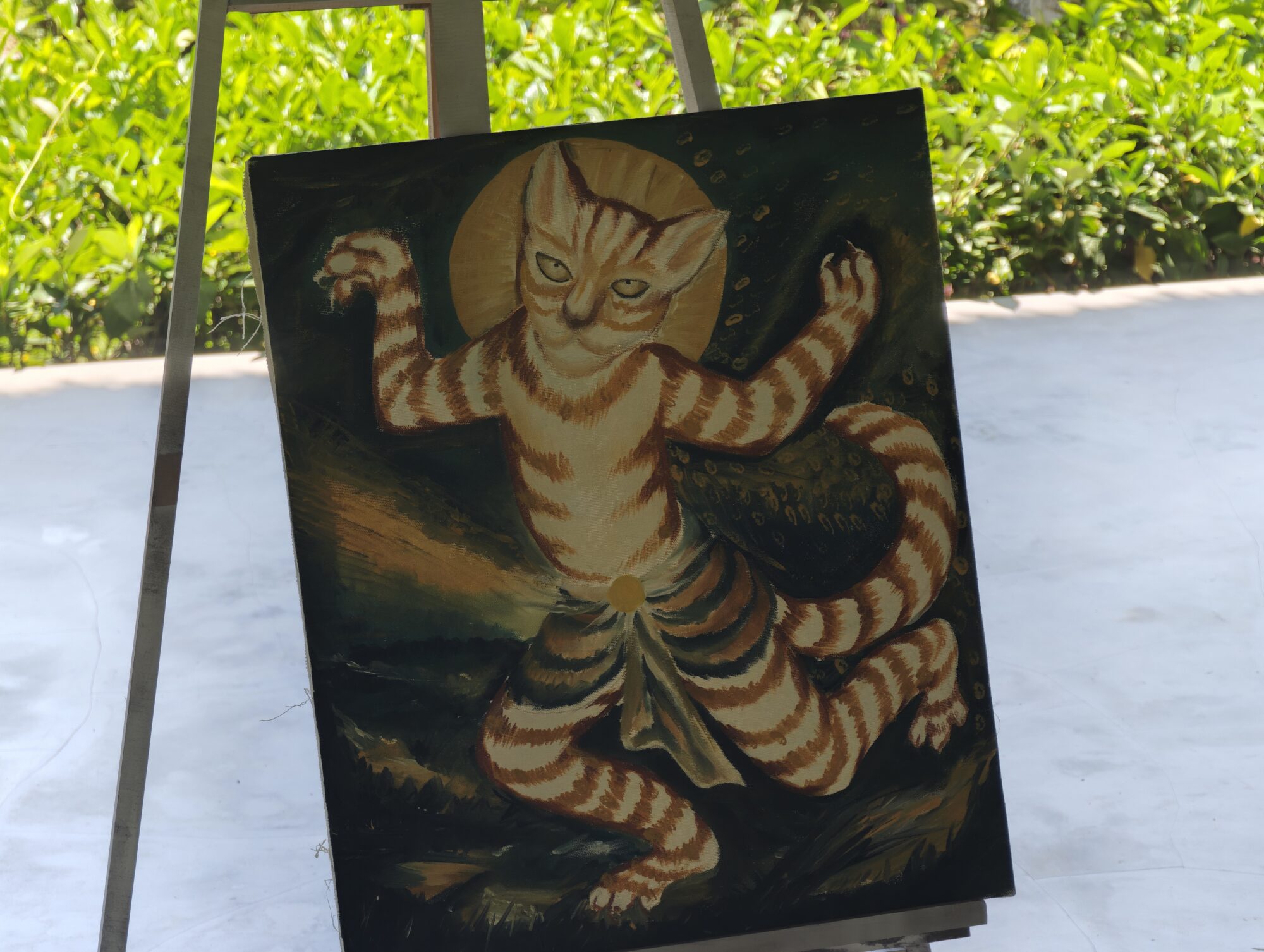
This is where a creative retreat in Ubud comes into its own. Ubud has been Bali’s artistic centre for generations, and the island’s most talented artists live within a few kilometres of the retreat. Goddess’s achievement is finding masters of this calibre who are willing to share their skills with complete beginners. Their talent, and their humility, are striking. I left with a painting I’m proud of and a creative side I’d forgotten I had.
Perfume making
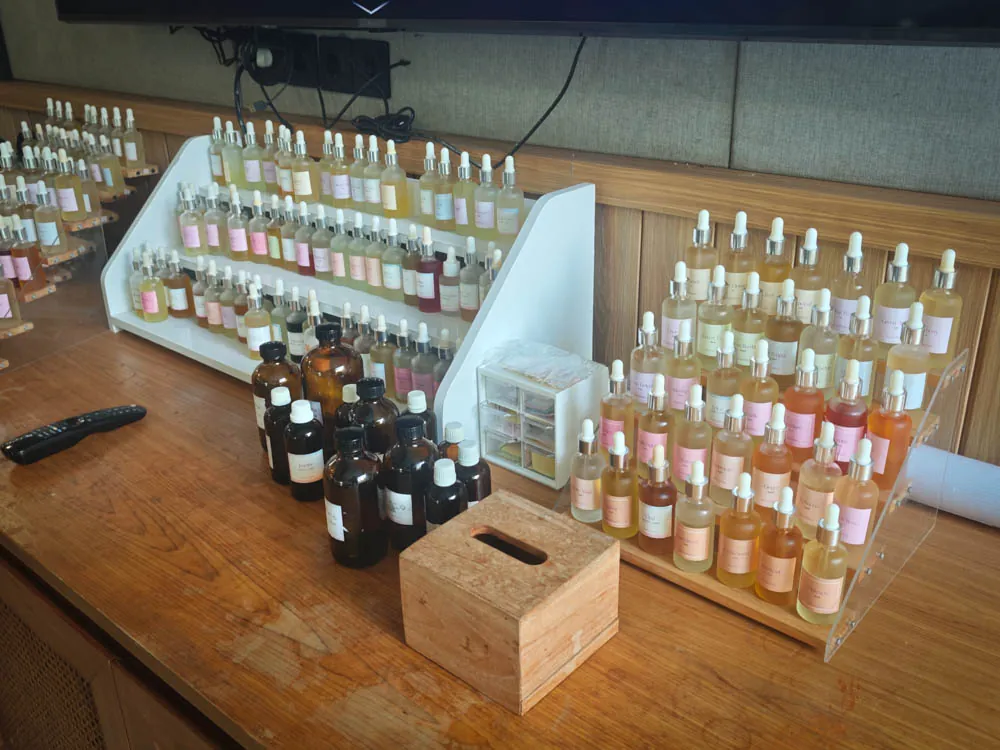
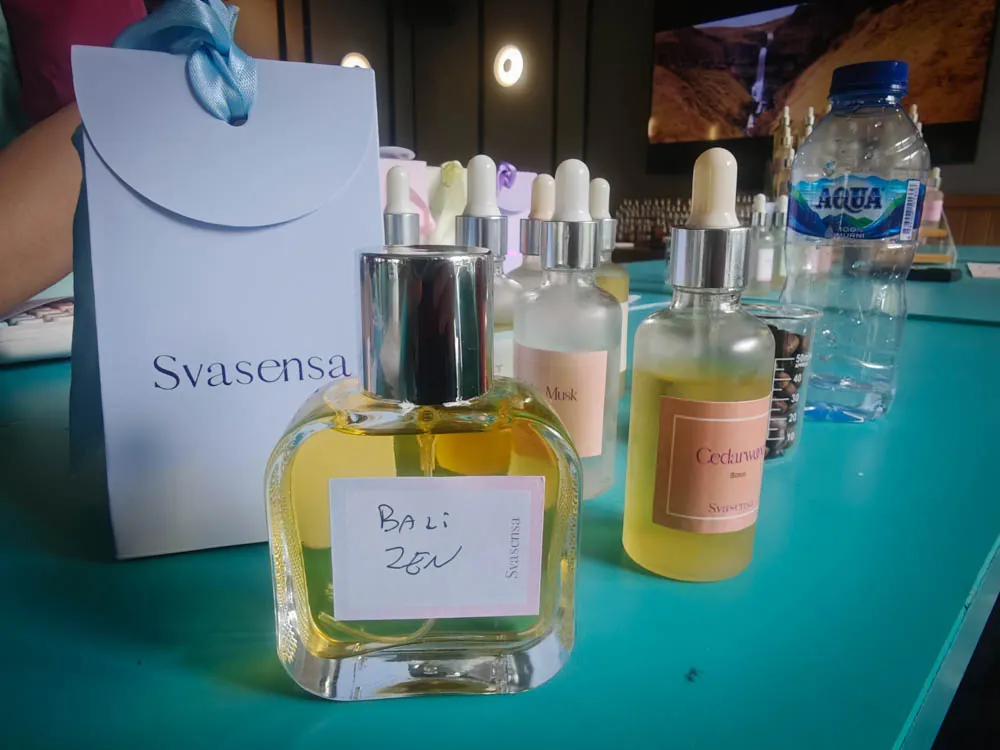
My third chosen experience, on the last full day, was the perfume-making workshop. You build your own scent from a fragrance wheel: two top notes from a tray that runs from bergamot and lemon peel to British pear and mint, three heart notes such as pink pepper, green bamboo, green tea or lotus, and a base from the woody, oriental or gourmand families. It is harder than it sounds. I struggled to create a perfume I actually liked and had to start again several times, which told me I could never be a perfume creator. But it was interesting to work with a sense I rarely use deliberately, and I came home with a bottle of my own creation, built on bergamot, lemon peel, jasmine, amber and tobacco.
The group workshops: aromatherapy and canang sari
Alongside your chosen experiences, the week includes workshops open to the whole group. The aromatherapy workshop, unique to Ubud, teaches how essential oils are blended to support emotional healing; I liked the blends enough to buy two rollers to take home. The canang sari workshop teaches you to make the daily Balinese offerings of flowers and palm leaf, and explains the philosophy behind them. It ties the whole creative idea back to the island’s daily rituals.
The other creative and cultural experiences in Ubud
The week I was there, guests also chose from:
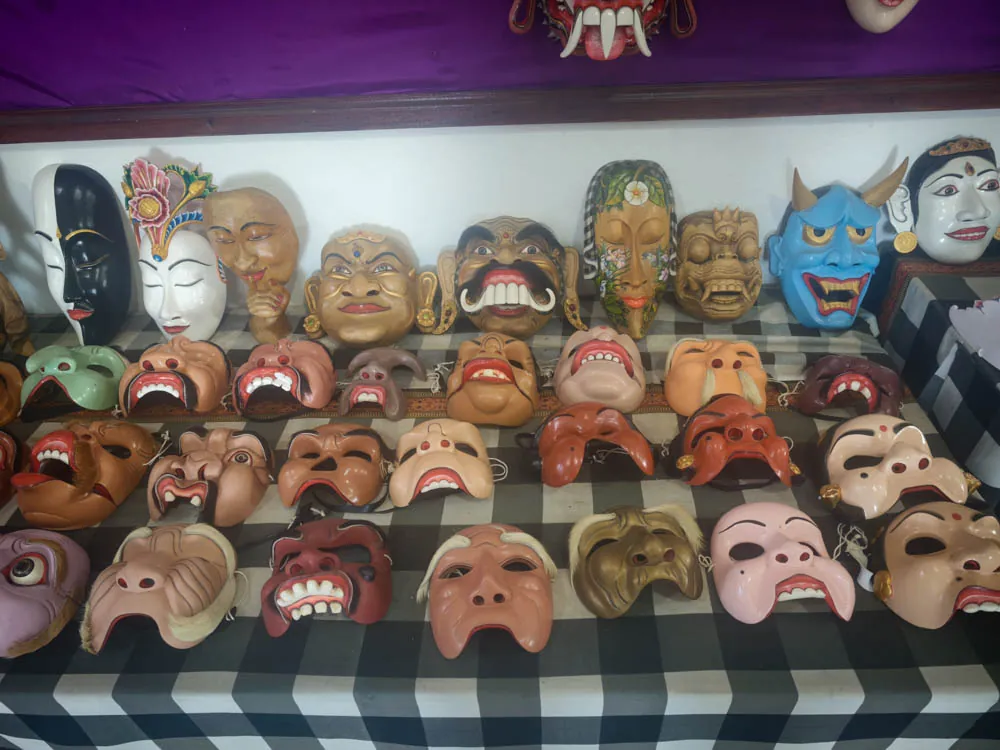
- Balinese mask painting with the same master carver, Komang
- Silversmithing: a 5-gram sterling silver piece designed with the artisans, gemstones extra
- Batik, the wax-resist dyeing of a cloth you take home
- Coconut candle making: a 200g candle blended from more than ten fragrances, customs-approved for the flight home
- Balinese cooking class with a floating lunch in the pool
- Jamu tonic making
- The Eat Pray Love temple journey to Pegulingan, Gunung Kawi and a water purification at Mengening Temple
- Sound healing at the Pyramids of Chi with Saraswati Temple and Ubud Palace
- Sacred waterfalls: Tibumana, Kanto Lampo and Tegenungan
- The Mount Batur sunrise trek, departing at 2:30am and rated 10/10 for physical effort; a favourite of my group
The two signature spa treatments I tried
Beyond the unlimited spa menu, Goddess Ubud offers a handful of longer, multi-step treatments that you choose as one of your experiences. Two of them were new to me: the Celestial Somatic Sleep Therapy and the Metabolic Booster.
Celestial Somatic Sleep Therapy
This is the treatment I had been most curious about: a 2.5-hour evening ritual, from 7:45pm to 10:15pm, that Goddess designs for burned-out nervous systems and schedules after dinner. My therapist, Dewi, led me through it in the retreat’s main spa. It starts in the Swedish sauna, followed by a mineral milk bath with Epsom salt and frangipani, which was simply divine. Next comes a red-light LED blanket on a warming mat, with an LED device over your face and a soothing scalp and temple massage at the same time. It ends with a full hour of Somatic Urut, a traditional Balinese massage done with extremely slow, heavy strokes along the back, neck and feet. The retreat says this follows the vagus nerve pathway and is meant to switch the body out of stress mode before sleep.
I’ll admit I was sceptical about the vagus nerve and mitochondria language. But I went straight to bed afterwards and slept deeply. By morning my Fitbit readiness score was 99, the highest it can go, with my HRV up to 40 ms. Whatever the mechanism, my body was convinced.
The Metabolic Booster
The Metabolic Booster is a three-hour session, 10am to 1pm, that Goddess designs for women dealing with burnout and hormonal change. Cici, my therapist, took me through it in four steps: contrast therapy, the 70°C Swedish sauna followed by the 3°C ice bath; the same divine Epsom-salt milk bath; a full-body mineral salt scrub finished with virgin coconut oil; the red-light cocoon, red light on a warming mat with an LED facial and a scalp and temple massage; then a lymphatic body massage and a chilled gua sha facial. Goddess’s idea is to clear the system first, then recharge it.
The effect was immediate. My skin has never felt so soft, and the heaviness and fluid retention I’d been carrying in my legs had started to ease by the evening.
INSIDER TIP
The schedule allows about 15 minutes for the sauna and ice bath, which I don’t think is enough. Go to the sauna 10 or 15 minutes before your treatment time.
Unlimited spa, really
Unlimited means unlimited, with one distinction worth knowing before you book. The basic spa menu, the Goddess Glow menu, is included on every package, as often as you like: massages (Balinese, hot stone, deep tissue, aroma, back, leg and foot), facials, scrubs and hair cream baths. A second, more sophisticated list, the Bliss menu, is included only on the Wellness and Healing programmes. If you’re on the Bali Goddess package, you choose your treatments from the basic menu, which is long enough to fill a week. The spa is open from 9am to 10pm on most days, from noon on arrival day and until 3pm on departure day. On my spa days I had a hot stone massage, a hair cream bath and a foot massage in a row; on another, a foot massage, a hair treatment and my first facial acupressure, a 30-minute treatment from the Body Bliss menu that works pressure points on the face to ease tension and lymphatic drainage. The standard of the therapists is consistently high, and two stood out: Dewi, who led my Celestial sleep ritual, and Cici, who took me through the Metabolic Booster. If you can, ask for either of them.
Floral baths are a Goddess signature, in the deep tubs of the spa rooms: rose, citrus, a sacred mandala bath with a ceremonial cacao drink, Cleopatra’s milk bath, an Ayurvedic herbal bath and the Bali Bliss bath with its homemade jamu. Healer sessions can be added to any package: an energy healer, a Balinese bodyworker from a priest lineage, a body-and-mind healer who combines deep tissue, acupuncture and cupping, and a colourpuncture pair, as well as the Tri Desna Melukat purification ceremony with a priestess. The healers are mostly the same in Ubud and Seminyak, Pak Hendra among them, and I describe my sessions with them in my Seminyak review of the Healing programme.
The food at Goddess Retreat Ubud
The food felt very organic, and it was: many of the ingredients come from the retreat’s own permaculture garden, the food forest you walk through on the way to the yoga shala. Everything was fresh and full of vegetables, and the cooking was mostly Indonesian. This is not spa food in the austere sense; it is proper Balinese and Indonesian home cooking, lightened with what the garden gives that week.
Breakfast, after morning yoga, is a buffet of fresh fruit, toast, juice and bacon, and you can order eggs cooked the way you like them. A special dish changes every day: avocado toast one morning, porridge or noodles the next. There is also a fresh juice of the day, and two things I came to look forward to: the shots of turmeric and ginger juice, and the shots of vinegar.
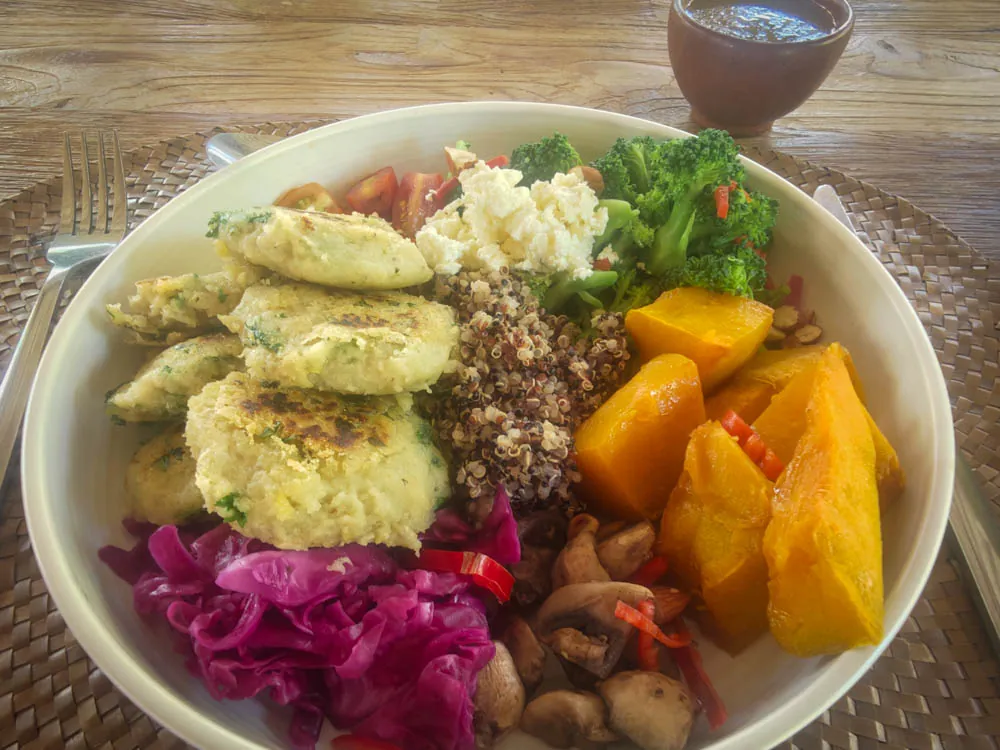
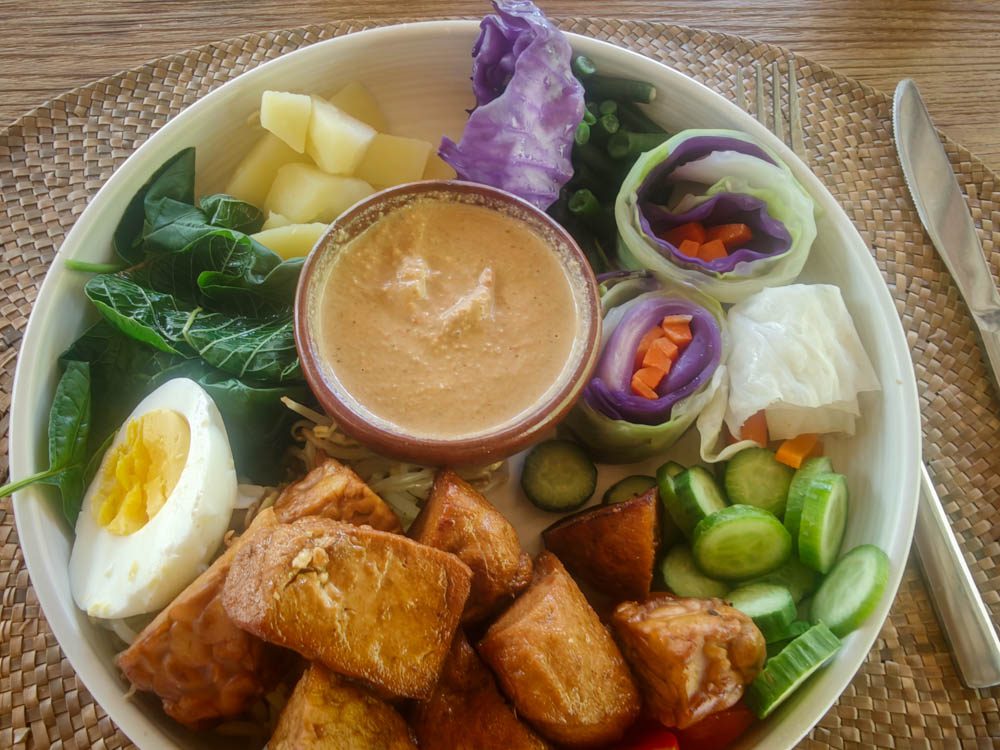
Lunch is served at 1pm every day. Mine were composed bowls and plates built around vegetables and grains: one day quinoa with fritters, roasted pumpkin, red cabbage and greens; another a gado-gado-style bowl of tofu, tempeh, a boiled egg, steamed greens and fresh rice-paper rolls, with a bowl of peanut sauce in the middle to pull it all together.
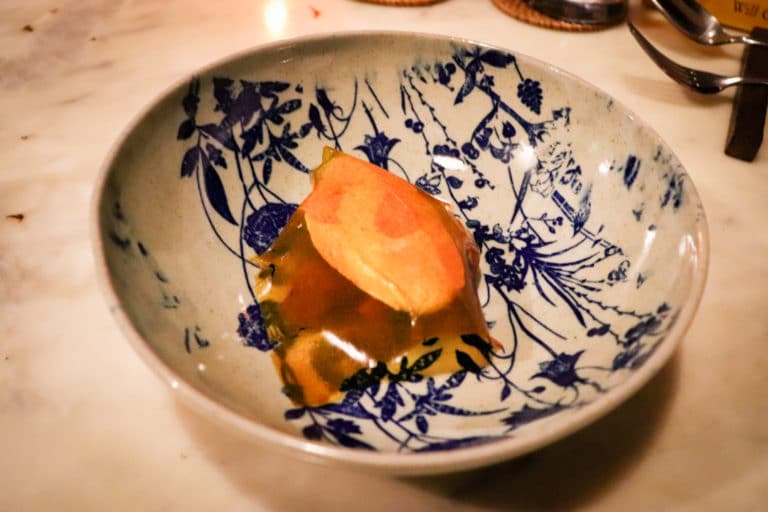
Dinners are themed, each one a tour of a different corner of the archipelago: a Welcome to Bali dinner of nasi uduk, serombotan, sayur lodeh and ayam bakar; a Spice of Island Life dinner of sate lilit fish and pepes ayam; a Flavours of Sumatra night of beef rendang and chicken satay; and a Sacred Rice dinner of ayam betutu, grilled prawns and jukut urab. The dishes come out buffet-style in carved wooden bowls on banana leaves, each with a small wooden label naming it, so you know what you are eating and can go back for more of it. One evening’s plate: red rice, tempeh, vegetables and a fresh sambal. The sate lilit, minced fish pressed around lemongrass stalks and grilled, is the dish to look out for.
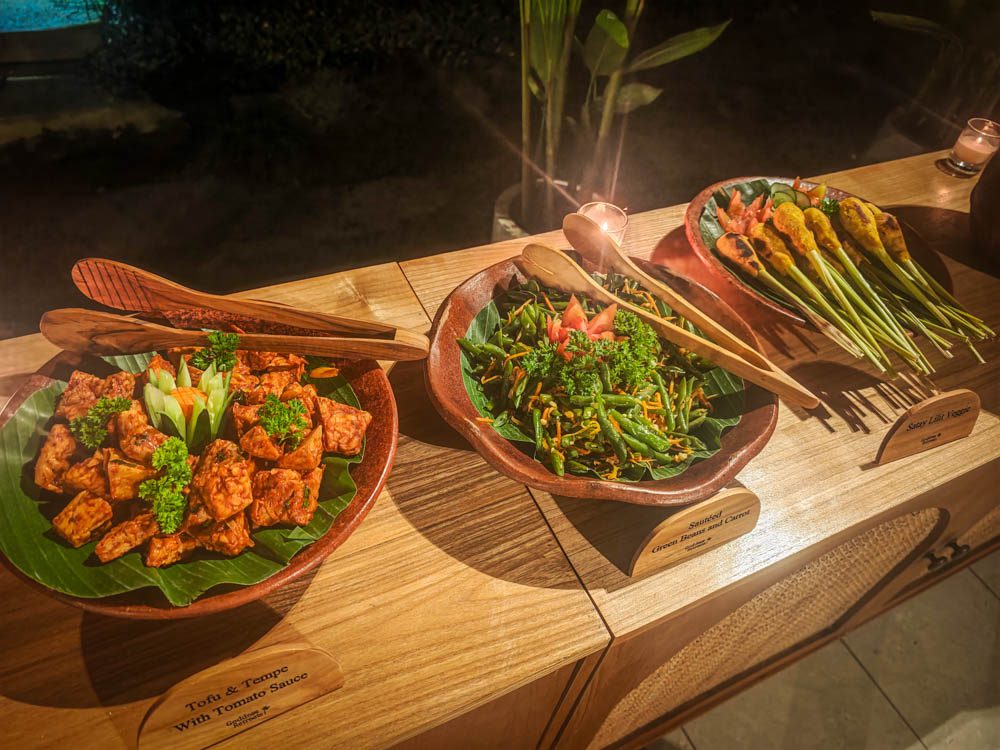
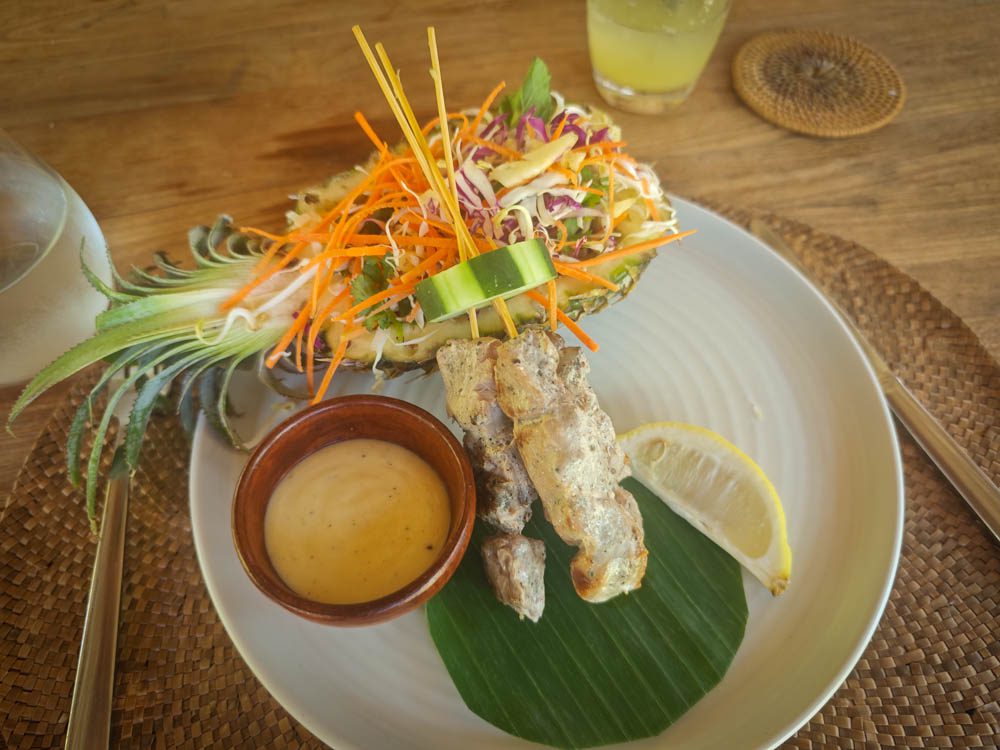
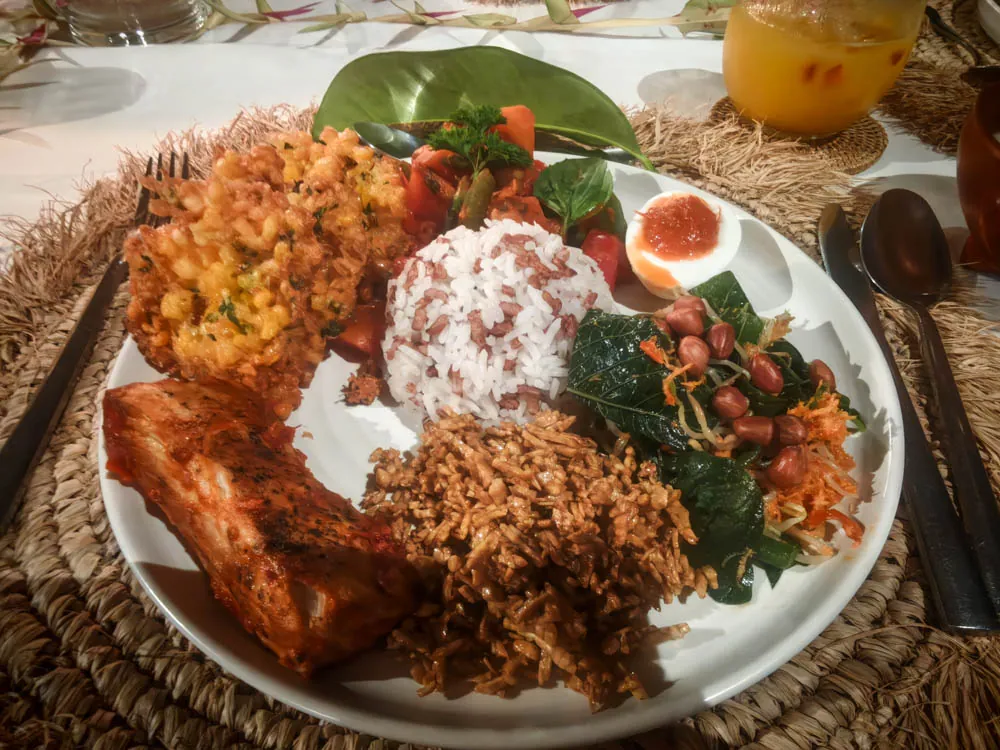
The kitchen is also remarkably proactive about food preferences and allergies, and every diet can be catered for. Whether you are gluten-free, vegan or simply don’t like something, the team adapts your plates without fuss, and the tailoring was as good as the cooking itself.
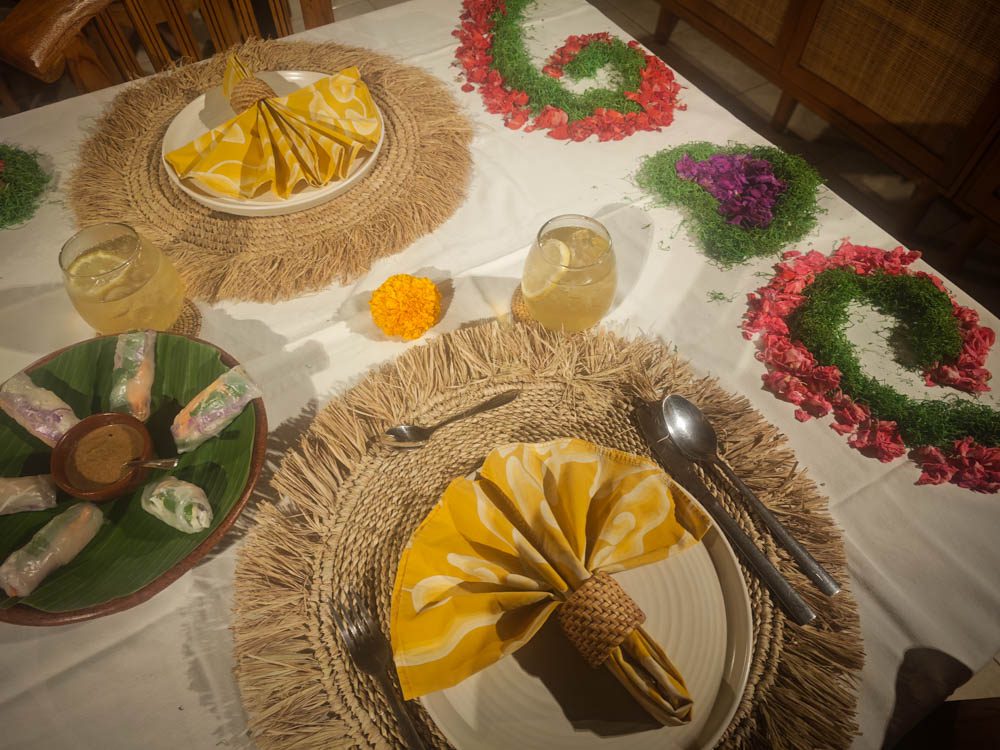
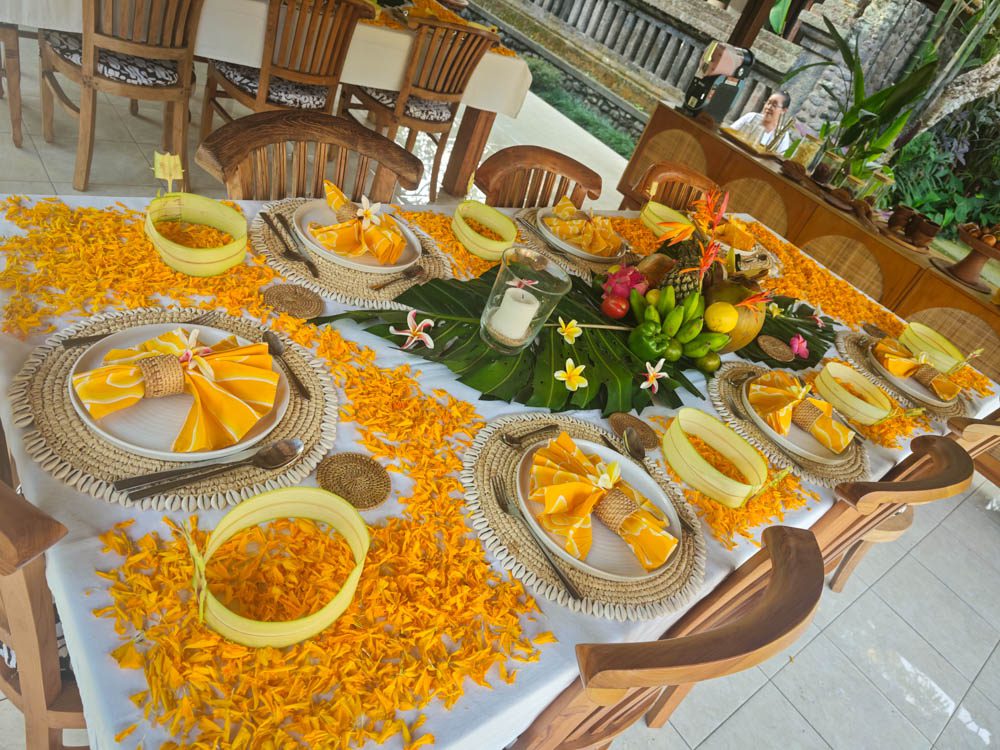
The table is dressed for the occasion. For the themed dinners the cloth was strewn with marigold petals, patterns of flower petals ran down the centre, and yellow napkins sat folded on woven rattan placemats, with fresh spring rolls and a dipping sauce waiting as a starter. It is a small thing, but it turns an ordinary dinner into the evening’s event, and the long table is where the group came together at the end of each day.
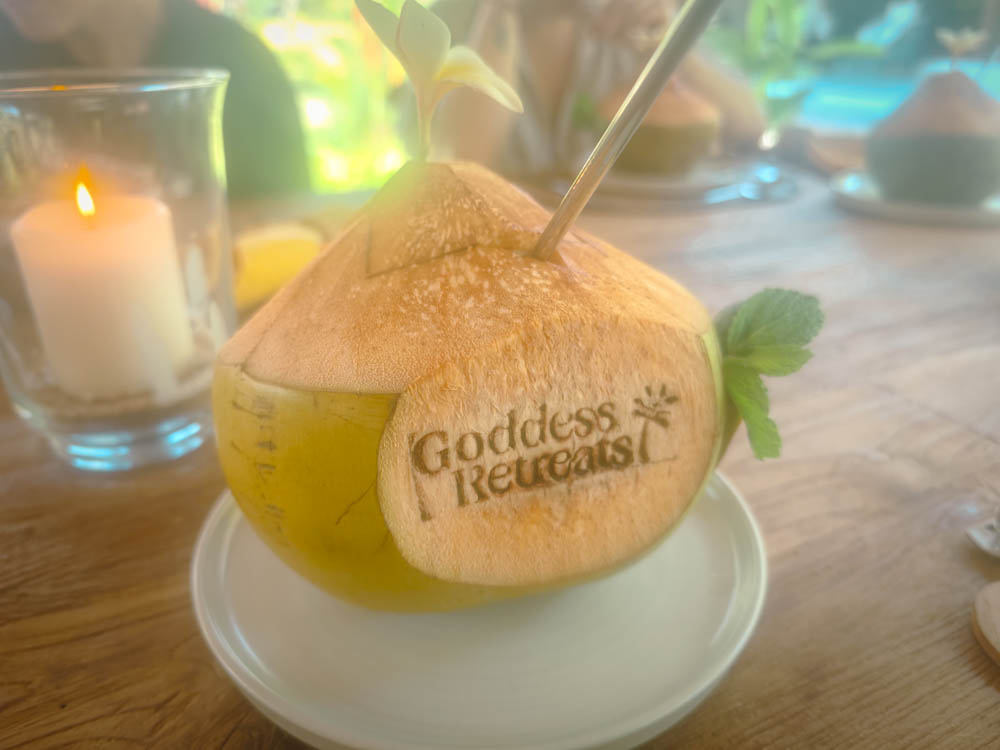
There is no alcohol at Goddess Retreats. Drinks are young coconuts, stamped with the Goddess logo and served with a straw, fresh fruit drinks like the one that greets you on arrival, and ceremonial cacao at the closing circle.
You will not go hungry between meals either. Snacks are always available, with vegetable crisps, cookies, tea and coffee laid out through the day, a slushie machine for a granita when the afternoon gets hot, and a different smoothie served every day at around 5pm.
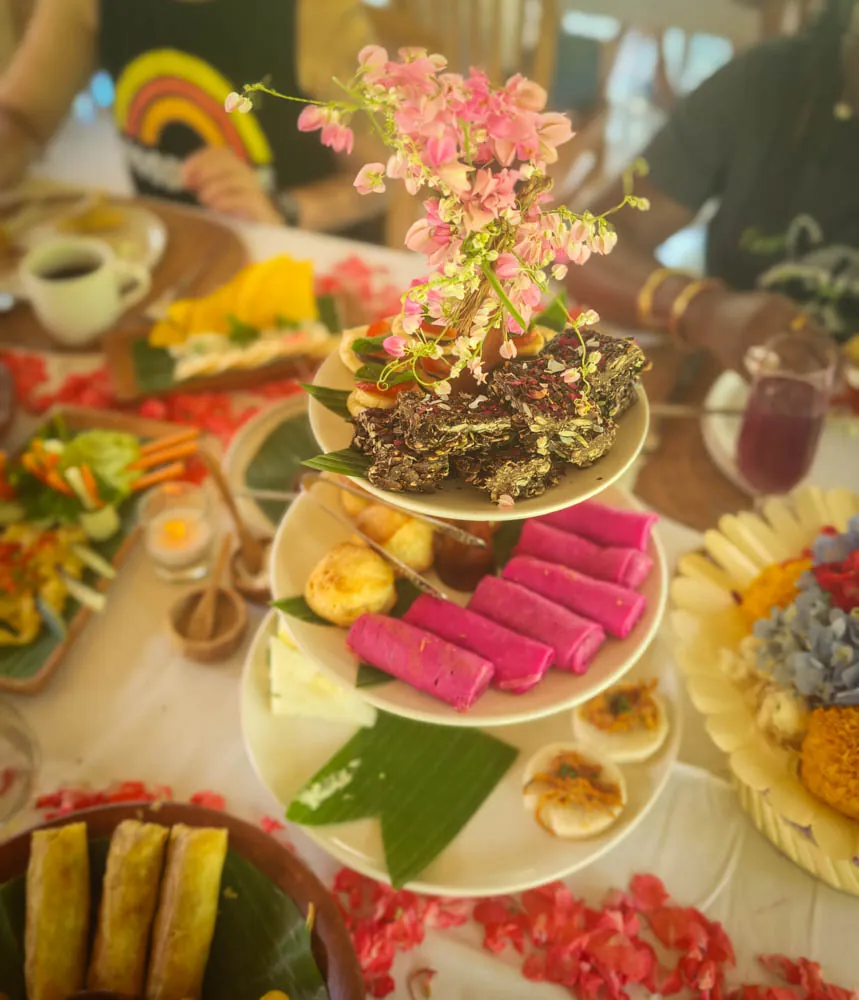
One dinner is left free so you can eat out in Ubud. On the Sunday the retreat drove the group into central Ubud for a shopping trip, followed by dinner at Uma Cucina, the Italian restaurant at the stylish COMO Uma Ubud; if you would rather choose your own table, my guide to the best restaurants in Ubud is a good place to start. On the last day, high tea replaces lunch: delicious, and a serious sugar high.
Smoking isn’t allowed in the retreat; there is a designated outdoor pavilion for those who want to smoke.
The closing circle
The last evening was the closing circle and cacao ceremony, and it was emotional. Everyone looked far more relaxed than on arrival, and the women who had come at significant points in their lives, through burnout, grief or separation, felt they had made real progress in a week. The themes were the same around the circle: letting go, feeling joy for the first time in a long time, finding their inner strength, reclaiming their power. It was remarkable how close a group of strangers can become once they relax and let their guard down. Many of the women were more open with people they had met six days earlier than with their own friends and family.
Ceremonial cacao was served, and the circle ended with a letting-go ceremony. We wrote what we wanted to leave behind on a piece of paper and burned it in a fire at the centre of the group. The last dinner was festive.
On the final morning there was time for a few more spa treatments and a last swim before the farewell high tea and a 3pm checkout.
INSIDER TIP
If you stay in Bali a few days after the retreat, keep your plans flexible. Don’t book too much in advance, because you may well want to travel with your new friends from the retreat.
Did my nervous system actually reset? What my heart-rate data showed
The internet now sells “nervous system resets” in every format, from vagus-nerve gadgets to ice baths. A Guardian investigation published while I was here, on 2 October 2026, takes a more useful view: the goal isn’t to switch your nervous system off but to make it flexible, able to rise to a challenge and then come back down. The habits its experts recommend are simple: slow breathing, yoga and meditation, massage, time in nature, and a calm, regular routine. This is where a Goddess Retreat comes in. A week there is built almost entirely from those habits, and it gives your nervous system the time and the conditions to come down.
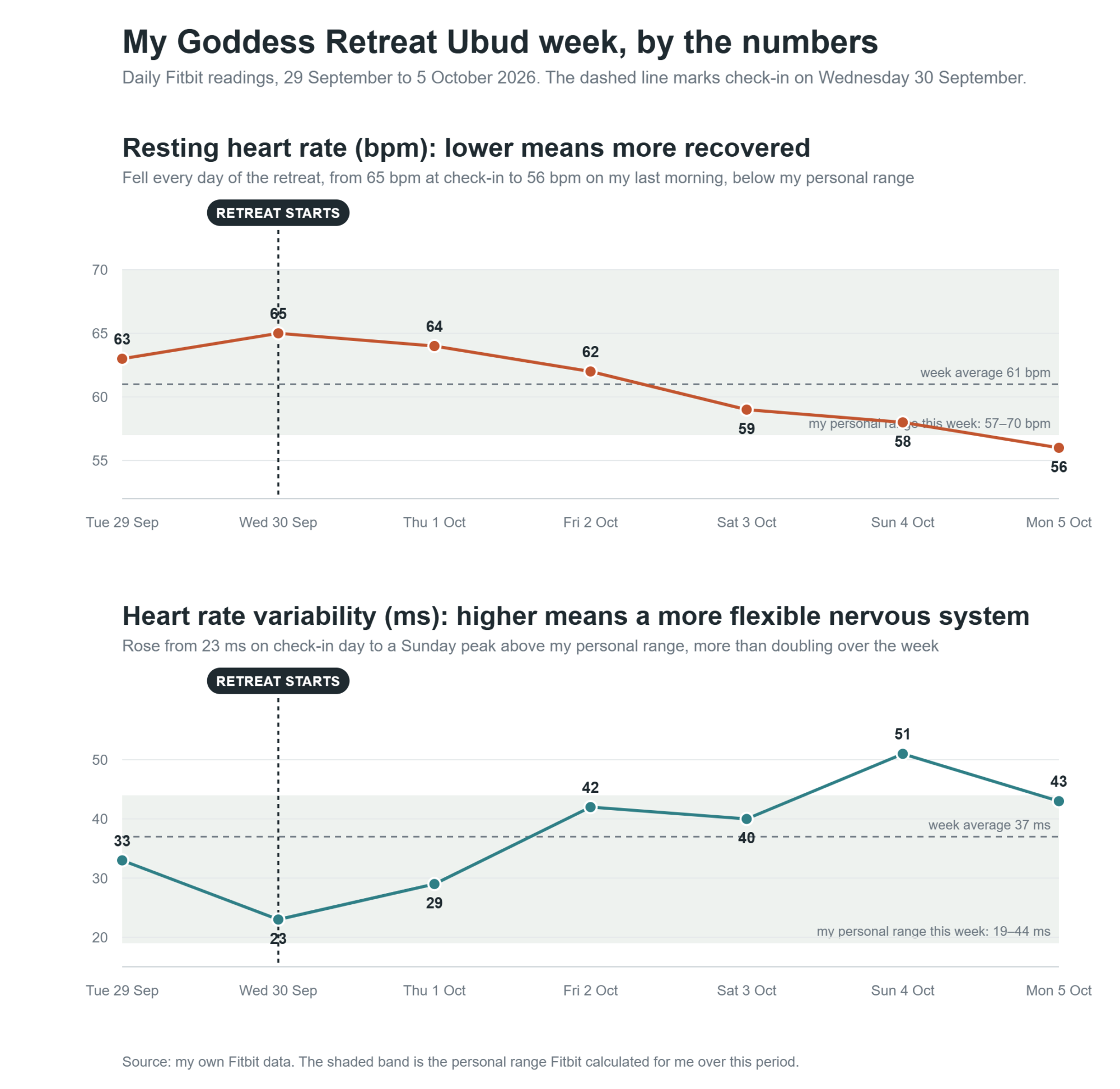
Two numbers show that shift. Heart rate variability (HRV) measures the small variations in time between heartbeats; a higher HRV means your body is switching easily between effort and recovery, which is what a resilient nervous system does, while chronic stress drives it down. Resting heart rate works the other way: a lower resting heart rate means your heart is working less hard at rest, a sign of better recovery and lower stress load. Both are worth watching because they change within days, long before you notice the difference yourself. I tracked mine all week. On the morning I arrived, after my last night at home, my HRV was 23 ms and my resting heart rate 65 bpm. Three nights later my HRV had risen to 40 ms, a 74% jump, and on the Sunday it peaked above the top of my personal range. On the Saturday morning, after the Celestial sleep ritual, my Fitbit readiness score read 99, the highest it can go. My resting heart rate kept falling every day of the retreat, and on my last morning it was 56 bpm, nine beats lower than when I arrived and the lowest reading of my whole month. Fitbit flagged it as below my personal range. I didn’t need the app to tell me, though: I could feel it.
The infographic below, built from Fitbit’s weekly view from the day before I arrived to my last full day, tells the same story. My resting heart rate slid almost every day of the retreat and averaged 61 bpm for the week, while my HRV climbed from its low on arrival day to a peak on the Sunday, well above the top of my personal range, and averaged 37 ms.
How much does Goddess Retreat Ubud cost?
An Ubud week is seven days, all-inclusive. The Bali Goddess package starts from US$2,499 per person in a shared twin room, with private rooms from US$2,599; the Healing Goddess package, which adds the Bliss spa menu and the healing treatments, from US$2,899 in a shared twin room and US$2,999 in a private room. Private pool villa rooms cost more, and Gaia, my private-pool room, sits near the top of the range. Every package includes accommodation, 16 meals, daily yoga, unlimited spa treatments, airport or hotel transfers between 8am and 3pm on the first and last days, your three or four chosen experiences and the ceremonies. Not included: the one leisure dinner, extra experiences at around US$70 to US$120 each, extras such as gemstones for your silver piece, healer sessions at US$125 to US$150, floral baths at US$50 (or US$110 for three) on packages that don’t include them, the Melukat ceremony at US$150, and shop purchases such as the aromatherapy rollers at IDR 350,000 each. Checkout is 3pm on the final day, and an onward transfer to the south costs IDR 650,000 to 850,000. Goddess asks for a US$900 deposit, with the balance payable in instalments, and lets you change dates up to 90 days before arrival. Tipping is optional; the hostesses suggested US$200 to US$250 per person for the week. Dates run year-round and the popular weeks sell out months ahead. The full Creative Goddess and Longevity Goddess retreats run at the Seminyak sanctuary; I cover them, with their prices, in my Seminyak review.
Who should book, and who shouldn’t
Book Goddess Retreat Ubud if you need a week of genuine rest in nature, with unlimited spa and a programme that bends around you. Fill it with the creative workshops, as I did, if you want to come home with something you made and a hobby you’d forgotten you loved, and you’d rather be absorbed in a chisel or a brush than in a screen. Skip it if you want a party week or a strict detox.
Verdict: why a Goddess week works
Burnout was the quiet theme of my week. Around the opening circle, woman after woman described the same exhaustion: years of demanding work, a divorce, grief, five children to care for. Some had arrived running on empty. Others had simply come to enjoy Bali and the spa, and the retreat suits them just as well. That is the cleverness of the Goddess formula: nineteen women follow the same retreat, but no two follow the same programme, and everyone sets her own pace.
What they share is permission to stop. For one week, nobody needs anything from you. The meals appear, the decisions are made, a driver waits with a cold towel, and your only job is to notice how you feel. By the last evening the change was visible in every face in the circle.
What I took home: a renewed love of creativity, because I didn’t expect to enjoy painting and carving this much; total relaxation, with the numbers to prove it; and, after a week of facials, hair masks and body scrubs, a lighter, less inflamed body and skin that feels new.
Goddess Retreats has been refining this recipe since 2003, and twenty-three years of practice shows. Whether you need a genuine break from burnout or simply a beautiful, well-looked-after week in Bali among other women, there is a version of this week that fits you. It isn’t hard to see why so many guests come back, myself included, or why weeks keep filling up months in advance.
How to book Goddess Retreat Ubud
Goddess Retreats sells its weeks directly. The Ubud sanctuary page on the Goddess Retreats website sets out the packages available in Ubud, and you can check dates and reserve on the Goddess Retreats booking page. Prices for each package are in the cost section above.
Spend more time in Bali
I also recommend spending more time in Bali, before or after your week. You leave the retreat rested and in no hurry, which is exactly the right state to explore the island. A few ideas from my other Bali articles:
- Stay on in Ubud: my Capella Ubud review, the best restaurants in Ubud and my review of Syrco BASÈ.
- Time your trip with a festival: my Bali Spirit Festival guide and the Ubud Writers and Readers Festival.
- Head to the beach: my Oberoi Seminyak review and Four Seasons Jimbaran vs Six Senses Uluwatu.
- Go under water: diving in Bali, region by region and a liveaboard from Bali to Komodo.
- Explore the uncrowded north: North Bali is the island before the crowds, with black-sand beaches, dolphins at dawn and quiet reefs. Stay at Villa Seaview, a seafront villa with an infinity pool in Bukti, then pick from the best North Bali waterfalls, the best restaurants in Lovina, fishing on the north coast, a day in Singaraja, the old capital and West Bali National Park and Menjangan Island.
- Compare the two sanctuaries: my Goddess Retreat Seminyak review.
FAQ
What is the difference between Goddess Retreats Ubud and Seminyak?
Ubud is rural, among rice fields with a jungle shala, a nicer spa, more upscale rooms and permaculture gardens, and runs the Bali, Wellness and Healing Goddess packages. Seminyak has a more urban vibe, is close to the ocean and runs the widest choice of programmes, including the full Creative, Longevity, Fitness, Pilates and Surf retreats. Choose Ubud for spa, wellness, nature and creativity. I’ve stayed at both; my Seminyak review covers the Healing programme there.
Is Goddess Retreat Ubud a good retreat for burnout?
Yes, and burnout was the most common reason the women in my week had come. The programme is built from the habits that help a stressed nervous system come down: slow yoga, massage, time in nature and a calm routine, with nothing you have to attend. My own resting heart rate fell from 65 to 56 bpm over the week and my HRV rose from 23 to 40 ms.
Is Goddess Retreat Ubud the best women’s wellness retreat in Bali?
It is the one I would choose for a wellness and spa week, having stayed at both Goddess sanctuaries. What sets it apart from other women’s retreats in Bali is unlimited spa treatments included in the price, a programme rebuilt around you every evening, and a rural Ubud setting with a better spa and more upscale rooms than its Seminyak sister.
Can I do the creative workshops at Goddess Retreat Ubud?
Yes. Wood carving and mask painting with master carver Komang, canvas painting with a master artist, silversmithing, batik, perfume making and candle making are all on the Ubud menu, and you choose them as your experiences on the Bali Goddess or Wellness Goddess package. The full Creative Goddess Retreat, with three workshops at the core of the week, runs in Seminyak.
What is included in a Goddess Retreat Ubud week?
Seven days, three or four experiences of your choice depending on the package, daily yoga and breathwork, 16 meals, unlimited spa treatments, sauna and ice plunge, a canang sari workshop, fire and cacao ceremonies, a Nature to Table permaculture tour, a shopping trip and transfers.
Do I need to be artistic to join an art retreat in Bali?
No. I hadn’t painted since I was 15. The master artisans sketch the outline for you, help with the hard parts and let you do the rest.
Can I have the Celestial Sleep Therapy and the Metabolic Booster in Ubud?
Yes. Both are on the Ubud Healing Goddess menu, and I had both there. The full Longevity Goddess Retreat, with its Contrast Therapy Suite, runs in Seminyak.
Is it suitable for solo travellers?
Most guests come alone. Of the 19 women in my week, nearly all had travelled solo; two best friends had come together, and so had two sisters. By day three the group felt like old friends.
Is there alcohol at Goddess Retreat?
No. The retreat doesn’t serve alcohol, and smoking is only allowed in a designated outdoor pavilion.
Who runs the workshops?
Local master artisans: Komang, a renowned mask carver who teaches in his home studio in Mas, for wood carving and mask painting; Sila, a master painter, for canvas painting; Balinese silversmiths and batik artists for those crafts.
This article contains affiliate links. If you book through them, I may earn a small commission at no extra cost to you.
Every review on This is Luxury Travel is written from a stay I have actually taken. Read more about how I review or visit my Work With Me page.