The short answer: if you want the biggest animals with the least effort, book a Maldives liveaboard; if you want the most diverse diving of your life, big animals plus stunning hard coral plus a critter list that runs to pages, and don’t mind a 4-knot current or 24°C water, go to Komodo. On a good week in the Maldives I have counted more than 100 grey reef sharks in a single channel at Kandooma Thila and 50-plus nurse sharks under the boat lights at Alimatha, all inside a rule-book that caps every dive at 30 metres and 60 minutes. In Komodo I have hooked onto Castle Rock in a current strong enough to tear a mask off, watched 30 mantas feed at Manta Alley and spent 70 minutes photographing nudibranchs in a volcanic bubble field at Sangean, sometimes all in the same week. That range is the point: the Maldives does one thing, big pelagic action in blue water, better than almost anywhere, while Komodo does big stuff, reef and macro on the same trip. Budget-wise the two are closer than people assume: a high-end Komodo liveaboard runs roughly USD 500–600 per person per night , and a Maldives central-atolls week on a boat such as Blue Force 3 lists at roughly USD 1,690–2,390 per person plus taxes . The real difference is the resort side: a decent overwater villa in the Maldives starts around USD 500 a night before the 23 percent tax and service, while Komodo’s best hotel, the AYANA, starts around USD 350–500 .
Maldives vs Komodo at a Glance
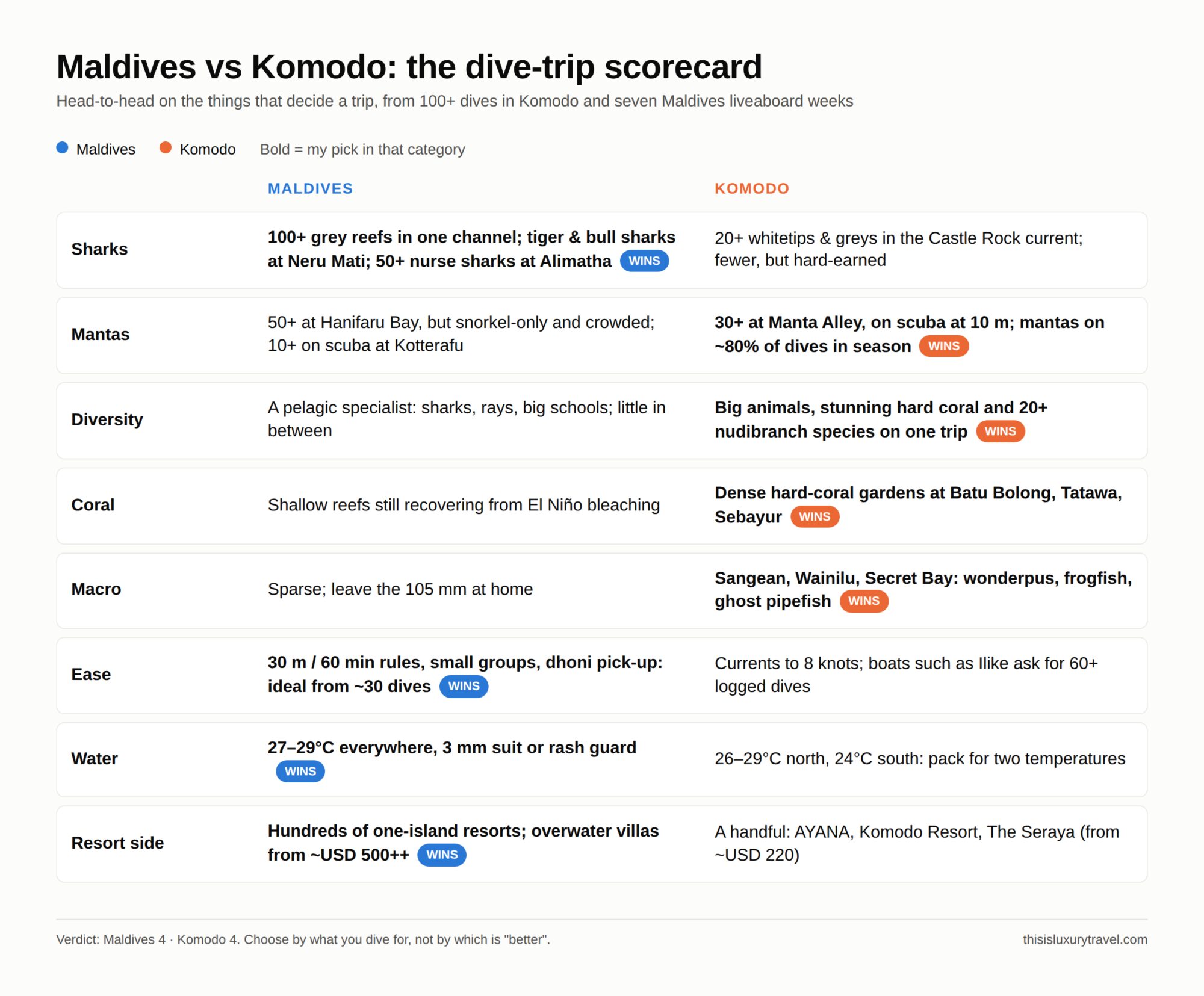
| Maldives | Komodo | |
|---|---|---|
| Signature encounter | Channel sharks in the hundreds, nurse sharks at night, mantas at cleaning stations | Mantas at Manta Alley and Makassar, sharks in current at Castle Rock, Komodo dragons on land |
| Diversity | Wide-angle destination: sharks, rays, mantas, big schools; little in between | The full spectrum on one trip: pelagics, dense hard-coral gardens, and nudibranchs and critters by the dozen |
| Currents | Strong in the kandus (channels), timed to tides, reef hook mandatory | Some of the strongest in the world, up to 8 knots at peak; reef hook and drift experience essential |
| Water temperature | 27–29°C year-round, 3 mm suit or rash guard | 26–29°C in the north, down to 24°C in the south; 5 mm suit for the south |
| Depth and time rules | Government limit 30 m, 60 minutes or 50 bar | No national depth cap; Batu Bolong drops to 90 m, 60 minutes standard on most boats |
| Macro | Sparse: I saw few nudibranchs or critters on any of my Maldives liveaboards | Excellent: Sangean, Wainilu and Secret Bay muck dives |
| Coral | Shallow reefs still recovering from El Niño bleaching | Healthier hard coral, red anthias clouds at Batu Bolong |
| Whale sharks | Year-round juveniles at South Ari, roughly a 50 percent chance on a search dive | Not inside the park; Saleh Bay (Sumbawa) on Bali–Komodo crossings |
| Nitrox | USD 50–100 per week, free on Duke of York | USD 15 per day on Tiare, USD 20 on Sea Dragon, none on Moana |
| Best months | Dec–Apr for visibility, Aug–Sep for Hanifaru mantas | Apr–Nov dry season, Dec–Feb for peak mantas (lower visibility) |
| Gateway | Malé (MLE), seaplane or domestic hop to the atolls | Labuan Bajo (LBJ), one hour from Bali |
| Resort options | Hundreds of one-island-one-resort properties, overwater villas from USD 500++ | A handful: AYANA Komodo, Komodo Resort, The Seraya |
| Extras and taxes | Green tax and fees of roughly EUR 300 per week per person on my Blueforce One trip | Park contribution around EUR 150 per guest per cruise (2026, Moana) |
Why Trust This Comparison
I have been diving Komodo since 2006 and have logged more than 100 dives inside the national park across 20 trips, on liveaboards including Tiare, Moana, Komodo Sea Dragon, Ilike, Carpe Diem and Scubaspa Zen, and from land at Komodo Resort on Sebayur, the AYANA at Waecicu Beach and The Seraya. In the Maldives I have completed seven liveaboard cruises, on White Pearl, Scubaspa Ying and Yin, Blueforce One, Duke of York and EcoPro Seascape, covering the central atolls, the far north from Baa to Lhaviyani, and the Vaavu and Meemu channels, plus resort stays such as Maafushivaru in South Ari. Every dive site named below is one I have dived myself, and every rate quoted comes from my own trips or from the operators’ published pages, dated where it matters. I hold 1,500-plus logged dives across 135 countries, and I have paid for a lot of nitrox.
The Diving: Big Animals, Currents and Rules
Before the head-to-head, one framing point. The Maldives is a specialist: it does blue-water pelagic diving, sharks in the channels, mantas at the cleaning stations and eagle rays in squadrons, and it does very little else. Komodo is a generalist that happens to be brilliant at everything: on my Ilike trip I logged 21 sites in nine nights and the logbook runs from 20-plus sharks at Castle Rock to two schools of jacks in the thousands at Tatawa Kecil, dense hard-coral gardens at Batu Bolong and Sebayur, and more than 20 nudibranch species, a wonderpus and ornate ghost pipefish in the muck at Wainilu. If you want one destination that shows a diver the whole reef, from a 4-metre manta to a 4-millimetre nudibranch, Komodo is that destination; the Maldives is where you go when you only want the big end.
Sharks
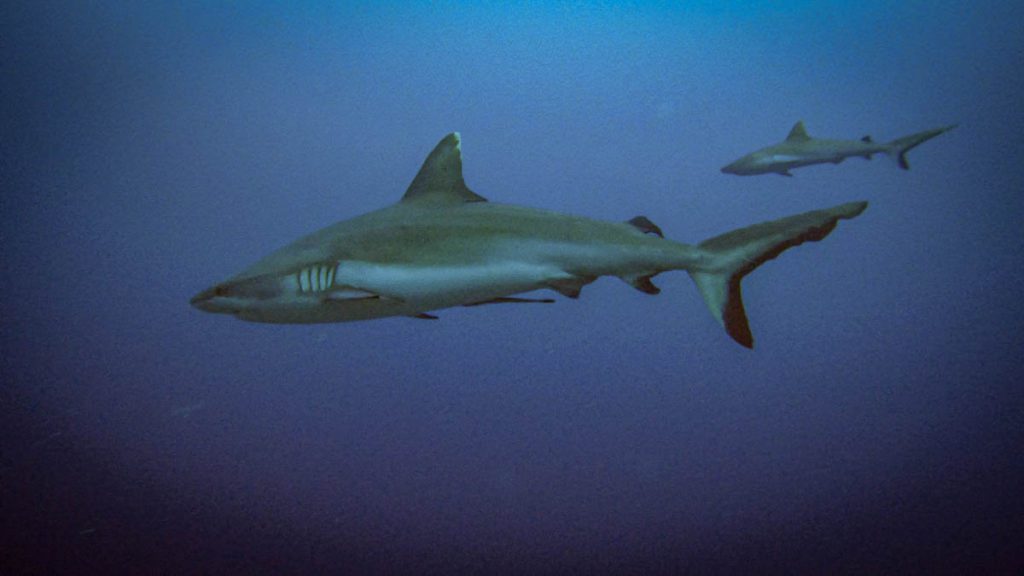
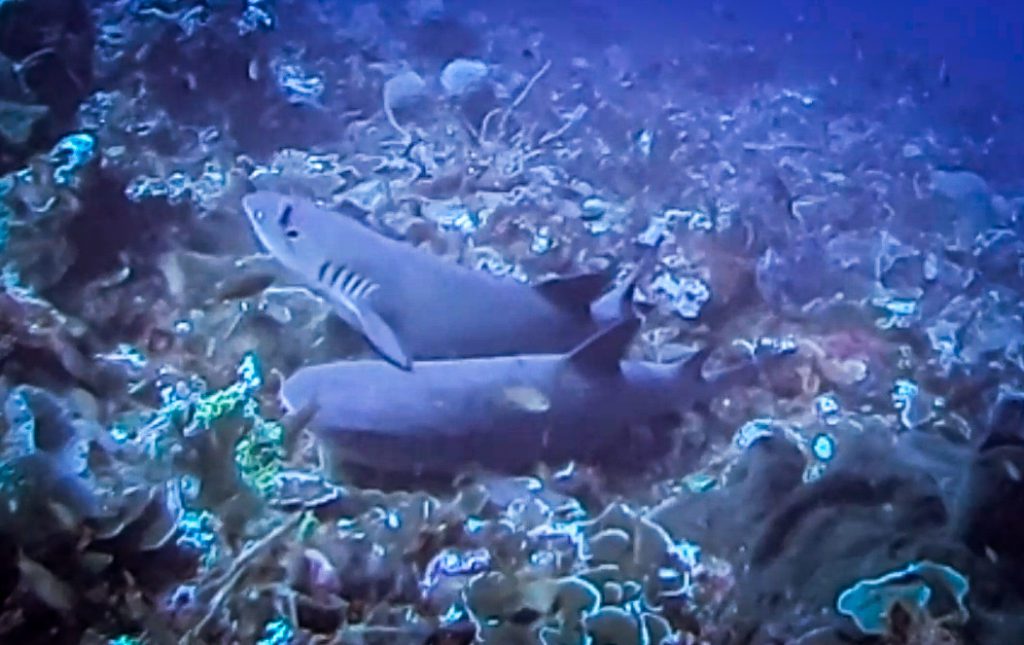
The Maldives wins on sheer shark numbers, and it is not close. At Kandooma Thila in South Malé Atoll I counted more than 30 grey reef sharks hanging in the current on my Scubaspa Ying cruise, and on the Duke of York the final dive at the same thila produced 70-plus sharks and 40-plus eagle rays in one 60-minute window. Miyaru Kandu in Vaavu gave me 50-plus grey reefs, and on my EcoPro Seascape ten-day itinerary in December 2025 I finally logged my first Maldives hammerhead at Fotteyo Kandu and a leopard shark, neither of which I had seen in the country in five previous cruises. The check dive at Neru Mati on my White Pearl cruise in August 2024 produced tiger sharks, bull sharks, spinner sharks, oceanic blacktips and around 20 stingrays in a single immersion, which is a species list Komodo simply cannot match. The night dive at Alimatha Pier is a Maldives institution: more than 50 nurse sharks circling under the boat lights, with blacktips and stingrays weaving through them.
Komodo’s sharks are fewer but the setting is more dramatic. Castle Rock and Crystal Rock in the north sit in open water where the current runs like a river; on my Ilike cruise we counted more than 20 whitetips and grey reefs at Castle Rock in a current I can only describe as ferocious. Batu Bolong, a pinnacle that drops to 90 metres in the channel between Komodo and Tatawa, is where I once watched sharks mating among clouds of red anthias, and it is the one site in the park that now requires a permit and has a fatality record that every briefing should mention. You will not see a hundred sharks in Komodo, but the ones you see are working hard against the flow, and so are you.
Mantas
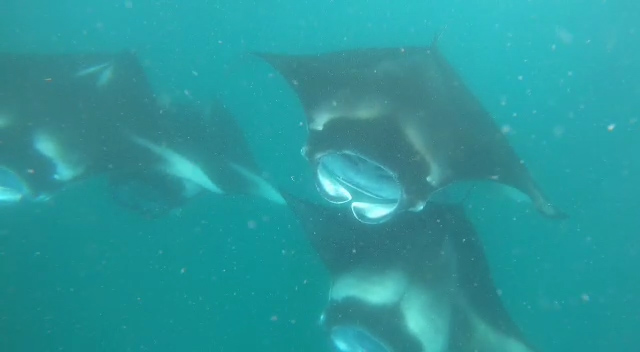
Both destinations are world-class for reef mantas, and the difference is style. In Komodo the encounters are on scuba, shallow and long. Makassar Reef and Mawan sit at around 10 metres, and on a good day the mantas come within touching distance; from Komodo Resort I once counted more than 20 at the Manta Point and eight at Mawan on consecutive dives, and on my Komodo Sea Dragon trip a school of 10 mantas swam straight at our group off Pink Beach. Manta Alley in the cold south is the big one: on one southern trip the krill was so thick it ruined visibility, and there were more than 30 mantas on the site. Across my Komodo logbooks mantas appear on roughly 80 percent of dives in season.
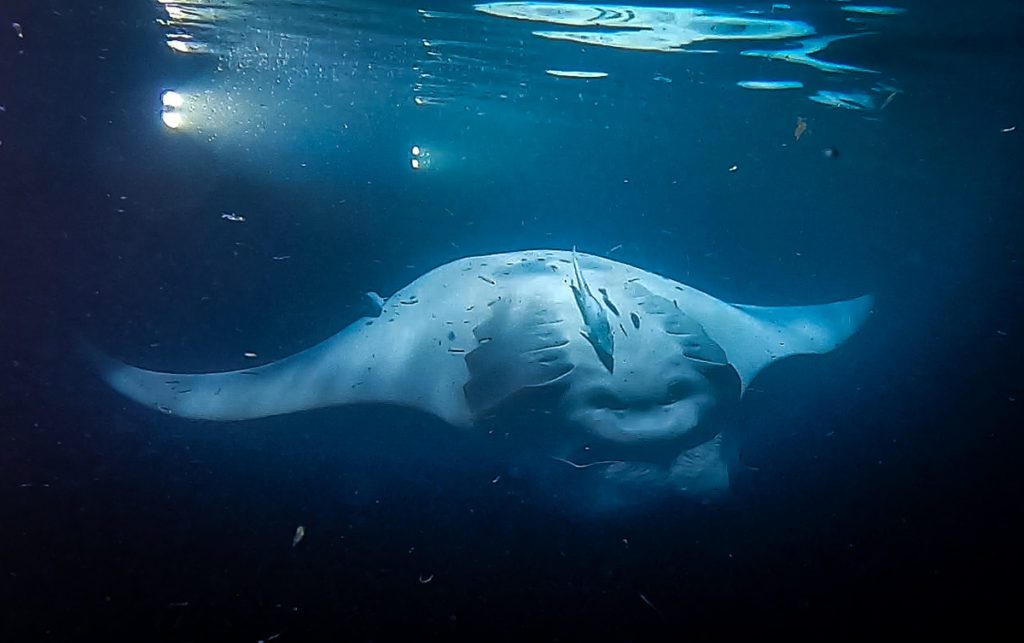
In the Maldives the mantas are a snorkel spectacle first and a dive second. Hanifaru Bay in Baa Atoll, which I visited from the Scubaspa Yin far-north itinerary, is snorkel-only with a USD 30 permit, and I counted more than 50 mantas feeding in the bay, but I also got hit by several fins in a crowd of boats. On scuba, Kotterafu manta point in Baa gave me 10-plus mantas on the first dive of the trip, Lankan Manta Point in North Malé and Kurali in Meemu delivered three each, and the Fesdu manta night dive on Blueforce One, where mantas feed in the beam of the boat’s lights, is one of the strangest and best dives in the country. The catch: mantas were absent at Makassar on my first Ilike dive and at Kudarah Thila most mornings, so neither destination guarantees anything.
Currents and Skill Level
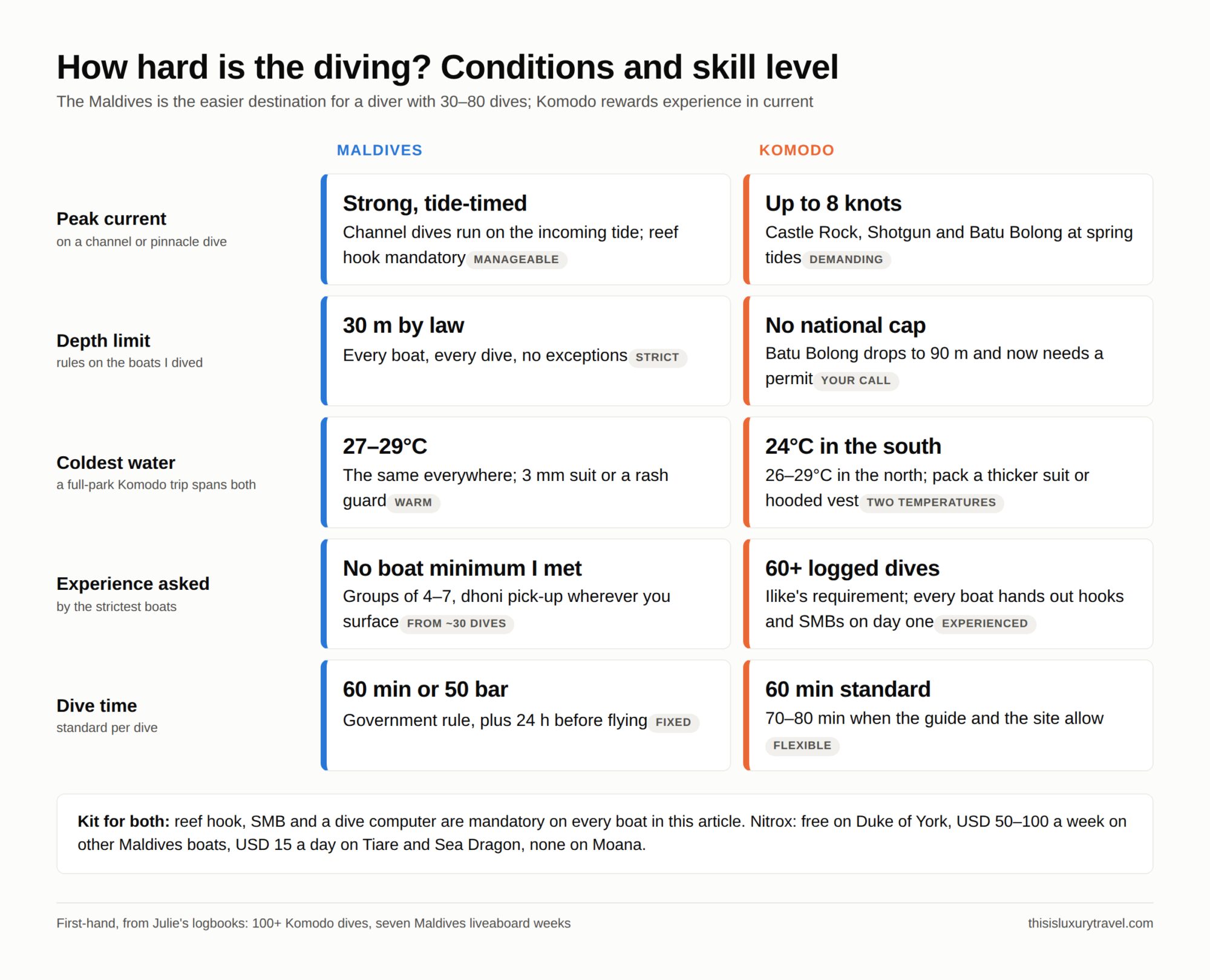
This is the section that should decide it for most divers. Komodo sits in the bottleneck between the Indian Ocean and the Pacific, and the tidal exchange through the straits can hit 8 knots at full and new moon. Every guide I have dived with in Komodo hands out reef hooks and SMBs on day one, and boats such as Ilike require 60 logged dives before they will take you. The Cauldron, nicknamed Shotgun, fires you through a gap in the reef on the incoming tide; it is exhilarating and it is not for a diver still fighting their buoyancy. I would not do an Open Water course in Komodo, and I say that as someone who loves the place.
The Maldives has real current too, especially in the kandus of Vaavu and Meemu where the channel dives are timed to the incoming tide and a hook is mandatory, but the framework around it is gentler. The government caps every dive at 30 metres and boats enforce 60 minutes or 50 bar, guides run groups of four to seven, and the dhoni picks you up wherever you surface. Experienced divers find the rules frustrating (I do), but they make the Maldives the better choice for a diver with 30 to 80 dives who wants big fish without the Komodo learning curve.
Water Temperature, Visibility and Coral
The Maldives is warm everywhere: 27 to 29°C on every one of my trips, a 3 mm suit or even a rash guard. Komodo is two destinations in one. The north around Castle Rock and Tatawa runs 28 to 29°C, but the south at Manta Alley, Cannibal Rock and Three Sisters drops to 24°C, and on Tiare the south felt like a different ocean: at 24°C you want a 5 mm wetsuit.
Visibility is a wash. Maldives channel dives in the south-west monsoon (May to November) can be green and dirty; at Orisma in Raa I called it horrendous, and Kandooma, Fishhead and Bathalaa were all poor in August. Komodo’s north is clear from May to October, while the south and centre lose visibility from November to February when the plankton that feeds the mantas rolls in.
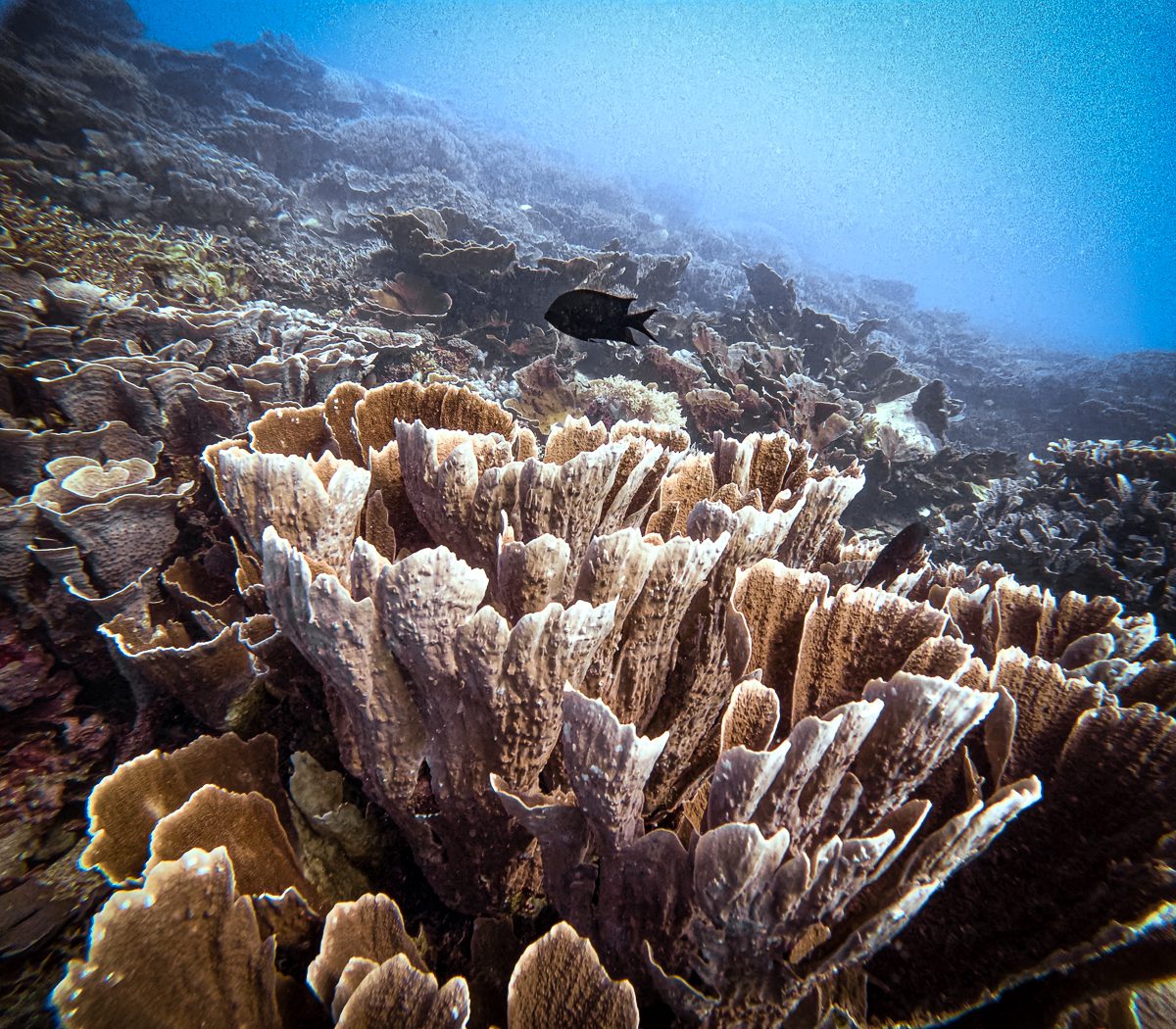
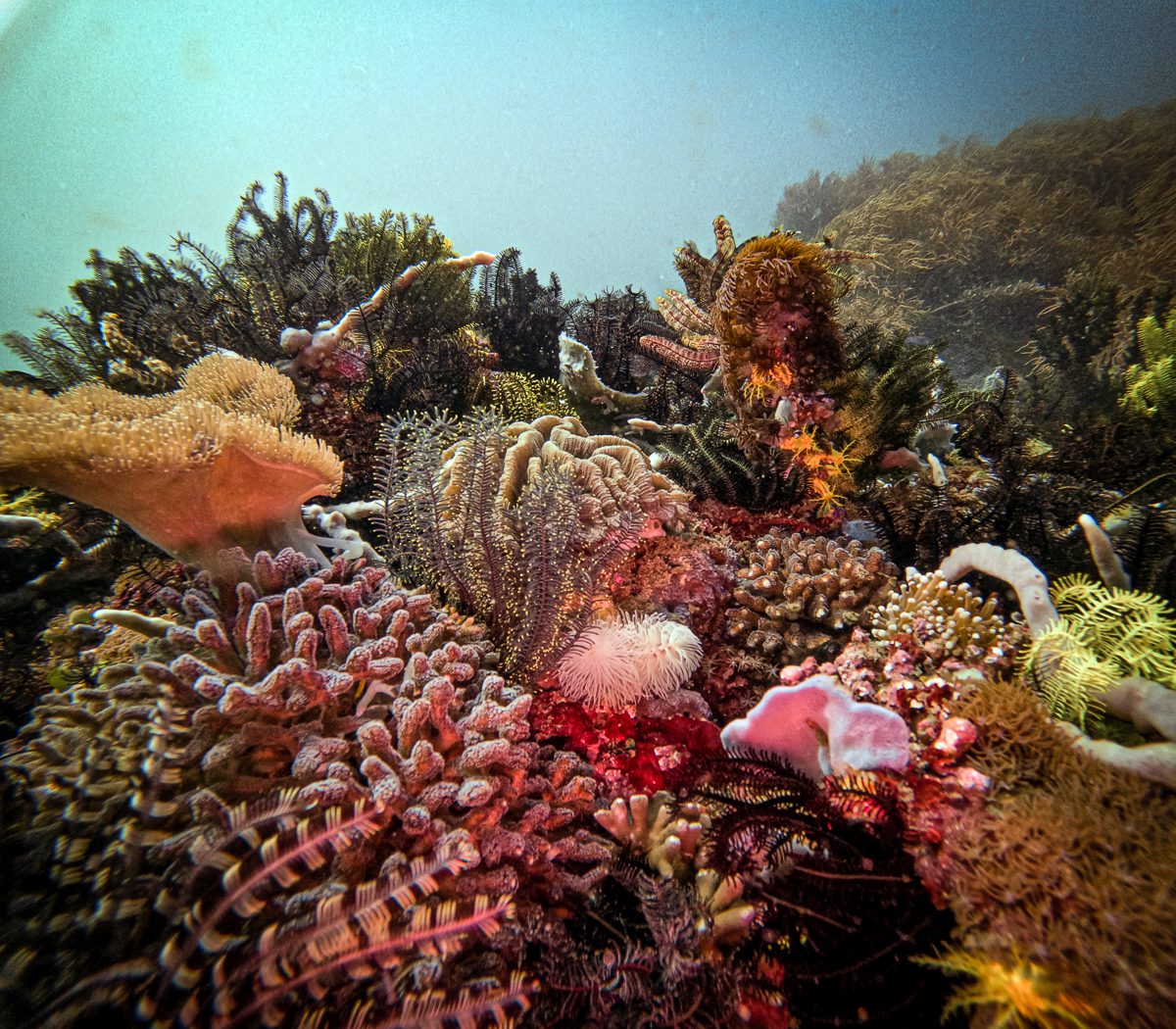
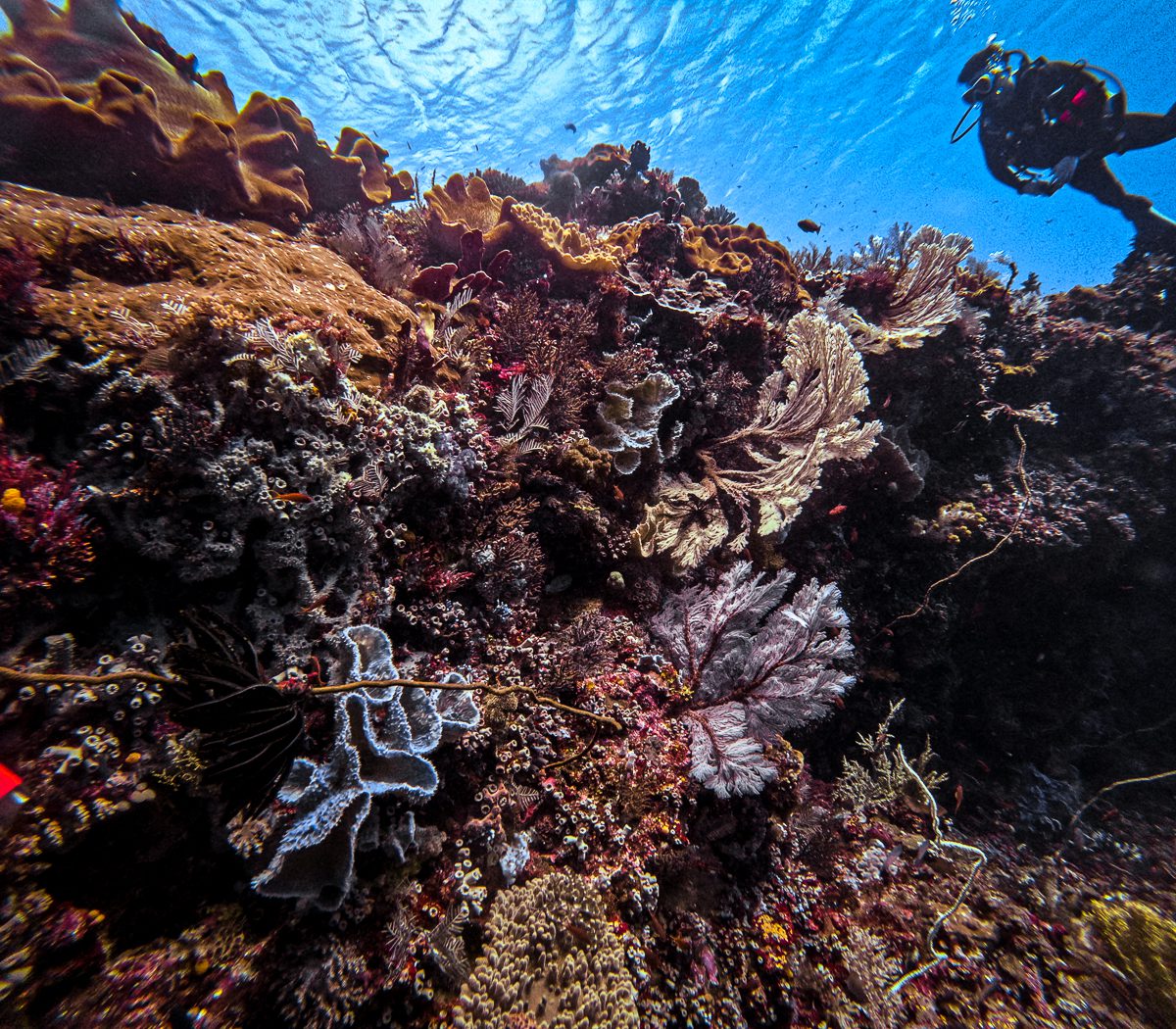
Coral is where Komodo pulls clearly ahead. The shallow reefs of the Maldives took a beating in the El Niño bleaching years and I noted dead and broken coral at Maaya Thila, Kudibodi Giri and the Maafushivaru house reef; the deeper thilas and channel walls are healthier but the top 10 metres is often rubble. Komodo’s hard coral gardens at Batu Bolong, Tatawa Besar and Sebayur are still dense, and the fish life over them, from clouds of red anthias to two schools of jacks in the thousands at Tatawa Kecil, is the richest I have seen outside Raja Ampat.
Macro and Muck
If you carry a macro lens, Komodo wins outright. Sangean, an active volcano north of the park, has a bubble dive from 4 to 40 metres where nudibranchs are everywhere and I logged 70 minutes without noticing; Wainilu and Secret Bay are proper muck sites with wonderpus, ornate ghost pipefish, orangutan crabs and more than 20 nudibranch species on my Ilike trip. On Tiare’s Bali–Komodo crossing the Sangean village muck dive produced black, pink and white-orange frogfish, a wonderpus and dwarf cuttlefish in a single tank. In the Maldives I have seen good macro exactly once, on an unnamed South Malé pinnacle from the Duke of York where sponge snails were mating and a tiger shrimp posed on a sponge. The Maldives is a wide-angle destination; leave the 105 mm at home.
Whale Sharks
The Maldives sells whale sharks harder than it delivers them. South Ari Atoll hosts year-round juveniles, the search is a drift along the outer reef at Maamigili with a 10-metre boat rule and 3-metre swimmer rule, and the crews quote a 50 percent chance. I have searched on Scubaspa Ying and Blueforce One and seen 10 pygmy devil rays, four turtles and 20 other boats, but no whale shark, and the resort excursion from Maafushivaru put roughly 100 people in the water at once. Komodo National Park itself has no whale sharks, but the Bali–Komodo crossing on Tiare stops at Saleh Bay in Sumbawa, where we dived with two whale sharks of 5 and 8 metres at the fishing platforms. If whale sharks are the goal, read my guide to the best places in the world to dive with whale sharks before you book either.
When to Go
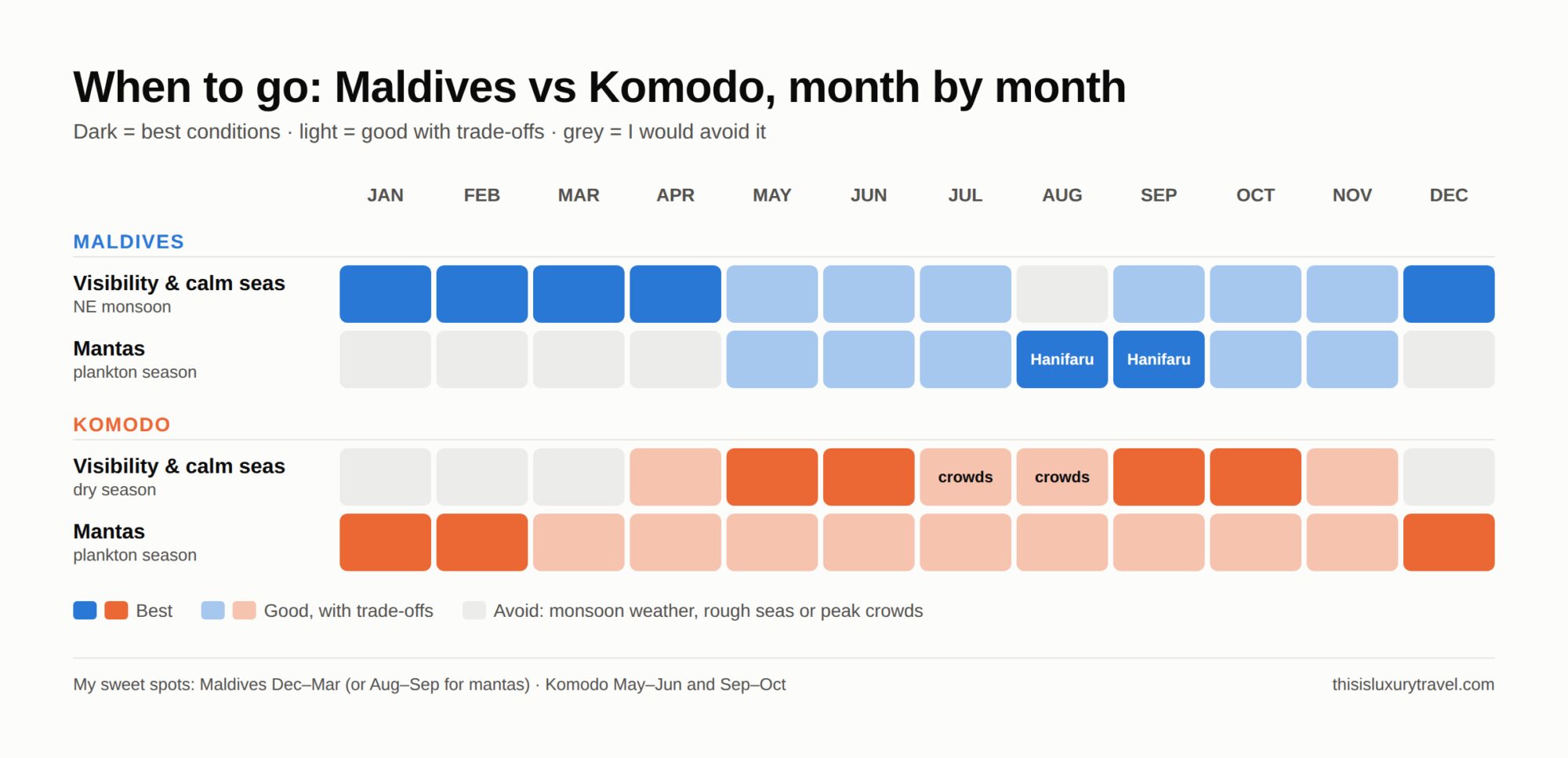
Maldives. The north-east monsoon from December to April brings the calmest seas and the best visibility on the eastern sides of the atolls. The south-west monsoon from May to November brings plankton, which means mantas (Hanifaru peaks in August and September) and lower visibility. I have dived the Maldives in August, September and December and would pick December to March for a first trip, August to September for mantas. The Duke of York had to swap its Ari itinerary for South Malé and Vaavu because of August weather, which tells you how much the monsoon matters.
Komodo. The dry season from April to November is the liveaboard season, with June to September the driest and clearest in the north. Mantas peak from December to February when the plankton arrives, at the cost of visibility and rougher seas from January to March; some boats stop running in the wettest months. Avoid July and August if you can: on my July 2026 Moana trip there were around 50 boats in the park and I have seen more than ten on a single dive site. May, June, September and October are the sweet spot.
Liveaboard or Resort? It Depends Which Country
In the Maldives the answer is liveaboard, and I have written a whole article on diving the Maldives by liveaboard or resort. The atolls are spread over 800 kilometres and the best sites are channels between them, so a resort dive centre reaches a fraction of what a boat covers in a week. When I re-ran the numbers for 2026, a week on a boat with 20-plus dives and full board still comes to around USD 2,000 per person, while 20 dives from a resort at about USD 80 each — resort dive centres list a single dive at about USD 77 including taxes — plus the villa, comes to roughly USD 3,350 per person sharing. The ideal is a week on the boat followed by three or four nights in an overwater villa to decompress before the flight.
Komodo is more forgiving of land-based diving because the park is compact. From Komodo Resort on Sebayur the wooden dive boat reaches Mawan and Batu Bolong in 30 to 40 minutes, against more than two hours each way from a Labuan Bajo day boat, so a resort week there is a serious dive holiday rather than a compromise. A liveaboard still wins for the cold southern sites and for Sangean, which no day boat reaches.

Where to Stay: Maldives
The Maldives Boats I Would Book for This Trip
I compare all of these in more depth in my guide to the best luxury Maldives liveaboards; the short version for a Maldives-or-Komodo decision is below. Check-price links go to Liveaboard.com, where I book my own trips.
White Pearl. At more than 50 metres the biggest diving liveaboard in the Maldives, with cabins roughly twice the usual size and the tiger and bull sharks of Neru Mati on its central itinerary. 4.5 / 5 in my White Pearl review; my week was hit by one of the worst storms of the year, so read the weather section before booking August.
Scubaspa Ying and Yin. The most luxurious boats I have dived in the Maldives: 16 to 17 guests, more than 25 staff, six treatment rooms and the best liveaboard spa I have seen anywhere. Ying runs the central atolls, Yin the far north from Dharavandhoo, and the Manta Suite on Yin’s upper deck, with its huge panoramic window, is the cabin to book. Nitrox is USD 100 per week. Read my full Scubaspa Ying review and Scubaspa Yin far-north review.
Blueforce One. A big, diver-first boat with a marine biologist guiding, three dives a day from day one, nitrox at USD 50 per week and a wooden jacuzzi on the sundeck for stargazing. Cabin 104 below deck was more spacious than I expected. Budget about EUR 300 for green tax and fees on top of the cruise. My Blueforce One review covers the full five-atoll route. Its sister ship Blue Force 3, which I dived in the Red Sea, now operates in the Maldives.
Check Blue Force One on Liveaboard.com | Check Blue Force 3 on Liveaboard.com
Duke of York. Not the newest boat, but owner Dodi has been running Maldives liveaboards since 1990 and it shows in the site choices. Free nitrox, a maximum of five divers per guide and an outstanding Italian cook. I rated it 5 / 5 in my Duke of York review.
EcoPro Seascape. The boat for the ten-day central and southern channel itinerary: Fotteyo, Miyaru Kandu, Gaahraa Kandu with 25-plus eagle rays, and a sustainability programme that goes beyond slogans. Twenty-eight divers is a lot, but four groups of seven on a big stable dhoni worked. Full details in my EcoPro Seascape review.
Maldives Resorts for Divers
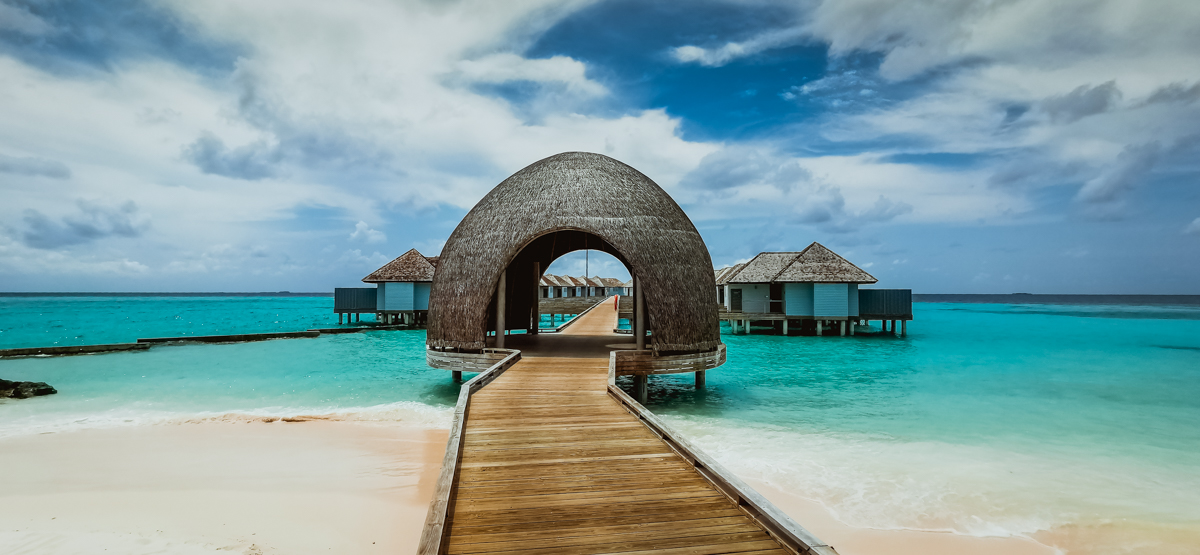
Maafushivaru (now Outrigger Maldives Maafushivaru), South Ari Atoll. Eighty-one villas, a house reef with longnose devil rays and blacktips off the jetty, and a 25-minute seaplane from Malé at roughly EUR 300 return. Water Villa 218 at 95 square metres was mine, and 216, 218, 220 and 221 get the sunset. I rated it 5 / 5 for value in my Maafushivaru review; the shallow coral is still recovering, and the whale shark excursion at USD 130 to 195 is crowded.
Where to Stay: Komodo
The Komodo Boats I Would Book for This Trip
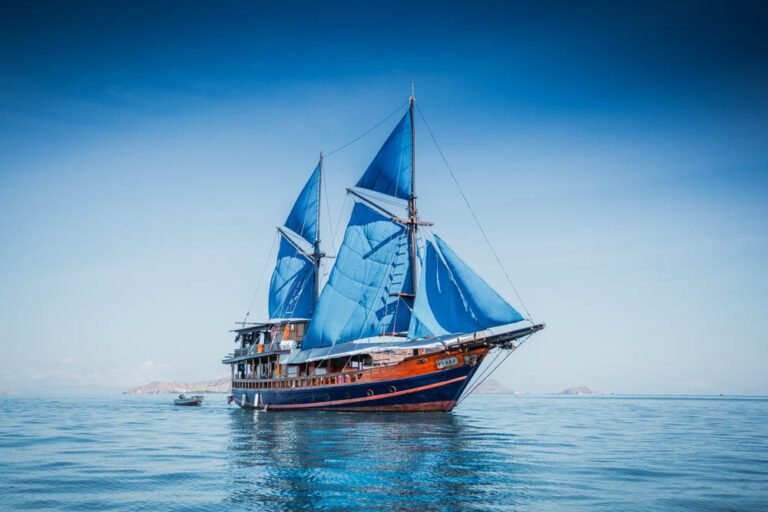
Komodo has more luxury phinisi per square mile than anywhere in Indonesia, and I compare the six I would book again in my guide to the best Komodo liveaboards. The short version for this decision:
Tiare. A 38-metre, six-cabin phinisi for a maximum of 12 divers, and the boat for the 12-day Bali–Lombok–Sumbawa–Komodo crossing with whale sharks at Saleh Bay and frogfish at Sangean. Cruise director Seno has more than 20 years in Indonesian waters. Nitrox is USD 15 per day. I gave it 5 / 5 in my Tiare review; the only real complaints were a 4 to 5 knot cruising speed and patchy 4G.
Moana. A 30-metre, five-cabin phinisi for ten guests, cosy rather than palatial, with chef Yanti’s rendang and a crew that has run Komodo for more than 20 years. No nitrox, no hot water (sun-heated tanks) and no wifi yet, but the small groups and easy vibe make it the best boat in the park for a first Komodo trip. Park fees are bundled at EUR 150 per guest, payable on site. 5 / 5 in my Moana review.
Komodo Sea Dragon. Thirty-eight metres, six cabins, 12 guests, 16 crew and a separate 18-metre dive boat. Four of the cabins have balconies, and Cabin 5 has a marble bathroom and ten plugs. Eighteen dives in six days in June 2024 including the school of ten mantas at Pink Beach; the nitrox compressor was still bedding in. 4.5 / 5 in my Komodo Sea Dragon review.
Ilike. Eight cabins, 14 guests, 16 crew and a 60-dive minimum, which is the right filter for its Komodo–Bali and Komodo–Maumere routes via Gili Banta and Sangean. Twenty-one sites in nine nights on my trip. Read my Ilike Komodo to Bali review.
Scubaspa Zen. The Komodo boat I would book when only half the party dives. She is a 53-metre phinisi carrying up to 20 guests in nine cabins and suites, with a crew of 26, a five-star spa and daily yoga, and Indonesia’s only two-boat operation: a separate 21-metre Maldives-style dive dhoni that keeps the diving fast and the mothership serene, with up to four dives a day. She runs Komodo from roughly April to October and swaps to Raja Ampat and the Banda Sea in the opposite season, and the 2026 Komodo departures are limited, so book early. Liveaboard.com lists her from USD 618 per day, plus 10 per cent VAT and park fees of USD 50 to 70 per day, with nitrox at USD 100 per week. Read my Scubaspa Zen review.
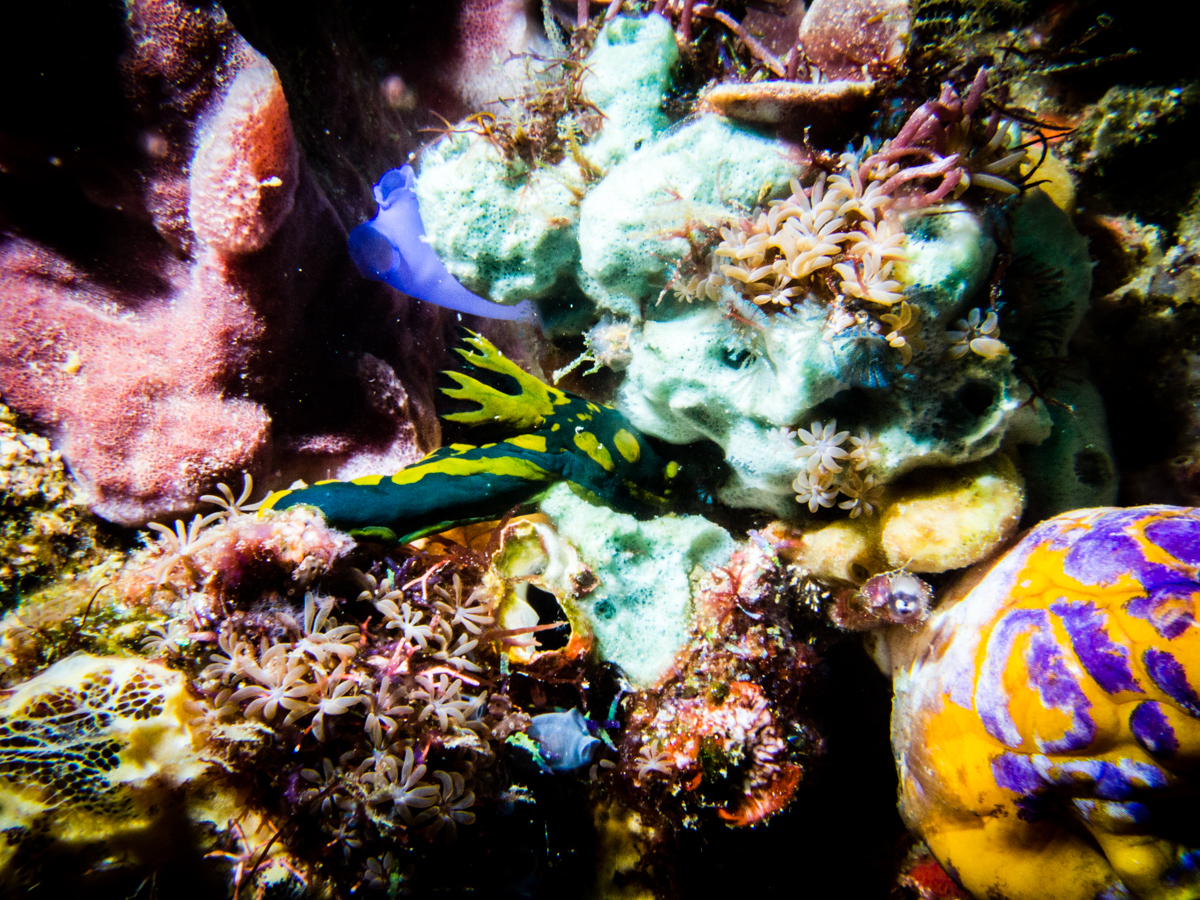
Carpe Diem. The best small boat in these waters, and the one I would book for a first liveaboard or for a partner still warming up to the idea: a classic French-owned phinisi with four cabins and a maximum of eight guests, unhurried mornings, easy company at the dinner table and Komodo’s essential sites without the expedition intensity of a bigger operation. Gear rental is usually included, which saves USD 200 to 300 per person, and she cruises Komodo from May to September. My days on her in the south of the park produced the green and blue nudibranch photographed above. Liveaboard.com lists her from USD 434 per day, plus a fuel surcharge of USD 5 to 16 and park and port fees of USD 20 to 30 per day. Read my Carpe Diem review.
Also worth knowing: Sea Safari VI, the ironwood classic at a friendlier price.
Komodo Resorts for Divers
If you are here to dive rather than to sightsee, Komodo Resort on Sebayur is my pick of the three below. Nothing else in the park sits this close to the dive sites, which makes it the most convenient base for a diving week.
Komodo Resort, Sebayur Island. Twenty bungalows, a bamboo dive centre with nitrox, and the shortest boat rides in the park: 40 minutes to Mawan and Batu Bolong. I saw more than 20 mantas at the Manta Point from here. Food is tasty rather than gastronomic. My Komodo Resort review explains why I call it the most comfortable resort to dive Komodo, and it is the resort I book myself when the trip is about the diving.
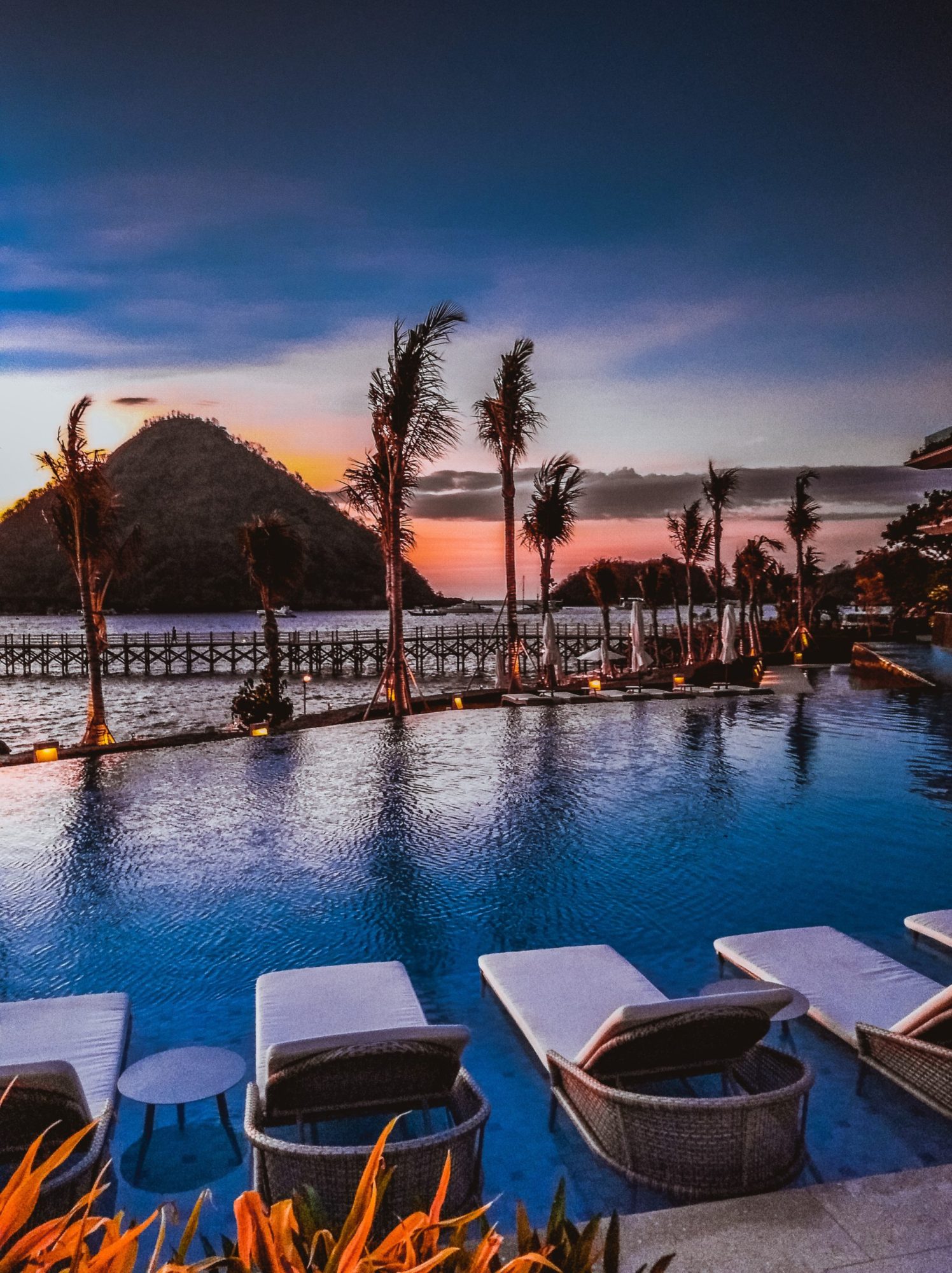
AYANA Komodo Waecicu Beach, Labuan Bajo. Still the best luxury hotel in Komodo, 15 minutes from LBJ airport, with an infinity pool, Honzen sushi on the eighth floor, the Unique rooftop bar and its own phinisi, Lako di’a, from the hotel pier. The building is large for its plot and the beach water is murky, but the service was outstanding even at soft opening. Deluxe Ocean View rooms start around USD 350–500 per night, much more in July and August. 4.5 / 5 in my AYANA Komodo review.
The Seraya, Seraya Island. Sixteen bamboo bungalows with open-air bathrooms, no TV and no internet, a 45-minute boat from Labuan Bajo. The house reef had about 20 baby sharks when I snorkelled it and a dugong has been reported. Hillside bungalows from around USD 250 and beachfront family bungalows around USD 400 in the late-2026 sample I checked. 4.5 / 5 in my Seraya review. Torn between the two? I settled it in AYANA Komodo vs The Seraya: AYANA for a night or two around flights and boats, Seraya for three days or more.
Getting There and Logistics
Maldives. Everything goes through Velana International Airport at Malé, with Emirates alone running up to four flights a day from Dubai. Central-atoll liveaboards collect you at arrivals and the tender takes 10 to 40 minutes; far-north boats such as Scubaspa Yin start from Dharavandhoo, a 20-minute domestic flight on Manta Air or Villa Air at USD 100 to 150 one way, from a domestic terminal five minutes’ walk from international. Resorts in Ari are a 25-minute seaplane on Trans Maldivian at roughly EUR 300 return with a 20 kg plus 5 kg allowance, so pack dive gear light or check the excess. Remember the 24-hour no-fly rule after your last dive and the IMUGA arrival form. Alcohol cannot be brought into the country. If you want to arrive rested, beOnd, the all-business-class airline, flies Malé to London, Paris, Zurich, Munich, Milan, Dubai and Riyadh with 44 lie-flat seats.
Komodo. Fly to Labuan Bajo (LBJ) on Flores: one hour from Bali with seven to nine nonstop flights a day on AirAsia, Batik and Garuda, about 2.5 hours from Jakarta, and since December 2025 direct from Singapore on Scoot and from Kuala Lumpur on AirAsia. Garuda still gives a free 23 kg sports-equipment allowance for dive gear, Batik adds 10 kg, and I no longer fly Lion Air. Delays on Bali–Labuan Bajo are frequent, so never book a same-day international connection at the end of the day. The pier is a 10-minute drive from the airport (taxi around IDR 100,000), and every liveaboard sends a tender.
Booking domestic Indonesian flights with an international credit card is often the hardest part of a Komodo trip: airline websites reject foreign cards, time out at payment or quote in rupiah only. I book all my domestic legs on Trip.com, which accepts international cards, lists every Indonesian carrier including Garuda, Batik and AirAsia side by side, and issues the e-ticket in minutes.
How Much Does It Cost? Maldives vs Komodo
Maldives liveaboard. Blue Force 3 lists its Maldives itineraries at around USD 210 per day, roughly USD 1,690 to 2,390 per person for an eight-day, seven-night cruise, with nitrox around USD 80 per week, a service charge of about USD 160 per trip, environmental tax of roughly USD 12 per day and a fuel surcharge of about USD 20 per night . On Blueforce One my green tax and fees came to about EUR 300 for the week, and nitrox ranges from free (Duke of York) to USD 100 per week (Scubaspa). Luxury boats such as Scubaspa sit well above these figures.
Maldives resort. A decent overwater villa starts around USD 500 per night before the roughly 23 percent tax and service added to every bill, single dives run about USD 80, a whale shark half-day is USD 130 to 195 and the seaplane is about EUR 300 return.
Komodo liveaboard. The high-end phinisi fleet works out at roughly USD 500 to 600 per person per night , with a park contribution of around EUR 150 per guest per cruise, nitrox at USD 15 per day where available, gear rental up to USD 300 per week if not included, and tips of EUR 25 to 30 per day or 10 percent of the cruise price.
Komodo resort. Island resorts and luxury hotels run USD 200 to 300 per night at the mid-range and USD 350 to 500-plus at the AYANA, a day dive trip from Labuan Bajo is about USD 150, and the flight from Bali is a fraction of a Maldives seaplane.
Rates on the same room typically swing 10 to 20 percent between booking platforms depending on the date, the cancellation terms and whether breakfast or transfers are bundled, so I always check the same dates on at least two of the three before I commit. For the liveaboards, use the Check price links above; Liveaboard.com shows live availability and the current promotions for every boat in this article. For the hotels:
AYANA Komodo Waecicu Beach: Booking.com | Trip.com | Expedia
Outrigger Maldives Maafushivaru: Booking.com | Trip.com | Expedia
The Seraya Resort: Booking.com | Trip.com | Expedia
Komodo Resort, Sebayur: Booking.com | Trip.com | Expedia
My Tips for Either Trip
Book the boat before the flights, and leave a buffer. Bali–Labuan Bajo delays are routine and a Maldives liveaboard leaves the pier once; I fly in the day before in both countries, and in the Maldives I book a lunchtime flight home so the 24-hour no-fly rule after the last dive takes care of itself.
Check the nitrox policy before you compare prices. Free on Duke of York, USD 50 a week on Blueforce One, USD 100 on Scubaspa, USD 15 a day on Tiare and Sea Dragon, none on Moana: on a 17-to-20-dive week that is up to USD 105 of difference hiding under the headline rate.
Pack for two temperatures in Komodo. A 3 mm suit is fine in the north, but a full-park itinerary that drops south to Manta Alley needs a thicker suit or a hooded vest; nobody enjoys 24°C on the fourth dive of the day.
Bring your own reef hook and SMB. Both destinations demand them and most boats lend them, but a hook you have clipped on a hundred times is faster to deploy in a Castle Rock or Fotteyo current than one you met that morning.
Fly Garuda with dive gear. The free 23 kg sports-equipment allowance to Labuan Bajo saves the excess-baggage argument, Batik adds 10 kg, and I no longer fly Lion Air. Citilink’s Sports Club membership (IDR 450,000 a year) buys a 20 kg gear allowance if you dive Indonesia more than once.
In the Maldives, sleep at Hulhumalé, not Malé. It is ten minutes from the airport, the tenders collect from there, and the taxi is about USD 6. Pick up a Dhiraagu or Ooredoo SIM or an eSIM before boarding; most boats still run on 4G with gaps on the crossings.
Book a middle-deck cabin on Scubaspa if anyone in your party has knees to protect. The step from mother ship to dhoni is 50 centimetres to a metre in a swell, and the middle-deck suites have the shortest path to it.
At Hanifaru, wear a life jacket if you are not a strong snorkeller. The bay is chaotic, the boats are many and I took several fins to the head; a jacket keeps you high, visible and out of the mantas’ way.
Budget the taxes as part of the trip. Roughly EUR 300 of green tax and fees per person on a Maldives week and about EUR 150 per guest in Komodo park fees, both usually payable on board, plus 10 percent or EUR 25 to 30 a day in tips for the crew.
Avoid July and August in Komodo, and August in the Maldives. Fifty boats in the park and ten on a single site is my July record; the Duke of York rerouted its whole August itinerary for weather and White Pearl spent five of seven nights sheltering near Malé.
So, Maldives or Komodo?
Choose the Maldives if you have fewer than 100 dives and want sharks in three figures without wrestling a current; you are travelling with a non-diving partner who wants an overwater villa; you are flying from Europe or the Gulf and want the shortest door-to-water time; or your dream shot is a manta feeding frenzy at Hanifaru in August.
Choose Komodo if you have 60-plus logged dives and good buoyancy; you want diversity, big animals on one dive and nudibranchs on the next; you want mantas on scuba at 10 metres rather than snorkelling in a crowd; you carry a macro lens; you want stunning hard coral and dragons on the same trip; or you want the luxury phinisi experience, teak decks and all, at a price that undercuts a comparable Maldives boat once you add the Maldives taxes and transfers.
Do both if you can: my ideal year has a Komodo liveaboard in May or June, when the north is clear and the boats are few, and a Maldives central-atolls week in February, when the visibility is at its best and the channels are full of sharks. They are not competing for the same trip; they are answering different questions.

Frequently Asked Questions
Is diving better in the Maldives or Komodo? It depends on what you dive for. The Maldives delivers far more sharks, with 100-plus grey reefs in a single channel at Kandooma Thila or Miyaru Kandu, and mantas by the dozen at Hanifaru. Komodo delivers far more diversity: big animals, stunning hard coral and far more nudibranchs and critters at Sangean and Wainilu on the same trip, with mantas on scuba at 10 metres, but it demands more experience in current.
Is Komodo diving harder than the Maldives? Yes. Komodo’s currents can reach 8 knots at spring tides and boats such as Ilike require 60 logged dives; the Maldives caps every dive at 30 metres and 60 minutes, runs small guided groups and picks divers up by dhoni wherever they surface, which makes it the easier destination for a diver with 30 to 80 dives.
Which is cheaper, a Maldives or a Komodo dive trip? A high-end Komodo liveaboard costs roughly USD 500 to 600 per person per night, while Maldives boats range from around USD 210 per day on Blue Force 3 to well above that on luxury boats such as Scubaspa, before EUR 300 or so in green tax and fees. Komodo’s park contribution is around EUR 150 per guest. On the resort side Komodo is clearly cheaper: the AYANA starts around USD 350 to 500 against USD 500-plus plus 23 percent for a Maldives overwater villa.
When is the best time to dive Komodo vs the Maldives? Komodo’s season is April to November, with May, June, September and October the best balance of visibility and crowds and December to February the manta peak. The Maldives is best for visibility from December to April and best for mantas at Hanifaru in August and September.
Can you see whale sharks in Komodo or the Maldives? The Maldives offers year-round juvenile whale sharks at South Ari Atoll with roughly a 50 percent chance on a search dive. Komodo National Park has none, but Bali–Komodo crossings on boats such as Tiare stop at Saleh Bay in Sumbawa, where whale sharks gather at fishing platforms.
Do I need nitrox in the Maldives or Komodo? It helps in both because the profiles are repetitive multi-level dives at 20 to 30 metres, three or four times a day. In the Maldives nitrox costs USD 50 to 100 per week and is free on Duke of York; in Komodo it is USD 15 per day on Tiare and USD 20 on Komodo Sea Dragon, and Moana does not carry it.
How cold is the water in Komodo compared to the Maldives? The Maldives sits at 27 to 29°C year-round. Komodo’s north is 26 to 29°C but the southern sites such as Manta Alley and Cannibal Rock drop to 24°C, so pack a 5 mm for a full-park itinerary.
This article contains affiliate links. If you book through them, I may earn a small commission at no extra cost to you, which helps keep This Is Luxury Travel independent.
Every dive and stay in this comparison is first-hand. Read more about how I review, or visit my Work With Me page.