
The short answer: the one item that changed long-haul flying for me is a forward-lean inflatable pillow, the kind you rest your head and arms on while leaning forward onto the tray table. On a very long flight, being able to rest forward is a game changer. After that, a power bank that is legal on every airline, a plug adaptor with USB ports, and a few comfort items do the rest.
Quick picks
What I actually fly with, after trips to 135 countries.
- Maliton Inflatable Travel Pillow — Best for sleeping forwardCheck price on Amazon
- 20,000 mAh power bank — Airline-legal powerCheck price on Amazon
- International plug adaptor with USB ports — One socket, every gadgetCheck price on Amazon
- Bose QuietComfort Ultra Headphones (2nd Gen) — Strongest noise cancellingCheck price on Amazon
- Sony WH-1000XM6 — Best all-rounderCheck price on Amazon
- Twelve South AirFly — Wireless in-flight audioCheck price on Amazon
- Silk eye mask — Better sleepCheck price on Amazon
- Compression socks (15–20 mmHg) — Flights over six hoursCheck price on Amazon
- Avène Thermal Spring Water — Mid-flight skinCheck price on Amazon
- Aesop Departure travel kit — Seat-pocket essentialsCheck price on Amazon
- Packing cubes — Organised carry-onCheck price on Amazon
- Apple AirTag — Luggage trackingCheck price on Amazon
1. A Forward-Lean Travel Pillow (My Top Pick)
Classic U-shaped neck pillows never really worked for me. Your head still drops forward the moment you fall asleep. A forward-lean inflatable pillow takes the opposite approach: you lean into it on the tray table, with an opening for your face so you can breathe freely and space for your arms. Being able to lean forward and rest during a very long flight is a game changer. Deflated, it folds down to almost nothing in your carry-on.
Why I pack it
Maliton Inflatable Travel Pillow
Lean forward onto the tray table and actually sleep, then deflate it to almost nothing in your carry-on.
2. A Power Bank That Every Airline Allows
A 20,000 mAh power bank is the practical maximum for flying, and it is allowed on every major airline. The rules are set in watt-hours (Wh), not mAh: 20,000 mAh at 3.7 V works out to about 74 Wh, comfortably under the 100 Wh limit that applies worldwide. Batteries between 100 and 160 Wh need airline approval, and anything above 160 Wh is not allowed at all.
Why I pack it
About 74 Wh, comfortably under the 100 Wh limit, so it is allowed on every major airline.
What changed recently is how you can carry and use them. The rules to follow in 2026:
- Power banks go in your carry-on only, never in checked luggage.
- Most airlines allow a maximum of two per passenger; Emirates allows only one.
- A growing number of airlines ban using or charging a power bank during the flight, so charge your devices before you board.
- Buy one with the capacity printed clearly on the case. Unlabelled batteries can be confiscated at security, and China additionally requires the 3C mark for flights within the country.
Airline rules keep changing, so check your airline’s page before you fly.
3. A Plug Adaptor with USB Ports
I travel with an international plug adaptor with USB ports so I can charge several gadgets at the same time from one socket: phone, headphones, power bank and camera. In a hotel room with one free socket by the bed after a long flight, it is the difference between everything charged by morning and choosing which device goes flat.
Why I pack it
International plug adaptor with USB ports
Charges phone, headphones, power bank and camera from a single socket.
4. Noise-Cancelling Headphones
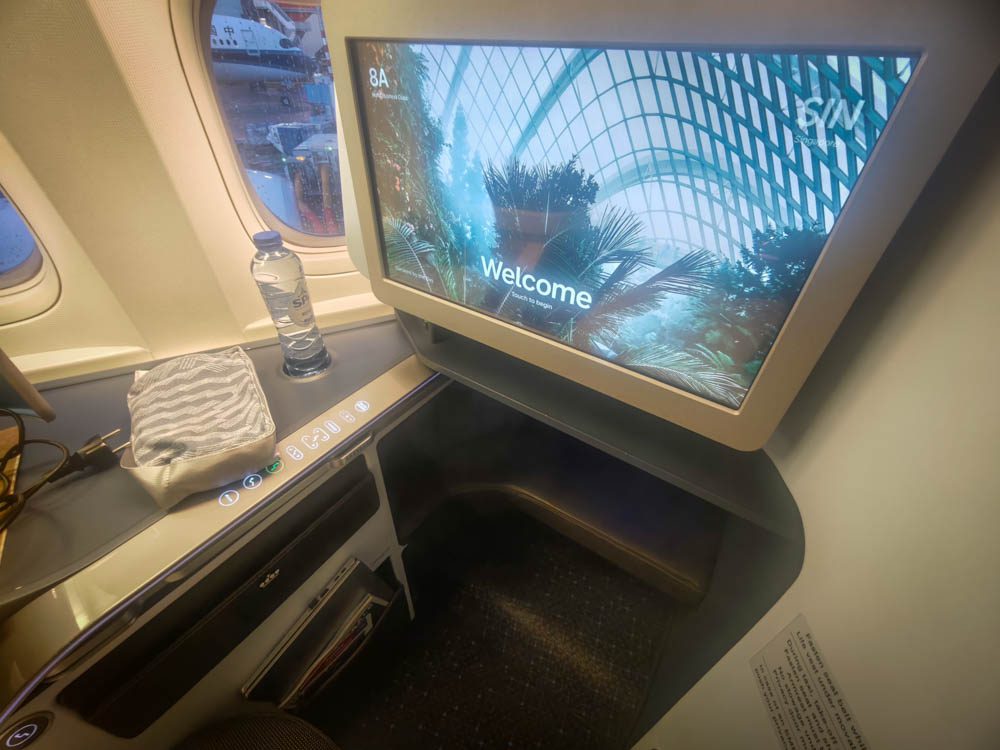
Engine noise is tiring even when you don’t notice it. Good noise-cancelling headphones are one of the best comfort upgrades for long flights.
- Bose QuietComfort Ultra Headphones (2nd Gen), widely rated among the strongest noise cancellation for flying.
- Sony WH-1000XM6, the best all-rounder, which fold into a compact case.
- Twelve South AirFly, a small adaptor that lets you use wireless headphones with the seat-back screen.
Why I pack it
Bose QuietComfort Ultra Headphones (2nd Gen)
Widely rated among the strongest noise cancellation for flying.
Why I pack it
The best all-rounder, and they fold into a compact case.
Why I pack it
Lets you use your wireless headphones with the seat-back screen.
5. Sleep and Comfort
- A silk eye mask: softer on the skin than airline masks, and it blocks out cabin light.
- Compression socks (15–20 mmHg) for flights over six hours, to reduce swelling in your feet and ankles.
Why I pack it
Softer on the skin than airline masks, and it blocks out cabin light.
Why I pack it
Compression socks (15–20 mmHg)
Reduces swelling in your feet and ankles on flights over six hours.
6. Skin
Cabin air is very dry. A few travel-size products make a real difference on arrival:
- Avène Thermal Spring Water in a travel size, a face mist for mid-flight.
- Aesop Departure travel kit, a set of in-flight essentials that fits in a seat pocket.
Why I pack it
A travel-size face mist for the dry cabin air mid-flight.
Why I pack it
A set of in-flight essentials that fits in the seat pocket.
7. Organisation
- Packing cubes to keep the carry-on in order.
- Apple AirTag in each checked bag, so you know where your luggage is before the airline does.
Why I pack it
Keeps the carry-on in order, so you find things fast in a dark cabin.
Why I pack it
One in each checked bag, so you know where your luggage is before the airline does.
Heading to a dive trip at the end of that flight? See my liveaboard packing list and the dive gear I actually use.
Frequently Asked Questions
Can I take a 20,000 mAh power bank on a plane?
Yes. A 20,000 mAh power bank is about 74 Wh, below the 100 Wh limit, so it is allowed on all major airlines. It must go in your carry-on, most airlines allow a maximum of two (Emirates one), and many now ban using it during the flight.
What is the best pillow for sleeping on a long-haul flight?
For me, a forward-lean inflatable pillow that lets you rest your head and arms forward on the tray table is far better than a U-shaped neck pillow. Being able to rest forward on a very long flight is a game changer.
What should I pack in my carry-on for a long-haul flight?
A forward-lean pillow, a labelled power bank under 100 Wh, a plug adaptor with USB ports, noise-cancelling headphones, an eye mask, compression socks and a face mist.
Disclosure: this article contains affiliate links. If you book through them, I earn a small commission at no extra cost to you. As an Amazon Associate I earn from qualifying purchases. Read my full disclosure policy.