Is Raja Ampat diving worth it? For me, yes, for its corals, its big fish and its macro life. This guide draws on my liveaboard trips on Ilike, Neomi, Coralia, Dewi Nusantara, Seahorse and Emperor Harmoni, and on stays at Misool Resort and Papua Explorers. The main season runs from October to April, with the best visibility in January and February, and every trip starts in Sorong, which you reach via Jakarta, Makassar or Manado.
Below is my list of the mesmerizing Raja Ampat dive sites that are a must-see in Indonesia.
I have dived all over the world, and Raja Ampat might be one of the best places I have ever dived.
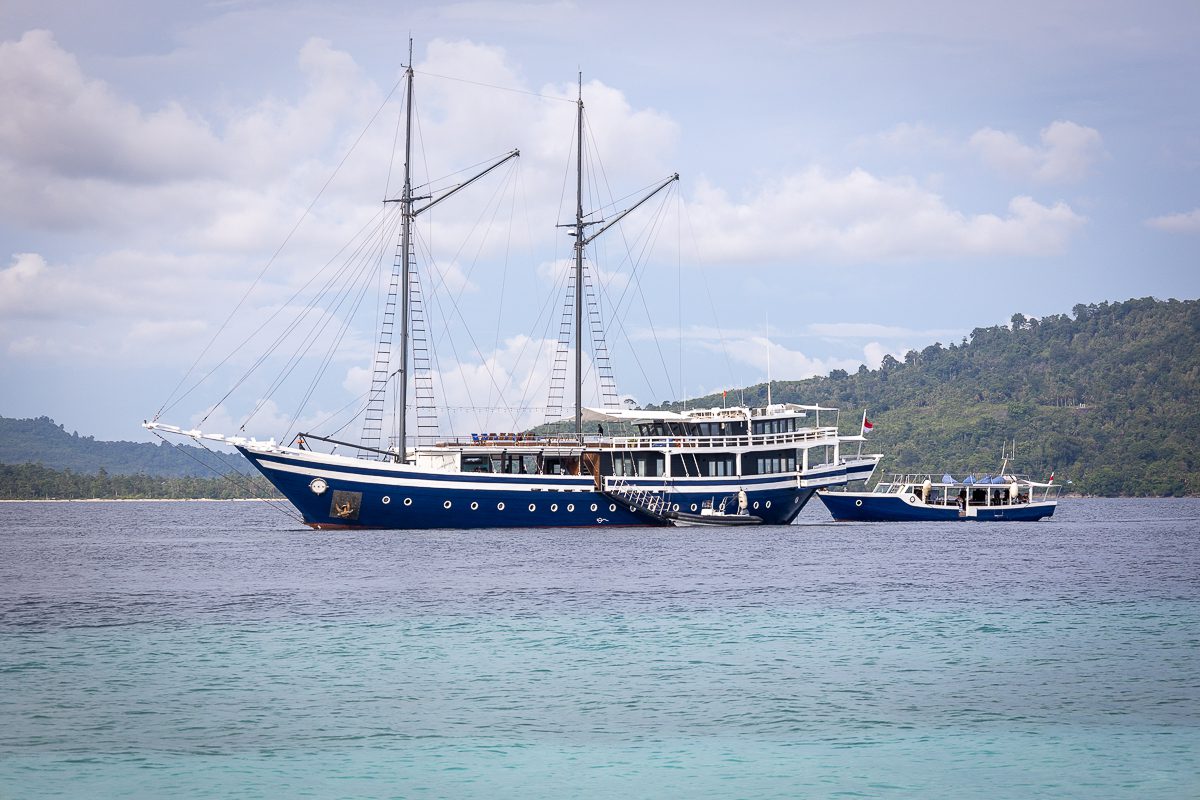
I did a two-weeks cruise onto the Ilike Liveaboard and got to experience some of the most famous Raja Ampat Dive sites.
So, let’s dive right into their details without further ado.
Raja Ampat sits at number one in my ranking of the best dive destinations in the world, which also explains how it compares with the Galapagos, Komodo and the Banda Sea.
Raja Ampat Diving at a Glance
| Destination | Raja Ampat, West Papua, Indonesia |
| Why it stands out | Widely rated among the best scuba diving destinations in the world for reef biodiversity |
| Gateway | Fly to Sorong (SOQ), then join a liveaboard or resort transfer |
| How I dived it | Six liveaboards (Ilike, Neomi, Coralia, Dewi Nusantara, Seahorse and Emperor Harmoni) and two resorts (Misool Resort and Papua Explorers). The 11 sites below are from my two-week Ilike cruise |
| Best months | October to April, with the best visibility in January and February. Mid-June to mid-September is windy, especially in the south |
| Based on | Ilike, Sorong to Kaimana (late January); Neomi in Misool; Coralia, 11 nights from Misool to the Dampier Strait; Dewi Nusantara (September 2023); Seahorse, Misool to Triton Bay (February 2026); Emperor Harmoni (May–June 2026); a week at Misool Resort; four days at Papua Explorers |
| Signature dive sites | Melissa Garden, Magic Mountain (Shadow Reef), Boo Ridge, Three Sisters and more |
| Best for | Experienced divers chasing world-class reefs, big fish and macro life |
| My verdict | Raja Ampat is one of the best places I have ever dived anywhere in the world |
When is the best time to dive Raja Ampat?
The main Raja Ampat season runs from October to April, when the seas are calmer. From roughly mid-June to mid-September the southeast monsoon brings strong winds and choppy seas, especially in the south around Misool, and most liveaboards leave for Komodo, Cenderawasih Bay, Halmahera or the Banda Sea.
Within the season, November and December bring plankton, bait balls and lots of fish, but lower visibility. January and February usually have the best visibility and the easiest crossings to Misool. That is when I did my Misool trips on Ilike (late January) and on Seahorse (February 2026).
The shoulder months can still be very good. On Dewi Nusantara in September 2023 we had mantas at Black Rock and Dayang, and on Emperor Harmoni in late May 2026 we were the only boat at every dive site in central Raja Ampat, although stronger winds kept us out of Misool. Mantas are most reliable from about November to April, peaking roughly December to March. For the other manta sites I rate and their best months, see my guide to the best places to dive with manta rays, and if your dates fall outside the Raja Ampat season, my calendar of where to dive each month shows what is good instead.
Where to dive in Raja Ampat: Misool, the Dampier Strait and beyond
Misool and the south. Most of the 11 sites in this guide are in Misool: Three Sisters, Edi’s Cave, Farondi’s Cave, Magic Mountain, Boo Ridge, Boo Window, Four Kings and Anti-chovy. It is remote and protected by the Misool Marine Reserve, and on my Ilike trip we were always the only boat whenever we dived. Magic Mountain is one of the few sites where reef and oceanic mantas share the same cleaning stations. I have dived Misool on Neomi, Coralia and Seahorse, and stayed a week at Misool Resort.
The Dampier Strait and central Raja Ampat. This is where the fish and the currents are: Cape Kri, Blue Magic, Sardine Reef, Mioskon, Manta Ridge and Sawandarek, with Melissa’s Garden near Penemu. Currents at Cape Kri and Blue Magic can be ferocious, so bring a reef hook. While staying at Papua Explorers, I had about 15 mantas at Manta Ridge, and they stayed with us for over an hour. On Emperor Harmoni we were the only boat at every site.
The north. The north sees fewer boats. On Dewi Nusantara we dived around Kawe, where a manta came to check us out at Eagle Rock and we saw three more at Black Rock.
Triton Bay and Kaimana. Some cruises carry on from Misool to Triton Bay diving and Kaimana, as my Ilike and Seahorse trips did.
Overview of dive sites:
1) Raja Ampat dive sites: Melissa Garden.
Melissa Garden is more of a dreamy place with the wealthiest blue waters surrounding the three lovely seamounts which are there right in the middle. The coral bed surrounding it is full of vibrant colors which are a significant attraction for the crowds of blue fusiliers swimming there.


2) Raja Ampat dive sites: My Reef.
If you are a marine life junkie, then you will love My Reef for it has so many fish and shark species that you can explore.
This reef is more of a large pinnacle extending 30 meters beyond the island and has some super strong water currents sometimes.
Heed to the current warning once you are there and sometimes you might have to do a negative entry and swim hard to get to the reef. But once you arrive there, the schools of big barracudas and snappers will greet you, and you will be at a loss at where to look and where not to.
So Many sharks patrol this reef that we quickly stop counting them.
We also saw an oceanic Manta towards the end of the dive. Don’t miss this dive site!


3) Raja Ampat dive sites: Three Sisters.
Three Sisters is a unique diving site at Misool which has three limestone projections embedded in water.
They even look a bit like the Australians’ three sisters but underwater.
The three rocks are further beautified by the walls that follow them and the blurriness caused by nutrient-rich water.
The various species of marine life like sponges, turtles, mantis shrimps, seahorses, and crabs there further enhance the appeal of the Three Sisters.
There is a lot of black corals ( which is actually red, yellow or purple) You can even climb up the slope to get a better view of fusiliers and other hypnotic sea creatures and fall in love with nature more.


4) Raja Ampat dive sites: Edi’s Cave.
Edi’s Cave opens 2 to 8 meters deep and has exotic sea views to feast the visitors’ eyes.
This wall dive has numerous nudibranchs which keep you company throughout your dive around the cave.
The mysterious aura of Edi’s Cave makes its tunnel-like dive so much more exciting and rewarding.

5) Raja Ampat dive sites: Farondi’s Cave
Farondi’s Cave is a lovely and aesthetically rich dive site at Raja Ampat which you will not be able to get enough of. The exit of this dive is some 20 meters deep and has a lifetime’s worth of experience with beautiful sea creatures.
The nudibranchs and pygmy seahorses swarming the waters of this dive are so appealing to the eye that you can hardly even think of getting bored of the view, no matter how long you look at them. A family of blue parrots was patrolling the area.

6) Raja Ampat dive sites: Shadow Reef ( or Magic mountain)
Diving in Raja Ampat is at its best in the beautiful blue waters of Shadow Reef in Misool.
The geographical aspects of this dive site are quite pleasant to look at, so are the schools of fishes swimming there. From small fish species to massive sharks and mantas, there is so much of the marine life to come across and interact with.
The encounter with each marine animal is of its own worth as it has so many things associated with it. Shadow Reef has a beautiful underwater pinnacle whose top runs from east to west for starting at about 5 meters.
This dive site is a hub of corals which include potato corals, soft corals, and brown leather corals. White and gray reefs are predominant there along with fusiliers, baby sharks, and jacks. If you dive this site close to sunset, you have a higher chance of seeing them hunting. In addition to these, parrot fish, oceanic triggerfish, octopus, and batfishes are all present there in abundance.
If you are particularly lucky on your diving day, you might even come across whales, dolphins, wobbegong sharks or whale sharks. We also saw over 15 mantas (both reefs and oceanic mantas), and they stayed with us for the whole 60 minutes dive.


7) Raja Ampat dive sites: Boo Ridge
Boo Ridge beside Boo Island is an impressive dive site that has a steep slope.
The diving ridge is more of a continuation of the island where a lot of marine life varieties are present.
If you want to see some cool long nose emperor fish that change their color like a chameleon, then this dive is totally your place to be at.
Triggerfish, moray eels, turtles, whitetip sharks, barracudas, sea fans and seahorses are some of the lovely sea creatures that you can hope to come across at Boo Ridge dive.
On the top, some parts are very colorful corals, but the waves have damaged some others. We also swam with two mantas which we were told is unusual for this site.


8) Raja Ampat dive sites: Boo Window
Boo Window is a dive site which connects Boo Island with Jamur Island.
The loveliness of this underwater beauty is further magnified by the soft corals which cover the rocks there.
The slope is steep, and there are corals on the surface of the slope. The name for Boo Window comes from a hole in the rock which is there at 5 meters into the slope. There, you can see so many turtles, fusiliers, wobbegongs, and jacks.
The corals are further beautified by the schools of fishes swimming over them and giving them a new life.
We again saw three mantas and a few large gray tips sharks.


9) Raja Ampat dive sites: Jackpot
This is a secret dive site that not many people have dived. We felt lucky to be on Ilike liveaboard who knew about the place and get the opportunity. We were with a group of relatively advanced divers.
We got the chance to go and explore the deep pinnacles. It takes a while to get down there as the pinnacle only starts at 23 meters.
There are many many fishes of all sorts. Schools of butterflyfishes give a wonderland feeling. We saw two gray sharks. Most amazingly for Raja Ampat, we also saw two leopard sharks which was a novel experience. One was swimming at 35 meters; the other one was sleeping.
There is also a manta cleaning station at about 25 meters where we saw two small oceanic mantas. What an amazing dive!


10) Raja Ampat dive sites: Four Kings
This beautiful dive is named after the four pinnacles which are present there at the site. It is hard to dive through all four of them so you may need to go for more than one dive.
There you get to see some white sponges since the light from the sun does not go all the way down for them to develop any color. In between the last two pinnacles, there is a dramatic canyon that drops to below 45 meters.
Barracudas often hang out in the canyon. There are a lot of batfishes, fusiliers.
We also witnessed fishes in their mating dance. in the corals above, there are nudibranchs and pipefish There is a great diversity of marine life down there which is worth exploring. What a fantastic dive four Kings was.
There were millions of anchovies and tons of bigger fish trying to feed on them. Talk about an action-packed dive. this dive site was so amazing that we did it one more time the next day.


11) Raja Ampat dive sites: Anti-chovy.
This is a unique and impressive dive site in Raja Ampat which has a large pinnacle.
The first pinnacle starts at 7-10 meters deep. The second pinnacle begins at 18 meters and goes down to 40 meters.
The dive there is more enjoyable due to the company of anchovies, wobbegong sharks and bump head parrotfish.
Sometimes, Mola molas come and eat those anchovies, but we were not lucky enough to witness that. We did see a wobbegong shark sleeping in corals and a huge bump head parrotfish sleeping at the end of a crack.

Liveaboard or resort?
The best way to dive Raja Ampat is with a liveaboard. A boat can cover Misool, the Dampier Strait and the north in one trip and reach remote sites that resort boats can’t, and on my trips we often had the sites to ourselves. My guide to the best Raja Ampat liveaboards compares the boats I rate.
A resort makes sense if you prefer to stay on land or want to snorkel every day. Misool Resort sits inside the Misool Marine Reserve, and I snorkelled every afternoon straight from the resort. Papua Explorers is on Gam island, on the Dampier Strait, where I dived Manta Ridge and Cape Kri. I compare the two in Misool Resort vs Papua Explorers.
If you stay on land, my pick is Misool Resort, because the most beautiful dive sites are in the Misool area.
How to get to Raja Ampat
Every Raja Ampat trip starts in Sorong (SOQ). There are no international flights into Sorong, so you connect in Indonesia, usually through Jakarta, Makassar or Manado. The Garuda red-eye from Jakarta lands just after 6 am.
Flights to Papua are often delayed, so arrive a day before your boat leaves. My pick is the Aston, opposite the airport; I compare it in Aston Sorong vs Swiss-Belhotel, and my guide to what to do in Sorong covers the rest. If your trip starts in Waisai, the fast boat from Sorong takes about two hours.
Foreign visitors also need two permits: the Raja Ampat marine park card (PIN) at IDR 1,000,000 and the Waisai regency tourism fee at IDR 1,000,000, so IDR 2,000,000 in total. Both are valid for one year from the date you buy them. Some liveaboards include park fees in the price, so check with your boat or resort.
Is Raja Ampat diving worth it?
Raja Ampat has some of the most impressive dive sites in the world. It is not easy to get to. See my article about Sorong which is the gateway to Raja Ampat.
The best way to dive Raja Ampat is with a liveaboard. I was on Ilike liveaboard, and it was a great experience. You can read my review here.
If you go all the way to Raja Ampat, you might also want to check diving at Triton Bay and Kaimana
If you prefer to stay on land, I recommend the Misool eco-resort as the most beautiful dive sites are located in the Misool area. Don’t wait too long to go. Raja Ampat is getting increasingly popular so go there quickly while it is still relatively quiet.
Happy Diving


Underwater macro pictures by Marc Van den Broeck who was also on the Ilike trip in Raja Ampat
Raja Ampat Diving FAQ
When is the best time to dive Raja Ampat?
October to April, when the seas are calmer. January and February usually have the best visibility, while November and December bring more plankton and fish. From mid-June to mid-September strong winds make the south rough and most liveaboards leave.
Is Raja Ampat good for beginners?
It is better for experienced divers. Currents can be strong at sites like My Reef, Cape Kri and Blue Magic, some dives need a negative entry, and several pinnacles start deep. Most operators recommend Advanced Open Water or around 50 logged dives, and some boats ask for more: Ilike required 70.
Is it better to dive Raja Ampat from a liveaboard or a resort?
A liveaboard, for most divers, because it can reach Misool, the Dampier Strait and the north in one trip. If you prefer to stay on land, I recommend Misool Resort, because the most beautiful dive sites are in the Misool area.
How do you get to Raja Ampat?
Fly to Sorong (SOQ), usually via Jakarta, Makassar or Manado, and arrive a day early because flights to Papua are often delayed. From Sorong you board your liveaboard, or take the fast boat to Waisai, about two hours.
How much is the Raja Ampat park fee?
Foreign visitors pay IDR 2,000,000 in total: IDR 1,000,000 for the marine park card (PIN) and IDR 1,000,000 for the Waisai regency tourism fee. Both are valid for one year from the date of purchase.
Can you see manta rays in Raja Ampat?
Yes. At Magic Mountain (Shadow Reef) in Misool we saw over 15 reef and oceanic mantas on one dive, and I also had mantas at Boo Ridge, Boo Window, Jackpot and My Reef. They are most reliable from about November to April.
Is Raja Ampat good for snorkelling?
Yes. At Misool Resort I snorkelled every afternoon straight from the resort, and resorts are a good base if you want to snorkel every day.
Disclosure: this article contains affiliate links. If you book through them, I earn a small commission at no extra cost to you. Read my full disclosure policy.